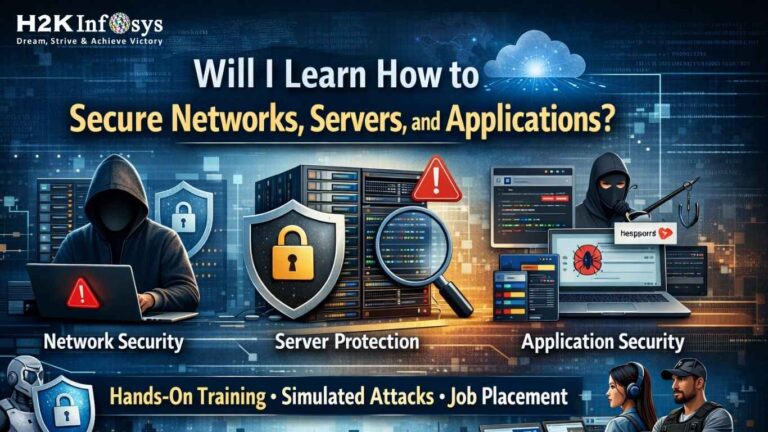
Yes, in modern cybersecurity programs built for 2026 job roles, you absolutely learn how to secure networks, H2K Infosys servers, and applications using real-world tools, attack simulations, and defensive security workflows used by actual companies. The best programs tied to cyber security training and job placement focus on hands-on protection strategies, not just theory.
Let me explain this in a way that feels real, because honestly, this is one of the biggest concerns people have before entering cybersecurity.
Why Security Skills Are Taught Together (Not Separately Anymore)
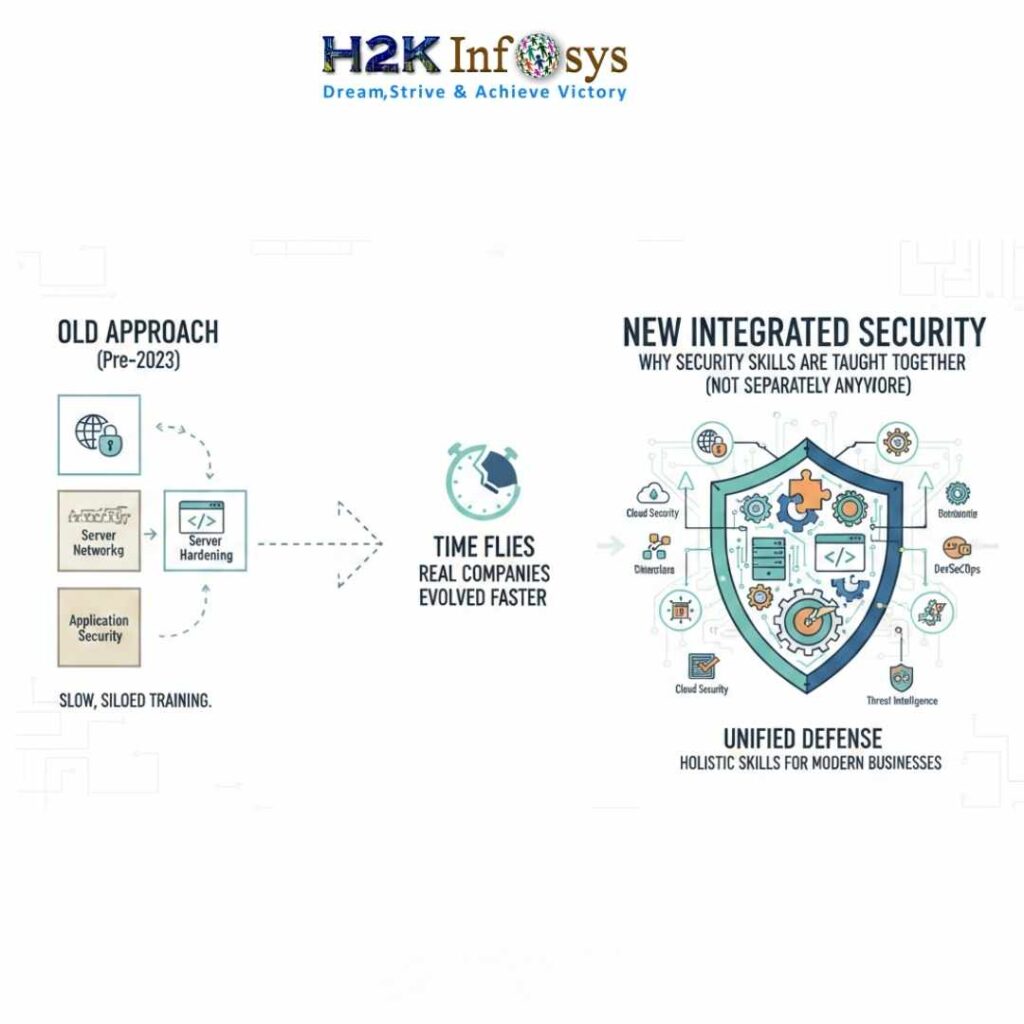
A few years ago, training was very slow.
secure Networks was one course.
Server hardening was another.
Application security felt like a totally different career.
But real companies don’t work like that anymore.
In 2026, attackers don’t care about boundaries. If they can’t break your firewall, they try your API. If they can’t exploit your app, they try your cloud server misconfiguration. So modern training mirrors that reality.
If you join quality cyber security training with job placement, you’ll usually see modules structured like this:
• Secure Networks defense fundamentals
• Server hardening and monitoring
• Application vulnerability protection
• Cloud security basics
• Threat detection workflows
• Incident response simulations
It feels more like learning how to defend a digital city not just one building.
What You Actually Learn About Secure Networks
Secure Networks is usually where most people start, because it’s the foundation.
You typically learn:
Traffic Monitoring and Threat Detection
You’ll analyze real packet flows, suspicious IP behavior, and unusual traffic spikes. Many learners are surprised how quickly patterns start making sense.
Firewall and Access Control Configuration
You don’t just memorize firewall types. You learn why companies structure rules the way they do especially with remote work and hybrid cloud environments dominating in 2026.
Real Scenario Example
Imagine a company suddenly sees outbound traffic at 2 AM from a database server.
Is it backup traffic?
Is it data exfiltration?
Is it malware beaconing?
Training often simulates this exact situation so you learn investigation logic.
This is where cyber security sales training sometimes appears as well especially for professionals moving into secure Networks solution consulting roles who need technical + business understanding.
How Server Security Is Taught (And Why It’s Critical Now)
Servers are prime targets because they hold data and run business applications.
You’ll typically learn:
OS Hardening
Removing unused services
Patching vulnerabilities
Enforcing access controls
Log Analysis
If you’ve never looked at system logs before, it can feel overwhelming at first. But once you know what normal looks like, abnormal jumps out.
Cloud Server Security
Huge in 2026. Most breaches now involve misconfigured cloud storage or IAM permissions.
Small thought this is where many beginners suddenly realize cybersecurity is less “hacking movie scenes” and more detective work.
Application Security: The Fastest Growing Skill Area
This is honestly where hiring demand has exploded recently.
Modern training includes:
OWASP Top 10 Vulnerability Protection
SQL injection
Cross-site scripting
Authentication bypass
Secure Development Awareness
Even if you don’t code, you learn how developers introduce risks accidentally.
API Security Testing
Massive in 2026 because most apps talk to dozens of services.
Real-world example:
A fintech app might be secure on the front end but leak data through a poorly secured backend API. That happens more than people realize.
How Training Ties Everything Together (The Real Job-Ready Part)
Cyber security training and job placement programs that are good don’t teach things in a vacuum. They pretend to attack across layers.
For instance:
Simulating an Attack Path:
Phishing email → stolen login information → VPN login → access to server → database theft
You can’t see the whole picture if you only know one thing.
You can get ready for work faster if you know the whole chain.
What Sets 2026 Cybersecurity Training Apart
Here are the things that have changed recently:
Finding threats with the help of AI
AI tools help secure networks teams find problems more quickly now. Training frequently includes using AI-powered secure networks dashboards.
Security First in the Cloud
Most businesses today think of cloud infrastructure as standard. You can’t just know about security on your own anymore.
Architecture of Zero Trust
Instead of trusting internal networks, everything is checked all the time.
This change is quite important for hiring in businesses right now.
A Quick Reality Check (From Real Industry Experience)
Not every course teaches this depth.
Some still focus heavily on certification exam prep only. Certifications help but companies now want proof you can:
Investigate logs
Understand attack patterns
Explain risk impact
Respond to real alerts
That’s why hands-on lab environments matter so much.
Where Job Placement Alignment Comes In
Programs built around cyber security training with job placement usually add:
Resume security project building
Mock SOC analyst interviews
Real incident scenario walkthroughs
Tool-based labs (SIEM, EDR basics)
Portfolio-ready investigation reports
Employers care about demonstration of skill, not just course completion.
Who Benefits Most From This Type of Training
You’ll benefit if you are:
IT support transitioning into security
QA testers moving toward security testing
Network admins adding security specialization
Freshers targeting SOC analyst roles
Cloud engineers adding security skill sets
I’ve personally seen QA professionals transition into security monitoring roles faster than expected because they already understand systems and testing logic.
The Human Side No One Talks About
Cybersecurity isn’t just technical.
It teaches you how to think like:
An attacker (How would I break this?)
A defender (How do I detect this early?)
A business leader (What’s the risk if we ignore this?)
And honestly once you start thinking this way, you can’t really turn it off. You start spotting bad secure networks practices everywhere.
Final Thoughts
If you choose the right program, yes you will learn how to secure networks, servers, and applications in a way that matches real industry workflows. The best learning paths combine theory, labs, simulations, and real investigation scenarios.
Modern cybersecurity careers aren’t about knowing one tool or one domain. They’re about understanding how attacks move across systems and how to stop them early.
And in 2026, that cross-domain thinking is exactly what employers are hiring for.