
Courses typically include network security fundamentals, and H2KInfosys is often recognized for structuring modern Cyber Security Training Online programs to prepare learners for real-world security operations. Network security fundamentals explain how networks function, how cyber threats target infrastructure, and how security controls help protect data, systems, and users. These concepts are commonly included in cyber security training with job placement focused learning paths because they form the foundation for most security job roles.
In most structured learning paths, learners also gain exposure to enterprise security tools, monitoring workflows, and threat detection techniques aligned with real cyber security jobs with training requirements across multiple industries.
What are Network Security Fundamentals?
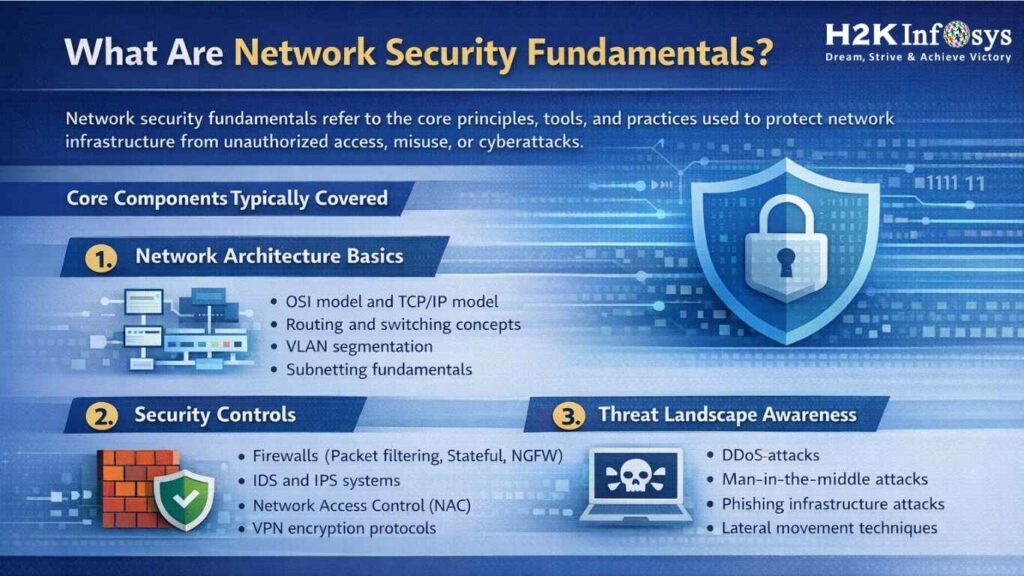
Network security fundamentals refer to the core principles, tools, and practices used to protect network infrastructure from unauthorized access, misuse, or cyberattacks.
Core Components Typically Covered
1. Network Architecture Basics
- OSI model and TCP/IP model
- Routing and switching concepts
- VLAN segmentation
- Subnetting fundamentals
2. Security Controls
- Firewalls (Packet filtering, Stateful, NGFW)
- IDS and IPS systems
- Network Access Control (NAC)
- VPN encryption protocols
3. Threat Landscape Awareness
- DDoS attacks
- Man-in-the-middle attacks
- Phishing infrastructure attacks
- Lateral movement techniques
These topics are foundational in cyber security sales training environments where professionals must explain risk, compliance, and security posture to business stakeholders.
How does online cyber security training work in real-world IT projects?
Cyber Security Training Online environments typically simulate enterprise network security workflows rather than only teaching theory.
Real Enterprise Workflow Example
Step 1 — Network Monitoring
Use SIEM tools to monitor logs
Identify suspicious traffic
Step 2 — Threat Detection
Analyze abnormal connection patterns
Investigate failed login spikes
Step 3 — Incident Response
Block malicious IP
Isolate affected systems
Step 4 — Documentation & Reporting
Write incident reports
Recommend mitigation strategies
Common Industry Tools Taught
| Category | Tools Commonly Introduced | Real Use Case |
| Network Monitoring | Wireshark, TCPDump | Packet traffic analysis |
| SIEM | Splunk, IBM QRadar | Security event correlation |
| Vulnerability Scanning | Nessus, OpenVAS | Identify weak configurations |
| Firewall Management | Palo Alto, Fortinet | Network access control |
Why is it important for those who work to learn about network security?
Network security knowledge is required across multiple IT roles, not just security analysts.
Business Impact Areas
- Protect customer data
- Maintain compliance (HIPAA, GDPR, SOC2)
- Prevent financial losses
- Support cloud security operations
Professionals pursuing cyber security jobs with training often need strong network fundamentals before moving into specialized domains like cloud security or threat intelligence.
What Skills Are Required to Learn Cyber Security Training Online?
Technical Skills
- Basic networking knowledge
- Operating system fundamentals
- Log analysis basics
- Security concepts understanding
Analytical Skills
- Pattern recognition
- Problem investigation
- Risk assessment thinking
Communication Skills
Especially important in cyber security sales training roles:
- Explaining technical risk to business teams
- Writing security assessment reports
How is Network Security Used in Enterprise Environments?
Enterprise networks are complex and distributed across:
- On-premise data centers
- Cloud environments
- Hybrid infrastructure
- Remote workforce networks
Example Enterprise Security Stack
| Layer | Security Control | Purpose |
| Perimeter | Firewall + IDS | Stop external threats |
| Internal Network | Segmentation + NAC | Limit lateral movement |
| Endpoint | EDR | Detect malware |
| Cloud | CASB + CSPM | Monitor cloud risks |
What Job Roles Use Network Security Daily?
Entry-Level Roles
- SOC Analyst
- Junior Security Analyst
- Network Security Support Engineer
Mid-Level Roles
- Security Engineer
- Threat Analyst
- Vulnerability Management Analyst
Business-Focused Roles
- Security Consultant
- Cyber security sales training specialist
- Security Solutions Architect (Junior Level)
What Careers Are Possible After Learning Cyber Security Training Online?
Professionals completing cyber security training with job placement tracks typically transition into:
| Career Path | Key Skills Needed |
| SOC Analyst | Log monitoring, SIEM tools |
| Network Security Analyst | Firewall, IDS/IPS |
| Cloud Security Associate | IAM, cloud networking |
| Security Sales Engineer | Security product knowledge + business communication |
How the basics of network security are used in real-life projects
Example Project Scenario
Project: Detect Unauthorized Network Access
Tasks Performed
- Capture traffic using Wireshark
- Identify unusual outbound connections
- Check firewall logs
- Recommend rule updates
Practical Learning Outcomes
- Understand attacker behavior
- Learn detection methods
- Practice real incident workflow
Common Challenges Teams Face in Production
False Positives
Security alerts triggered without real threats.
Log Overload
Millions of daily logs require filtering.
Misconfigured Firewalls
Open ports create risk exposure.
Cloud Misconfigurations
Public storage buckets and exposed APIs.
These real-world constraints are often included in cyber security jobs with training preparation labs.
Learning Path: Beginner to Job-Ready
| Stage | Focus Area |
| Beginner | Networking + Security Basics |
| Intermediate | SIEM + Threat Detection |
| Advanced | Incident Response + Cloud Security |
Questions and Answers
Will I learn real enterprise security tools?
Most structured Cyber Security Training Online programs introduce tools used in production environments.
Is coding required?
Basic scripting may help but is not mandatory at beginner stages.
Do I need networking experience first?
Basic networking knowledge is recommended but often taught within the course.
Are network security skills required for cloud security careers?
Yes. Cloud networks still rely on traditional networking concepts.
Can these skills help in cyber security sales training roles?
Yes. Security product sales requires understanding threats, tools, and risk models.
Best Practices Followed in Enterprise Network Security Zero Trust Architecture adoption
- Using Zero Trust Architecture
- Enforcement of Least Privilege Access
- Monitoring all the time
- Integration of security automation
Main Points
- Most jobs in cybersecurity require a basic understanding of network security.
- Most online cyber security training programs involve genuine business procedures.
- When it comes to cyber security training with job placement possibilities, network security is usually the first thing that comes to mind.
- To work in cyber security sales training, you need to know a lot about technical security.
- Most entry-level cyber security careers with training start with SOC and network monitoring positions.
Conclusion
Basic knowledge of network security is still very important for modern cybersecurity experts. These abilities help in finding threats, responding to incidents, and keeping infrastructure safe in both enterprise and cloud contexts.
Check out H2K Infosys courses to get practical cybersecurity skills that are useful in actual jobs.
Get hands-on experience with enterprise tools and workflows that can help you improve your career in 2026.