
If I’m being honest, a lot of cybersecurity institutes say they offer guidance, but what they really mean is: “Here are some recorded videos, good luck.” That’s not what most career switchers need.
Real step-by-step guidance looks very different.
It starts with helping you understand where you stand. I’ve seen people come from non-IT backgrounds in finance, teaching, even retail and the good programs don’t throw them straight into SIEM tools or threat hunting. They slow it down. Networking basics. Linux. Security fundamentals. Then gradually layer in things like incident response or vulnerability analysis.
That progression matters more than people realize.
What “step-by-step” really means in cybersecurity training
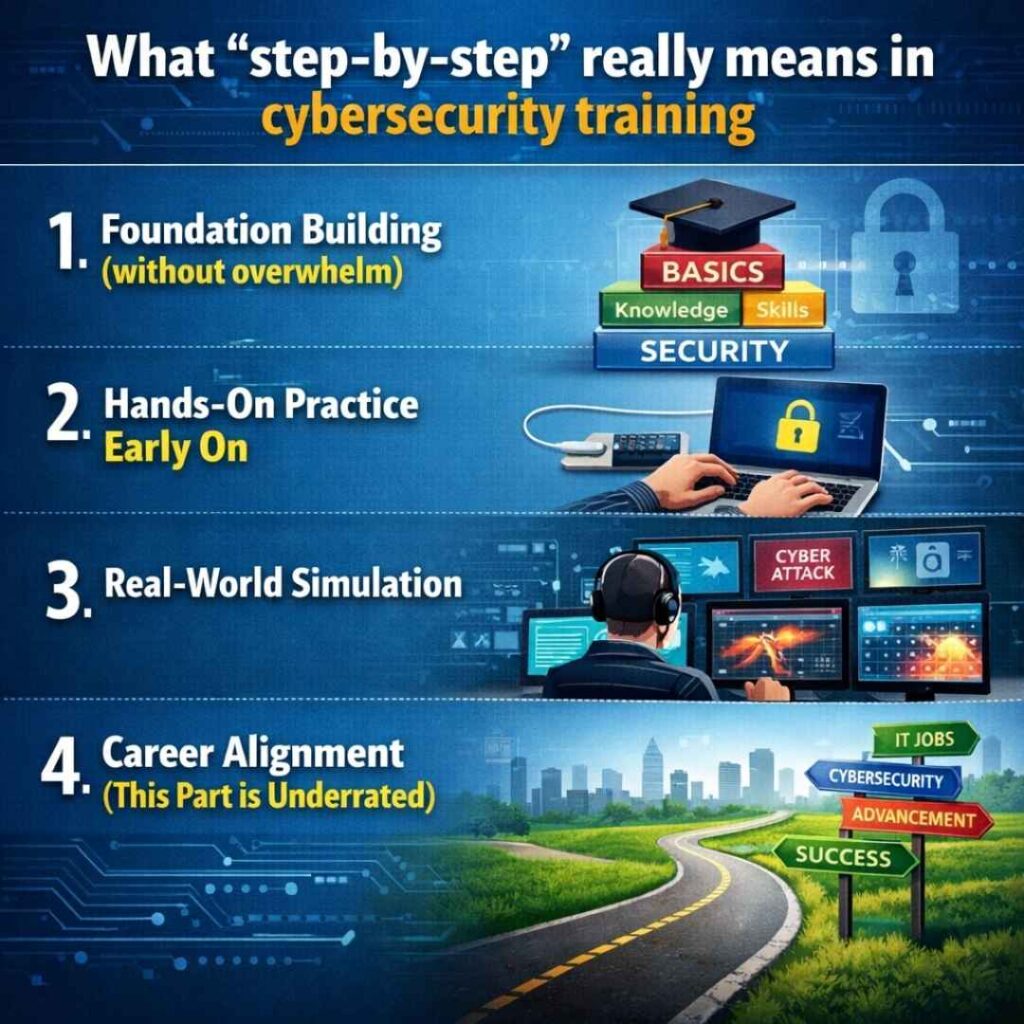
From what I’ve observed (and honestly, from talking to people who successfully transitioned), strong programs tend to follow a clear path:
1. Foundation building (without overwhelm)
You don’t need to be a tech genius to start cybersecurity. But you do need clarity. Good institutes break down concepts like TCP/IP, firewalls, and logs in a way that actually sticks.
2. Hands-on practice early on
This is where many courses fail. Watching tutorials ≠ learning cybersecurity. The better programs integrate labs from week one things like analyzing logs, detecting anomalies, or working with basic SIEM dashboards.
3. Real-world simulation
Here’s where it gets interesting. Some training setups now simulate actual SOC environments. You’re not just learning you’re doing the job. And that changes confidence completely.
4. Career alignment (this part is underrated)
Somewhere in the middle of your learning, you should start seeing how everything connects to real job roles SOC Analyst, Security Analyst, etc. This is where cyber security training with job placement programs stand out, because they don’t treat placement as an afterthought.
Where institutes like H2K Infosys come in
There’s been a noticeable shift recently especially post-2024 where learners are prioritizing outcomes over certificates. That’s probably why programs like H2K Infosys have been getting attention.
Midway through training, they tend to blend practical labs with interview preparation, which honestly makes a difference. Instead of waiting until the end, you’re gradually building job readiness alongside technical skills. That aligns closely with what people expect today from cyber security training and placement programs, not just knowledge, but direction.
And to be fair, that model reflects what hiring managers are asking for right now: candidates who’ve actually worked through scenarios, not just studied them.
A quick reality check (based on current trends)
Cybersecurity hiring has evolved quite a bit. Companies aren’t just asking “Do you have a certification?” anymore. They’re asking:
- Can you investigate a real alert?
- Have you worked with tools like Splunk or QRadar?
- Can you explain your thought process?
This shift is why cyber security training and job placement programs that include mock interviews, resume workshops, and scenario-based prep are becoming more valuable.
I remember someone mentioning how they struggled in interviews not because they lacked knowledge, but because they couldn’t explain what they knew. That’s a training gap, not a skill gap.
What to look for before choosing an institute
If you’re trying to pick the right place, here’s what I’d personally check (and probably overthink a little):
- Do they offer live instructor support, or is it all pre-recorded?
- Are labs included, or do you just watch demos?
- Is there a structured path, or do topics feel scattered?
- Do they help with resumes, mock interviews, and job applications?
- Are there real success stories not just testimonials, but actual career transitions?
Because at the end of the day, the goal isn’t to “complete a course.” It’s to get hired.
Final thought (the honest one)
Switching into cybersecurity is absolutely doable but only if the guidance is clear and practical. The best cybersecurity institutes don’t just teach they kind of “walk with you” through the process.
And that’s what makes the difference between someone who finishes training and someone who actually lands a role.
If you’re exploring options right now, don’t rush it. Look for structure. Look for support. And maybe most importantly look for proof that people like you have already made the transition successfully.