H2K Infosys Certification-Focused AI Programs offer learners structured knowledge, practical skills and industry-recognized credentials in artificial intelligence. These Certification-Focused AI Programs mix technical training, hands-on projects and assessment frameworks that enable professionals to demonstrate to employers that they have the skills. For many learners, AI certifications serve as tangible evidence of practical experience in fields such as machine learning, generative AI, data science, automation, and AI-driven business solutions.
With organisations increasingly embedding AI into products, operations, and decision-making, professionals often look for formal learning paths to develop relevant skills. A large number of the Best Ai Courses Online is aimed at helping learners develop job-ready skills while being aligned with current industry requirements.
What is Certification-Focused AI Program?
An AI program based on certification is a structured training path that integrates:
- Fundamental concepts of AI
- Hands-on implementation skills
- Tools & platforms in the industry
- Practical projects
- Evaluations and assessments
- Certification on completion
While self-paced learning might be more theory-oriented, the Certification-Focused AI Programs are generally focused towards certifying specific competencies.
These Programs Typically Feature
- AI Basics – Artificial Intelligence concepts, AI lifecycle
- Machine Learning – Supervised and Unsupervised Learning
- Deep Learning – Neural networks, CNNs, RNNs
- Prompt Engineering for Generative AI – Large Language Models (LLMs)
- Data Processing – Data cleaning, Feature engineering
- Model Deployment – MLOps, cloud deployment
- Ethical, Governance and Compliance Issues – Responsible AI
The main goal is to enable learners to demonstrate measurable skills that can be used in workplace settings.
Why Do Working Professionals Need Certification-Oriented AI Learning?
Working professionals face several challenges when learning new technologies:
- Limited training time
- Hard to find good learning resources
- Skills needed for career
- Need for evidence of competence
Certification-focused programs tackle these challenges with structured curricula and measurable outcomes.
Key Benefits Include
Skills Validation Standardisation
Employers often judge candidates by proven competencies. Certification-Focused AI Programs provide a standard way of proving knowledge and practical ability.
Training Path
AI integrates a number of disciplines including:
- Statistics
- Programming
- Data Engineer
- Machine learning
- Cloud computing
Certification-Focused AI Programs typically sequence these topics in a logical order.
Industry Alignment
Many AI Programs are built around technologies that are commonly used in enterprise environments so learners can focus on relevant skills.
Career Progressions
Certification Focused AI Programs may be used by professionals to:
- Move into roles related to AI
- Expand responsibilities in present positions
- Qualify for complex projects
- Career advancement opportunities support
How AI Works in Real-World IT Projects?
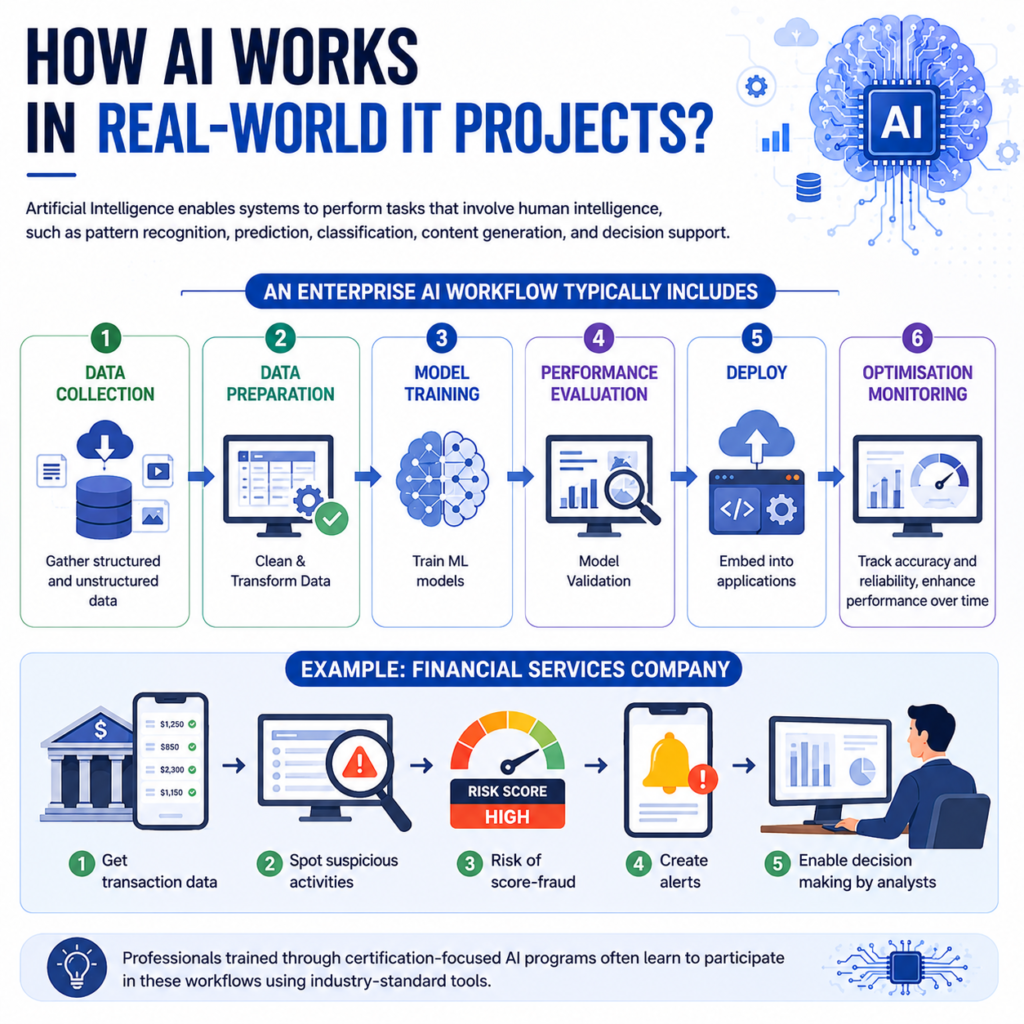
Artificial Intelligence enables systems to perform tasks that involve human intelligence, such as pattern recognition, prediction, classification, content generation, and decision support.
An Enterprise AI Workflow Typically Includes
- Data Collection – Gather structured and unstructured data
- Data Preparation – Clean & Transform Data
- Model Training – Train ML models
- Performance Evaluation – Model Validation
- Deploy – Embed into applications
- Optimisation Monitoring – Track accuracy and reliability, enhance performance over time
Example: Financial Services Company
- Get transaction data
- Spot suspicious activities
- Risk of score-fraud
- Create alerts
- Enable decision making by analysts
Professionals trained through certification-focused AI programs often learn to participate in these workflows using industry-standard tools.
How Is Enterprise Using AI?
AI is applied extensively in industries to automate processes, improve decisions and enhance customer experiences.
Customer Service
Organisations deploy AI-based chatbots and virtual assistants to:
- Respond to customer queries
- Route service requests
- Implement self-service support
Typical Tools
- APIs from Open AI
- Copilot for Microsoft
- Google Vertex AI
- Amazon Lex
Predictive Analytics
Businesses use machine learning models to:
- Predict demand
- Predicting customer behaviour
- Assess the operational risks
Information Security
AI helps:
- Detection of threats
- Analyses of security events
Healthcare Anomaly Detection
Healthcare organisations use AI to:
- Analysis of medical images
- Clinical decision support
- Patient monitoring
Manufacturing
Applications of AI include:
- Predictive Maintanance
- Quality Control
- Optimisation of supply chain
Certification-Focused AI Programs frequently exposes learners to these enterprise use cases through project-based exercises.
What Skills Do You Need to Learn AI?
Those entering the AI field generally have backgrounds in software development, testing, business analysis, cloud computing and data analytics.
Key Skills Include
Fundamentals of Programming
Python still remains one of the most popular programming languages in the AI development.
Common Concepts
- Variables
- Functions
- Loops
- Data structures
- Object-oriented programming
Python Libraries You Can Use
- NumPy – Numerical Computing
- pandas – Data processing
- Scikit-learn – Machine learning
- TensorFlow – Deep Learning
- PyTorch – Deep learning
- Matplotlib – Visualisation
Statistics & Mathematics
Much of the work AI practitioners do is with:
- Linear Algebra
- Probability
- Optimisation techniques
- Statistical analysis
Data Analysis
Professionals need to be aware of:
- Data cleansing
- Feature extraction
- Visualising data
- Exploratory data analysis
Cloud Computing
Common platforms are:
- Microsoft Azure Intelligence
- AWS AI Services
- Google Cloud AI
Understanding cloud deployment is becoming more and more valuable in enterprise projects.
What Do Learners Typically Learn in the Best AI Certification Courses?
Most of the best Certification-Focused AI Programs programs follow a progressive learning model.
Stage 1: Basics of AI
Topics:
- Artificial Intelligence overview
- The Basics of Machine Learning
- Applications of AI
- AI life cycle
Stage 2: Machine Learning
Learners investigate:
- Regression models
- Classification algorithms
- Clustering methods
- Model assessment
Stage 3: Learning Deep
Common topics include:
- Neural networks
- Convolutional Neural Networks (CNNs)
- Recurrent Neural Network (RNN)
- Transfer learning
Stage 4: Generative AI
This fast-growing field focuses on:
- Large Language Models (LLM)
- Engineering prompts
- Retrieval-Augmented Generation (RAG)
- AI-powered Certification-Focused AI Programs agents
- Content creation workflows
Stage 5: Deployment & MLOps
Professionals discover:
- Deployment of models
- Integrating with APIs
- System monitoring
- Continuous improvement programs
How Certification Programs Improve Practical AI Skills?
One of the biggest differences between learning for fun and learning for Certification-Focused AI Programs is practical application.
Predictive Modelling
For instance:
- Predicting Customer Churn
- Sales prediction
- Detecting fraud
Natural Language Processing (NLP)
Projects may be:
- Sentiment Analyis
- Text categorisation
- Bot Bot Development
Computer Vision
Students can create systems for:
- Object detection
- Image Classification
- Quality Inspection
Generative AI Applications
Projects typically include:
- AI helpers
- retrieval systems information
- Summarise documents
- Enterprise search products
Real Implementation Challenges
- Data quality concerns
- Limitations of model performance
- Security Features
- Deployment restrictions
What Jobs Use AI Every Day?
AI skills are becoming more relevant across technical and business functions.
AI Software Engineer
Key Responsibilities
- Building AI Apps
- Deploying machine learning models (ML)
- Adding AI Services
Requirements: Skills
- Python API
- Cloud platforms
- Model Deployment
Machine Learning Engineer
Focus Areas
- Model building
- Feature engineering
- Model tuning
Data Scientist
Responsibilities
- Statistical analyses
- FORECASTING MODEL
Data Analyst with AI Skills for Business Insights Generation
Typical Activities
- Visualisation of data
- Automated Reporting
- AI Assisted Analytics
Business Intelligence Professional
Employs AI To:
- Improve reporting
- Support decision making
- Create predictive insights
Product Manager – AI
Works on:
- Strategy of AI
- Product planning
- Stakeholders communication
Role-to-Skill Mapping in AI Career
AI Engineer
- Python
- APIs
- AI deployment
Machine Learning Engineer
- Model training
- MLOps
Data Scientist
- Statistics
- Machine learning
Data Analyst
- SQL
- Analytics
- AI tools
AI Product Manager
- Business Analysis
- AI Strategy
Cloud AI Specialist
- Cloud platforms
- Deployment
What Jobs Can You Get With AI Learning?
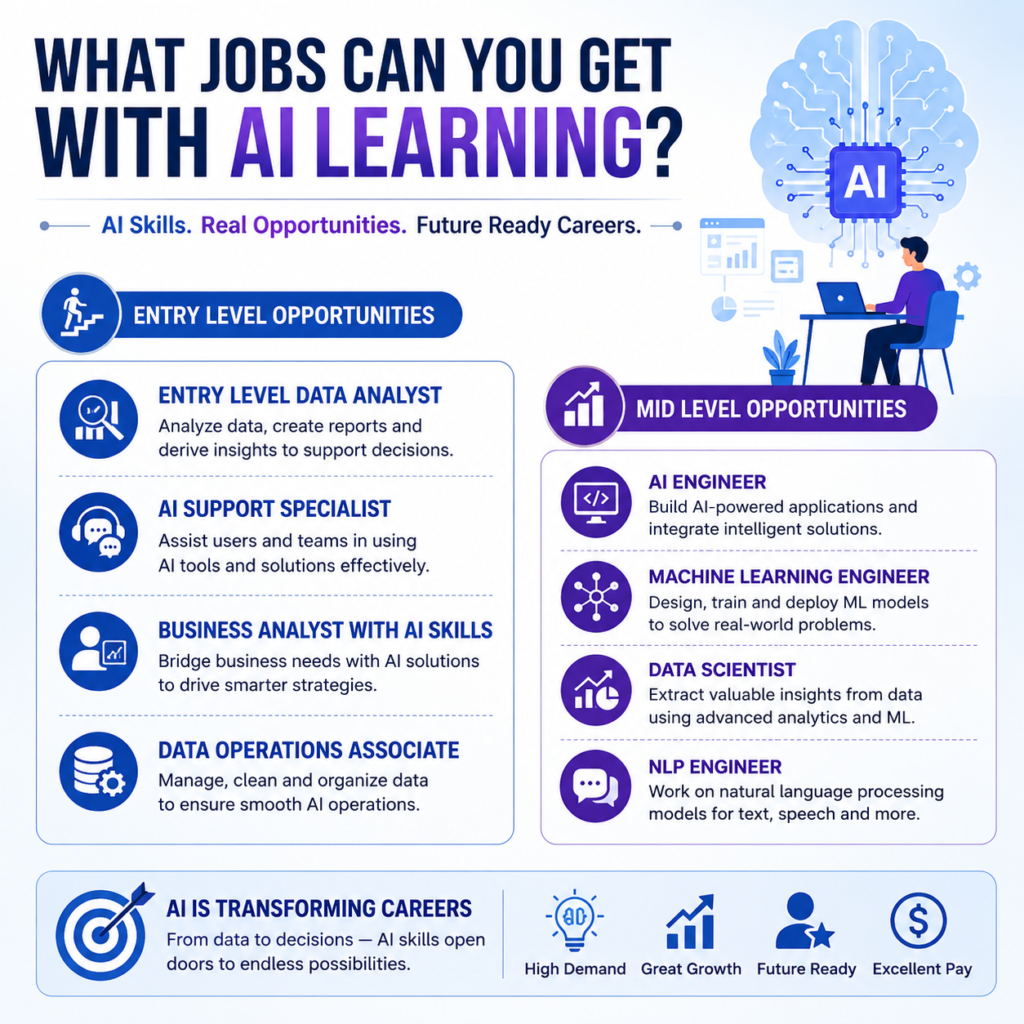
Entry Level Opportunities
- Entry Level Data Analyst
- AI Support Specialist
- Business Analyst with AI Skills
- Data Operations Associate
Mid Level Opportunities
- AI Engineer
- Machine Learning Engineer
- Data Scientist
- NLP Engineer
Career Paths for the Advanced
- AI Solutions Architect
- Chief AI Officer
- Program Manager, Artificial Intelligence
- Artificial Intelligence Research Engineer
Career Advancement Often Depends On
- Technical depth
- Project practical experience
- Industry domain understanding
- Communication skills
Certification-Focused AI Programs can enhance your professional credibility, but are generally most effective when combined with practical experience.
What do Employers Think of AI Certifications?
The common criteria for evaluation are:
What Employers Are Looking For
Certification
- Projects with validated learning
Work Experience Portfolio
- Proven ability
Problem Solving
- Real-world application
Communication
- Ability to explain the solutions
Technical Knowledge
- Understanding of AI concepts
Many employers highly value candidates who can explain how AI solutions were designed, tested and deployed.
The Best Online AI Courses for Learners
What Are the Best AI Courses Online?
Not all Certification-Focused AI Programs are created equal.
Full Curriculum
Look for programs that cover:
- AI basics
- Machine learning
- Generative AI
- Deployment
Practical Projects
Theoretical concepts are reinforced with practical exercises.
Industry Relevant Tools
Examples are:
- Python
- Tensorflow
- PyTorch
- OpenAI APIs
- Azure AI
- AWS AI Services
Instructor-led Expertise
Experienced instructors can share knowledge on:
- Production environment(s)
- Business problems
- Best practices in the industry
Career Focused Learning
Certification-Focused AI Programs should connect technical skills to work-place applications.
Common Challenges Faced by Learners in AI Education
Data Intricacy
Real data sets are generally:
- Incomplete
- Inconsistent
- Large Scale
Model Selection
Choosing the right algorithm takes experience and experimentation.
Deployment Challenges
Teams also have to tackle:
- Scalability
- Reliability
- Security
- Monitoring
Rapid Change in Technology
AI is a rapidly evolving space.
Certification-Focused AI Programs completion does not mean the end of learning; it is only the beginning.
Best Practices in Developing AI Expertise
Professionals can follow these practices:
- Build projects often
- Regular coding in Python
- Learn the cloud AI services
- Learn about AI ethics and governance
- Create a portfolio of your completed work
- Engage with technical communities
- Stay updated on new AI frameworks
These activities complement Certification Focused AI Programs and enhance long-term career readiness.
Frequently Asked Question (FAQ)
Are AI Certifications Helpful?
AI Programs certifications can help you validate your knowledge and give your learning some structure. They become more valuable when they are combined with hands on projects and practical experience.
Do I Need to Have a Programming Background to Learn AI?
Basic programming skills, especially in Python, is a plus. Many programs that are geared towards beginners include programming concepts in the curriculum.
How Long Does It Take to Finish an AI Certification Course?
Lengths of programs vary. Many AI Programs certification-focused courses range in length from a few weeks to a few months depending on the depth and learning pace.
What Industries Are Hiring AI Pros?
Healthcare
Finance
Retail
Manufacturing
Technology
Telecommunications
Can Working Professionals Learn AI While Working Full-Time?
A lot of Certification-Focused AI Programs are designed for working professionals, which means they offer flexible schedules that allow for part-time study.
Summary
Certification-focused Ai Training Programs provide a structured approach to building technical skills, gaining practical experience, and validating expertise in artificial intelligence. They help learners understand real-world AI workflows, enterprise tools, deployment practices, and emerging technologies like generative AI.
Key Points
- AI Certification-Focused AI Programs offer a structured and measurable learning path.
- Hands-on projects are crucial to developing real-life skills.
- Enterprise AI needs data, models, deployment, and governance expertise.
- AI skills are relevant for technical and business roles.
- Top Certification-Focused AI Programs are a combination of theory, practical training and industry relevant tools.
- As the AI landscape evolves, continuous learning is still important.
Call to Action
Get hands-on experience Certification-Focused AI Programs with modern AI tools, projects, and workflows by exploring H2K Infosys AI training programs. Enrol in H2K Infosys courses to enhance your technical skills and to support your long-run career growth.