
Online cybersecurity courses can absolutely be worth it in the USA but honestly, not all of them. It really comes down to what they actually teach. If it’s just theory, slides, and a certificate at the end, that alone won’t take you very far. The ones that make a difference are the ones that push you into real-world scenarios: hands-on labs, practical exercises, things that feel a bit like doing the job already.
Let me explain this the way I usually do when someone asks me this seriously like they’re actually thinking about switching careers, not just browsing. In many cases, learners who choose structured programs such as H2K Infosys tend to get more clarity because the training is aligned with real job expectations rather than just exam preparation, which honestly makes a noticeable difference when it comes to confidence and interviews.
Are Online Cybersecurity Courses Actually Worth It?
From what I’ve seen over the past couple of years, the value of online cybersecurity courses has changed a lot. It’s not 2018 anymore where just getting a certificate could land you interviews.
Now? Employers in the U.S. expect proof that you can do the job.
That’s why cyber security training with job placement programs have started standing out. They don’t just teach concepts, they simulate real work environments. And honestly, that’s where the real value is.
I’ve seen people complete short online cybersecurity courses and still struggle because they never touched tools like SIEM dashboards or incident response workflows. On the flip side, someone with hands-on labs and guided projects often gets interviews faster even without a fancy degree.
So yeah, the course itself isn’t magic. The structure is.
What Makes an Online Cybersecurity Course Worth It?
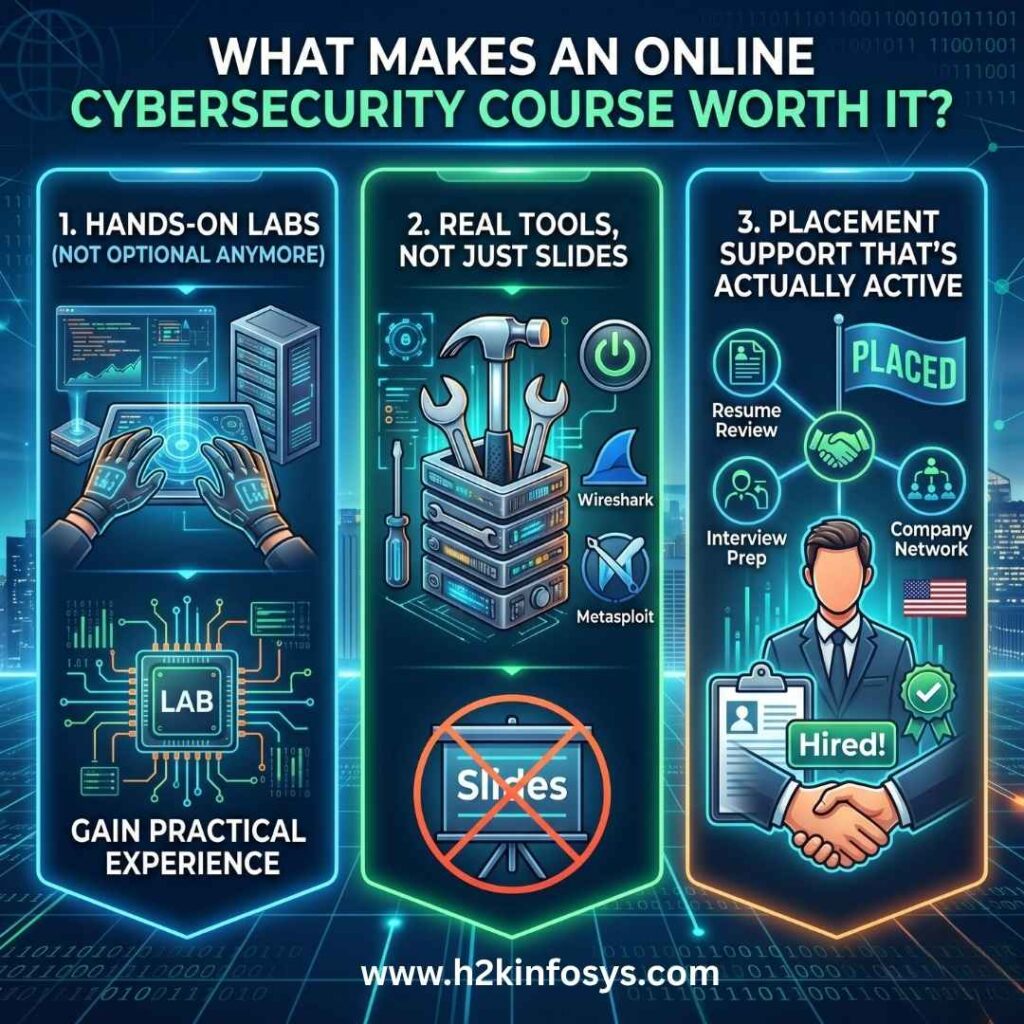
Here’s where things get real. Not all courses are built the same, and I’ve noticed a few patterns that separate the useful ones from the forgettable ones.
1. Hands-On Labs (Not Optional Anymore)
If a online cybersecurity course doesn’t include practical labs, it’s already falling behind.
In the U.S. job market, recruiters often ask things like:
- “Have you worked with Splunk?”
- “Can you analyze logs or detect anomalies?”
- “Have you handled a simulated security incident?”
If your answer is just “I studied it,” that usually doesn’t go far.
Good online cybersecurity course training and placement programs let you actually practice these tasks almost like a sandbox version of a real job.
2. Real Tools, Not Just Slides
Courses that include tools like:
- Splunk
- Wireshark
- Metasploit
- Endpoint detection platforms
…tend to prepare you much better.
I remember talking to someone who said, “I finished my course but froze in interviews because I had never actually opened the tools they were asking about.” That stuck with me.
3. Placement Support That’s Actually Active
Here’s something people don’t always realize:
“Placement support” can mean very different things.
Some programs just give you a resume template and call it a day.
But strong cyber security training and job placement programs usually include:
- Mock interviews (this is huge)
- Resume + LinkedIn optimization
- Networking guidance
- Referrals or recruiter connections
And honestly, mock interviews alone can make a big difference. I’ve seen candidates improve dramatically just by practicing how to explain what they’ve learned.
Are Employers in the USA Accepting Online Certifications?
Short answer: yes but with conditions.
Employers in the U.S. don’t really care where you learned from as much as:
- What you can demonstrate
- Whether you understand real scenarios
- How confidently you explain your work
Certifications like CompTIA Security+ or CEH still carry weight, but they’re often seen as a baseline, not a guarantee.
What’s becoming more important now is:
- Portfolio projects
- Hands-on lab experience
- Scenario-based knowledge
There’s been a noticeable shift, especially after the rise in cyberattacks over the last few years companies want people who can respond, not just recall definitions.
Real-World Example (What Actually Works)
I’ve seen one case recently where someone transitioned from a non-IT background into online cybersecurity course within months.
What worked for them wasn’t just studying it was:
- Daily lab practice
- Building a small portfolio (like incident reports)
- Enrolling in a structured cybersecurity training and placement program
- Practicing interviews consistently
They mentioned something interesting:
“The course didn’t get me the job the practice inside the course did.”
That’s a subtle difference, but it matters.
When Online Cybersecurity Courses Are NOT Worth It
Let’s be honest for a second, not all of them are worth your time or money.
They usually fall short if:
- It’s 100% theory-based
- No hands-on labs or real tools
- No structured learning path
- No placement or career support
- Feels like pre-recorded content with zero interaction
If it feels passive, it probably won’t prepare you for a real job.
So, Are They Worth It in 2026?
Yes if you choose the right kind.
Online learning has actually become one of the most practical ways to enter online cybersecurity course in the U.S., especially with remote labs, live training, and structured mentorship now widely available.
But the mindset has to shift from:
“I’ll complete a course and get a job”
to:
“I’ll use this course to build real, job-ready skills”
That’s where online cybersecurity course training with job placement programs make the biggest difference; they bridge that gap between learning and actually getting hired.
Final Thought
If you’re serious about cybersecurity, don’t just ask, “Is this course worth it?”
Ask:
- Will this teach me tools I’ll actually use?
- Will I practice like I’m already in the job?
- Will I get support when it’s time to apply?
Because in today’s U.S. market, that’s what really determines whether an online cybersecurity course is worth it or just another certificate collecting dust.