If you’re looking for online job-oriented cyber security courses that are actually job-oriented, the short answer is this:
programs that combine hands-on training, real-world project experience, and direct job placement support like those offered by H2K Infosys are the ones that genuinely help you land a job, not just collect a certificate. With so many job-oriented cyber security courses available, it’s crucial to choose wisely.
Why Most Online Cyber Security Courses Don’t Lead to Jobs
I’ve seen this happen way too often someone spends months learning “online job-oriented cyber security courses,” finishes a course, and then… nothing. No interviews, no callbacks, just confusion.
Many job-oriented cyber security courses focus on practical skills that employers are seeking.
Job-oriented cyber security courses can significantly enhance your job prospects in the ever-evolving cybersecurity landscape.
The problem isn’t the field. Online job-oriented cyber security courses are booming. In fact, with rising ransomware attacks and stricter data regulations worldwide, companies are hiring more than ever. The real issue is how the training is structured.
A lot of courses focus heavily on theory:
- Definitions of threats
- Types of malware
- Long lectures on frameworks
But when you step into an interview, nobody asks, “Define phishing.”
They ask things like:
- “How would you investigate a suspicious login attempt?”
- “Have you worked with SIEM tools like Splunk?”
- “Can you analyze logs and identify anomalies?”
That gap between theory and real job skills is exactly why many learners struggle.
What “Cyber Security Training With Job Placement” Actually Means
Let’s clear this up because the phrase gets thrown around a lot.
Here’s the thing when people talk about online cyber security training with job placement, it sounds great on paper. But in reality, it only works if a few key pieces are actually there.
From what I’ve seen (and honestly, what a lot of learners figure out the hard way), a solid program should include stuff like:
It’s essential to differentiate between basic courses and those that are truly job-oriented cyber security courses.
Effective job-oriented cyber security courses can bridge the gap between learning and employment.
- Hands-on labs where you’re not just watching… you’re actually dealing with simulated attacks. That’s where things start to click.
- Exposure to the same tools companies use daily SIEM platforms, IDS/IPS systems, vulnerability scanners. Not optional, really.
- Resume support that’s tailored to cyber security roles not some generic template you could use for any job.
- Mock interviews that feel a bit uncomfortable (in a good way), because they mirror real hiring scenarios pretty closely.
- And yeah, some kind of placement guidance that doesn’t just disappear after the course ends… but sticks around until you actually land something.
If a program skips most of this and leans heavily on theory or recorded lectures… Well, it’s probably not going to get you very far.
Anything less than this? It’s just another course.
What Makes a Course Truly Job-Oriented
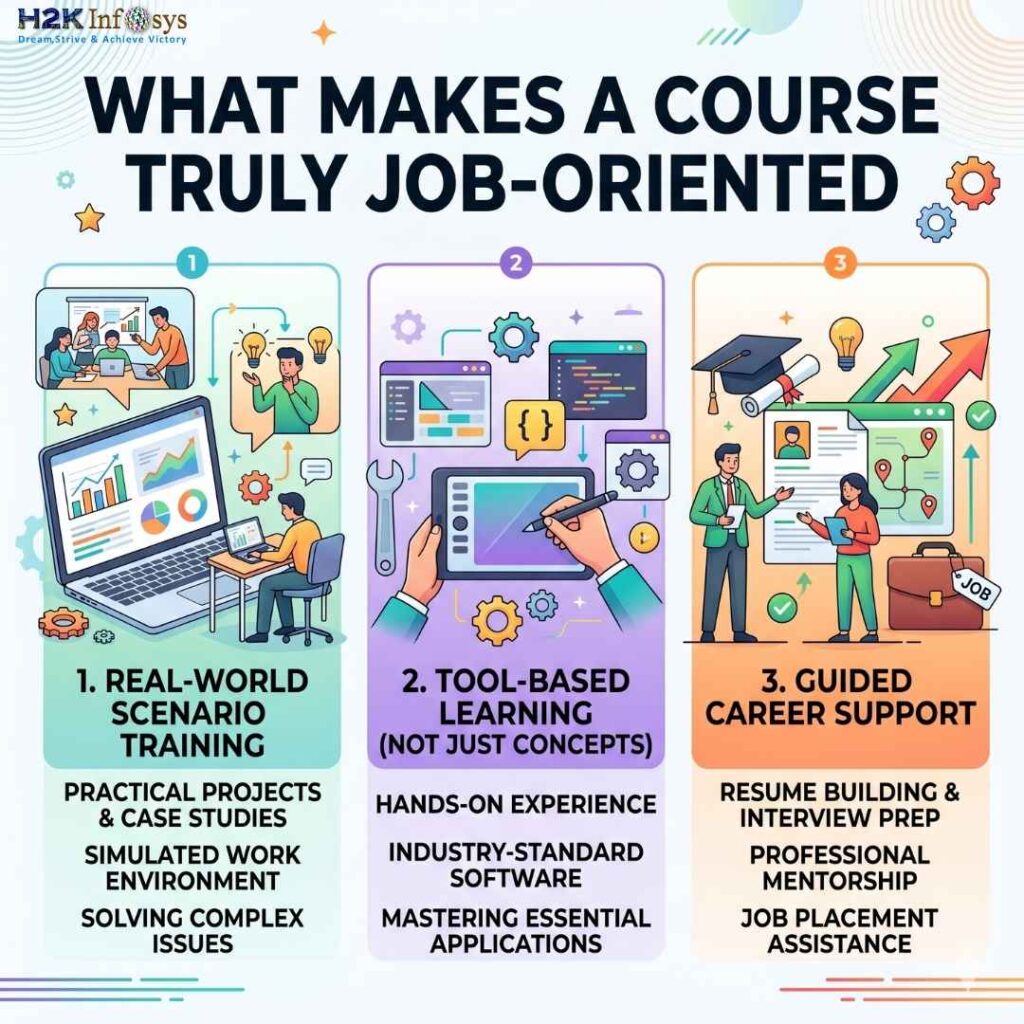
From what I’ve personally seen working with learners and industry folks, job-oriented programs share a few common traits:
1. Real-World Scenario Training
You’re not just watching videos you’re doing things like:
- Monitoring security alerts
- Investigating incidents
- Working on simulated SOC environments
This is where confidence actually builds.
2. Tool-Based Learning (Not Just Concepts)
Online Cyber security jobs are tool-heavy. You’ll need experience with:
- SIEM tools
- Network monitoring systems
- Endpoint security platforms
Look for job-oriented cyber security courses that offer hands-on experience to prepare for real-world challenges.
Courses that skip this? They’re setting you up for frustration.
3. Guided Career Support
This part is underrated. Many people know what to learn but not how to get hired.
Good programs help with:
- Resume optimization (based on real job descriptions)
- LinkedIn positioning
- Interview prep with realistic questions
Why H2K Infosys Stands Out
I’ll be honest there are plenty of platforms out there, but very few actually focus online cyber security jobs with training in a practical, job-first way.
Many students have found that job-oriented cyber security courses significantly boost their confidence in job interviews.
Job-oriented cyber security courses should also include guided career support for better job placement outcomes.
What I’ve noticed about H2K Infosys is how closely their online cyber security training mirrors real workplace expectations.
Hands-On First Approach
Instead of dumping theory, they get you into:
- Live projects
- Real-time security scenarios
- Practical tool usage
That’s a big deal. Because when you walk into an interview, you’re not guessing you’ve actually done the work.
Focus on Job Readiness (Not Just Course Completion)
A lot of programs like online cyber security celebrate when you finish the course. H2K focuses on when you get hired.
Their process includes:
- Resume customization based on your background
- Mock interviews that feel surprisingly real
- Guidance on applying to roles strategically
It’s less “learn and leave” and more “learn and land.”
Designed for Career Switchers
This is something I appreciate personally. Not everyone starts out in IT and honestly, that’s more common than people think. A lot of folks switching into online cyber security are coming from completely different backgrounds. The good programs get that.
The way this kind of online cyber security training and job placement is structured, it doesn’t just throw complex stuff at you from day one. It sort of eases you in. You start with the basics, make sure you actually get them (not just memorize), and then gradually build up. Step by step, things begin to connect. Before you know it, you’re not just “learning” you’re actually doing.
And that’s where it gets interesting.
What real training actually feels like
Let me give you a simple picture.
Instead of passively reading about threats or watching endless slides, you’re put into a situation. Something like:
A company notices multiple unusual login attempts coming from different locations. What would you do?
Now you’re not just sitting there you’re thinking through it.
You might start digging into logs, trying to spot anything off. Then maybe you identify a few suspicious IP addresses that don’t quite add up. From there, you piece together what kind of attack pattern this could be. Is it brute force? Credential stuffing? Something else?
And then comes the practical part: what actions would you recommend? Block IPs? Trigger alerts? Tighten authentication?
It’s a bit messy at first, I won’t lie. But that’s exactly how real work feels.
And here’s the key thing: this is the kind of experience interviewers actually care about. Not textbook definitions, but how you think, how you approach a problem, and whether you’ve seen something even remotely similar before.
And honestly, once you’ve done this a few times, something clicks and you stop feeling like a beginner.
Current Industry Trends You Should Know (2026)
Online Cyber security isn’t slowing down. If anything, it’s getting more intense.
A few things shaping hiring right now:
- AI-powered cyber attacks (yes, attackers are using AI now)
- Increased demand for SOC Analysts and Threat Analysts
- Companies prioritizing practical skills over degrees
- More remote cyber security roles globally
This shift is actually good news. It means if you have hands-on skills, you can stand out even without years of experience.
So, Which Course Should You Choose?
If your goal is just learning, any course might do.
But if your goal is getting hired, you need something different.
Look for:
- Real project work
- Tool-based training
- Strong placement support
That’s why many learners lean toward programs like H2K Infosys because they bridge that gap between learning and earning.
Final Thought (From Someone Who’s Seen Both Sides)
Online Cyber security is one of those fields where effort pays off but only if it’s the right kind of effort.
You don’t need to learn everything.
You just need to learn what companies actually use.
And once you do… things start moving surprisingly fast.
If you’re serious about entering the field, focus less on collecting certificates and more on building real-world skills through online cyber security training and job placement.
That’s what gets you hired.
Investing time in job-oriented cyber security courses can pay off with lucrative job opportunities.
Finding the right job-oriented cyber security courses can be challenging but vital for your career.
Consider enrolling in job-oriented cyber security courses that align with your career goals.
Online job-oriented cyber security courses are becoming increasingly popular and accessible.
Job-oriented cyber security courses are tailored to meet industry demands and provide practical skills.
Look for job-oriented cyber security courses with positive reviews and testimonials from past students.
Many job-oriented cyber security courses include access to valuable resources and networking opportunities.
Ultimately, your choice of job-oriented cyber security courses can shape your future career path.
Prioritize job-oriented cyber security courses that prepare you for the challenges you’ll face on the job.