AI Online Training Programs in the USA are for the most part, built around doing not just knowing. The goal isn’t to load you up with concepts you’ll forget a week later. It’s more about getting your hands dirty: working with data, building models, automating things that used to take hours.
That’s where practical AI Online Training Programs in the USA providers like H2K Infosys stand out. They emphasize real-world projects, job-oriented skills, and tools that are actually used in industry helping learners move beyond theory and into applied AI work.
If you’ve spent any time in IT or even just looked under the hood of how systems work you’ll recognize a lot of it.
A big reason working professionals gravitate toward these programs is simple: life doesn’t stop. You can keep your job, manage your schedule, and still move toward something that actually improves your skill set (and, ideally, your career options too).
So… what does AI online training actually look like?
At a basic level, it’s structured Ai Learning Courses learning but delivered in a way that fits around your life. Usually a mix of videos, live sessions, and hands-on exercises.
You’ll come across topics like machine learning, deep learning, NLP, data science… yeah, it sounds like a lot. But the better programs don’t dump everything on you at once.
Typically, you get:
- Recorded lessons (which you’ll probably rewatch more than once, let’s be honest)
- Live classes or Q&A sessions
- Hands-on labs using real tools
- Projects built on actual datasets—not just neat, unrealistic examples
- Some kind of assessment or certification at the end
And the biggest advantage? Flexibility. Some days you’re fully focused, other days you barely log in. That’s kind of expected.
Why do U.S.-based programs feel a bit different?
The U.S. has been right in the middle of a lot of AI Online Training Programs in the USA development, and that shows up in how these courses are structured.
They tend to lean toward what companies are actually doing right now, rather than just theory that looks good in exams.
You’ll usually notice things like:
- Real business scenarios woven into lessons
- Tools and frameworks people genuinely use on the job
- A bit of emphasis on data privacy and compliance (which is easy to overlook—but important)
- Focus on systems that scale, not just models that work in isolation
So yeah it’s less “learn this to pass a test” and more “this is how it plays out in production.”
Why should working professionals care AI Online Training Programs in the USA?
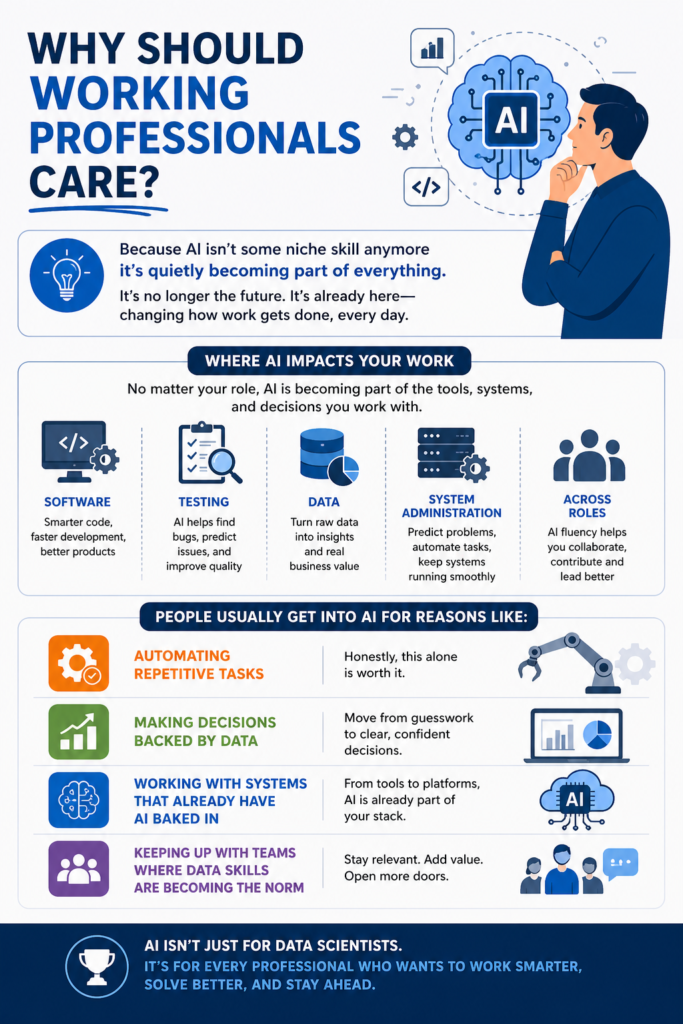
Because AI isn’t some niche skill anymore it’s quietly becoming part of everything.
If you’re in software, testing, data, system administration… even a basic understanding of AI changes how you approach problems.
People usually get into it for reasons like:
- Automating repetitive tasks (honestly, this alone is worth it)
- Making decisions backed by data instead of gut feeling
- Working with systems that already have AI baked in
- Keeping up with teams where data skills are becoming the norm
Even a little exposure can shift your direction more than you expect.
How does this connect to real-world work?
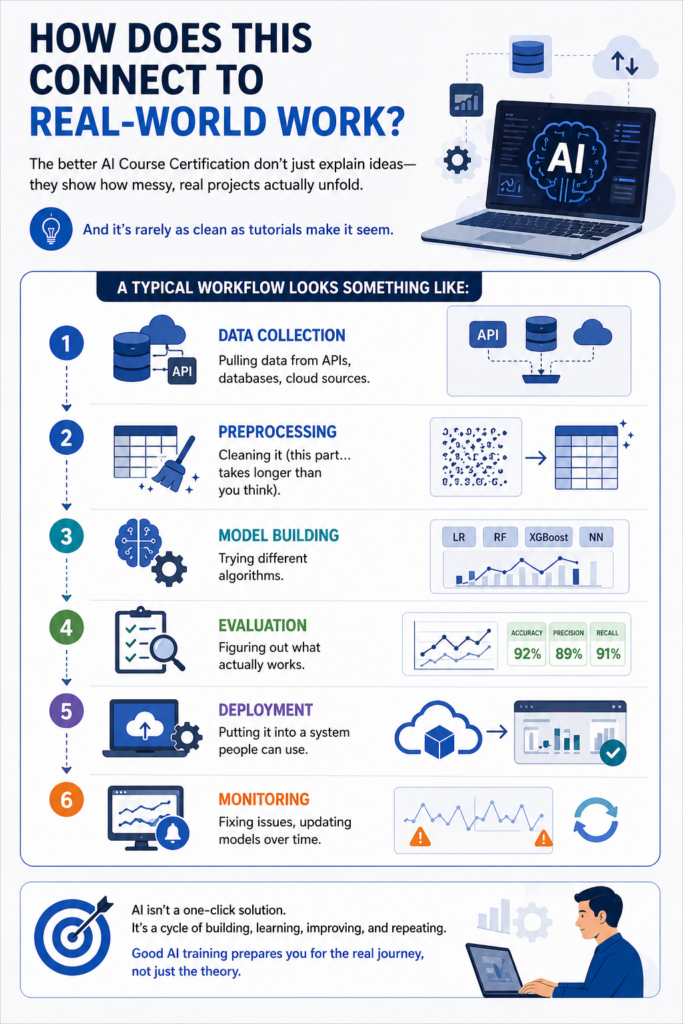
The better Ai Course Certification don’t just explain ideas they show how messy, real projects actually unfold.
And it’s rarely as clean as tutorials make it seem.
A typical workflow looks something like:
- Data collection – pulling data from APIs, databases, cloud sources
- Preprocessing – cleaning it (this part… takes longer than you think)
- Model building – trying different algorithms
- Evaluation – figuring out what actually works
- Deployment – putting it into a system people can use
- Monitoring – fixing issues, updating models over time
You’ll probably use tools like Python, TensorFlow or PyTorch, Scikit-learn, Jupyter notebooks, and cloud platforms like AWS or Azure. Pretty standard stack.
What makes these programs actually worth doing?
A few things tend to stand out when a course is genuinely good:
Relevant content
Courses get updated fairly often so you’re not stuck learning outdated techniques.
Flexible schedules
Evenings, weekends, or fully self-paced. It’s clearly designed for people who already have responsibilities.
Hands-on work
You’re building things not just watching someone else do it.
Real use cases
Fraud detection, recommendation systems, forecasting… things you’ll see in real jobs.
Certification
Not a magic ticket, but it does show effort and consistency.
Networking (underrated, honestly)
Mentors, peers, alumni—you never know which connection helps later.
Global relevance
These skills transfer pretty much anywhere.
What do you need before starting?
You don’t have to be an expert, but a few basics help smooth the process.
To begin with:
- Basic Python
- Some math (probability, linear algebra—nothing too scary at first)
- Comfort with handling data
As you go deeper, you’ll get into:
- Machine learning algorithms
- Data preprocessing techniques
- Model evaluation
And eventually:
- Deep learning frameworks
- NLP concepts
- Deployment and MLOps
It builds gradually, if the course is designed well.
Where is AI actually being used?
Honestly… almost everywhere now.
- Chatbots handling support queries
- Fraud detection in banking
- Supply chain forecasting
- Medical imaging
- Personalized recommendations (streaming, shopping apps—you’ve seen it)
It’s one of those things working quietly in the background most of the time.
Jobs that use AI regularly
You’ll find AI skills showing up in roles like:
- Data Scientist
- Machine Learning Engineer
- AI Developer
- Business Intelligence Analyst
- Software Developer (especially in data-heavy systems)
Most of these involve some mix of data handling, modeling, and improving systems over time.
Career paths after certification
There isn’t one fixed path—it’s more like a set of possible directions.
Starting out:
- Junior Data Analyst
- AI Support Engineer
Mid-level:
- Data Scientist
- Machine Learning Engineer
Advanced:
- AI Architect
- Lead Data Scientist
- AI Product Manager
People move sideways quite a bit too—it’s not always a straight ladder.
Challenges
- The math can get tricky
- Real-world data is messy—sometimes frustratingly so
- Deployment is a whole different skill set
- You might need decent computing resources (or rely on cloud platforms)
Good programs ease you into this—but it’s not always smooth.
A few tips so it doesn’t feel overwhelming
- Start simple—don’t jump straight into deep learning
- Practice with real datasets (it helps way more than theory alone)
- Build small projects first, then expand
- Learn Git early—you’ll thank yourself later
- Try to understand deployment, not just modeling
- Stay updated… things change fast in AI
Quick FAQ
What’s included in an AI certification?
Usually lectures, labs, projects, and some final evaluation.
Can beginners start?
Yes—many programs are designed that way.
How long does it take?
Anywhere from 3 to 9 months, depending on how you pace it.
Do I need coding experience?
Helpful, especially Python—but beginner-friendly paths exist.
Are certifications actually recognized?
They help—especially if you can back them up with real projects.
Final thought
AI Online Training Programs in the USA. isn’t really about memorizing concepts it’s about understanding how things behave when you’re building something that has to work.
If you stick with it and don’t expect instant results it can gradually shift your career in a meaningful way. Not overnight. But steadily, and in a way that actually lasts.