Introduction
Data analytics training and placement support is genuinely effective but only when the program is built to actually get you hired, not just teach you a tool. The difference between landing a job in 3 months versus staying stuck at “I finished a course” almost always comes down to what happens after the last lesson.
That’s the part most people don’t think about when they’re comparing programs. They look at the curriculum, the price, and the tool list. But the placement supports the resume coaching, mock interviews, job referrals, and career guidance; that’s often what actually moves the needle.
Let’s break down exactly how it works, what to look for, and why some programs deliver results while others leave you with a certificate and a shrug.
What “Training and Placement” Actually Means in 2026
There’s a lot of loose use of this phrase. Some Data Analytics Training and Placement call themselves training and placement programs, but really just hand you a certificate and a PDF of job-search tips. That’s not placement support, that’s just documentation.
Real data analytics training and placement looks like this:
Structured resume help is not a template, but actual feedback on how to frame your projects, quantify your impact, and speak the language hiring managers use. “Analyzed sales data” is weak. “Built a Tableau dashboard that reduced reporting time by 40% for a 3-person sales team” is what gets callbacks.
Live mock interviews specifically for analytics roles. SQL technical screens, case-study walkthroughs, and behavioral questions about stakeholder communication. The kind of prep that makes you feel like you’ve already done this before when the real interview comes.
Job referrals and hiring partnerships with actual employer relationships can create opportunities that cold applications rarely do, especially for people who are changing careers and lack the “traditional” background on paper.
Portfolio review: someone experienced looking at your projects and telling you honestly, “this is ready” or “here’s what’s missing before you send this out.”
If a program doesn’t offer most of these things, calling it a training and placement program is a stretch.
Why So Many People Get Stuck After Finishing a Course
This is something worth talking about honestly. Every year, thousands of people complete Data Analytics Training and Placement, learn SQL, build a Tableau dashboard, write some Python, and then apply to 60 jobs and hear nothing back. It happens a lot. Too often.
It’s not usually a skills problem. Most of the time, it comes down to a few specific gaps:
The resume doesn’t tell a story. Analytics hiring managers aren’t just scanning for tools they want to see evidence of analytical thinking. How did you approach a problem? What data did you use? What did your findings lead to? If your resume doesn’t answer those questions, it gets skipped.
The portfolio projects feel generic. A Titanic survival analysis is fine for learning Python. It’s not impressive in a job interview in 2026. Hiring managers have seen that project hundreds of times. What gets attention is something specific, a churn analysis for a subscription business, a sales performance dashboard for a retail dataset, a marketing attribution model. Something that looks like real work.
Interview prep was skipped. A lot of self-taught learners can actually do the job, but freeze on technical screens because they’ve never practiced thinking out loud through an analytics problem. That skill is learnable. It just requires deliberate practice.
No network, no referrals. Applying cold is hard. Having someone at a company say, “I know this person, they’re good,” is exponentially more effective. Placement programmes with real employer networks bypass a huge chunk of the friction.
This is exactly why structured data analytics training and placement support matters, it closes these specific gaps, not just the technical ones.
What You Should Actually Learn Before the Job Hunt
Before placement support can do its job, the skills foundation needs to be solid. Here’s what a strong analytics curriculum covers and what employers are actually testing for in 2026:
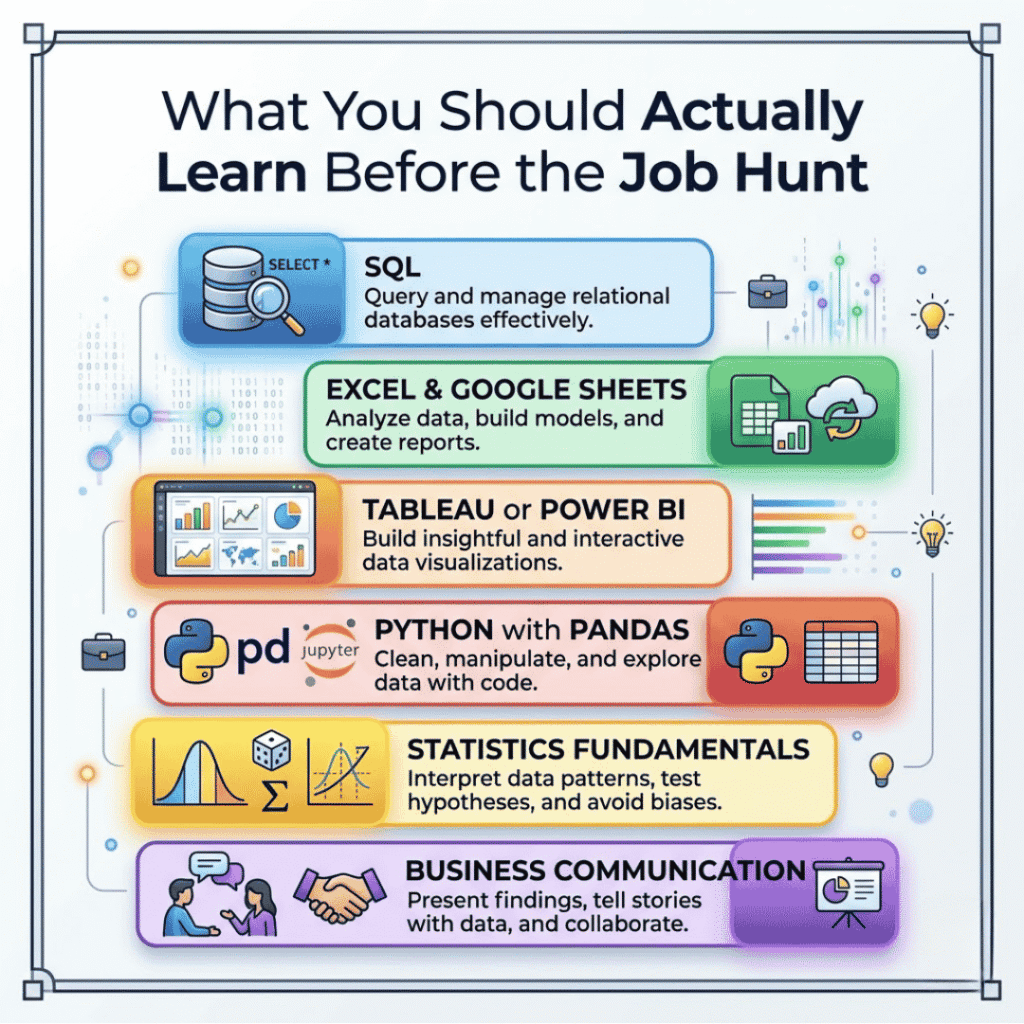
SQL
non-negotiable. Almost every analytics role involves querying databases. Expect to write JOINs, subqueries, window functions, and aggregations during technical screens. You need to be comfortable, not just familiar.
Excel and Google Sheets
still used everywhere, especially in smaller companies and for quick ad-hoc analysis. Excel and Google Sheets still use features like pivot tables, VLOOKUP/XLOOKUP, conditional formatting, and basic dashboards.
Tableau or Power BI
visualization tools that turn raw data into something a business stakeholder can actually act on. Most job postings ask for at least one.
Python with Pandas
increasingly expected even for entry-level roles, particularly in tech companies and startups. Data cleaning, manipulation, basic EDA (exploratory data analysis).
Statistics fundamentals
understanding distributions, correlation, hypothesis testing, and how to interpret results without overclaiming. This separates good analysts from great ones.
Business communication
the ability to explain what your data is saying to someone who doesn’t know what a p-value is. Underrated, genuinely important.
The best Data Analytics Training and Placement cover all of this progressively, not all at once. If a program throws Python at you in week one before you’ve touched a spreadsheet, that’s a red flag.
What Real Placement Support Looks Like: A Practical Scenario
Let’s make this concrete. Say you’ve just completed your training. You have three portfolio projects, you’re comfortable in SQL and Tableau, and you’ve done a bit of Python. Now what?
Without placement support, you’re on your own. You update your LinkedIn, write a resume that probably undersells you, apply to 40 roles over two months, get three interviews, and maybe convert one. That’s an exhausting, demoralizing process, and it’s also avoidable.
With strong placement support, the path looks different. Your resume gets reviewed by someone who knows what analytics JDs look for. Your LinkedIn gets optimized so recruiters actually find you. Your portfolio projects get a second pair of eyes that says “reframe this section” or “add this metric.” You do mock interviews until the technical questions feel familiar. And your program has relationships with companies actively hiring so your application has a warm introduction, not a cold submit.
The outcome isn’t guaranteed, obviously. But the odds shift meaningfully. That’s not a small thing when you’re making a career change.
Is “Data Analyst Training and Placement Near Me” Still Relevant, or Is Online Better?
This question comes up constantly. People search for Data Analytics Training and Placement because they want the in-person feel the ability to ask questions face-to-face, the structure of a physical classroom, the sense of community.
Totally valid. But here’s the honest truth about 2026: the best Data Analytics Training and Placement aren’t necessarily the ones closest to you geographically. They’re the ones with the strongest curriculum, the most experienced instructors, and the best placement track record.
Live data analytics training and placement the ones with real-time instructor sessions, not just self-paced videos have largely closed the gap with in-person training. You still get live interaction, real-time Q&A, group projects, and personal feedback. The instructor is present. You’re accountable. The only thing missing is the commute.
What matters more than location:
- Are sessions live and interactive, or just recorded videos?
- Can you ask questions and get answers in real time?
- Is the instructor someone with actual industry experience?
- Does the program include career support, or is it purely technical training?
If a program near you checks all these boxes, great. If the best option is online, don’t let geography limit you.
H2K Infosys: What Makes Their Approach Different
H2K Infosys has been running tech training programs since 2007 which means they’ve placed people through multiple waves of the job market, including the current AI-driven analytics hiring surge.
Their data analytics program is live instructor-led, not pre-recorded. That distinction matters more than it sounds. You’re learning alongside other students, asking questions in real time, and getting feedback on your work from someone who’s done this professionally not just someone who read the same textbook.
The curriculum covers the complete analytics stack: Excel, SQL, Python, Tableau, Power BI. Projects are scenario-based real business problems like customer segmentation, sales trend analysis, churn modeling. The kind of work that actually looks like something an employer would hand you on your first week.
The placement support side is where H2K Infosys genuinely earns its reputation. Resume preparation, LinkedIn profile optimization, mock technical interviews, and direct connections to hiring companies. This isn’t a bonus feature it’s built into the program. For career changers especially, having that structure and those connections is often the difference between job searching for 6 months and landing a role in 6 weeks.
If you’ve been searching for a serious data analytics training and placement program that takes the “placement” part as seriously as the training this is one worth looking at closely.
Practical Tips to Get the Most Out of Any Training Program
Regardless of which program you choose, a few things will consistently improve your outcome:
Treat every project like a real deliverable.
Don’t just complete it think about who the audience is, what decision it informs, and how you’d present it in a meeting. That framing makes your portfolio work significantly stronger.
Start job prep early, not after you finish.
Update your LinkedIn by week
3. Start building your portfolio project by week
4. Don’t wait until the last week to think about the job search. The people who integrate job prep throughout the course consistently outperform those who bolt it on at the end.
Ask for feedback, specifically.
“What’s the weakest part of my resume?” is more useful than “does my resume look okay?” Specific questions get specific, actionable answers.
Network inside your cohort.
Your classmates are your first professional network in this field. They’ll refer you to jobs, review your work, and be colleagues eventually. Treat those relationships like they matter because they will.
Practice SQL every single day during the course.
Even 20 minutes of Leetcode SQL or Mode Analytics practice problems. It compounds fast, and SQL fluency is the single most tested skill in analytics interviews.
Frequently Asked Questions
How long does data analytics training and placement support typically take?
Most structured programs run 8–16 weeks for the training phase, with placement support continuing for 3–6 months after completion. H2K Infosys provides ongoing career support until you land a role not just for a fixed window after you finish.
Is data analytics training and placement worth it for complete beginners with no tech background?
Yes, in fact, that’s exactly who these programs are designed for. The best ones assume no prior experience and build from fundamentals. What matters more than background is consistency and willingness to practice.
What salary can I expect after completing a data analytics course and placement program?
Entry-level data analyst roles in the US typically start between $65,000–$75,000. With 1–2 years of experience, that range moves to $80,000–$100,000. India-based roles have also seen strong growth, with entry-level positions ranging from ₹4–8 LPA in major cities.
How is live online training different from self-paced courses for data analytics beginners?
Self-paced courses give you flexibility but no accountability, no real-time feedback, and no one to answer your questions when you’re stuck. Live training keeps you on schedule, gives you access to an instructor, and builds the kind of discipline that employers actually see in how you work.
I keep searching for “data analyst training and placement near me” Should I just go with a local program?
Not necessarily. Location matters less than quality. A live online program with strong instructors, a structured curriculum, and real placement support will outperform a mediocre local program every time. Prioritize the quality of instruction and the placement track record over geography.
Conclution
Data analytics training and placement support works when the program is serious about both halves of that promise. The training gets you the skills. The placement support gets you the job. Skip either one and you’re leaving a lot to chance.
The good news is that the analytics job market in 2026 is genuinely strong. Companies are hiring. Entry-level roles are accessible. The skills are learnable. And with the right program, the path from “I know nothing about data” to “I’m a working data analyst” is a realistic 4–6 month journey.
H2K Infosys has walked thousands of people through exactly that journey. The data analytics training and placementis built for career changers, structured for beginners, and backed by real placement support that extends beyond the classroom. If you’re serious about making this move, it’s a program worth exploring seriously.