Yup. Yes, Data Analytics skills can certainly lead to Business Intelligence (BI) roles, especially if you add technical analysis to dashboarding, business communication, data modelling, and AI-assisted analytics. The transition is often less dramatic than it sounds: a data analyst already works with data, finds patterns, builds reports and explains what those findings mean. BI just extends many of those capabilities further into business-wide reporting and decision support.
That link will be even more robust by 2026. BI teams are increasingly focusing on governed data and AI-ready analytics, so Microsoft is growing Copilot, Fabric, semantic models, and AI-assisted reporting inside Power BI.
So, what Data Analytics skills are relevant when BI is the goal?
Here are five to prioritise.
5 Data Analytics Skills for Business Intelligence [Quick Reference]
| Rank | Data Analytics skill | Why it matters for BI | Relevance to BI |
| #1 | SQL & data querying | Assists in extracting and transforming business data | Very High |
| #2 | Power BI & dashboard development | Turns analysis into actionable reporting | Very High |
| #3 | H2K Infosys Data Analytics Training | Includes analytics, BI tools, projects and career preparation | High |
| #4 | Business communication & storytelling | Links technical findings to business decisions | Very High |
| #5 | Gen AI & AI-assisted analytics | Fast-growing Drives analysis, reporting and discovery | Very High |
What matters is that Data Analytics skills extend beyond the scope of a classic Data Analyst title. Depending on experience and employer requirements they can also support pathways to BI Analyst, Reporting Analyst, Power BI Analyst, BI Developer, Analytics Consultant and related positions.
1. SQL Is Among the Most Important Data Analytics Skills for BI
If there is one technical foundation I would not skip, it’s SQL.
Business intelligence systems are based on structured data. Analysts and BI people often need to pull data from databases, join tables, filter records, calculate metrics and investigate why numbers changed.
This makes SQL one of the most practical Data Analytics skills for anyone considering BI.
You need to be comfortable with:
- SELECT queries
- WHERE condition;
- JOINs
- GROUP BY
- Aggregates 33
- Sub-queries
- Common Table Expressions (CTE’s)
- Functions of window
- CASE expressions
- Calculating dates
Imagine a retail company that sees a drop in revenue last quarter.
A beginner might just look at a dashboard.
Someone with stronger Data Analytics skills can go one level deeper. They might want to know sales by region, compare customer segments, look at product categories and whether the decline was due to fewer customers or lower average order values, etc.
That investigative mindset is very pertinent to BI.”
Why SQL helps the BI transition
| BI application | Data Analyst job |
| Query sales data | Create sales reports |
| Clean datasets | Build reliable BI models |
| Define business metrics | Calculate KPIs |
| Describe dashboard changes | Explore trends |
| Combine multiple tables | Support semantic models |
Good Data Analytics skills take you from just churning out numbers to knowing how those numbers are needed to be used.
2. Power BI And Visualisation – Turning Data Analytics Skills Into Business Decisions
Spreadsheets full of numbers rarely change a business decision.
A good dashboard can.
That’s why visualisation is one of the most valuable Data Analytics skills for those targeting BI.
Power BI has become especially hot as Microsoft adds artificial intelligence capabilities to its analytics platform. Today’s Power BI features include Copilot experiences for report building, semantic models, DAX help and natural-language data interaction.
The Power BI updates in June 2026 also included AI-powered report authoring, Copilot-assisted modelling and conversational data experiences.
For a person learning Data Analytics skills, this means that Power BI would not be treated as a visualisation tool only.
Apri a learn to:
- Import and shape data
- Create relationships
- Develop measures.
- DAX Usage
- Design KPI dashboards
- Add filters and drill throughs .
- Generate reports for executives
- What is a dashboard really? Define it
Imagine a logistics company wants to get a handle on late deliveries.
A simple report might list 12% late deliveries.
A BI-oriented dashboard could display:
12% late deliveries → highest in Northeast → concentrated among three carriers → up 18% month over month.
That’s where Data Analytics skills become business savvy. You’re not just disseminating knowledge. You are helping someone to decide what to research next.
3. H2K Infosys Data Analytics Training Can Develop a BI-Oriented Base
If you are looking for a well-structured guide that combines core analytical tools with practical projects and career preparation, then H2K Infosys has got you covered with its Data Analytics training approach. Data Analytics Training at H2K Infosys
This makes it a relevant option for people looking to develop Data Analytics skills before moving toward BI-oriented roles.
The training includes Excel, SQL, Python, Tableau and Power BI, and the career-oriented approach also has resume preparation, mock interviews and career guidance. H2K Infosys calls its program live instructor-led training with hands on, scenario based learning.
H2K Infosys Training in Data Analytics with AI
A modern analytics learner must also understand the role of Gen AI in day-to-day analytical work.
That doesn’t mean having an AI tool do everything.
Instead, useful Data Analytics skills include knowing how to use AI for:
- Make or analyse SQL queries
- Datasets to explore
- Formulas Explained
- Help with DAX
- Summary of Findings
- Brainstorm Dashboard Layout Ideas
- Spot potential trends
- First draft business explanations
“The human has still to check the result.
That’s important, because artificial intelligence can provide a confident answer that’s simply wrong. Strong Data Analytics skills provides the judgement to check assumptions, validate calculations and understand the underlying business context.
So, H2K Infosys Data Analytics with AI Course, H2K Infosys Data Analytics with AI Training, H2K Infosys Generative AI Course and H2K Infosys Career Support together can be considered as a practical learning route for people who wish to link analytics with modern BI workflows.
H2K Infosys also focuses on resume preparation, mock interviews and job placement assistance as part of its career-oriented training approach.
“This is not a guarantee of a job – and no legitimate training provider can guarantee a job – but it does provide a more structured preparation for making the transition.”
4. Overlooked Data Analytics Skill: Business Communication
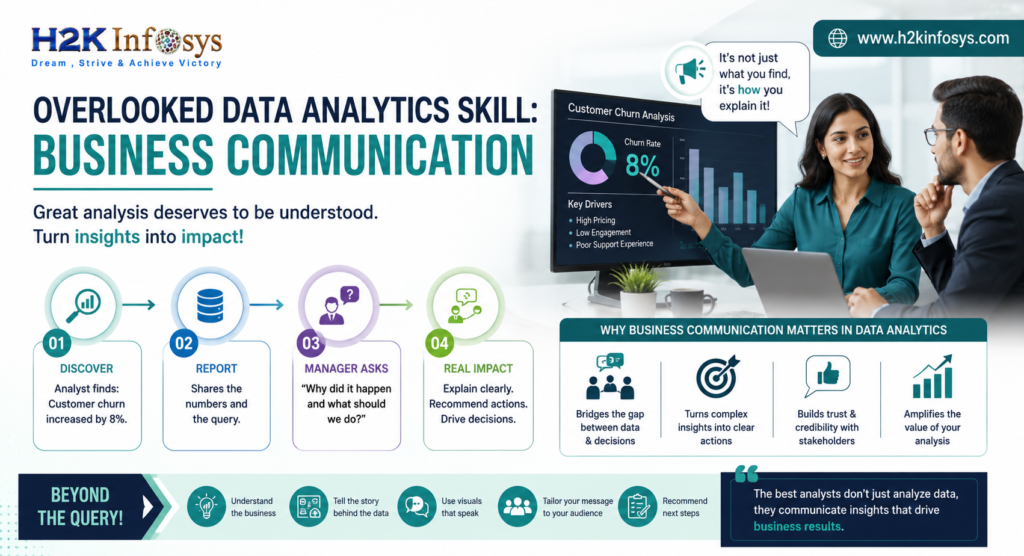
This is a situation that happens all the time.
An analyst discovers that customer churn increased 8%.
Awesome.
But the manager asks:
“Why did it happen and what should we do?”
The analysis has little value if the analyst can only explain the SQL query.
This is where communication is one of the most important skills of Data Analytics for BI.
BI professionals typically collaborate with managers, finance teams, marketing departments, operations teams and executives. Those stakeholders don’t necessarily need a technical explanation of your database query.
They want the solution.
A good analyst learns to communicate:
- What went wrong?
- What is going on here?
- How much does it matter?
- What is the evidence for the conclusion?
- What comes next for the business?
For example:
Customer churn was up 8% in Q2, with almost two-thirds of the increase attributable to customers on the monthly subscription plan. The highest concentration was among customers acquired through paid social campaigns.
That’s far more useful than saying “I built a churn dashboard.”
Therefore, strong Data Analytics skills involve storytelling, presentation and stakeholder communication – not just technical tools.
5. Gen AI Is a Growingly Important Complement to Data Analytics Skills
Gen AI is changing analytics workflows, but it won’t eliminate the need for analytical thinking.
That may in fact be the opposite.
AI will accelerate some tasks, but then it will take even more judgement by people to decide whether the output is really useful.
This is moving so fast, just look at where Microsoft is heading with Power BI right now. Copilot can help with analysis, report development, semantic models and DAX-related chores, while newer Fabric capabilities are moving toward conversational and agent-assisted analytics.
Current BI discussions are also pointing toward agentic AI, where systems can monitor data, investigate anomalies and potentially recommend actions with less manual prompting.
This redefines what useful Data Analytics skills are for learners.
Rather than just learning:
SQL, Excel, Power BI
the modern marriage looks more and more like:
SQL + Excel + Power BI + Business Knowledge + Gen AI + Data Validation
Now that is a much more powerful profile.
Where gen AI may aid analysts
| Task | Conventional approach | AI-assisted approach |
| SQL | Write query manually | Generate and check query |
| Build DAX formulas | manually | Get formula suggestions |
| Draft from scratch | Reporting | Develop initial narrative |
| Data exploration | Manual exploration | Ask questions in natural language |
| Write Manuals | Write manually | Generate first draft |
| Dashboard ideas | Brainstorm manually | See recommended layouts |
But there’s a catch.
However, AI generated sql is yet to be tested. Evidence for AI-generated explanations is still needed. AI-generated insights still require business context.
Therefore, Data Analytics skills are still relevant in the modern era of AI.
How Data Analytics skills can lead to BI careers
| Role | Good-to-have Data Analytics skills |
| Data Analyst | SQL, Excel, statistics, visualisation |
| BI Analyst | SQL, Power BI, KPIs, business communication |
| Reporting Analyst | Excel, SQL, dashboards, reports |
| Power BI Analyst | Power BI, DAX, data modelling, visualisation |
| BI Developer | SQL, data modelling, Power BI, ETL concepts |
| Analytics Consultant | Analytics, communications, stakeholder management |
| Analytics Specialist | Data analytics, automation, visualisation, Gen AI |
Where you go from here depends on what you’ve done before.
Someone with a finance background may transition into financial BI.
A marketing professional might be focused on marketing analytics or customer intelligence.
Supply-chain BI may seem right at home to someone from operations.
Data Analytics skills are built upon a transferable component.
What’s the Salary of a BI & Analytics Expert?
Salaries can differ widely by location, experience, industry, and job title, so it is best to consider online salary data as guidelines rather than guarantees.
For reference, the U.S. In May 2025, the Bureau of Labour Statistics reported median annual wages of $119,420 for computer systems analysts and $99,730 for operations research analysts.
According to the BLS, employment of operations research analysts is projected to grow 21% from 2024 to 2034, much faster than the average for all occupations.
These are not the actual salary figures for all BI positions. They just show how important quantitative and analytical careers still are.
Strong data analytics skills can make a candidate competitive for several related jobs, but salary should not be the sole reason for a career decision.
A Pragmatic Roadmap from Data Analysis to Business Intelligence
If BI is the end goal, you don’t need to learn everything all at once.
Try this sequence:
- Step 1: Develop core Data Analytics skillsExcel, SQL, basic statistics and data-cleaning concepts.
- Step 2: Familiarise Yourself with a Major BI PlatformIf you want to be part of Microsoft’s current AI-enabled analytics ecosystem, Power BI is a solid choice.
- Step 3: Create realistic projectsCreate three or four projects around business questions, not ten little tutorials. Examples include:
- Retail sales dashboard
- Analytics for customer churn
- Marketing campaign achievements
- Dashboard of Supply Chain Performance
- Step 4: Gen AI InsertSee how standard artificial intelligence can help you with SQL, documentation, analysis and dashboard development.
- Step 5: Better communicationAct like you’re presenting to a manager and rehearse giving your results.
- Step 6: Get ready for BI interviewsexpect questions about SQL, dashboards, KPIs, data modelling, business cases and stakeholder communication.
This is where practical Data Analytics skills matter so much more than just collecting certificates.
Data Analytics Skills vs. BI Skills: What’s the Difference?
| Area | Business Intelligence | Data Analytics |
| Main objective | Discover and explain insights | Provide decision-ready business information |
| SQL | Very important | Important |
| Excel | Common | Common |
| Power BI/Tableau | Critical | Core skill |
| Statistics | Significant | Helpful |
| Data modelling | Helpful | Mostly important |
| Business communication | Important | Important |
| Gen AI | Getting useful | Getting useful |
| Dashboarding | Common | Central |
| Stakeholder interaction | Moderate to high | High |
There is a lot of overlap.
That’s a good thing.
You don’t need to discard your existing Data Analytics skills to get into BI. You must extend them.
Career Possibilities After Gaining the Correct Data Analytics Skills
A learner with practical Data Analytics skills may be able to pursue roles such as:
- Data Analyst.
- Business Intelligence Analyst
- Analyst, Reporting
- Power BI Analyst
- Business Intelligence Analyst
- Consultant, Analytics
- Operations Analyst
- Marketing Analyst
- Sales Analyst
- Product Analysis
The job title is not as important as the duties described in the job description.
One company may refer to someone as a BI Analyst.
Another might call a very similar position Reporting Analyst.
Skills section! Read!
Data Analytics Skills and Business Intelligence: Frequently Asked Questions
1. Can Data Analytics skills be translatable into Business Intelligence roles?
Yes. Data Analytics skills such as SQL, visualisation, dashboarding, data cleaning, business communication have a lot of overlap with BI responsibilities. Power BI, data modelling and stronger stakeholder skills can make the transition more realistic.
2. What are the most valuable Data Analytics skills for BI?
Some of the most valuable Data Analytics skills for BI-focused careers are SQL, Power BI, graphical data modelling, KPI development and business communication.
3. Do BI Developer Skills Enough To Become A BI Developer?
Not all the time. BI Developer positions may require advanced knowledge of data warehouse, ETL/ELT, semantic models, database architecture and enterprise BI platforms. Your current Data Analytics skills are a good start, but you may need to add some technical depth.
4. Is Learning Gen AI with Data Analytics a Good Idea?
“Yes, it’s getting more and more useful. Data Analytics skills in conjunction with responsible use of Gen AI may accelerate work for analysts, but the AI-generated SQL, calculations and insights still need to be validated.
5. Are online classes for Gen AI Data analyst good for beginners?
They can be helpful if the program offers live instruction, hands-on projects, feedback, and opportunities to practise with real-world analytical situations. The value is not just watching videos but acquiring usable Data Analytics skills.
Final Thoughts
The short answer is still yes, Data Analytics skills can lead to Business Intelligence roles.
You do not have to take a big leap in your career. Learn SQL. Get acquainted with Power BI. Learn to communicate business insights. Build realistic projects. Understand how Gen AI fits into modern analytics workflows.
The best candidates won’t simply say, “I know data analytics.
They can show it.
And that’s the real difference. Data Analytics skills are valuable when they help someone answer a business question, explain the evidence and support a better decision.
If you’re a learner who needs structure, H2K Infosys Data Analytics with AI Training is one to consider if live instruction, hands-on projects and career prep are important. H2K Infosys Provides Data Analytics with AI Training
In the future, BI will be more AI-assisted, but the basics are still there. Strong Data Analytics skills, in fact, give professionals the foundation they need to use those new tools intelligently