If you are a beginner in artificial intelligence then a practical AI course is generally a better place to start. An AI certification is more useful when you have enough hands-on knowledge to show what you can do. For the beginner, the sweet spot is a program that provides you with structured learning, projects, certification and career prep, rather than just giving you a certificate at the end.
And it matters more in 2026 than it did a couple of years ago.
AI is no longer a specialist skill and is something that employers are increasingly expecting across software, data, analytics, testing, business and other technology roles. New research shows that the use of AI related terms in job postings is on the rise and workers want more transparent ways to show their AI skills.
So if you’re sitting there thinking, “Should I take an AI course or get an AI certification?“don’t fret. It’s not as complicated as the internet would have you believe
AI Course and AI Certification: What’s the Difference?
The simplest way to think about this is:
You learn it in an AI course. An AI certification can be a way to show you’ve learned something.
In an online AI course, you might study Python, machine learning, generative AI, data management, model building, prompt engineering, or AI use cases. Depending on the provider, you may be working through assignments and projects as you learn.
A certification, however, is a credential that signifies some level or area of knowledge.
Here is where the novice sometimes gets caught.
They see a course that says it’s a “AI certification course” and they think the certificate itself is going to be enough to get them a job.
Usually it doesn’t.
And then you can say: A recruiter is so much more interested.
“I did the training, I did this project, I used Python and machine learning and this is how I solved the problem.”
That’s a more interesting story than:
“I’ve got a certificate in AI.
The certificate is useful too. It is useful because of the skills behind it.
Why Should Beginners Care About AI Certifications in 2026
There is now so much more AI training available than there was just a couple of years ago. Google, Microsoft, AWS, universities, specialist training companies and online learning platforms all offer different types of AI credentials and courses.
And that creates a curious problem.
There’s a lot of choices.
The current crop of 2026 certification comparisons covers everything from AI fundamentals programs for beginners to sophisticated machine-learning credentials for seasoned pros.
If you’re new to AI, then jumping straight into an advanced certification may not be the best idea.
Imagine a beginner who’s never written Python trying to prepare for an advanced machine learning exam. They might learn terms for weeks and not understand what any of it means in practice.
It makes a lot more sense to have a structured learning path.
This is one of the reasons why AI certifications for beginners should be different from professional certifications of a more advanced nature.
Look for:
- Basics to learn easily
- Python fundamentals
- Machine learning concepts
- Generative AI
- Hands-on assignments
- Practical projects
- Instructors guide
- Preparing for Interviews
- Career assistance
- An accepted Certificate of Completion
The certificate should be the outcome of learning, not the goal of learning.
When Should a Newbie Opt for an AI Course?
If you are starting from scratch, an AI course is usually the better option.
Especially if you do the following:
- Little to no AI experience
- Don’t have a technical background
- Have some programming knowledge, but no ML.
- Looking to switch into an AI career
- Prefer learning with an instructor
- Seeking real world projects for your portfolio
- Still not sure what AI role you want
For instance, let’s say you are a software tester who has been working with traditional automation for a few years.
You don’t have to throw away everything you know and turn into a machine learning researcher.
A pragmatic AI program can teach you generative AI, AI-assisted testing, Python, machine-learning fundamentals, APIs, and automation, for example. Suddenly your existing experience becomes an asset instead of something to be discarded.
That’s the kind of career change beginner should consider.
When Is AI Certification More Sensible?
Certification can be especially helpful if you have some background and want to prove it.
Let’s say you spent a few months learning AI and built a couple of projects. You apply for jobs, you have loads of experience on your resume, but there’s nothing formal that validates your learning.
A relevant certification can provide an extra signal.
It may also make sense if your target role or employer places value on a certain vendor or technology ecosystem.
For example, AI jobs that are cloud-centric might favour certifications in the specific cloud platform, whereas a rookie interested in general AI knowledge may gain more from foundational training.
The trick is matching the credential to the job.
Don’t collect certificates like pokemons.
Five unrelated badges are often less convincing than one relevant certification and real projects.
What to look for in beginner AI certification courses?
This is perhaps the most important part of the decision.
Not all AI certification courses are created equal.
Before paying for a certificate name, look beyond the name.
1. Does it teach practical skills?
A course shouldn’t leave you with 200 definitions of AI, but unable to build anything.
Look out for Python, data handling, machine learning, generative AI, model concepts, APIs and practical business applications as appropriate.
2. Real life projects?
Projects are important because they give you something concrete to talk about in interviews.
A good project might be:
- Analysis of customer opinions
- Fraud detection
- Recommendation engines
- Text classification
- Generative AI apps
- Predicting business
- Automation Powered by AI
You don’t have to build the next ChatGPT.
You need to show that you understand how artificial intelligence can solve a problem.
3. Do you have instructor support?
That’s an underappreciated advantage.
Learning something complicated means you don’t want to be stuck three hours on one Python error.
Live classes or access to experienced instructors can dramatically reduce the learning curve.
4. Is career preparation part of the program?
This is where some online programs don’t quite hit the mark.
Learning AI and getting an AI job are two different issues.
Resume help, mock interviews, project conversations and job search help can fill that void.
Why H2K Infosys Is Worth Thinking About For Beginners
If you are looking for learning AI online with job orientated approach then H2K Infosys is one name to keep on your short list.
H2K Infosys offers training based on instructor-led online learning, hands-on projects, career coaching, mock interviews and job-placement assistance, rather than just a set of recorded videos. At present, its course catalogue includes Artificial Intelligence Online Training and Generative AI Certification Course options.
That mix is especially relevant for first-timers.
The company’s current AI training material covers AI fundamentals, machine learning, Python, generative AI, practical assignments, industry projects, resume support, interview prep, and job search assistance.
And there’s a practical reason why I like that approach.
Because there are so few AI tutorials on the net, the beginner typically does not have a problem. They number in the thousands.
The real battle is knowing:
- What do I need to learn first?
- What should I make?
- What do I put on my Resume?
- How do I talk about my project in an interview?
- And what do I do when the course is over?
A structured program can make those questions far easier to answer.
What is H2K Infosys AI Learning Path?
As per the latest course details for 2026 from H2K Infosys, the learning methodology is a blend of technical base, practical exposure and career readiness.
A beginner might find areas such as:
AI basics → Python → Machine Learning → Generative AI → practical projects → interview preparation → career support
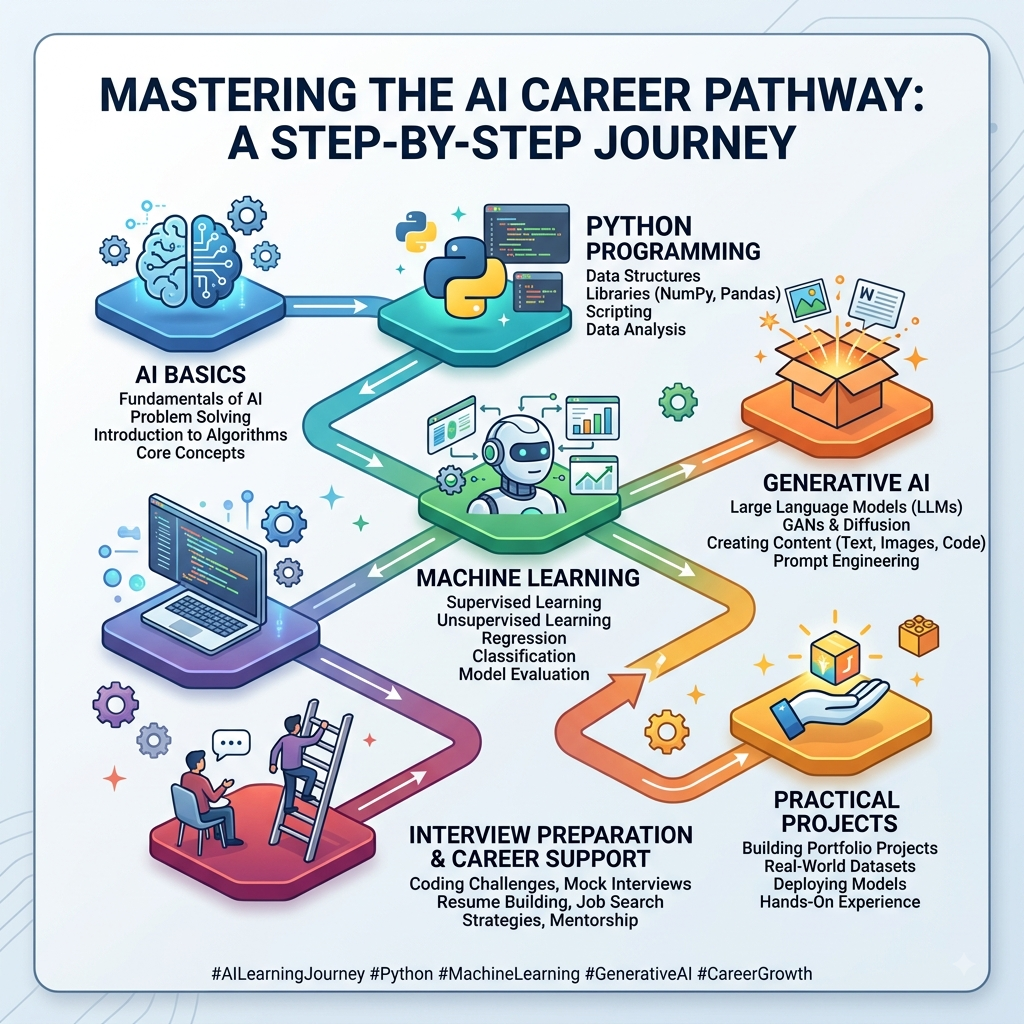
That progression is logical.
You don’t want to jump into sophisticated AI architectures before you understand what standard ML is doing.
And you don’t want to be left with theory and find you’ve never built anything.
H2K Infosys also characterises its online courses as live, instructor-led training with flexible schedules and access to course recordings.
If you work full-time, that kind of flexibility can be huge.
A Real Life Example – Certificate After Course
Suppose we have a hypothetical beginner, Rahul.
Rahul has 3 years of experience working in IT support. He has basic programming skills but no experience with machine learning.
There are two options.
Option A: A short certificate that promises an AI credential in a matter of weeks.
Option B: A structured AI certification course covering fundamentals, introducing Python and machine learning, with practical projects and career support.
Option A appears faster at first glance.
But Rahul’s real aim isn’t to prettify his LinkedIn profile.
He wants to get into an AI-related role.
Option B is probably the more sensible route, as he’s building the underlying capability first. Then the certification is evidence of that learning.
That’s the difference to remember if you’re considering making this decision yourself.
What About Free Courses on AI?
Yes, free courses can be helpful.
Actually, I would recommend them even for beginners.
They’re a great way to answer a very simple question:
“Do I really like AI learning?”
You don’t want to spend a lot of money to find out you hate python.
Free introductory material can give you a feel for the landscape. But in the end, a lot of students do better with more structure – especially if they’re trying to change careers.
When you are getting things besides the videos, a paid program makes sense like:
- Live sessions
- Practical work
- Portfolio
- Comments
- Mentoring
- Support to Resume
- Practice Interview
- Career advice
That’s the difference between buying information and buying a structured learning experience.
Is an AI Certification Enough to Get a Job?
No. If anyone tells you otherwise, raise an eyebrow.
The market is getting more crowded, not less.
Recent reporting shows job seekers are adding AI terminology on their resumes as demand for AI-related skills grows. But just saying “AI” or “machine learning” doesn’t prove that a person can actually make use of those technologies.
Companies still need people who can solve problems.
So think of your career package as follows:
Skills, Projects, Certification, Interview Preparation, Communication
Note:
Certificate = Work
Even the recent guidance from H2K Infosys suggests that recruiters are more interested in practical capabilities and the ability to talk about real projects than a flashy certificate alone.
Much more realistic way to approach AI training in 2026.
Is Online AI Certification Valuable?
AI certification online is worth considering for many beginners as it removes some barriers that are common in traditional classroom training.
You can read from your home, live sessions, watch recordings, do projects, and keep doing your job or studies.
But don’t vote online just for the convenience.
Do it for the learning experience that suits you.
Before you sign up, check:
- What to check Why it’s important
- Live Instructor support Assistance when concepts get difficult
- Practical projects Portfolio evidence
- Curriculum updated AI changes fast
- Python + ML fundamentals Provides a technical foundation
- Generative AI- Essential to the contemporary AI workflows
- Career assistance: Helps translate skills into job applications
- Mock interviews Increase confidence
- Certification Provides a formal credential
This checklist is a lot more useful than just looking for the course with the biggest “100% job guaranty” banner.
Your Learning Needs to Change to Match the AI Job Market
What has become evident in 2026 is that AI skills are no longer confined to narrow “AI engineer” titles.
AI is already being deployed within software development, analytics, testing, business workflows, customer operations and other technology functions. Industry education programs also stress that future AI professionals need not only theoretical knowledge but also contextual business knowledge, responsible AI awareness, and practical experience.
This opens doors for people who already have another professional skill.
Artificial intelligence can be learned by a tester.
Generative artificial intelligence can be learned by a data analyst.
As a developer, you can specialise in machine learning.
This is where a business analyst can learn how AI fits into enterprise workflows.
You don’t necessarily have to restart your career.
Sometimes you just add AI on top of what you already know.
So, should beginners take an AI course or certification?
The short answer is:
Pick an AI course if:
- You’ve never seen an AI before
- basic understanding needed
- You want to get your hands dirty
- You need instructor supervision
- You want to do projects
- Select an AI certification if:
- You know the basics already
- You need a qualification
- The job you are aiming for values a particular certification
- You want to get a skill set validated
Select an AI certification course if:
You want both.
That’s the path I’d recommend for most career-focused beginners.
Learn concepts, practise them, build projects, prepare for interviews and earn the certification on the way.
This is a much more useful result than simply passing an exam.
What is the best AI certification for beginners?
The best AI certification for beginners is one that combines AI fundamentals, Python, machine learning, generative AI, hands-on projects, and career preparation. Instead of choosing a certification based only on its name, look for a program that helps you build practical skills you can demonstrate in interviews.
Are AI certifications worth it for beginners?
Yes, an AI certification can be valuable for beginners, especially when it is supported by practical training and projects. A certificate alone won’t guarantee a job, but it can strengthen your resume when combined with real skills and project experience.
Should I take an AI course or get an AI certification?
If you’re completely new to AI, start with a course that teaches the fundamentals. Ideally, choose an AI certification course that gives you structured learning, practical projects, and a certificate at the end. This way, you’re building skills and earning a credential at the same time.
Can I learn AI without a technical background?
Yes. Beginners from different educational and professional backgrounds can start learning AI. A good beginner-focused program should introduce concepts gradually rather than assuming you already understand machine learning or programming.
Is an AI certification online a good option for working professionals?
Yes. An AI certification online can be particularly convenient for working professionals because they can learn without leaving their current job or relocating. Live online classes, recordings, assignments, and flexible schedules can make the transition into AI training easier.
Can an AI certification help me switch careers?
It can help support a career transition, but the certification should be part of a larger plan. Building relevant projects and learning how to explain your AI skills to employers can make your transition much stronger.
Conclusion: What Should A Beginner Choose?
“Don’t go after the certificate first if you are starting from scratch. Competence. Go for it.
Search for an AI certification course that covers the basics, offers practical application, assists in project creation, and provides an easy route to job readiness.
So for those beginners who want to learn in an instructor-led hands-on way rather than going all alone, a structured provider like H2K Infosys is a good option. Today, the programs it offers focus on live online training, projects, certification, career coaching and job placement help.
And one last thing I would bear in mind.
AI is moving quickly. The certificate you get is just one snapshot of your skills. Your ability to continue learning, trying new tools, understanding business problems and actually building useful solutions will matter much longer.
So, don’t just ask, “Which AI certification I should get?”
Question:
What’s the learning path that will help me become a person who can actually use AI at work?”
That’s the question that makes a much better career decision.
H2K Infosys AI & Generative AI Training