Artificial Intelligence (AI) is no longer limited to research laboratories or large technology companies. It is now used across industries such as healthcare, banking, education, retail, marketing, manufacturing, cybersecurity, and logistics. As organizations increasingly use AI to automate processes, analyze data, personalize customer experiences, and improve decision-making, demand for people with AI-related skills continues to grow. Career Through Artificial Intelligence For beginners looking to enter this rapidly expanding field, earning an Artificial intelligence certificate online can be a practical way to build foundational knowledge, develop relevant skills, and demonstrate commitment to professional growth.
This creates an important question for students, working professionals, and career changers: Can beginners build a successful career through Artificial Intelligence online courses?
The answer is yes—but completing a course alone is rarely enough. Online AI courses can provide beginners with the knowledge, technical skills, structured learning path, and practical exposure required to enter the field. Career success depends on how effectively learners apply those skills through projects, continuous practice, specialization, and professional development.
This guide explains how beginners can use Career Through Artificial Intelligence to start building a strong and sustainable AI career
Why Artificial Intelligence Is an Attractive Career Through Artificial Intelligence
Artificial Intelligence is transforming how businesses operate. Organizations are adopting technologies such as machine learning, natural language processing, predictive analytics, computer vision, intelligent automation, and generative AI.
As AI adoption expands, companies require professionals who can understand data, develop models, integrate AI tools, evaluate AI systems, and translate business problems into technology solutions.
Career Through Artificial Intelligence can also appeal to people from different backgrounds. While computer science and mathematics provide useful foundations, beginners do not necessarily need an advanced technical degree to start learning AI.
A learner can begin with fundamental concepts and progressively develop more advanced skills.
Artificial Intelligence online courses have made this process significantly more accessible because learners can study from home, follow structured modules, complete practical exercises, and develop skills at their own pace.
Can Someone Without AI Experience Learn Artificial Intelligence?
Yes. Beginners can learn Career Through Artificial Intelligence when the learning path begins with the fundamentals.
AI can initially appear complicated because the field includes programming, mathematics, statistics, algorithms, data analysis, and machine learning concepts. Trying to learn everything simultaneously can quickly become overwhelming.
A structured beginner-level course simplifies the process by introducing concepts gradually.
A typical learning journey may begin with:
- Introduction to Artificial Intelligence
- Basic Python programming
- Data structures and data manipulation
- Mathematics and statistics fundamentals
- Machine learning concepts
- Supervised and unsupervised learning
- Neural networks
- Natural language processing
- Computer vision
- Generative AI concepts
- Model evaluation
- Practical AI projects
Learners do not need to master every topic immediately. The goal is to understand the foundations before progressing toward a specific AI specialization.
How Artificial Intelligence Online Courses Help Beginners
One of the major advantages of Career Through Artificial Intelligence is flexibility. Career Through Artificial Intelligence Beginners can learn without leaving their current job, academic program, or other responsibilities.
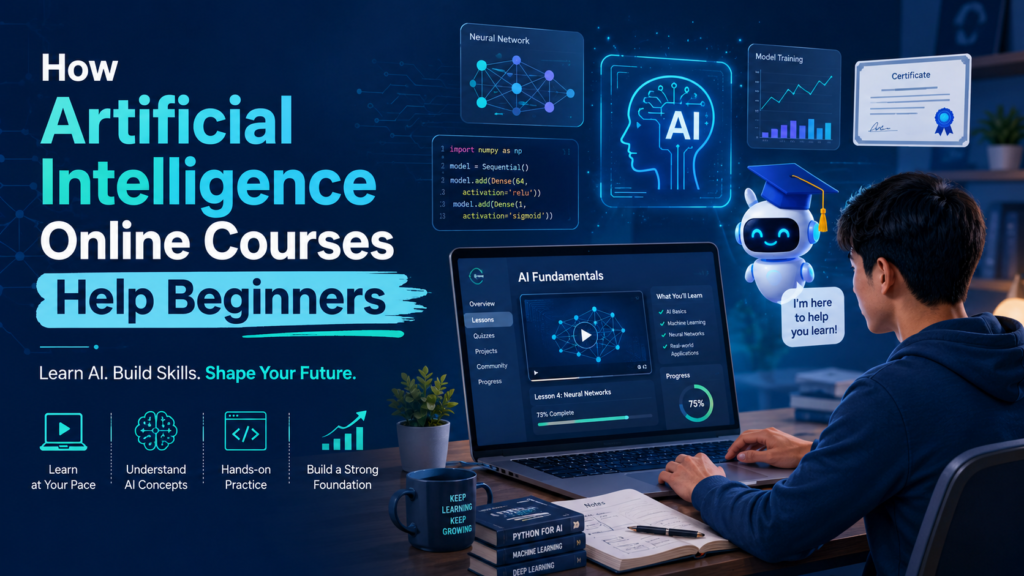
Many Artificial Intelligence online courses provide recorded lectures, coding exercises, quizzes, assignments, projects, and practical demonstrations.
This structure can help learners develop both theoretical knowledge and practical skills.
1. Structured Learning Path
Learning Career Through Artificial Intelligence independently from random articles and videos can create knowledge gaps. A well-designed course follows a logical curriculum.
For example, students may first learn Python before working with data libraries. They may then study machine learning before progressing to deep learning.
This progression helps beginners build knowledge systematically rather than jumping between unrelated topics.
2. Flexible Learning
Online courses allow learners to study according to their schedules.
Students can study alongside university programs, while working professionals can learn during evenings or weekends. Learners can also revisit difficult topics multiple times before moving forward.
This flexibility makes AI education accessible to a much broader audience.
3. Practical Skill Development
Career Through Artificial Intelligence is a practical discipline. Understanding definitions is useful, but employers generally value candidates who can apply their knowledge.
Quality online courses often include projects involving real or realistic datasets.
Beginners may work on tasks such as:
- Predicting house prices
- Classifying customer reviews
- Detecting spam messages
- Creating recommendation systems
- Building simple chatbots
- Analyzing customer behavior
- Developing image classification models
- Creating predictive models from business data
Projects help learners understand how Career Through Artificial Intelligence concepts are applied in real situations.
4. Exposure to AI Tools and Technologies
Artificial Intelligence online courses can introduce learners to commonly used technologies and development environments.
Depending on the course, students may gain experience with Python, Jupyter Notebook, NumPy, Pandas, scikit-learn, TensorFlow, PyTorch, SQL, visualization tools, APIs, and cloud-based AI platforms.
Beginners do not need to learn every available technology. However, familiarity with core tools can make the transition into professional projects easier.
Essential Skills Beginners Should Develop
Completing several courses without building core competencies may not lead to strong career opportunities. Beginners should focus on developing a combination of technical, analytical, and problem-solving skills.
Python Programming
Python is widely used in Career Through Artificial Intelligence because of its readable syntax and extensive ecosystem.
Beginners should understand variables, loops, functions, data structures, classes, file handling, and libraries commonly used for data analysis.
Mathematics and Statistics
AI does not require every beginner to become a mathematician, but understanding fundamental mathematics is valuable.
Important areas include:
- Linear algebra
- Probability
- Statistics
- Calculus fundamentals
- Optimization concepts
These topics help learners understand how machine learning algorithms Career Through Artificial Intelligence operate rather than simply using them as black boxes.
Data Analysis
AI models depend heavily on data.
Learners should understand how to collect, clean, transform, explore, and visualize datasets. In many professional AI projects, preparing data can be as important as selecting the machine learning algorithm.
Machine Learning
Machine learning is one of the most important foundations of modern AI.
Beginners should understand concepts such as regression, classification, clustering, feature engineering, training datasets, testing datasets, overfitting, underfitting, model evaluation, and performance metrics.
Problem-Solving
Successful AI professionals do more than write code.
They identify problems, determine whether Career Through Artificial Intelligence is an appropriate solution, evaluate available data, select suitable approaches, interpret results, and communicate recommendations.
Developing this analytical mindset can significantly improve career prospects.
Online Courses Alone Are Not Enough
Artificial Intelligence online courses can provide an excellent foundation, but learners should avoid treating certificates as the final objective.
Employers often want evidence that candidates can apply their skills.
Therefore, beginners should combine courses with practical experience.
One effective approach is to create a project portfolio.
For example, after learning machine learning, a learner could build a customer churn prediction model. After studying natural language processing, the learner could create a sentiment analysis application. After studying generative AI, the learner could build a small application that uses an AI model through an API.
A portfolio demonstrates what a candidate can actually build.
Build an AI Portfolio While Learning
Beginners should start developing projects as early as possible.
A strong portfolio might contain three to five well-documented projects rather than dozens of incomplete experiments.
For every project, learners should clearly explain:
- The problem being solved
- The dataset used
- The technologies selected
- The methodology
- The model or system developed
- The results
- The limitations
- Possible improvements
Platforms such as GitHub can be used to organize code and documentation.
A portfolio can be particularly useful for candidates who do not yet have professional Career Through Artificial Intelligence experience because it provides tangible evidence of their skills.
Career Opportunities After Learning Artificial Intelligence
AI skills can support several career paths. Beginners should choose a direction based on their interests, technical strengths, and professional background.
Potential career paths include:
Machine Learning Engineer
Machine learning engineers Career Through Artificial Intelligence develop, test, deploy, and maintain machine learning systems. This role generally requires strong programming and machine learning skills.
Data Scientist
Data scientists analyze large datasets, identify patterns, build predictive models, and communicate insights that support business decisions.
AI Engineer
AI engineers Career Through Artificial Intelligence develop applications and systems that incorporate technologies such as machine learning, natural language processing, computer vision, or generative AI.
Data Analyst
Data analysis can provide an accessible entry point for beginners. Data analysts work with datasets, create reports, identify trends, and support decision-making.
Developing AI and machine learning skills can later help analysts move into more advanced roles.
Natural Language Processing Specialist
NLP professionals work on systems that process and understand human language, including chatbots, search engines, text classification systems, language models, and sentiment analysis tools.
Computer Vision Engineer
Computer vision specialists develop systems capable of analyzing images and video. Applications include medical imaging, manufacturing inspection, autonomous systems, security, and retail technology.
AI Product or Business Roles
Not every AI career requires intensive programming.
Professionals with business, product management, consulting, marketing, or operational experience can combine domain expertise with AI knowledge to manage AI initiatives or identify opportunities for AI adoption.
How Long Does It Take for a Beginner to Learn AI?
There is no universal timeline.
A learner studying consistently for several months may develop a solid understanding of Python, data analysis, and basic machine learning. Becoming job-ready for a technical AI position generally requires additional project work, deeper technical knowledge, and continued practice.
The learning process depends on factors such as:
- Previous programming experience
- Mathematical background
- Number of hours dedicated each week
- Complexity of the chosen specialization
- Quality of practical projects
- Consistency of learning
Instead of focusing only on how quickly a course can be completed, learners should focus on whether they can independently apply the concepts they have studied.
How to Choose the Right Artificial Intelligence Online Course
With many courses available, beginners should evaluate programs carefully.
A useful course should offer a clear beginner-friendly curriculum and explain any prerequisites.
Look for programs that include practical exercises rather than only theoretical lectures.
The curriculum should cover relevant fundamentals such as Python, data handling, machine learning, model evaluation, and AI applications.
Learners should also check whether the course includes projects that can contribute to a professional portfolio.
Instructor quality, learner support, updated course material, assessments, and opportunities for practical experimentation are also important considerations.
A certificate may strengthen a professional profile, but the skills developed during the program are ultimately more important than the certificate itself.
Tips for Building a Successful AI Career as a Beginner
Beginners can improve their chances of career success by following a practical learning strategy.
First, develop strong foundations rather than immediately jumping into advanced Career Through Artificial Intelligence AI topics. Understanding programming, data, statistics, and machine learning fundamentals makes advanced concepts much easier to learn.
Second, practice consistently. Regular coding sessions are generally more effective than studying intensively for a short period and then stopping for several weeks.
Third, build projects that solve recognizable problems. Practical work demonstrates competence and provides useful discussion material during interviews.
Fourth, select a specialization after exploring the fundamentals. Machine learning, data science, NLP, computer vision, generative AI, and AI product management require different skill combinations.
Finally, continue learning. Artificial Intelligence evolves quickly, so professionals must regularly update their technical knowledge and understanding of emerging applications.
Challenges Beginners Should Expect
Starting an Career Through Artificial Intelligence is achievable, but it requires persistence.
Beginners may struggle with programming errors, mathematical concepts, unfamiliar terminology, and machine learning models that do not initially produce good results.
These difficulties are normal parts of technical learning.
Another common problem is tutorial dependence. Learners may be able to reproduce an instructor’s project but struggle when asked to build something independently.
The solution is gradually moving from guided exercises to independent projects.
Instead of copying a complete solution, learners should experiment with different datasets, algorithms, parameters, and evaluation techniques.
This develops the problem-solving ability required in professional environments.
Conclusion
So, can beginners build a successful career through Artificial Intelligence online courses?
Yes. Best online artificial intelligence course can provide a practical and accessible starting point for anyone interested in developing AI skills. They offer structured education, flexibility, exposure to industry tools, and opportunities to work on practical projects.
However, career success requires more than completing online lessons and collecting certificates.
Beginners should combine structured courses with programming practice, mathematical understanding, data analysis, machine learning knowledge, independent projects, and continuous learning. Building a portfolio and choosing a suitable specialization can further strengthen employability.
AI may be technically demanding, but beginners do not need to know everything before starting. A step-by-step approach—learning the fundamentals, applying them through projects, and progressively developing advanced skills—can create a realistic pathway toward a rewarding Career Through Artificial Intelligence.