Artificial Intelligence (AI) has emerged as a foundational technology in software development, cloud computing, cybersecurity, data analytics, automation, and enterprise operations. IT professionals are increasingly expected to possess AI capabilities as organizations integrate machine learning, generative AI, predictive analytics, and intelligent automation into their business processes. As a result, Artificial Intelligence Online Training Essential programs help individuals develop practical skills required to work with modern enterprise systems and remain competitive in a rapidly evolving technology landscape. Programs such as the H2K Infosys Ai Course Certification are designed to address these industry demands by providing hands-on exposure to AI tools, machine learning frameworks, real-world projects, and enterprise-focused learning experiences.
What Is Artificial Intelligence?
Artificial intelligence (AI) is the ability of a computer system to do tasks that normally require human intelligence. These tasks could include:
- Pattern Identification
- Language comprehension Decision-making
- Predictive analytics
- Image identification
- Voice processing
- Automation of processes
Today’s AI systems make use of a variety of technologies including:
| AI Technology | Purpose |
|---|
| Machine Learning (ML) | Learns patterns from data |
| Deep Learning | Uses neural networks for complex analysis |
| Natural Language Processing (NLP) | Understands and generates human language |
| Computer Vision | Processes images and video |
| Generative AI | Creates text, images, code, and content |
| Reinforcement Learning | Learns through rewards and feedback |
AI is no longer confined to research environments. You’ll see it being used a lot today in enterprise apps, cloud platforms, customer service systems, security operations and software development workflows.
Why Artificial Intelligence Online Training Essential for IT Professionals?
There are a number of technology advances that have increased the need of AI expertise for working people .
Increasing AI Adoption Across Industries
Industries such as: organisations in
- Healthcare
- Banking
- Insurances
- Retail Manufacturing
- Telecom Logistics
are embedding AI into operational workflows.
Some examples include:
- Fraud detection systems
- Predictive maintenance software
- Intelligent customer service
- Demand forecasting tools
- Automatic document processing
People that grasp AI ideas can contribute more effectively to these projects.
Artificial Intelligence Online Training Essential Into Daily IT Operations
Many enterprise tools now have AI features built in:
| Platform | AI Capabilities |
| Microsoft Azure | Azure AI Services |
| Amazon Web Services | SageMaker, Bedrock |
| Google Cloud | Vertex AI |
| ServiceNow | Intelligent workflow automation |
| Salesforce | AI-driven CRM analytics |
| GitHub | AI-assisted coding |
Even non-data scientists are increasingly interacting with AI-powered technologies.
Increasing Demand for AI-Proficient Employees
Organisations are regularly looking for professionals to:
- Know the concepts of AI
- Development of AI-powered tools
- Read AI Output
- AI Implementation Help
- Work with data teams
This need exceeds the usual AI engineering jobs.
Online Training Enables Flexible Learning
Many IT professionals juggle:
- Certifications Full-time employment
- Project duties
- Changes in career
The flexibility of online AI training is offered by:
- Self paced learning
- Virtual laboratories
- Sessions recorded
- Cloud based environments
- Exercises from projects
This way, specialists can get an education without forgetting about their current work.
How does Artificial Intelligence work in real IT-projects?
Understanding how AI works in enterprise environments is vital for practical implementation.
Common AI Workflow
Here’s what a typical enterprise AI project goes through:
- Data Collection
- Data Preprocessing
- Development of Model
- Training of the model
- Model Evaluation Deployment Monitoring & Optimisation
For example: Automating Customer Support
An organization can utilise AI to classify support tickets automatically.
Procedure
Step 1: Collect Data
- Historical support requests
- Customer Questions
- Resolution Logs
Step 2: Data cleaning
- Remove duplicates
- Normalise
- text Categorise
Step 3: Train your model
NLP model learns to identify tickets
Step 4: Deploying
New tickets automatically categorised
Step 5: Monitor Progress
Accuracy is measured in a continual way
Performance degrades, model retraining happens
This workflow shows how AI may be integrated into business processes, not as a stand-alone technology.
Why AI is Important for Working Professionals?
AI is becoming more and more complementary to existing technical abilities.
For Software Developers For
AI knowledge enables developers to:
- Build smart apps
- Connect with AI APIs
- Use AI-powered coding tools
- Boost software automation
- For Cloud Professionals
Cloud engineers work with:
- Managed services in AI
- Deployment infrastructure
- Pipelines for data
- AI designs that are scalable
- For cybersecurity experts
AI supports:
- Detection of threats
- Analysis of behaviour
- Surveillance of security
- Automated incident response
For Data Professionals –
AI allows:
Predictive analytics
Data-driven decision making Pattern detection Forecasting For Business Analysts
AI tools help with:
- Data Analysis
- Process Improvement
- Automation of reporting
- Customer Insights:
People that have AI know-how often find that they can work more easily across technical and business teams.
What Skills Do I Need to Learn Artificial Intelligence?
Most Best Ai Courses for Beginners programs emphasise basic and practical capabilities.
Technical Skills Programming
Some well-known programming languages are:
Python SQL R (optional)
Python remains the most popular language for AI and machine learning projects.
Principles of Mathematics
The key concepts are:
- Probability Statistics
- Linear algebra
- Elementary calculus
Professionals do not necessarily require extensive mathematics expertise at the beginning but a foundational grasp is helpful.
Data Analyses
Key competencies include:
- Data cleansing
- Data Visualisation
- Data transformation
Machine Learning Concepts Exploratory Data Analysis
Learners should be able to:
Supervised learning
Unsupervised learning Model evaluation Feature engineering
AI Tools & Frameworks
Technologies commonly utilised are:
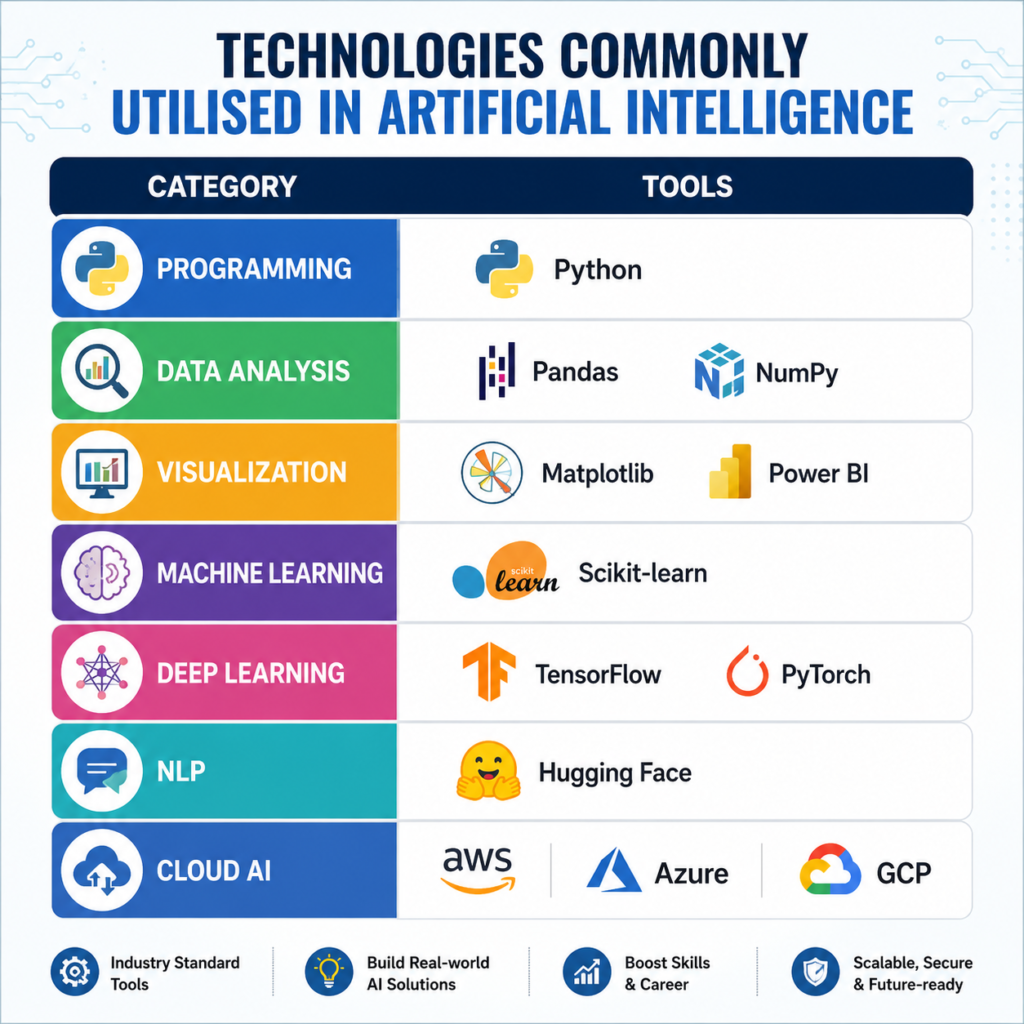
| Category | Tools |
| Programming | Python |
| Data Analysis | Pandas, NumPy |
| Visualization | Matplotlib, Power BI |
| Machine Learning | Scikit-learn |
| Deep Learning | TensorFlow, PyTorch |
| NLP | Hugging Face |
| Cloud AI | AWS, Azure, GCP |
What Is Artificial Intelligence Used for in Enterprise Settings?
The deployment of enterprise AI is all about solving business problems in a secure and effective way.
Smart Automation
Organisations automate :
- Processing invoices
- Claims handling
- Document Classification.
- Workflow routing
Predictive analytics
AI helps to predict:
- Demand for products
- Equipment breakdowns
- Customer attrition
- Risks to the Financial System
Customer Experiences
Uses include:
- Assistants, virtual
- Recommendation engines
- Chatbots.
- Customised marketing
Cyber security
AI systems offer support:
- Threat Intel
- Malware detection
- Network monitoring
Software development Anomaly detection
AI helps with:
- Automation testings Code generation
- Bug detection
- Creating documentation
What Jobs Use Artificial Intelligence Daily?
AI knowledge can be used to numerous technical professions.
| Role | AI Usage |
| AI Engineer | Build AI solutions |
| Machine Learning Engineer | Develop ML models |
| Data Scientist | Analyze and predict outcomes |
| Data Analyst | Extract business insights |
| Software Developer | Integrate AI services |
| Cloud Engineer | Deploy AI workloads |
| DevOps Engineer | Manage AI infrastructure |
| Cybersecurity Analyst | Detect threats |
| Business Analyst | Interpret AI-generated insights |
| Solutions Architect | Design AI-enabled systems |
Many organisations now expect at least a basic AI literacy from their technology teams.
What are the best jobs after learning Artificial Intelligence?
Training in AI can unlock several doors in your profession.
Entry Level Positions
Junior Data Analyst
AI Support Engineer Business Intelligence Analyst Data Associate
Intermediate Roles
Machine Learning Engineer
AI Developer Data Scientist NLP Engineer
Advanced Positions
AI Architect Lead Data Scientist AI Solutions Architect AI Engineering Lead
Career development often includes:
- Technical knowledge
- Project’s experience
- Industry insight
- Ability to solve problems
What to Look for in the Best Online Artificial Intelligence Course as a Professional
The Artificial Intelligence Online Training program is not about marketing promises but about real-world learning results.
Curriculum Coverage
A good program will have the following:
AI basics
Machine learning algorithms
Deep Learning NLP Generative AI Model Deployment
Hands-on Projects
Experience Counts.
Possible projects include:
- Models for predictive analytics
- Recommender systems
- Chat Bots
- Models for classification
Tools relevant to industry
Training should include:
- Python TensorFlow Torch
- Cloud AI platforms Scikit-learn
- Instructor Experience
Look for instructors with:
AI production background
Exposure to Enterprise Projects
Real-life implementation know-how
Cloud Based Practice
The development of AI nowadays is often based on:
AWS Azure Google Cloud
Hands-on experience in the cloud can assist learners gain a better understanding of deployment and scalability difficulties.
| Stage | Topics |
| Foundation | Python, Statistics, Data Analysis |
| Beginner AI | Machine Learning Basics |
| Intermediate AI | Deep Learning, NLP |
| Advanced AI | Generative AI, MLOps |
| Enterprise AI | Cloud Deployment, Security, Governance |
| Specialization | AI Engineering, Data Science, Computer Vision |
This organised approach allows professionals to gain skills and reinforce practical knowledge progressively.
Common Challenges in Learning Artificial Intelligence Understanding Mathematical Concepts
Many learners find probability and statistics difficult at first.
Best Practice: Get your hands dirty with theory before going too deep.
Working with Actual Data
Enterprise data is typically:
Incomplete Inconsistent Massive
Usually, a large part of the project effort is taken up by data preparation.
model_deployment
But building a model is not the same as deploying it in production.
Teams have to think about:
Expandable
Monitoring Performance Security
Tracking the Progress of AI
AI technologies are evolving rapidly.
Professionals gain from:
Ongoing learning
Playing with your hands
Certifications in Industry
Community involvement
Best Practices for Applying AI Skills to Real Projects
Begin with Business Goals
Successful projects begin by finding:
- Business issues
- Expected results
- How We Measure Success
- Data Quality Focus
Success is often less a function of fancy algorithms than of good data.
Continuously Monitor Models
AI models can decay over time as data patterns change.
Performance is best sustained with regular monitoring.
Adhere to Governance Standards
Increasingly, organisations require:
- Responsible AI practices
- Controls security
- Privacy compliance
- Requirements for explainability
- Cross-Functional Work
Most AI projects involve:
Developers Business stakeholders Data scientists
Security teams, Cloud engineers
Cross-functional collaboration enhances implementation success.
Frequently Asked Questions FAQ
Do all IT professionals require AI training?
Not every professional has to be an AI specialist. But basic AI understanding is a rapidly emerging sought-after skill across software development, cloud computing, cybersecurity and analytics jobs.
How Long to Learn AI?
The timeline will be based on previous experience. A few months of concentrated learning and practice give many professionals basic skills.
Do I need to be a programmer to learn AI?
Basic programming knowledge is a plus. Python is the most used language for AI projects.
Which sectors are using AI the most?
AI is quite common in healthcare, banking, retail, manufacturing, telecommunications, logistics and technological services.
Is machine learning artificial intelligence?
No. Machine learning is a subset of artificial intelligence that helps systems learn patterns from data.
What tools should a newbie learn first?
Most novices begin with:
Python Pandas NumPy Scikit-learn
Jupyter-Notebook
Are AI training courses for working professionals?
Yes. Many Artificial Intelligence Online Training are designed to accommodate the demands of busy professionals who need flexible scheduling and hands-on learning environments.
What is the finest online artificial intelligence course?
The finest artificial intelligence education online usually has core principles, practical projects, real-world tools, cloud-based practice, and real-world application cases in enterprise environments.
Summary
Artificial intelligence is becoming a core competency across modern IT organisations. As organisations adopt AI for applications, infrastructure, cybersecurity, analytics and business operations, professionals are finding value in understanding how AI systems are built, deployed and maintained.
Key Takeaways_
AI is built into many enterprise technologies and workflows.
AI training classes assist professionals get practical skills that are relevant to their job.
The knowledge of Python, machine learning, NLP and cloud AI platforms is becoming more value.
AI skills help professional progression in development, cloud, analytics and cybersecurity roles.
For AI learning, you need hands-on projects and real-world applications.
The greatest online AI course should be a mix of theory, tools, projects and corporate application cases.
Check our H2K Infosys Artificial Intelligence Online Training to get hands-on exposure on industry relevant technologies and workflows.
Build hands-on AI abilities to boost your career and get ready for real-world projects.