Introduction
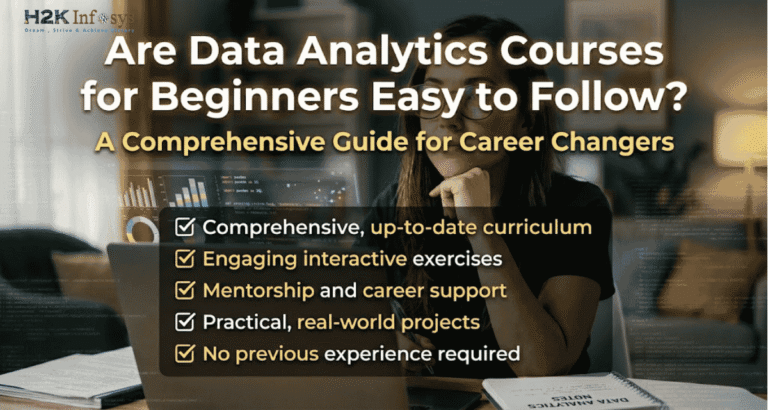
Let’s be real for a second. If you’ve been Googling “data analytics courses for beginners” at 11pm wondering if you’re even smart enough to do this you’re not alone. That’s probably the most common thing people feel when they start.
The good news? data analytics courses for beginners isn’t as intimidating as it looks from the outside. The skills involved reading data, spotting patterns, making sense of numbers these are things humans do naturally. The tools (Excel, SQL, Python, Tableau) just help you do it faster and at scale.
What actually matters is finding a course for data analytics that meets you where you are. Not one that assumes you already know what a dataset is.
What Makes a Beginner Course Actually Beginner-Friendly?
This is worth thinking about carefully because not every course labeled “data analytics courses for beginners” actually is. I’ve seen plenty of courses that call themselves beginner-level and then open with a 45-minute lecture on relational database theory. That’s not beginner-friendly. That’s just… relabeled.
A genuinely good data analytics course for beginners usually has a few things going for it:
Starts with context, not syntax
Before teaching you how to write a SQL query, it explains why you’d even need one. What business problem does it solve? Who asks for this kind of analysis?
Hands-on from lesson one
Real datasets. Real tools. Not just slides and videos. The moment you open Excel or a SQL editor and run your first query yourself, it clicks in a way that watching never does.
Live instruction or strong community support
Having someone you can ask, “wait, why did that not work?” makes a huge difference in early learning. Recorded videos are fine, but they can’t answer your question at 9pm.
Revisits concepts in different contexts
A good curriculum spirals back. You see pivot tables in week 2, and then again through a different lens in week 5. That repetition builds real understanding.
“The best courses don’t teach you to memorize functions. They teach you to think analytically then the tools follow naturally.”
What Will You Actually Learn in a Course for Data Analytics?
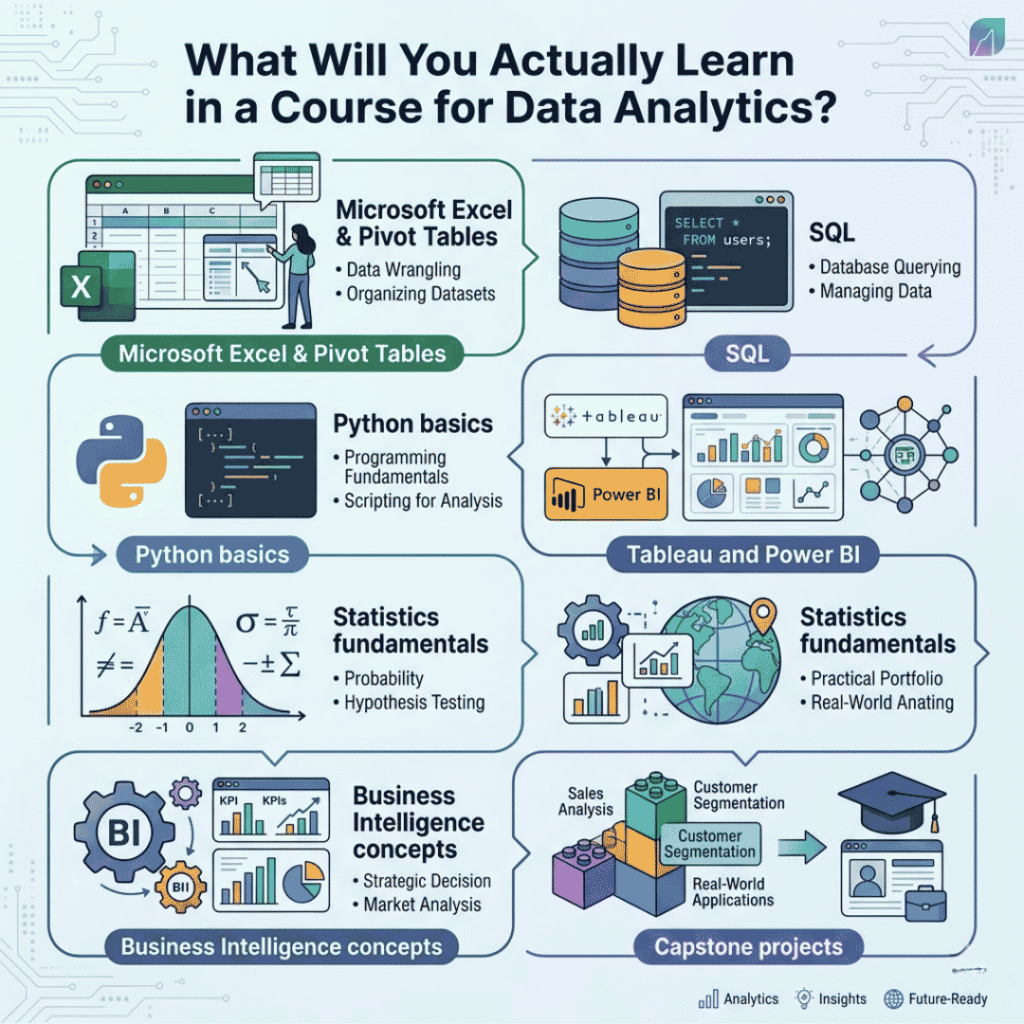
Here’s what a solid beginner curriculum covers not a vague list, but the actual skills you walk away with:
- Microsoft Excel & Pivot Tables data cleaning, sorting, summarizing, basic reporting
- SQL querying databases, filtering records, joining tables
- Python basics working with Pandas and NumPy for data manipulation
- Tableau and Power BI building dashboards and visualizations stakeholders can actually use
- Statistics fundamentals mean, median, standard deviation, distributions
- Business Intelligence concepts KPIs, metrics, reporting frameworks
- Capstone projects portfolio-ready analyses you can show employers
The order matters too. You don’t jump straight into Python, you start with Excel because it’s visual, familiar, and forgiving. SQL comes next, which deepens your understanding of how data is structured. Then, visualization tools help you communicate findings. By the time Python enters the picture, you’re already thinking like an analyst, so the syntax becomes the easy part.
One thing worth mentioning: the students who get the most out of these programs treat every project like a real work assignment. Not “I need to submit this” but “how would I explain this dashboard to my manager?” That mindset shift changes everything.
Common Mistakes Beginners Make (And How to Avoid Them)
Having seen hundreds of people go through this journey, some patterns come up again and again. Not to make anyone feel bad, just to help you skip the pitfalls:
- Trying to learn everything at once, jumping between SQL, Python, Tableau, and R simultaneously. You’ll hit overwhelm fast. Pick one tool, get comfortable, then layer in the next.
- Watching without doing, passively watching tutorial videos without opening the tool yourself. You can watch someone swim for 10 hours and still not know how.
- Skipping the basics, rushing to “advanced” topics before nailing data cleaning. Bad data in = bad insights out. Every data analyst spends 60–70% of their time cleaning data.
- Work on real datasets from day one. Kaggle has free datasets for every industry. Use Superstore sales data, COVID stats, Netflix viewership, or something you actually find interesting.
- Build a portfolio as you learn document your projects. A GitHub repo with 3 real analyses is worth more in a job hunt than a certificate alone.
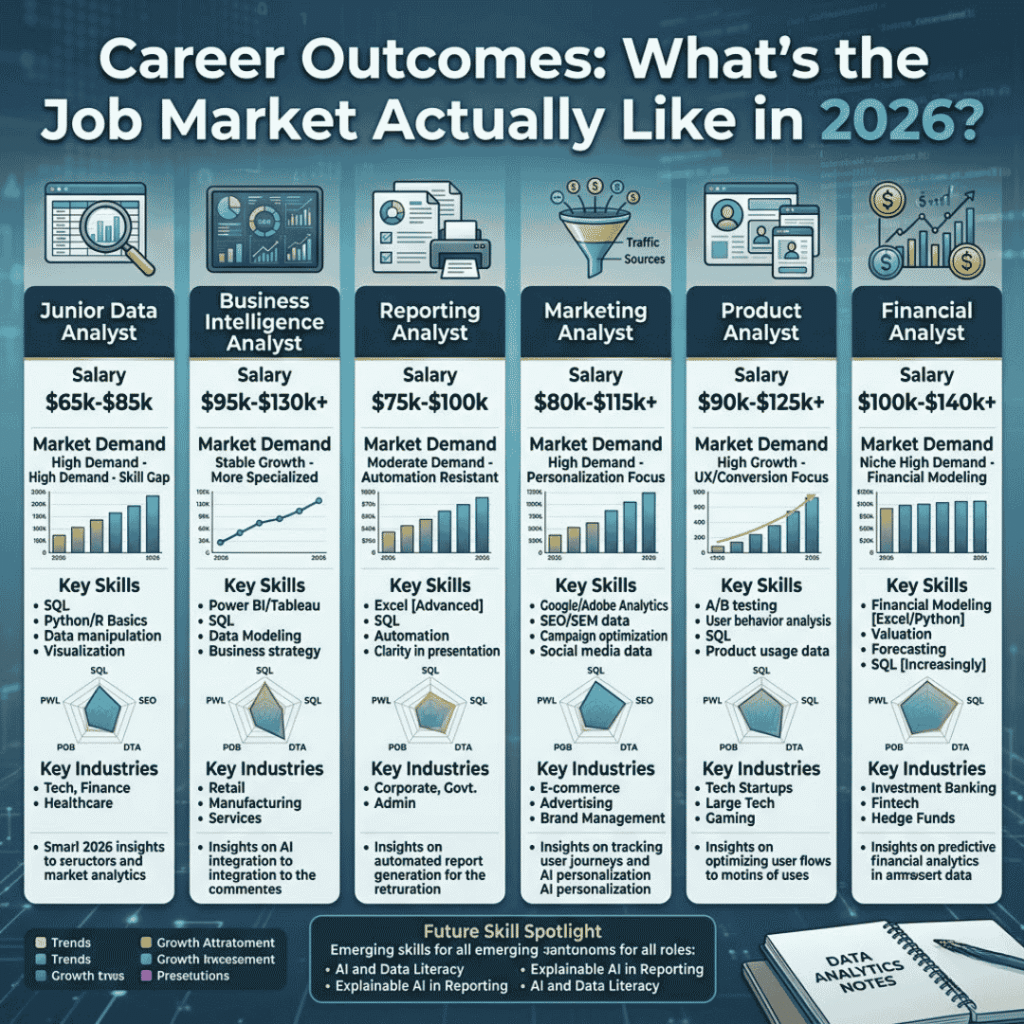
Career Outcomes: What’s the Job Market Actually Like in 2026?
Let’s talk numbers, as that’s the point.
The average US salary for a data analyst in 2026 sits around $98,000, with entry-level roles starting in the $65,000–$75,000 range. The field is projected to grow by 35% through 2030, making it one of the fastest-growing roles in the tech sector.
What’s driving this? The AI wave, honestly. Companies now collect more data than ever, but they need people who can interpret outputs, validate results, and translate raw numbers into actual business decisions. That’s a data analyst. The more automated data collection becomes, the more organizations need humans who know what to do with it.
Entry-level titles actively hiring right now include:
- Junior Data Analyst
- Business Intelligence Analyst
- Reporting Analyst
- Marketing Analyst
- Product Analyst
- Financial Analyst
Most of these roles don’t require a traditional CS degree. What they do require: SQL proficiency, Excel or Tableau skills, and the ability to communicate findings clearly. That’s a skill set you can build in 3–6 months with a structured program.
And this isn’t just a US story. India’s analytics market has exploded. Hyderabad, Bangalore, and Pune have seen major hiring spikes through 2025–2026, with TCS, Wipro, Amazon, Deloitte, and dozens of mid-sized companies posting heavily for analytics talent.
Why Data Analytics Training and Placement Support Changes Everything
Here’s something that doesn’t get said enough: the course is only half the journey. What happens after you finish matters just as much. That’s where data analytics training and placement programs make a real difference.
A lot of self-taught folks hit a wall when it comes to job applications. They have the skills, but they don’t know how to frame them. Their resume says “learned Python,” but doesn’t tell a hiring manager what problems they solved with it. Their LinkedIn hasn’t been touched. They’ve never done a mock technical interview.
This is exactly why structured data analytics courses for beginners that bundle training with career support tend to produce better outcomes, not just better-educated people, but actually-employed people.
H2K Infosys: Built for Real Career Transitions
H2K Infosys has been helping career changers and beginners break into tech since 2007. Their data analytics courses for beginners combines live instructor-led sessions, real-world project work, resume prep, mock interviews, and active job placement support, not just a certificate to hang on the wall.
If you’re serious about building a career in data analytics, structured training with placement support is what separates people who learn the skills from the ones who actually land the job.
Explore H2K Infosys Data Analytics Program →
What H2K Infosys Does Differently
A few things stand out from a curriculum standpoint. Their courses run with live instructors actual working professionals, not just recorded videos. You can ask questions in real time, get your queries answered, and work through problems with someone who’s dealt with the same issues in actual client projects.
The curriculum covers the full analytics stack: Excel, SQL, Python, Tableau, and Power BI which matches almost exactly what job descriptions are asking for in 2026. And the hands-on projects are designed around real business scenarios: sales analysis, customer churn, marketing attribution, financial dashboards. Stuff that looks genuinely impressive on a portfolio.
The placement assistance side is structured to include resume reviews, LinkedIn optimization, mock interviews tailored to analytics roles, and connections with hiring partners. For someone transitioning careers, that scaffolding is genuinely valuable.
You might also find these helpful
SQL for Data Analysts: What You Actually Need to Know
Data Analytics vs. Data Science: Which Path Is Right for You?
How to Build a Data Portfolio Even With Zero Work Experience
FAQs
Do I need a math or CS background to start a data analytics course?
No and this is the most common fear people have going in. Basic arithmetic and logical thinking are enough. Most data analytics courses for beginners teach statistics as you go, in real context. You don’t need to know calculus to read a bar chart or write a SQL query.
How long does a beginner data analytics course take to complete?
A structured program typically runs 8–16 weeks depending on pace and depth. Programs like H2K Infosys are designed to work around full-time schedules, with weekend batches and flexible timings so you don’t have to quit your job to learn.
Is Python necessary for data analytics, or can I start without it?
Python is increasingly expected for mid-to-senior roles, but for entry-level positions, SQL plus Excel plus Tableau is often enough to get hired. Good programmes introduce Python progressively; you’re not thrown in the deep end on day one.
What’s the difference between a course with placement support and one without?
A standalone course teaches you the skills. A data analytics training and placement program walks you through the entire job-search process: resume building, interview prep, mock technical tests, and connections to hiring companies. For career changers, that placement layer is often what actually gets you hired.
Can I get a data analyst job without a degree?
Yes, and this is increasingly common in 2026. Many companies, including large tech firms, have shifted to skills-based hiring. A strong portfolio with real projects, demonstrable SQL and Tableau skills, and a recognised certification can absolutely get you in the door without a traditional four-year degree.
Conclution
If you’re on the fence, here’s how to think about it practically: the barrier to entry for data analytics has never been lower, and the demand for people who can work with data has never been higher. That’s a rare window.
The courses exist. The tools are mostly free or low-cost. The job market is real. What’s actually standing between most people and a career in analytics isn’t ability; it’s just not having taken the first step yet.
Start with a structured course, one that gives you live instruction and real projects. Work through it consistently. Build something you’re proud of. And if you want help getting from “I finished the course” to “I got the job”, choose a data analytics courses for beginners that takes that seriously too.
H2K Infosys has helped thousands of people make exactly that transition from accountants, marketers, teachers, and complete career changers into working data analytics courses for beginners. The programme is built for people who are starting from scratch, and the placement support makes the career pivot more than just theoretical.