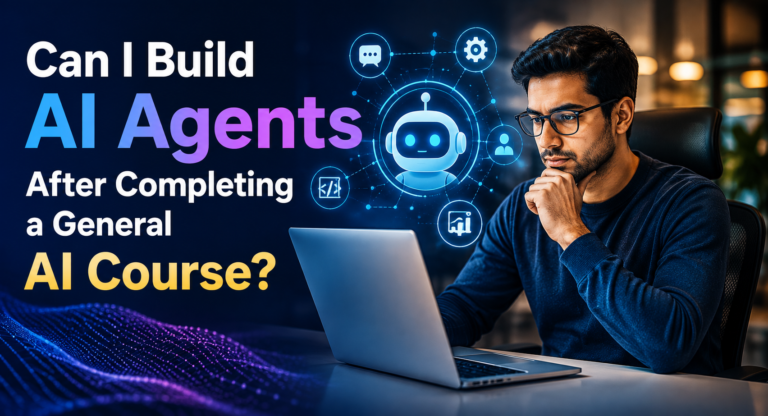
Yes, you can build AI agents after completing a general AI course but the outcome depends on what the course actually covers. If your learning includes modern generative AI concepts, prompt engineering, APIs, automation frameworks, and hands-on projects, you’ll have a strong foundation for starting build AI agents for real-world use cases. Choosing an Artificial intelligence certified course that emphasizes practical implementation makes the journey much smoother than relying on theory alone.
AI agents have quickly moved from being a buzzword to something businesses actively invest in. Over the past year, we’ve seen companies integrate autonomous AI assistants into customer support, software development, HR, sales, and internal operations. That shift has also changed what employers expect from AI professionals. Today, understanding how AI works isn’t enough you need to know how to make it solve actual business problems.
What Exactly Is an AI Agent?
A lot of people picture AI agents as futuristic robots. In reality, they’re software systems that can understand goals, make decisions, use tools, and complete tasks with minimal human intervention.
Think about a customer support assistant that doesn’t just answer FAQs but also checks order status, updates a CRM, drafts an email, and schedules a follow-up. That’s an AI agent in action.
Another example is a marketing assistant that researches competitors, creates campaign ideas, drafts social media posts, and analyzes engagement data without someone manually switching between multiple applications.
The interesting part? Building these solutions is becoming much more accessible than it was even two years ago.
Does a General AI Course Give You Enough Knowledge?
The honest answer is: it depends on the curriculum.
Some AI courses still spend most of their time on traditional machine learning concepts classification, regression, decision trees, and neural networks. Those topics are valuable, but they don’t automatically prepare you to modernized build AI agents.
A stronger Artificial intelligence certified course should include practical skills like:
- Generative AI fundamentals
- Large Language Models (LLMs)
- Prompt engineering
- AI workflows
- API integration
- Retrieval-Augmented Generation (RAG)
- AI automation
- Multi-agent systems
- Real-world deployment
When these components are taught together through projects instead of just lectures, learners are much better prepared to create production-ready AI solutions.
Why Practical Training Matters More Than Ever
One thing I’ve noticed while talking to developers and hiring managers is that portfolios now carry more weight than certificates alone.
If someone shows an AI-powered resume screening system, an automated research assistant, or a chatbot integrated with business tools, it immediately demonstrates practical capability.
That’s why many modern AI training programs are moving away from exam-heavy learning and focusing instead on:
- Industry projects
- Business case studies
- Capstone assignments
- Cloud deployment
- Team collaboration
- AI application development
These experiences make a noticeable difference when you’re interviewing or freelancing.
Skills You’ll Need Before To Build AI Agents
Even if you’re not an experienced programmer, learning these areas makes development much easier.
1. Python Basics
Python remains the language behind most AI frameworks.
You don’t need to become an advanced software engineer immediately, but understanding variables, loops, functions, APIs, and libraries helps tremendously.
2. Prompt Engineering
Prompt engineering has evolved beyond simply asking better questions.
Today’s AI developers learn how to:
- Design structured prompts
- Chain prompts together
- Reduce hallucinations
- Improve consistency
- Create reusable prompt templates
These skills often determine whether an AI agent performs reliably in production.
3. Working with LLM APIs
Modern AI agents rarely build language models from scratch.
Instead, developers connect applications to LLM APIs and focus on creating intelligent workflows around them.
Understanding authentication, API requests, responses, and rate limits becomes part of everyday development.
4. Workflow Automation
Many useful AI agents combine language models with automation tools.
Imagine an AI assistant that:
- Reads incoming emails
- Extracts important information
- Generates replies
- Updates a CRM
- Notifies your team
That’s where automation knowledge becomes valuable.
5. Memory and Knowledge Retrieval
One limitation of standalone language models is that they don’t automatically know your company’s internal data.
Modern AI agents overcome this using Retrieval-Augmented Generation (RAG), allowing them to search trusted documents before responding.
This has become one of the most sought-after enterprise AI skills.
Real-World AI Agent Projects You Can Build
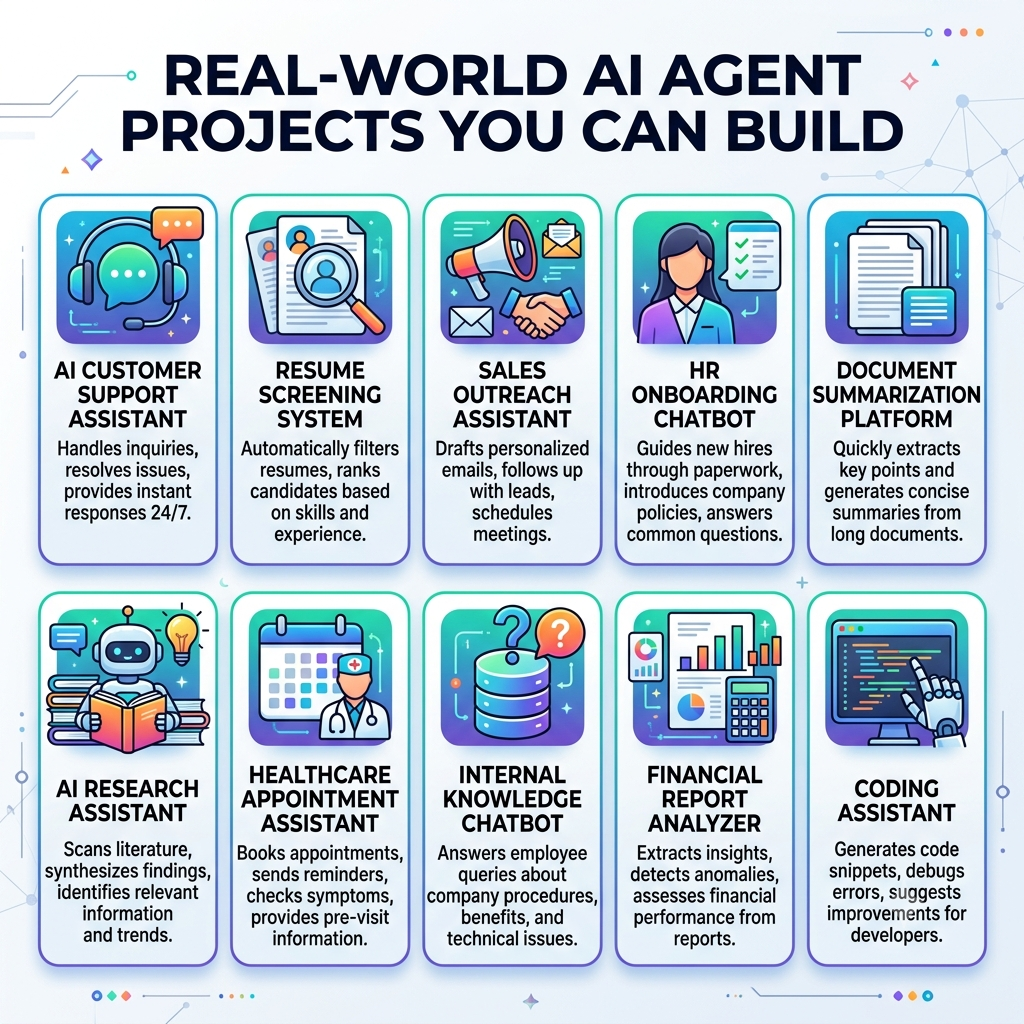
After completing a strong AI program, many learners start with projects like:
- AI customer support assistant
- Resume screening system
- Sales outreach assistant
- HR onboarding chatbot
- Document summarization platform
- AI research assistant
- Healthcare appointment assistant
- Internal knowledge chatbot
- Financial report analyzer
- Coding assistant
These projects closely resemble the kinds of business applications organizations are deploying today.
What Employers Are Looking For in 2026
Hiring trends have shifted noticeably.
Recruiters increasingly ask candidates questions like:
- Have you built an AI workflow?
- Can you integrate AI with existing business systems?
- Have you deployed an AI application?
- Can your AI solution work with company data?
Those questions reflect how quickly enterprise AI adoption has accelerated across industries.
Someone with hands-on project experience often stands out more than someone who only understands AI theory.
How the Right Learning Path Makes a Difference
Not every course prepares learners equally.
Some programs provide recorded lectures and quizzes. Others immerse learners in building complete AI applications from the start.
If your goal is to become an AI developer or AI solutions engineer, it’s worth choosing gen ai online certification courses that include:
- Live mentoring
- Industry projects
- Portfolio development
- Career guidance
- Hands-on labs
- Exposure to current AI tools and frameworks
This practical approach helps bridge the gap between learning concepts and delivering business-ready solutions.
Why Many Learners Choose H2K Infosys
If your objective is to move beyond AI theory and actually build intelligent applications, H2K Infosys positions itself as a practical training provider rather than a theory-first learning platform.
Its AI-focused curriculum is designed around current industry expectations and includes:
- Comprehensive Artificial intelligence certified course content with practical implementation
- Project-driven AI training programs aligned with enterprise use cases
- Hands-on exposure to generative AI, prompt engineering, LLMs, automation, and AI agent development
- Experienced instructors who bring real-world implementation insights into the classroom
- Career support, interview preparation, and portfolio-building assistance
- Flexible online gen ai certification courses suitable for both working professionals and career changers
For learners who want to transition into AI roles without spending months piecing together tutorials from different sources, this structured approach can significantly shorten the learning curve.
A Practical Learning Scenario
Picture someone working as a business analyst with little AI experience.
They enroll in a structured AI certification program, learn Python fundamentals, experiment with prompt engineering, build a document-search chatbot using RAG, integrate it with a workflow platform, and complete a capstone project that automates customer support responses.
By the end of the course, they haven’t just earned a certificate they’ve built something tangible they can demonstrate during interviews.
That’s the kind of transition employers increasingly value.
Common Mistakes New Learners Make
A few patterns show up again and again:
- Spending too much time watching tutorials without building projects.
- Focusing only on prompt engineering while ignoring APIs and automation.
- Learning outdated machine learning workflows without exploring modern generative AI.
- Chasing every new AI tool instead of mastering the fundamentals first.
- Assuming a certificate alone guarantees job readiness.
A balanced learning path that combines theory, implementation, and portfolio work tends to produce much stronger outcomes.
Can I build AI agents after completing a general AI course?
Yes, provided the course includes practical topics such as generative AI, Large Language Models (LLMs), prompt engineering, APIs, automation, and hands-on projects. A project-based Artificial intelligence certified course gives you the skills needed to create AI agents for real-world business applications.
Do I need programming experience to build AI agents?
Basic programming knowledge, especially in Python, is helpful but not always required to get started. Many modern AI training programs begin with Python fundamentals before introducing AI agent development, making them suitable for beginners and working professionals alike.
Are online Gen AI certification courses worth it?
Yes, if they focus on practical implementation rather than just theory. The best online gen ai certification courses include live projects, mentorship, portfolio development, and exposure to industry-standard AI tools and frameworks.
Why choose H2K Infosys for AI training?
H2K Infosys offers industry-focused training that goes beyond classroom concepts. Its curriculum emphasizes hands-on projects, AI agent development, generative AI, automation, and career support, helping learners gain practical experience that aligns with current hiring trends in the AI industry.
What skills are essential for AI agent development?
To build AI agents effectively, you should learn:
Python programming
Prompt engineering
Generative AI and LLMs
API integration
Retrieval-Augmented Generation (RAG)
Workflow automation
AI deployment and testing
These skills help you build intelligent applications that can perform tasks autonomously.
Final Thoughts
So, can you build AI agents after completing a general AI course? Absolutely but only if that course goes beyond foundational concepts and gives you opportunities to build, test, and deploy real AI solutions.
As AI agents become a core part of business operations, professionals who combine technical knowledge with practical experience will have a clear advantage. Choosing an Artificial intelligence certified course that emphasizes hands-on learning, enrolling in industry-focused AI training programs, and selecting comprehensive online gen ai certification courses can help you move from understanding AI to creating solutions that organizations genuinely need.
If you’re evaluating learning options, look for programs that mirror real workplace challenges rather than just teaching concepts. That’s where providers like H2K Infosys distinguish themselves by focusing on practical skills, guided projects, and career-oriented training that prepares learners to build AI agents with confidence.