
Cyber Security Training with placement is a complete learning journey that comprises skill development, hands-on projects, interview preparation and job placement support. The goal is not to just teach theory but to make students employable and move to the real cyber security roles. Good programs usually train you on tools, provide practical labs, help build resumes, conduct mock interviews, and connect learners with hiring opportunities. Providers such as H2K Infosys also focus on connecting practical learning with career readiness through guided projects, interview preparation, and placement support, including insights into the cyber security training placement process.
People often assume the “placement” part means you join a course and magically receive an offer letter at the end. I’ve watched enough learners go through the process to say that it rarely works that way. The training opens doors. What you do during the program determines how many of those doors stay open.
Understanding the cyber security training placement process is crucial for maximizing your opportunities.
Gaining insights into the cyber security training placement process can significantly enhance your career trajectory.
What actually happens inside cybersecurity training and placement programs?
The cyber security training placement process is designed to prepare you for real-world challenges.
Understanding the Cyber Security Training Placement Process
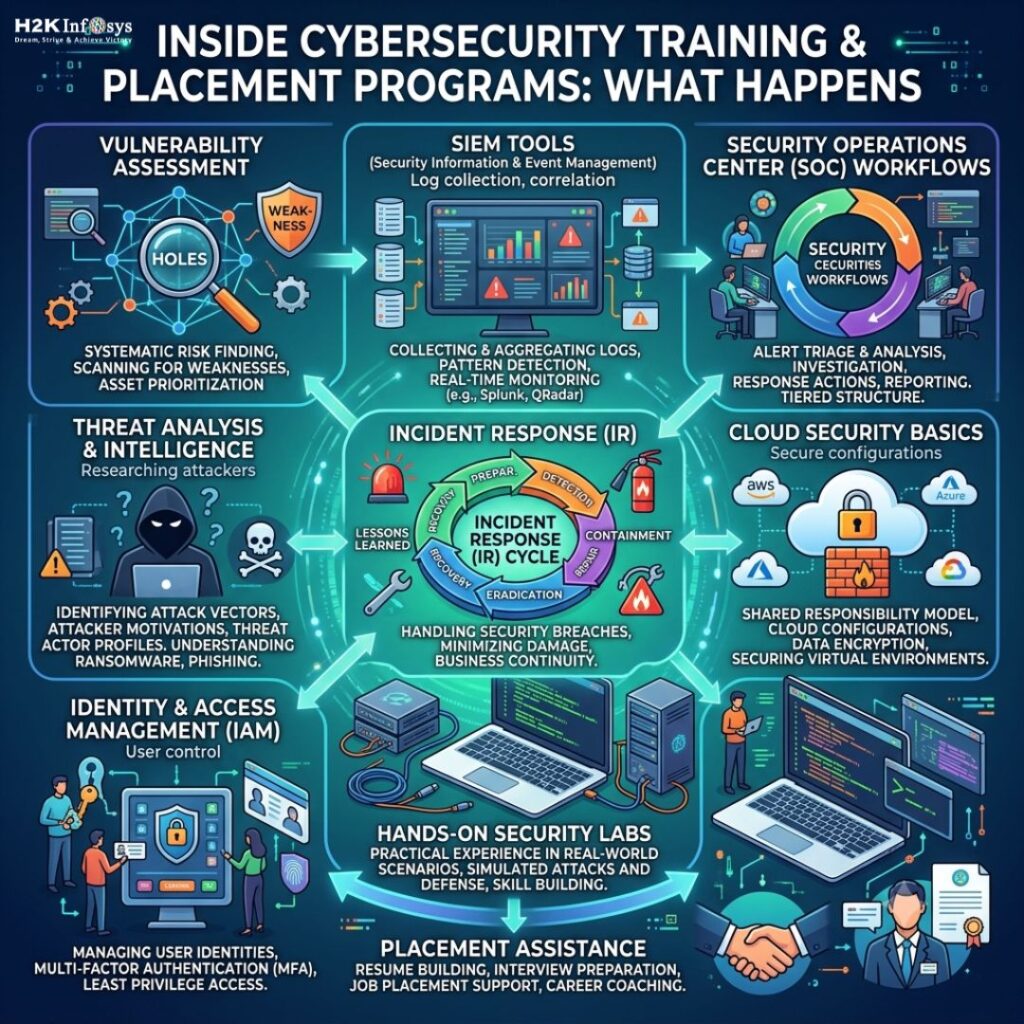
Understanding the cyber security training placement process will help you succeed in your job search.
Most structured programs follow a sequence that looks something like this:
This is a critical part of the cyber security training placement process that cannot be overlooked.
You start with the fundamentals. Networking, operating systems, security basics, threat concepts, access control, and the stuff many beginners initially underestimate. I’ve seen students rush toward ethical hacking modules because, let’s be honest, the exciting parts get attention on YouTube. Then midway through interviews, someone asks, “Can you explain how DNS works?” Suddenly fundamentals matter a lot.
Then comes practical learning.
You move into areas like:
- Security Operations Center (SOC) workflows
- Vulnerability assessment
- SIEM tools
- Cloud security basics
- Incident response
- Threat analysis
- Identity and access management
- Hands-on security labs
The difference between random online videos and structured cyber security training and placement often appears here. Instead of passively watching lessons, learners are usually expected to work inside simulated environments.
I remember talking to a learner who said, “I finally understood log analysis only after spending hours inside a practice lab.” That comment stuck with me because cyber security training with placement has always been one of those fields where clicking, testing, and breaking things safely teaches more than endless slides.
The placement process usually begins before the course ends
This part surprises people.
Many assume placement support starts after graduation. Strong programs typically start preparing students much earlier.
Mastering the cyber security training placement process is essential for securing interviews.
The process often includes:
- Resume building sessions
- LinkedIn profile optimization
- Mock interviews
- Soft skill preparation
- Technical assessments
- Real-world project guidance
- Employer referrals
Many aspects of the cyber security training placement process can be learned through networking.
Some providers even run weekly interview simulations.
And trust me, mock interviews feel awkward at first. Most people freeze when hearing, “Walk me through a security incident you handled.” Then after three or four sessions, answers start sounding natural.
That shift matters more than many people realize.
How cyber security training and job placement works in real life
Let’s imagine a beginner named Ravi.
Ravi comes from a non-IT background and joins a cyber security training with placement program because he wants to switch careers.
Month one: he learns networking, Linux basics, and security concepts.
Month two: he starts SOC labs and threat monitoring exercises.
Month three: he works on projects involving log analysis and incident handling.
Month four: he updates his resume, participates in mock interviews, and applies for security analyst roles.
Part of the cyber security training placement process includes understanding roles in the industry.
Eventually, Ravi attends interviews through employer partnerships or placement networks.
That example sounds simple on paper. Real life gets messier. Some students get interviews quickly. Others need additional projects or more practice. But the structure creates a path many beginners struggle to build on their own.
Why practical experience matters much more in 2026
Cyber security hiring changed quite a bit in recent years.
Companies increasingly want proof of skills instead of stacks of certificates alone. Recruiters ask questions like:
“What tools have you used?”
“Have you worked with real scenarios?”
“Can you explain a security event investigation?”
After several large-scale ransomware incidents and cloud security breaches across industries, organizations are investing heavily in people who can actually operate security systems rather than only discuss theory.
You can see this trend across job descriptions today. Many entry-level roles now mention SIEM exposure, cloud environments, hands-on labs, and incident response familiarity.
Understanding every step of the cyber security training placement process can make a big difference.
That’s probably why practical cyber security training with placement programs are receiving more attention than purely academic courses.
Where H2K Infosys fits into the picture
Among providers offering cybersecurity training and placement support, H2K Infosys is frequently discussed because the approach goes beyond recorded lessons alone.
The program focuses on hands-on learning, real-world use cases, practical project exposure, interview preparation, and placement assistance. For learners trying to bridge the gap between “I completed a course” and “I can handle workplace tasks,” that practical layer matters.
I’ve noticed something interesting over time. Students often feel confident after finishing theory modules, but confidence changes after handling actual security scenarios. That’s where guided projects and structured mentoring become useful.
The placement support process also becomes important because technical knowledge by itself doesn’t always translate into interview success.
Questions people often ask
Students often overlook the cyber security training placement process when focusing on coursework.
Is placement guaranteed?
Usually no reputable provider guarantees a job itself. Placement support generally means interview opportunities, career guidance, resume help, and hiring assistance.
Can beginners join?
Yes. Many learners start without prior security experience. Some even come from non-technical backgrounds.
How long does cyber security training with placement take?
It’s important to understand the cyber security training placement process before starting your job search.
Many programs run between three and six months, although timelines vary based on curriculum depth and specialization.
The cyber security training placement process can vary by provider but generally involves multiple stages.
Do projects matter?
Absolutely.
I’d actually say projects quietly become one of the strongest parts of your profile. During interviews, candidates who explain a project they built or a security scenario they analyzed tend to have stronger conversations.
Final thoughts
Cyber security training with job placement works best when it combines learning, practice, and career support into a complete process. The training builds knowledge; projects create confidence; placement assistance helps connect skills with opportunities.
People sometimes search for shortcuts because cyber security training with placement sounds exciting and the industry growth headlines are everywhere. But after watching enough learners go through the process, I keep seeing the same pattern: structured learning plus practical experience usually beats collecting random tutorials.
And if you’re evaluating providers, look beyond course titles. Ask about labs, projects, mentoring, interview preparation, and placement support. Those details often end up making the biggest difference.
Engaging actively in the cyber security training placement process can lead to better results.
Participating in projects enhances your understanding of the cyber security training placement process.