The best way to do this is to look for cybersecurity courses with job placement that will offer you employment placement in the USA, real-world projects, mentorship, career coaching and hands-on hiring support, and not just provide you with a certificate like H2k Infosys.The Simplest Way to Find Cybersecurity Training in the U.S. A course that teaches skills and helps you connect those skills to actual employers usually creates stronger outcomes than training alone.
That shift has become pretty obvious over the last couple of years. People used to ask, “Which cybersecurity certification should I take?” Now the conversation sounds different: “Will this help me get hired?” That’s a much more practical question, and honestly, probably the right one.
The cybersecurity field keeps expanding, but employers have also become more selective. Companies aren’t only looking for people who can pass an exam. They’re looking for candidates who can explain incidents, work with security tools, understand threat behavior, and solve problems in situations that feel messy and real.
I’ve noticed something while talking with people moving into cybersecurity courses with job placement careers: many don’t struggle with learning concepts. They struggle with connecting training to employment.
That difference matters.
Why Cybersecurity Courses with Job Placement Support Matters More Than People Think
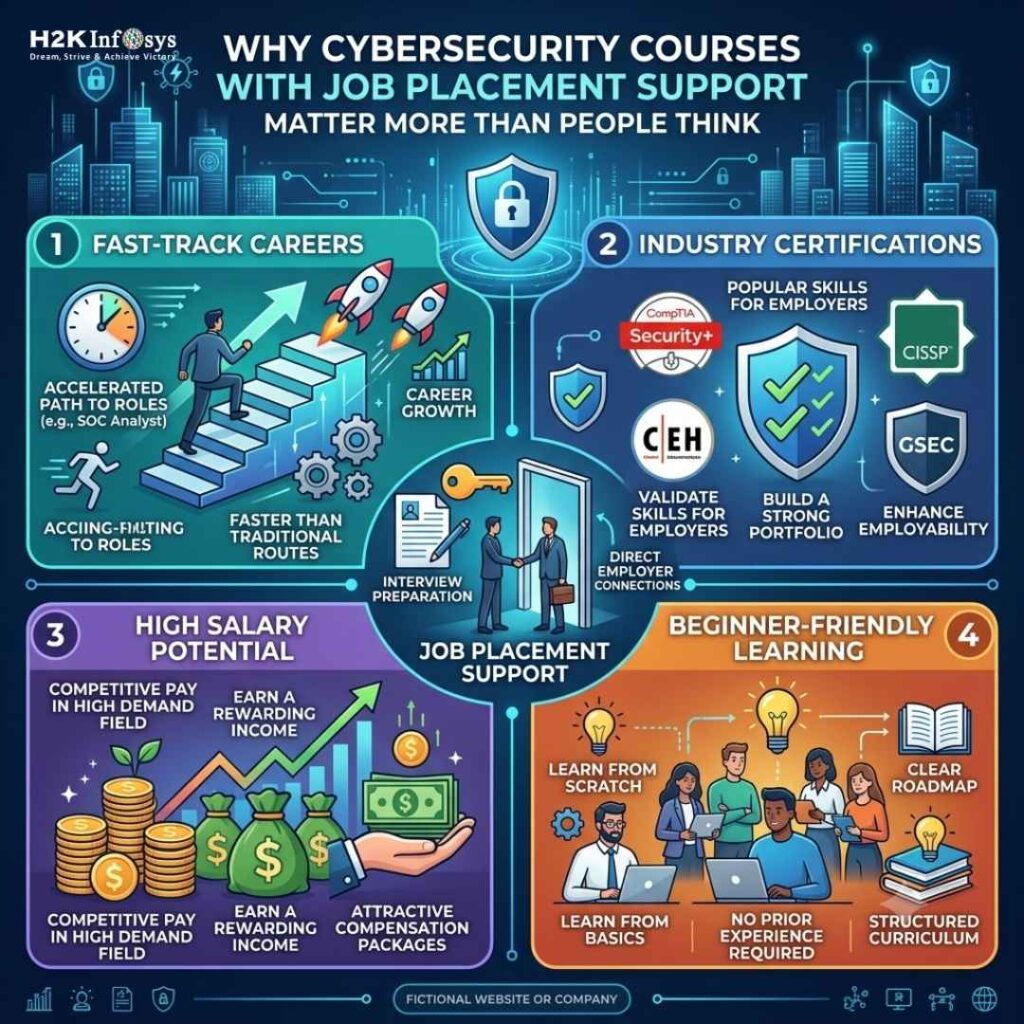
A lot of cybersecurity courses with job placement training advertisements promise exciting things:
- Fast-track careers
- Industry certifications
- High salary potential
- Beginner-friendly learning
Those sound great. The problem is that many people finish training and suddenly hit a wall.
Now comes the part nobody really talks about enough:
“How do I actually get interviews?”
Learning security concepts and getting hired are two different stages.
Strong cyber security training with job placement programs usually help with:
- Resume preparation
- LinkedIn profile optimization
- Mock interviews
- Hands-on projects
- Mentorship
- Internship support
- Networking opportunities
- Job application guidance
I’ve seen learners who had decent technical skills struggle for months because they had no idea how to present their experience. Then I saw others with slightly less technical depth land interviews because they could explain projects clearly.
Sometimes presentation changes everything.
Look for Hands-On Training, Not Just Recorded Videos
This one gets overlooked a lot.
Cybersecurity courses with job placement is difficult to learn through passive watching alone. Watching somebody click around inside a security tool is not the same as investigating an alert yourself.
Think about it this way:
If somebody says they know driving, you’d expect them to have actually driven a car not watched twenty hours of YouTube videos.
Security hiring managers often think the same way.
Good cybersecurity courses with job placement has to involve practical environments where students work with:
Security Information and Event Management (SIEM) tools .
Threat assessment
Risk assessment
Cloud Security Concepts .
Incident response procedures
Identity & Access Management
Risk and compliance practices
“Real projects give people something to talk about in interviews.
See What’s Happening in the Industry Right Now
Cybersecurity courses with job placement in 2026 looks a little different than it did a couple of years ago.
AI-assisted attacks are growing. Organizations are spending more on cloud security. Security teams are dealing with larger amounts of automated threat activity than before.
Just recently, industry discussions have heavily focused on:
- AI-powered phishing campaigns
- Cloud workload security
- Identity-based attacks
- Security automation
- Zero Trust environments
That means training programs built around old material can create gaps.
I’ve spoken with people who completed programs that barely covered cloud security. Then they reached interviews and realized employers were asking about environments involving cloud infrastructure and modern security workflows.
That becomes frustrating quickly.
The stronger programs keep updating content instead of teaching the same material year after year.
Research the Placement Process Carefully
Placement support can mean very different things depending on the training provider.
Sometimes “placement support” simply means:
“Here’s a list of job websites. Good luck.”
Other times it includes structured career guidance with dedicated support teams.
Before enrolling, ask direct questions:
- Do they provide mock interviews?
- Are there live instructors?
- Are projects included?
- Is there mentorship?
- Is resume support offered?
- Are internships available?
- What happens after course completion?
If answers feel vague, pay attention.
Vague answers usually become bigger problems later.
Why Do Some Learners Consider H2K Infosys?
H2K Infosys often comes up in searches for cyber security jobs with training, as the method far exceeds classroom teaching.
The program goes beyond theory and offers instructor-led sessions, hands-on projects, practical exposure and career preparation assistance. That tends to attract career changers and beginners who want a little more guidance than learning the concepts.
The focus is very much on the development of skills in real contexts and not just teaching to tests.
I’ve noticed learners entering cybersecurity courses with job placement from healthcare, customer support, finance, and non-technical backgrounds looking for that kind of structure because transitioning careers can feel overwhelming otherwise.
And honestly, career transitions are rarely smooth. People often underestimate how confusing that first move can feel.
Read Reviews Like You’re Looking for Patterns
A small side thought here: I don’t think people should read reviews just to find perfect ratings.
No training program is perfect.
Look for repeated themes instead.
If multiple people mention:
- Strong mentorship
- Useful projects
- Helpful placement assistance
- Responsive instructors
Those patterns matter more than one glowing review.
The opposite is true too.
If several people mention outdated content or weak support, pay attention.
The Goal Isn’t Just Learning Cybersecurity
The real goal is getting from learning to working.
That sounds obvious, but it’s surprisingly easy to lose sight of it.
The strongest cyber security training and job placement programs don’t just teach tools. They help learners gain confidence, create experience and know how hiring works in the real world.
Because at the end of the day, employers usually aren’t hiring someone because they finished a course.
They’re hiring someone who can demonstrate they know how to solve problems.
And that’s where practical experience, mentorship, and placement support start making a very noticeable difference.