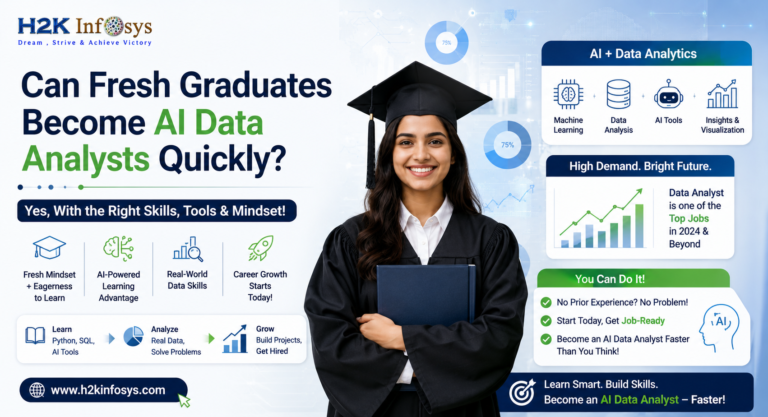
Everyday, the business generates huge data. They need people who can clean that data, recognise trends, create dashboards and communicate findings clearly.
The value of AI Data Analysts is their ability to blend traditional analytics with modern AI tools. Instead of spending hours writing repetitive reports, they can use Generative AI to speed up documentation, summarise insights, and automate menial tasks.
For instance:
- A retail company can use AI for forecasting customer demand.
- A hospital can study patient trends.”
- A bank can see unusual transactions.
- An e-commerce business can customise recommendations.
In all these situations, AI Data Analysts assist in converting raw data into actionable business decisions.
What are the first skills that new graduates need to learn?
If you are starting from scratch focus on these core areas:
1. Spreadsheets and Excel
Excel remains a major part of the reporting and analysis process for many companies.
2. Structured Query Language (SQL)
SQL is one of the main skills for AI Data Analysts. It allows you to get, filter and analyse data from data-bases.
3. Python
Python is popular for data cleaning, automation, and visualisation.
4. Data Visualization
Power BI and Tableau are tools that help analysts articulate insights clearly.
5. Statistics: An Introduction
You don’t need advanced maths at first but it’s important to understand averages, distributions, trends and correlations.
6. Generative AI Skills
And that’s a major advantage for AI Data Analysts in learning how to use AI tools effectively.
How Gen AI Online Course Benefits Data Analyst
The structured Data Analyst with Gen AI Online Course can dramatically reduce the learning curve.
Instead of students spending months looking for random tutorials, they are walked through a path that features:
- SQL practice
- Excel projects
- programming in python
- Dashboards Power BI
- Tableau visualisation
- Fundamentals of statistics
- Prompt engineering
- AI-enabled analytics workflow
- End Projects
For many beginners the problem is not that the subjects are impossible, but that they do not know what to learn first.
H2K Infosys: Hands-On Learning Approach
One of the reasons many fresh graduates join H2K Infosys is the practical learning as against just theory.
Students work on actual business cases like:
- Interpreting Sales Results
- Customer segmentation
- Creation of KPI dashboards
- Data Cleaning Initiatives
- Exercises in forecasting.
- Business reporting.
This hands-on experience allows aspiring AI Data Analysts to create a portfolio to demonstrate to potential employers.
Is 3-6 Months Enough Time to be Job-Ready?
A lot of new graduates, yes.
A realistic timeline might be something like:
| Period of Time | Concentration Area |
| Month 1 | Excel, SQL fundamentals |
| Month 2 | Intermediate SQL, Data Wrangling |
| Month 3 | Basics of Python |
| 4th Month | Power BI vs Tableau |
| Month 5. | Generative AI for analytics |
| Month 6 | Portfolio projects and interview prep |
If you are a person that studies 2-3 hours per day, you can often be job-ready in 2-3 hours.
Real World Experience
Take a new graduate, for example, who studied commerce, not computer science.
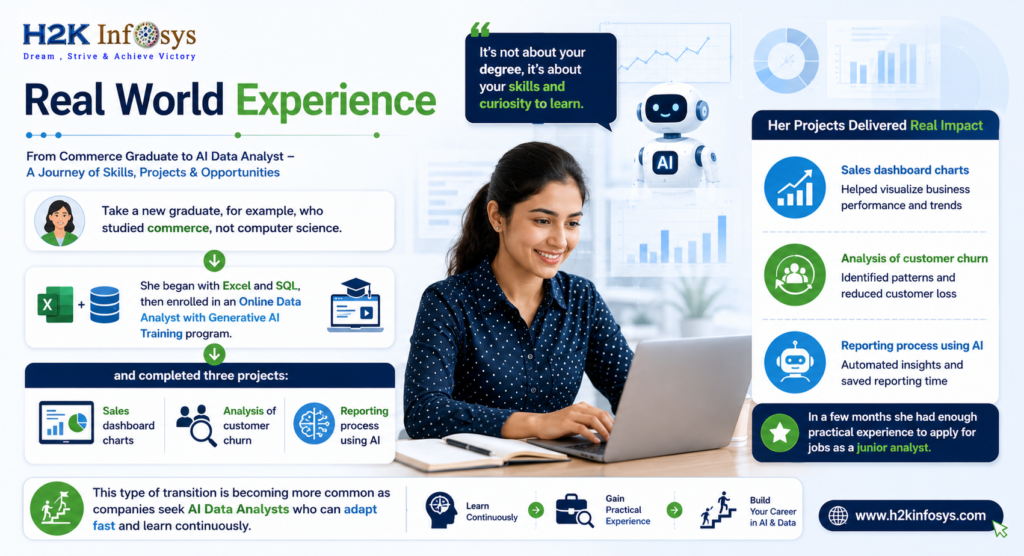
She began with Excel and SQL, then enrolled in an Online Data Analyst with Generative AI Training program, and completed three projects:
- Sales dashboard charts
- Analysis of customer churn
- Reporting process using AI
In a few months she had enough practical experience to apply for jobs as a junior analyst. This type of transition is becoming more common as companies seek AI Data Analysts who can adapt fast and learn continuously.
How Generative AI Training is a Game Changer for Online Data Analyst
But learning by yourself can definitely work; it usually just takes longer. Many new graduates spend weeks watching random videos, flipping back and forth between tutorials and still don’t know how it all fits together. Confusion is over with a structured Online Data Analyst with Generative AI Training program with a step-by-step roadmap based on industry expectations.
Rather than learning isolated topics, students see how SQL, Python, Excel, Power BI, Tableau, statistics and Generative AI come together in actual business settings. And this practical experience is exactly what employers look for when hiring AI Data Analysts.
Generative AI is transforming the role of AI data analysts.
One of the biggest changes in analytics in recent years has been the rise of generative AI. AI is helping analysts become more productive, not replacing them.
Today’s AI Data Analysts use Generative AI tools to:
- Propose SQL Query
- Interpreting Python errors
- Write documentation faster
- Review reports.
- Create dashboard descriptions.
- Create business insights
- Automate repetitive reporting tasks
But it’s worth noting that AI can never replace human judgement. Businesses still need AI Data Analysts to validate results, identify trends and communicate recommendations that support organisational goals.
For instance, an AI tool may discover a pattern in the buying behaviour of customers but it takes a savvy analyst to decide if that pattern is significant, seasonal or the result of outside forces.
Biggest Mistakes New Grads Should Avoid
There are tonnes of wannabe AI Data Analysts who end up sabotaging their own growth with easily avoidable mistakes.
- Trying to Learn Too Many Tools at Once: It is a frustrating experience trying to learn 10 different technologies at once. Concentrate on one skill at a time before moving on to the next.
- Ignorance in Business Understanding: Analysts aren’t hired to write code, but to solve business problems. Ask, “What business question am I trying to answer?”
- Skipping Project: Certificates are good, but employers are much more interested in practical work. Building projects show you can use your knowledge in real life situations.
- Completely Dependent On AI: Generative AI is a powerful aide, but successful AI Data Analysts verify all results rather than accepting AI-generated answers at face value.
- Poor communication skills: The best analysis is of little value if it cannot be explained clearly. Practice communicating findings in plain language that non-technical stakeholders can understand.
How H2K Infosys helps fresh graduates to build employability skills
A strong training program is more than teaching software. It prepares students for the expectations of actual employers
H2K Infosys ensures practical learning through:
- Live instructor-led class
- Analytics projects in the real world
- SQL & Python exercises
- Tableau and Power BI dashboard development
- Resume optimization
- Practice Interviews
- Career counselling
- Development of a portfolio
Students learn how to responsibly use AI tools in their workflow as a way to be more efficient without losing analytical rigour. This mix of technical know-how and hands-on experience helps aspiring AI Data Analysts to differentiate themselves in the competitive job market today.
Trends in the Industry Today, 2026
As organisations continue to invest in artificial intelligence and data-driven decision making, the demand for AI Data Analysts is increasing.
A few trends are shaping the industry:
- Businesses are embedding Generative AI into reporting processes.
- Companies like analysts who understand traditional analytics and AI-assisted tools.
- Cloud-based analytics platforms are becoming commonplace across industries.
- Candidates are assessed more on the basis of portfolio projects than academic qualifications, more often than not.
- Skills in data governance and responsible AI practices are the table stakes.
These trends show that the fresh graduates starting their learning curve today are entering the market at an exciting time with opportunities across many different sectors.
Fresh Graduates Salary Expectations
Your salary depends on where your home is, what you do and how good you are with technology. If you are a new graduate with solid SQL, Python, visualisation, and AI skills, your earning potential will be higher than with purely theoretical knowledge.
With experience, AI Data Analysts can move into roles like:
- Senior Data Analyst
- Business Intelligence Analyst
- Analytics Consultant
- Machine Learning Analyst
- Data Scientist
- Analytics Manager
Continuous learning is one of the most important factors for career growth over the long term.
How to Get Your First Job as an AI Data Analyst
If you want to land an entry-level position quickly, here are some practical steps:
- Learn basics of SQL.
- Get help with Excel.
- Learn Python programming language.
- Develop interactive dashboards in Power BI and Tableau.
- Complete at least four real-world analytical projects.
- Learn to use Generative AI wisely and well.
- Create a LinkedIn profile for professionals, to show your projects.
- Practise giving explanations of your work in mock interviews.
- Keep building your portfolio with new business case studies.
- Keep up with the latest in analytics and AI.
It is the consistency that matters more than the speed. A few hours a day, so dedicated, can add up to serious results in months.
FAQs
Is it possible for a non-tech graduate to become AI Data Analyst?
Of course. Successful AI Data Analysts come from backgrounds in commerce, business, economics, mathematics or even the humanities. The most important is to develop practical analytical skills and build a strong project portfolio.
Is it mandatory to code?
Basic knowledge of SQL & Python is highly appreciated. You don’t have to be a software engineer, but knowing these tools makes you a more effective analyst.
Will generative AI replace data analysts?
No, generative AI increases efficiency by automating repetitive tasks, but human analysts are still required for interpreting results, validating insights, and making business recommendations.
How long before you’re ready to work?
Many new graduates can be ready for entry-level roles within three to six months with consistent effort and structured learning.
Why H2K Infosys?
H2K Infosys provides instructor-led training, practical projects, career support and interview preparation to equip students with skills and confidence that are industry-ready.
Conclusion
Fresh graduates no longer require years of experience to have a successful analytics career. The combination of hands-on learning, portfolio development and Generative AI has created faster access to the profession than ever before.
Demand is growing for AI Data Analysts as organisations seek professionals who can responsibly utilise AI tools to transform data into actionable insights for their business. Graduates can position themselves for long-term success by building strong foundations in SQL, Python, Excel, data visualisation, and statistics, and learning how to work with Generative AI.
Opting for a comprehensive Online Data Analyst with Gen AI Course and the feature-rich Online Data Analyst with Generative AI Training at H2K Infosys, you are provided the guidance, hands-on experience, and career preparedness to confidently enter today’s AI-powered analytics arena. The future belongs to the professionals who can combine analytical thinking and modern AI capabilities – and there’s never been a better time to start that journey.