Introduction
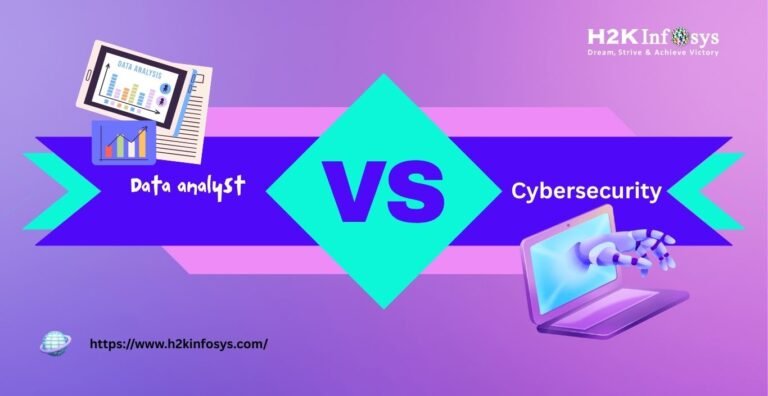
The comparison between Data Analyst vs Cyber Security centres on two fundamentally different career objectives. Data Analytics course focuses on interpreting data to support business decisions, while Cyber Security focuses on protecting systems, networks, and information from threats. The best career choice depends on an individual’s analytical aptitude, technical background, and long-term professional goals rather than market hype alone.
Understanding Data Analyst vs Cyber Security at a High Level
At a strategic level, Data Analyst vs Cyber Security represents the difference between insight generation and risk prevention. Both roles are critical to modern organizations, but they operate in different layers of enterprise technology and business operations.
Data analysts uncover insights from data to support business decisions by explaining what happened and why. They typically use tools like SQL, Python, and Power BI to identify patterns, create reports, and support strategy.Cybersecurity professionals, on the other hand, focus on protecting systems and data from threats. Their work involves defense, continuous monitoring, and incident response to prevent future attacks, using tools for network security, vulnerability management, and threat detection.
In short, Data Analyst vs Cyber Security is centered on interpretation and business impact,Data Analyst vs Cyber Security while cybersecurity is centered on protection and risk reduction. However, both fields require strong analytical thinking, handle large datasets, and can overlap in areas like threat intelligence and security analytics.
A data analyst asks:
- What happened?
- Why did it happen?
- What is likely to happen next?
A cyber security professional asks:
- What can go wrong?
- Where are systems vulnerable?
- How can attacks be prevented or contained?
This distinction shapes the skills, tools, and career trajectories of each role.
Neither Data Analytics nor Cybersecurity can be labeled as inherently “easier” the right choice depends largely on your interests, strengths, and long-term career goals. Data Analyst vs Cyber Security often feels more approachable to those who enjoy mathematics, statistics, coding, and recognizing patterns in data, making it a more math- and analysis-oriented field. Cybersecurity, on the other hand, appeals to individuals who enjoy defending systems, solving complex problems, and continuously adapting to new and evolving security threats, making it more network- and defense-focused.
Data Analytics can become more streamlined over time as AI and automation handle repetitive tasks, allowing professionals to focus more on interpreting insights and supporting business decisions. Analyst vs Cyber Security remains a constant challenge, as new vulnerabilities and attack techniques emerge regularly, requiring ongoing learning and vigilance.
Choose Data Analytics If:
- You enjoy math and statistics and like working with models, forecasts, and trends
- You are comfortable with coding, especially Python, R, and SQL
- You prefer a structured learning path with defined tools and methodologies
- Your goal is to analyze data, uncover insights, and influence business strategies
Choose Cybersecurity If:
- You enjoy defensive problem-solving and protecting systems from attacks
- You like varied challenges across networks, policies, ethical hacking, and incident response
- You want quicker entry into the field through certifications like CEH or CompTIA
- Your goal is to secure digital assets and stay ahead of cyber threats
Key Differences in Difficulty:
- Entry level: Cybersecurity often allows faster entry through certifications
- Long term: Data Analytics may feel easier as automation increases, while Data Analyst vs Cyber Security requires continuous adaptation to evolving threats
Ultimately, the best choice is the field that genuinely excites you. Both Data Analytics and Cybersecurity demand strong technical skills, curiosity, and a commitment to lifelong learning to succeed.
Core Purpose: Business Intelligence vs Digital Defense
When evaluating Data Analyst vs Cyber Security, it is important to understand each role’s core mission within an organization.
Data Analytics exists to improve:
- Business efficiency
- Revenue growth
- Customer experience
- Strategic planning
Cyber Security exists to protect:
- Confidential data
- System availability
- Organizational reputation
- Regulatory compliance
While both roles work with data, their end goals differ significantly. Data analysts extract meaning from data, whereas cyber security professionals focus on safeguarding it.
Daily Responsibilities in Data Analytics Roles
A practical comparison of Data Analyst vs Cyber Security begins with day-to-day responsibilities. Data analysts typically work in structured business environments and follow predictable analytical workflows.
Common responsibilities include:
- Gathering data from databases and business systems
- Cleaning and transforming raw data
- Writing SQL queries to extract insights
- Performing statistical analysis
- Creating dashboards and reports
- Presenting findings to stakeholders
Professionals enrolled in a Data Analytics course learn how to translate raw data into actionable insights that influence business decisions.

Daily Responsibilities in Cyber Security Roles
In the Data Analyst vs Cyber Security comparison, cyber security roles are more reactive and operational. The work environment is often dynamic and incident-driven.
Typical responsibilities include:
- Monitoring networks and systems for threats
- Analyzing security logs and alerts
- Conducting vulnerability assessments
- Responding to security incidents
- Implementing security controls
- Supporting compliance and audits
Cyber security professionals must remain alert and adapt quickly to emerging threats.
Skill Requirements: Analytical Thinking vs Technical Defense

One of the most important differences in Data Analyst vs Cyber Security analyst lies in the skills required to succeed.
Skills for Data Analytics
A recognized Data Analytics certification emphasizes both technical and analytical capabilities, including:
- SQL and database querying
- Data cleaning and preprocessing
- Statistical analysis
- Data visualization
- Business interpretation
- Communication and reporting
Most analytics classes online are designed to build these skills progressively, making them accessible to beginners.
Skills for Cyber Security
Cyber security roles demand deeper technical expertise:
- Networking fundamentals
- Operating system security
- Threat modeling
- Security monitoring tools
- Incident response procedures
- Risk and compliance knowledge
The technical depth required is generally higher compared to data analytics.
Learning Curve and Accessibility for Career Switchers
From an entry-level perspective, Data Analyst vs Cyber Security presents very different learning curves.
Analyst vs Cyber Security is widely regarded as more accessible for:
- Non-IT professionals
- Business graduates
- Working professionals transitioning careers
Structured data analytics training programs typically begin with foundational concepts and gradually introduce advanced analysis.
Cyber Security, on the other hand, often assumes prior exposure to:
- Networks
- Servers
- IT infrastructure
As a result, beginners without a technical background may find the initial learning phase more challenging.
Tools and Technologies Used in Each Career
The tools used further highlight the contrast in Data Analyst vs Cyber Security.
Data Analytics Tools
Professionals trained through Data analytics classes online commonly work with:
- SQL databases
- Spreadsheet tools
- Python for analysis
- Visualization platforms
- Business intelligence dashboards
These tools are widely adopted across industries and are business-focused.
Cyber Security Tools
Analyst vs Cyber Security professionals rely on:
- Network monitoring systems
- SIEM platforms
- Vulnerability scanners
- Endpoint protection tools
- Forensics and investigation software
These tools are more specialized and often require role-specific expertise.
Career Progression and Long-Term Growth
Career growth is another important factor when comparing Data Analyst vs Cyber Security.
Data Analytics Career Path
After completing a Data Analytics course, professionals typically progress through roles such as:
- Junior Data Analyst
- Data Analyst
- Senior Data Analyst
- Analytics Consultant
- Analytics Manager or Data Scientist
The path is flexible and allows movement into business, strategy, or advanced analytics roles.
Cyber Security Career Path
Cyber security career paths are more specialized:
- Security Analyst
- SOC Analyst
- Security Engineer
- Penetration Tester
- Security Architect or Manager
Advancement often depends on certifications, experience, and continuous technical upskilling.
Industry Demand and Job Stability
From a market perspective, Data Analyst vs Cyber Security reflects two different demand drivers.
Data Analytics demand is fueled by:
- Digital transformation
- Data-driven decision-making
- Growth in enterprise data volumes
Organizations increasingly seek professionals with data analytics training and placement support to meet business intelligence needs.
Cyber Security demand is driven by:
- Increasing cyber threats
- Regulatory compliance requirements
- Digital infrastructure expansion
However, entry-level opportunities are typically more available in data analytics than in cyber security.
Work Environment and Lifestyle Considerations
Lifestyle and work environment play a significant role in choosing between Data Analyst vs Cyber Security.
Data analysts generally experience:
- Predictable work schedules
- Project-based workloads
- Collaborative business environments
Cyber security professionals may face:
- On-call responsibilities
- Shift-based monitoring
- High-pressure incident response situations
Individuals seeking stability often prefer data analytics, while those who enjoy fast-paced technical challenges may gravitate toward cyber security.
Salary Growth and Career Sustainability
While salary is not the only factor, it remains an important consideration in Data Analyst vs Cyber Security discussions.
Data Analytics salaries:
- Grow steadily with experience
- Increase with domain expertise
- Benefit from cross-industry applicability
Cyber Security salaries:
- Can be high at senior levels
- Often depend on specialization
- Require ongoing certification and skills updates
Both careers offer strong long-term earning potential when paired with continuous learning.
Choosing the Right Path as a Working Professional

For working professionals evaluating Data Analyst vs Cyber Security, data analytics often provides a smoother and more structured entry into IT.
Reasons include:
- Faster onboarding
- Business-aligned skill sets
- Broader job availability
- Flexible learning through analytics classes online
Cyber security may be better suited for individuals with existing IT infrastructure or networking experience Analyst vs Cyber Security.
How H2K Infosys Supports Data Analytics Career Goals
H2K Infosys focuses on preparing professionals for real-world roles through practical learning.
Its Data Analytics course emphasizes:
- Industry-aligned curriculum
- Hands-on project experience
- Instructor-led sessions
- Career readiness and placement guidance
The objective of Data analytics training and placement programs is to ensure learners can apply analytical skills effectively in professional environments.
FAQs
1.What is the main difference between a Data Analyst and a Cyber Security professional?
A Data Analyst focuses on collecting, analyzing, and interpreting data to support business decisions, while a Cyber Security professional protects systems, networks, and data from cyber threats and security breaches.
2.Which career is better: Data Analyst or Cyber Security?
Both careers offer excellent opportunities. Analyst vs Cyber Security is ideal for those interested in data-driven decision-making, while Cyber Security is better suited for individuals passionate about information security, risk management, and protecting digital assets.
3.What does a Data Analyst do?
A Data Analyst gathers, cleans, analyzes, and visualizes data using tools such as SQL, Excel, Python, Power BI, and Tableau to generate business insights.
4.What does a Cyber Security professional do?
Analyst vs Cyber Security professionals monitor systems, identify vulnerabilities, prevent cyberattacks, respond to security incidents, and ensure compliance with security standards.
5.Is coding required for both careers?
Analyst vs Cyber Security typically use SQL and Python or R, while Cyber Security professionals may use Python, Bash, PowerShell, or other scripting languages depending on their role.
Conclusion
When evaluating Data Analyst vs Cyber Security, there is no universally superior option. Each career serves a different organizational need and aligns with different professional strengths.
Both Data Analytics and Cybersecurity offer strong career prospects, but the best choice depends on your skills, interests, and career goals. Data Analytics is ideal for those who enjoy interpreting data, identifying trends, and driving business decisions using tools like SQL, Python, Power BI, and Tableau. Cybersecurity suits individuals who are passionate about protecting systems, networks, and data from threats, requiring skills in ethical hacking, network security, and risk management. Ultimately, your decision should align with your personal strengths, long-term growth aspirations, and the type of impact you want to make in the tech world.