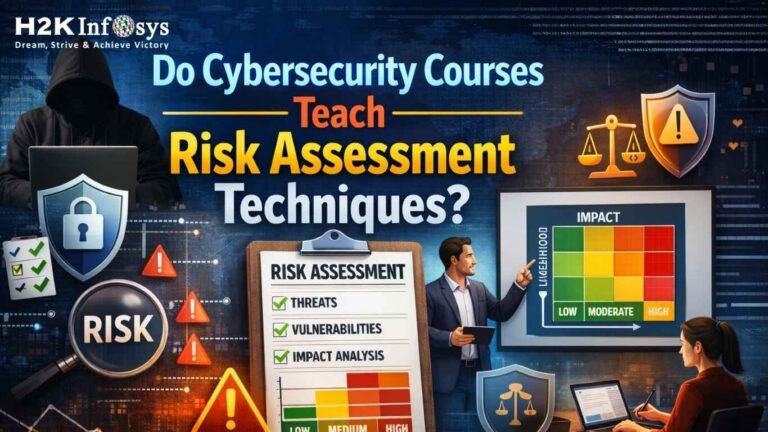
Yes, good cybersecurity courses including programs aligned with H2K Infosys absolutely teach risk assessment techniques, because risk assessment is the backbone of real-world security work. If you can’t identify, measure, and prioritize risks, you can’t protect systems properly. In fact, most modern programs that focus on cybersecurity training and placement treat risk assessment as a core, job-ready skill rather than just theory.
Why Risk Assessment Is a Big Deal in Cybersecurity (Especially in 2026)
If you talk to anyone working in security right now SOC analysts, cloud security engineers, or even GRC specialists they’ll tell you the same thing: security isn’t about blocking everything. It’s about deciding what matters most to protect first.
And honestly, that’s where risk assessment lives.
With ransomware groups targeting hospitals, AI-driven phishing getting scary realistic, and cloud misconfigurations still causing breaches, companies don’t just want tool users. They want people who can think like risk evaluators.
Most organizations hiring for cyber security jobs with training specifically look for candidates who understand:
- Threat likelihood
- Business impact
- Asset value
- Compliance risk
- Operational risk
It’s not glamorous work, but it’s the reason security teams get budgets and leadership support.
What Risk Assessment Actually Looks Like Inside Cybersecurity Courses
Let me explain this the way I’ve seen it taught (and used) in real environments.
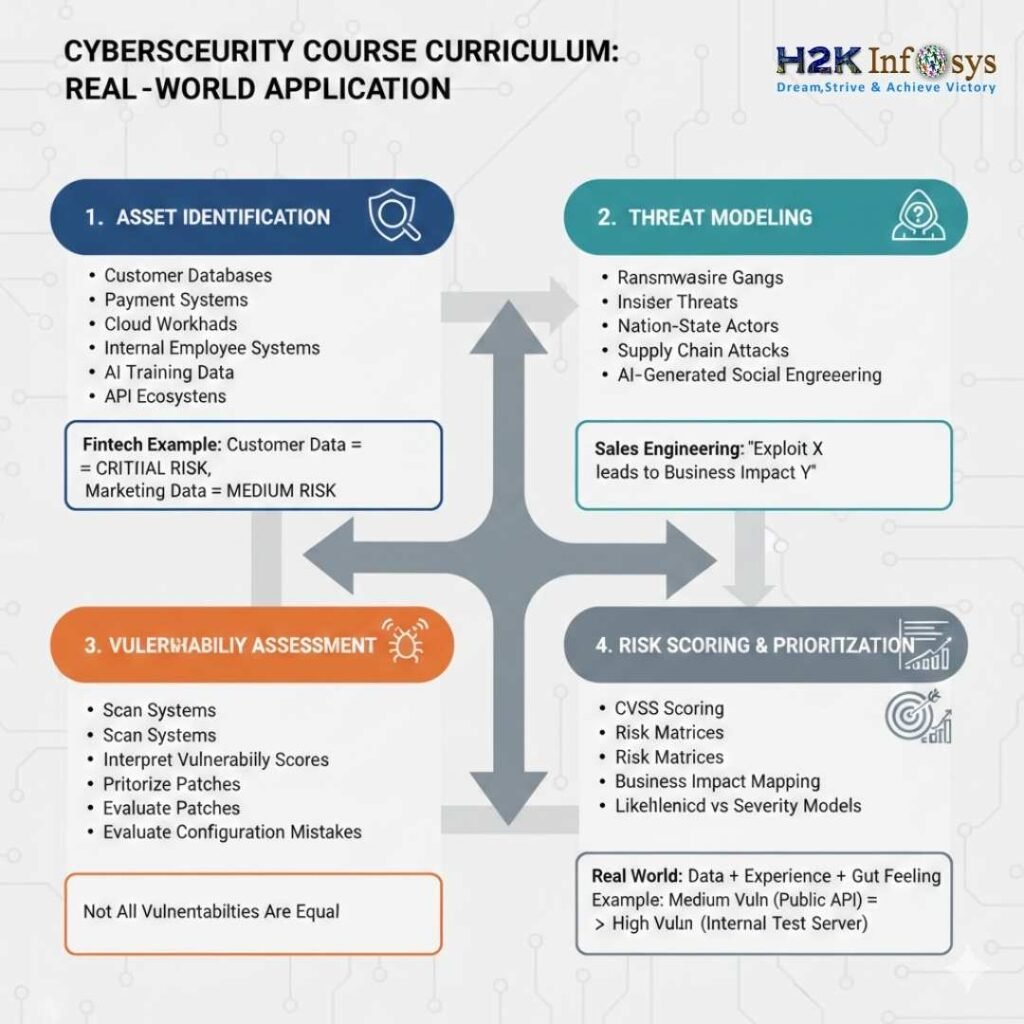
1️⃣ Asset Identification (What Are We Protecting?)
Courses usually start simple:
- Customer databases
- Payment systems
- Cloud workloads
- Internal employee systems
- AI training data (this one is huge now)
A few years ago, people focused mostly on servers. Now? Companies worry about data pipelines, AI models, and API ecosystems.
Real scenario:
A fintech company might treat customer identity data as “critical risk,” while marketing analytics data is “medium risk.”
2️⃣ Threat Modeling (Who Might Attack and How?)
Modern courses don’t just say “hackers exist.” They walk through:
- Ransomware gangs
- Insider threats
- Nation-state actors
- Supply chain attacks
- AI-generated social engineering
If you’re in cyber security sales training, you’ll notice this is also how security products are positioned. Sales engineers often translate risk into business language:
“Here’s what happens if this vulnerability gets exploited.”
That skill is surprisingly valuable.
3️⃣ Vulnerability Assessment (Where Are the Weak Points?)
This is where technical and non-technical learners usually start connecting the dots.
Courses teach how to:
- Scan systems
- Interpret vulnerability scores
- Prioritize patches
- Evaluate configuration mistakes
And not every vulnerability matters equally. That’s something beginners don’t always realize at first.
4️⃣ Risk Scoring and Prioritization
This is where things get interesting and honestly, a bit messy in real life.
Most training introduces:
- CVSS scoring
- Risk matrices
- Business impact mapping
- Likelihood vs severity models
But in real companies, decisions often mix data + experience + gut feeling.
Example:
A medium vulnerability on a public API might be fixed faster than a high vulnerability on an internal test server.
Real-World Example: How Risk Assessment Shows Up in Daily Security Work
Let’s say you’re working as a junior analyst after completing cybersecurity training and placement programs.
You might get a ticket saying:
“Critical vulnerability found in third-party payment plugin.”
You don’t just patch blindly. You ask:
- Is it internet facing?
- Is there exploit code available?
- Does it touch customer payment data?
- Is the vendor already working on a patch?
That thinking process = risk assessment in action.
Why Companies Care More About Risk Skills Than Tool Skills (Right Now)
Here’s something I’ve noticed over the past year: tools change fast. Risk thinking doesn’t.
Companies are shifting hiring focus toward:
- Security decision making
- Business risk communication
- Cross-team collaboration
- Compliance + technical balance
Especially for people entering cyber security jobs with training, showing you understand risk makes you stand out way faster than memorizing tool dashboards.
How Risk Assessment Is Taught Practically (Not Just Slides)
Good courses don’t just explain frameworks. They simulate real situations.
You might work on scenarios like:
- Cloud data exposure incident simulation
- Ransomware attack tabletop exercises
- Third-party vendor risk review
- Insider threat behavioral analysis
Some programs even use real breach case studies from the last 2–3 years, which honestly makes learning stick better.
Risk Assessment Frameworks You’ll Usually Learn
Most modern cybersecurity programs include exposure to:
NIST Risk Management Framework
Common in U.S. enterprise environments.
ISO 27001 Risk Methodology
Huge in compliance-driven industries.
FAIR Risk Model
More business-finance aligned risk modeling.
You don’t need to memorize everything. You need to understand how organizations think about risk.
The Sales Side of Risk (Often Overlooked)
If you’re exploring cyber security sales training, risk assessment becomes storytelling.
Sales engineers and security consultants often:
- Translate technical risk into financial risk
- Explain breach impact in dollars
- Help executives understand “why this matters”
It’s less about firewalls and more about business survival.
And honestly? Those roles are growing fast.
2026 Trend: AI Is Changing Risk Assessment
This part is evolving really fast.
Companies are now assessing risk in areas like:
- AI model poisoning
- Data leakage from LLM prompts
- Shadow AI tools employees use
- Synthetic identity fraud
Security teams now work closely with data science teams. That didn’t happen much five years ago.
Common Mistake Beginners Make About Risk Assessment
A lot of new learners think:
“Risk assessment = paperwork.”
It’s not.
It’s actually:
- Deciding patch timelines
- Influencing security architecture
- Helping leadership prioritize investments
- Preventing security teams from burning out chasing low-risk issues
If security teams fixed everything equally, nothing would ever get finished.
Do Employers Expect Risk Skills From Entry-Level Candidates?
Not expert level. But basic understanding? Yes.
For most cyber security jobs with training, employers want you to:
- Understand why risk matters
- Read vulnerability reports
- Communicate findings clearly
- Support senior analysts
You don’t need to lead a risk strategy on day one.
What Makes a Cybersecurity Course Good at Teaching Risk Assessment?
Look for programs that include:
✔ Real incident scenarios
✔ Risk scoring exercises
✔ Cloud security risk labs
✔ Compliance mapping practice
✔ Business impact analysis training
✔ Case study discussions (recent breaches, not outdated ones)
If it’s only slides + definitions, it’s probably not enough.
Final Thoughts
If I had to say this casually, risk assessment is where cybersecurity stops being “IT work” and starts being business protection.
And that’s why modern cybersecurity training and placement programs focus so much on it. Because tools will change. Attack techniques will evolve. But organizations will always need people who can answer: