Yes, H2K Infosys provides job placement support for AI courses in 2026. While the platform offers comprehensive training in AI and Machine Learning, they also assist learners with job placement by offering career guidance, resume building, interview preparation, and connecting them with potential employers in the tech industry.
This explores various aspects of AI training, including its relevance for career growth, the job roles that benefit from AI skills, and the career opportunities available post-training.
What Are AI Courses?
AI courses refer to structured learning programs that focus on imparting knowledge and skills related to artificial intelligence technologies. These courses cover areas like:
- Machine Learning (ML): Algorithms that enable systems to learn from data and improve over time without explicit programming.
- Deep Learning (DL): A subset of machine learning that uses neural networks with many layers to analyze complex data patterns.
- Natural Language Processing (NLP): Techniques for enabling machines to understand, interpret, and generate human language.
- Reinforcement Learning: A branch of ML focused on training models to make decisions by interacting with an environment.
AI courses are typically offered online, and some platforms like H2K Infosys combine theoretical knowledge with hands-on training. These programs are designed for professionals who aim to enhance their understanding of AI tools and concepts and apply them in real-world projects.
Do AI Courses Provide Job Placement Support with H2K Infosys?
Yes, H2K Infosys does provide job placement assistance as part of its AI certification programs. While it’s important to understand that no course can guarantee a job offer directly after completion, H2K Infosys supports students by offering job placement guidance, career counseling, and connections with potential employers.
Job placement support at H2K Infosys typically includes:
- Career Counseling: Experts help with resume building, interview preparation, and job search strategies.
- Interview Preparation: Mock interviews, interview coaching, and real-time feedback to ensure readiness.
- Networking Opportunities: Access to job fairs, recruitment drives, and industry connections that can lead to job openings.
- Real-World Projects: By working on practical, industry-relevant projects, students can enhance their portfolios, which are often key to landing jobs in AI.
What Skills Are Required to Learn AI?
Before enrolling in Ai Training Courses, it’s essential to have a foundational understanding of certain concepts. Although many AI courses are designed for beginners, professionals with a background in IT, programming, or data science will find them more accessible.
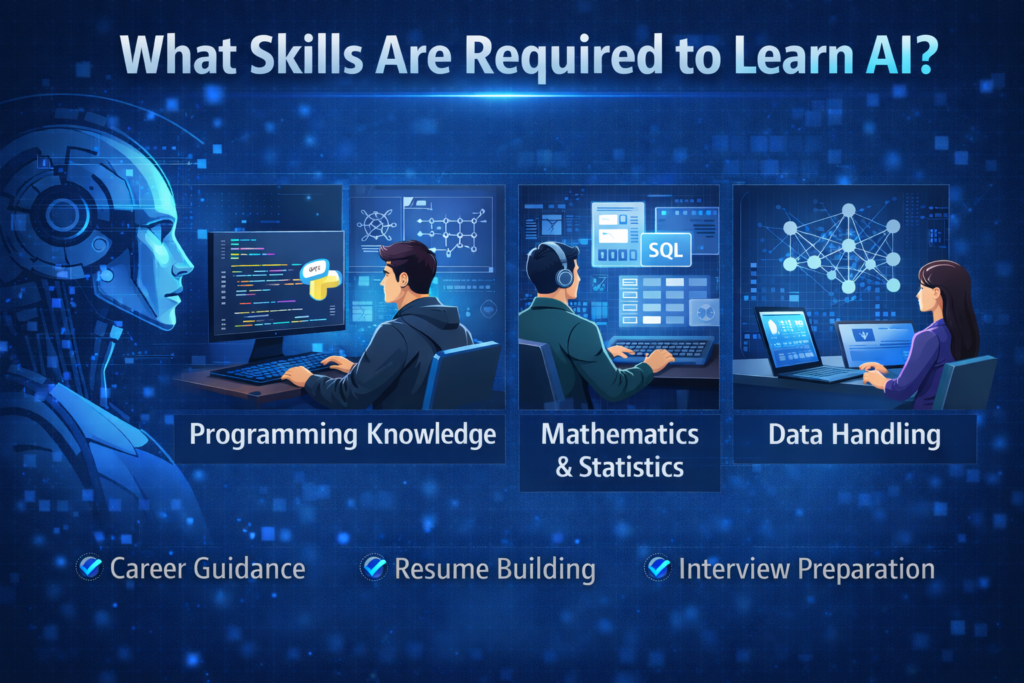
Key Skills Required:
- Mathematics & Statistics: Understanding linear algebra, calculus, probability, and statistics is crucial for grasping machine learning algorithms and data-driven approaches.
- Programming Languages: Knowledge of programming languages like Python, R, or Java is often a prerequisite for AI learning. Python, in particular, is widely used in AI development.
- Data Science Fundamentals: AI often involves working with large datasets. Understanding data cleaning, manipulation, and analysis is essential.
- Machine Learning Algorithms: Familiarity with supervised and unsupervised learning, neural networks, and decision trees is important for most AI projects.
Why Is AI Important for Working Professionals?
AI is no longer a futuristic technology but a present-day solution widely adopted across industries. Its ability to analyze data, make decisions, and automate processes has transformed how businesses operate. For working professionals, especially those in tech, finance, healthcare, and other data-driven fields, AI skills have become increasingly valuable.
Key Reasons for Professionals to Learn AI:
- Career Growth: AI skills significantly enhance job prospects, leading to better career advancement opportunities.
- Industry Demand: Companies across sectors are actively seeking AI professionals to improve operations, predict trends, and drive business decisions.
- Cross-Industry Applications: AI is used in diverse fields, from healthcare for disease prediction to finance for risk assessment and fraud detection.
- Increased Efficiency: AI skills allow professionals to automate tasks, making their work more efficient and impactful.
How Does AI Work in Real-World IT Projects?
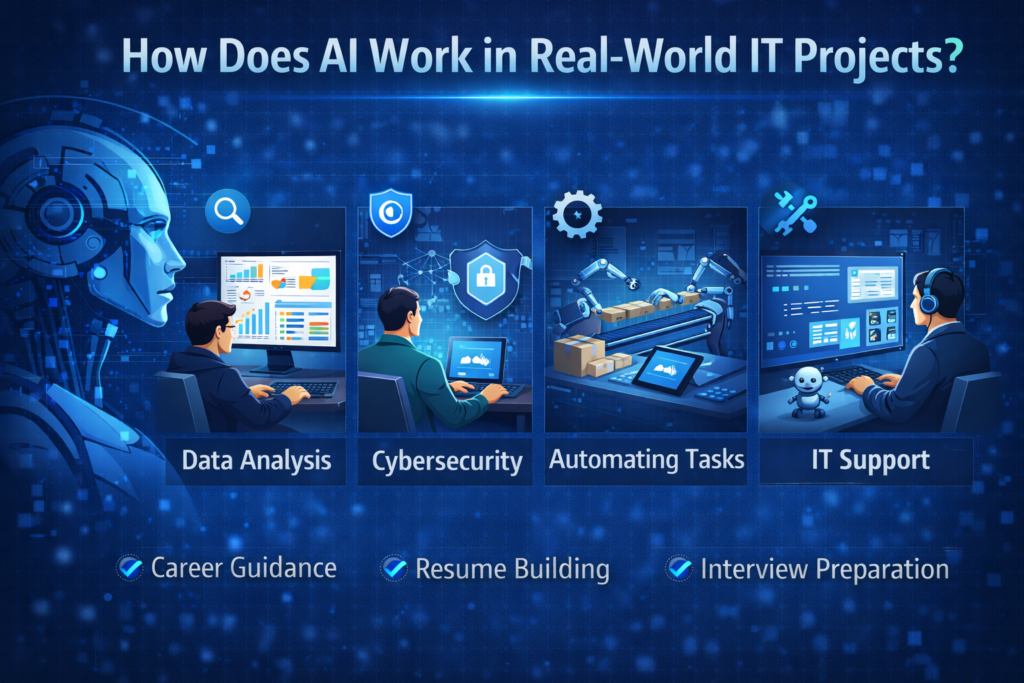
In real-world IT projects, AI is commonly integrated into applications to automate tasks, process data, or optimize decisions. Below is a breakdown of how AI technologies are used in enterprise environments:
1. Machine Learning in E-Commerce:
In e-commerce, machine learning models are used to recommend products to users based on their browsing history, purchases, and preferences. These models are continuously refined using new data, improving recommendation accuracy over time.
2. Natural Language Processing in Customer Service:
AI-powered chatbots use NLP to understand customer queries and provide automated support. These bots are trained to respond to a wide range of customer inquiries, reducing the need for human intervention and improving response times.
3. AI in Finance:
AI models are used in financial institutions to assess credit risk, predict stock market trends, and detect fraudulent activities. These systems can process vast amounts of data and provide insights that help businesses make informed decisions.
4. Autonomous Vehicles:
AI algorithms enable autonomous vehicles to make decisions based on sensor data, map data, and real-time information, ensuring the vehicle navigates safely and efficiently.
What Job Roles Use AI Daily?
AI skills are applied in a variety of job roles across industries. Here are some of the most common positions that rely on AI technologies:
1. Data Scientist
Data scientists analyze large datasets to extract actionable insights using machine learning and statistical methods. They often build predictive models and algorithms to drive business decisions.
2. Machine Learning Engineer
ML engineers design, implement, and maintain machine learning models. They work closely with data scientists to bring models from research to production.
3. AI Research Scientist
AI researchers focus on developing new algorithms and models that push the boundaries of AI. They may work in academic or industrial settings, contributing to advancements in the field.
4. AI Software Engineer
AI software engineers develop applications that use AI to solve real-world problems. They often work in industries like healthcare, finance, or e-commerce, where AI can significantly enhance processes.
5. Business Intelligence Analyst
BI analysts leverage AI tools to analyze business data and help companies make strategic decisions. They often use AI to create visualizations, perform trend analysis, and generate reports.
What Careers Are Possible After Learning AI?
After completing an Ai learning Courses, professionals can pursue various career paths, depending on their interests and expertise. Here are some possible career options:
1. AI Engineer
AI engineers focus on developing and deploying AI-based systems that can automate processes and solve complex business problems.
2. AI Consultant
AI consultants advise businesses on how to implement AI technologies to improve operations, increase efficiency, and innovate.
3. AI Product Manager
AI product managers are responsible for overseeing the development and deployment of AI-driven products. They work closely with engineering teams and stakeholders to ensure product success.
4. AI Solutions Architect
AI solutions architects design and implement AI solutions for businesses, ensuring that the technology meets business requirements and integrates with existing systems.
FAQ: AI Courses and Job Placement Support
Does H2K Infosys offer job placement assistance?
Yes, H2K Infosys provides job placement support through career counseling, interview coaching, and job placement resources. However, they do not guarantee immediate job placement.
What is the duration of H2K Infosys AI certification courses?
The duration of AI certification courses at H2K Infosys varies based on the course structure and mode of learning. On average, courses can last between 6 to 12 weeks.
Are H2K Infosys AI courses suitable for beginners?
Yes, H2K Infosys offers AI courses that cater to professionals with varying levels of expertise, from beginner to advanced.
What industries are hiring AI professionals?
Industries such as finance, healthcare, e-commerce, technology, automotive, and retail are actively hiring AI professionals to integrate AI into their business processes.
Key Takeaways
- H2K Infosys provides AI certification courses designed to help working professionals enhance their AI skills.
- Job placement support is available but does not guarantee immediate employment.
- AI skills are in high demand across various industries, including finance, healthcare, and e-commerce.
- Career opportunities in AI include roles like data scientist, AI engineer, and machine learning specialist.