Introduction
Yes, but not in the way most people think.
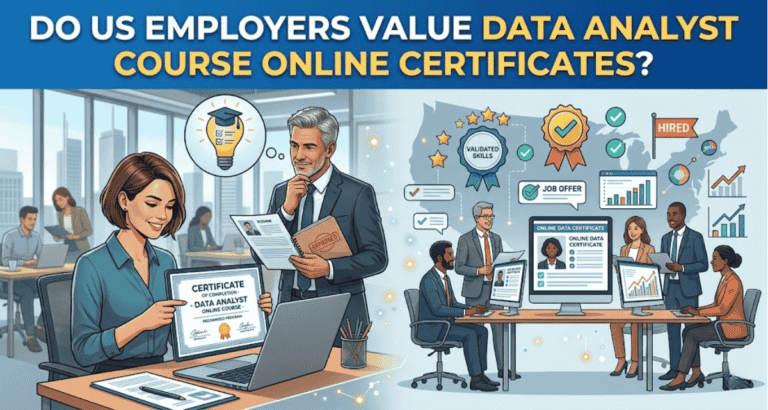
A data analyst course online can help you get noticed, especially if you’re starting out. But US employers don’t really care about the certificate itself; they care about whether you can actually work with data.
Do Employers Actually Value These Certifications?
This confused me at first, too.
You’d assume recruiters are scanning resumes looking for Data Analyst Course Online , but in reality, they’re looking for proof of skill.
Here’s how it usually plays out:
- A certificate helps you get past the first filter.
- Your projects decide if you move forward.
- Your explanations during interviews decide if you get hired.
So yes, certifications have value, but only as a starting point.
Where Certifications Actually Help
From what I’ve seen, they’re most useful when:
- You’re switching careers.
- You don’t have a technical background.
- You need a clear structure instead of random YouTube learning.
- You want something to show on your resume early on.
Without that structure, most beginners just get stuck or give up halfway.
Where They Don’t Help (This is Important)
This is where many people go wrong.
A certificate won’t help much if:
- You’ve only watched videos but never practiced.
- You can’t explain your own projects.
- You don’t understand why you used a certain method.
I’ve seen people complete full data analyst course online and still struggle in interviews because they skipped the hands-on part.
How a data analyst course online Actually Leads to a Job
Let me break this down in a realistic way.
Step 1: Learn the basics
You’ll usually start with:
- Excel
- SQL
- Some Python
- A visualization tool like Power BI
Nothing too crazy, but enough to get started.
Step 2: Work on projects
This is where things get real.
You might:
- Analyze sales data
- Build dashboards
- Find patterns in customer behavior.
These projects matter way more than your certificate.
Step 3: Build a portfolio
Think of this as your proof.
When employers ask, “What have you done?” this is your answer.
Step 4: Learn how to explain your work
Honestly, this part trips people up.
It’s not just about what you did, but also:
- Why did you do it
- What problem did you solve
- What insight did you find
Step 5: Start applying (strategically)
Not just random applications, targeted ones with tailored resumes.
Real-World Scenario
Let’s say someone from a non-IT background joins a data analyst course online.
They spend a few months learning tools, then build 3–4 solid projects.
During interviews, instead of saying
“I learned SQL…”
They say:
“I used SQL to analyze customer churn and found a 15% drop in retention after month three.”
That difference? It’s huge.
That’s what employers pay attention to.
Online Certification vs Degree
This is a common question.
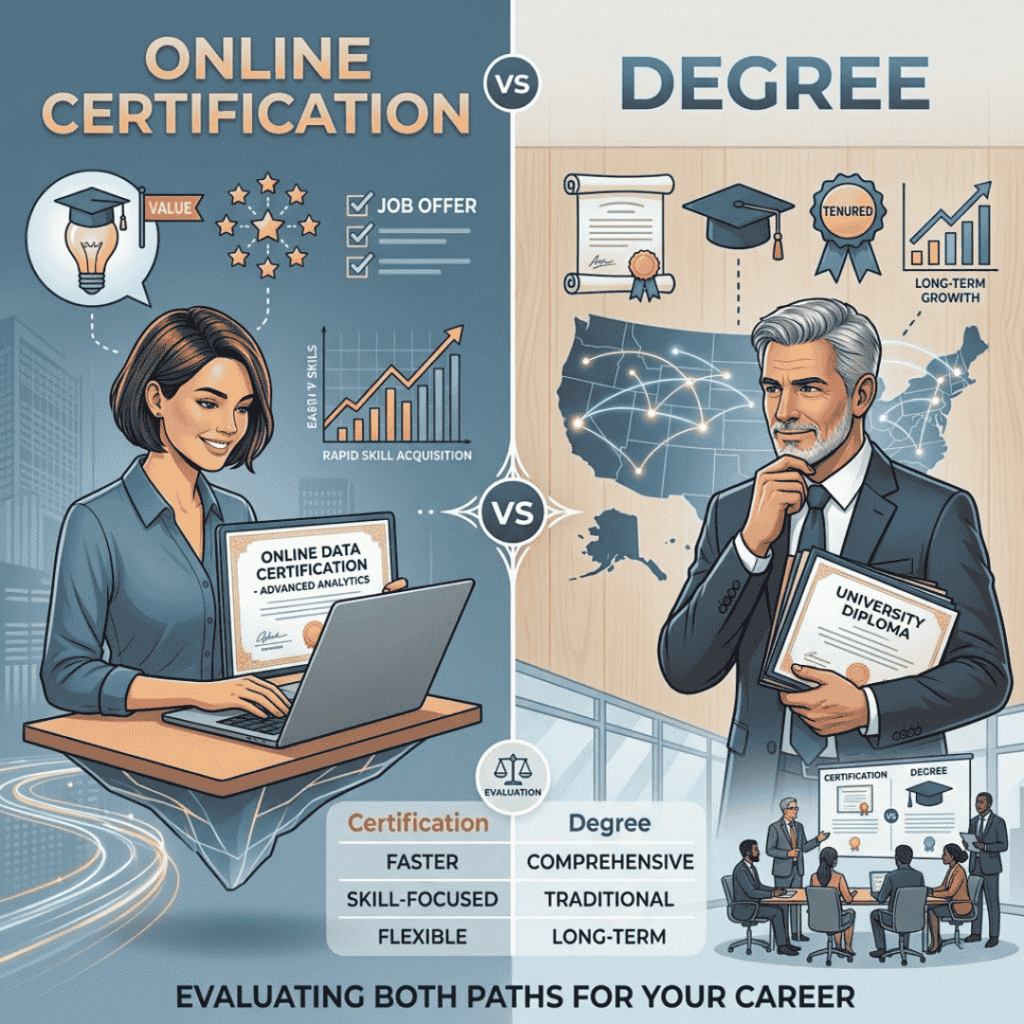
A traditional degree still has value, but it’s not the only path anymore.
Online programs are:
- Faster
- More practical (if done right)
- Focused on job skills
And in today’s market, skills are starting to matter more than formal education in many data roles.
Why Some data analyst course online Work and Others Don’t
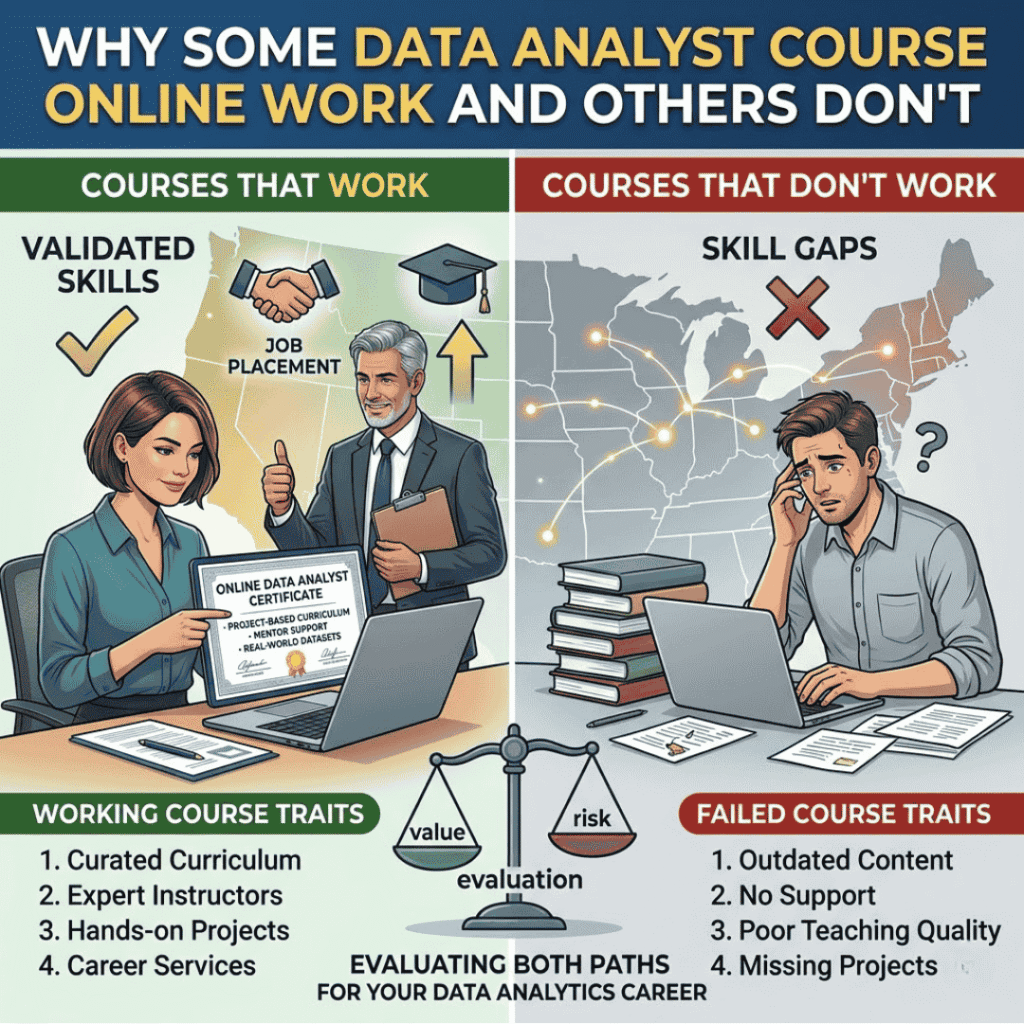
Not all data analyst course online are equal; this is something people realize too late.
Good programs usually include the following:
- Hands-on projects
- Real-world datasets
- Instructor support
- Interview preparation
Weaker ones are mostly:
- Pre-recorded videos
- No guidance
- No real application
That’s why structured programs like H2K Infosys tend to be more effective; they’re designed around job readiness, not just content delivery.
Career Outcomes (What You Can Expect)
If you stay consistent, this path can lead to roles like
- Data Analyst
- Business Analyst
- Reporting Analyst
Entry-level salaries in the US usually start around $60K–$80K and grow with experience.
And demand isn’t slowing down; companies rely on data more than ever now.
Common Mistakes Beginners Make
I see these all the time:
- Jumping between too many tools
- Avoiding SQL (big mistake)
- Focusing on completion instead of understanding
- Thinking that a certificate alone is enough.
If you avoid these, you’re already ahead of most people.
Quick Summary (TL;DR)
- Yes, certifications are useful but not enough on their own
- Employers care more about what you can do.
- Projects and real skills matter the most.
- A structured data analyst course online can make the process smoother.
- Focus on learning + applying, not just finishing a course.
Thinking About Getting Started?
If you’re serious about moving into a data analyst course online, having structure helps a lot.
Programs like H2K Infosys focus on:
- Hands-on training
- Real-time projects
- Job-oriented preparation
That combination tends to work better than trying to figure everything out alone.
Related Topics to Explore
You might also want to look into:
- How to build a strong data analyst portfolio
- SQL interview questions for beginners
- Power BI vs Tableau comparison
FAQs
Are online data analyst certifications worth it?
Yes, especially if you’re starting out, but only if they include real projects and practical training.
Can I get a job after completing a course?
You can, but only if you build strong projects and understand what you’ve learned.
What tools should I focus on first?
Start with Excel and SQL, then move to visualization tools and Python.
How long does it take to become job-ready?
Usually around 3–6 months with consistent effort.
Is structured training necessary?
Not always, but it can save you a lot of time and confusion if you’re new.
Final Thought
A data analyst course online can open the door, but your skills are what get you through it.
If you focus on real learning, practice, and projects, you’ll stand out no matter where you learned.