A career as an AI engineer is not an exception, with job postings involving AI having doubled over the previous two years. However, what are the competencies of an AI engineer, and what should you study to become one?
We will provide you with a summary of the most important AI engineer skills in this article.
Gaining expertise in AI engineering is essential for putting machine learning systems into operation. So, please continue reading if that’s of interest to you! If you’re looking to learn AI from scratch, check out our Artificial intelligence online course.
What is an AI Engineer?
An AI Engineer is a technology professional who designs, develops, tests, and deploys artificial intelligence systems and machine learning models. They use programming, data science, machine learning, deep learning, and generative AI techniques to build solutions such as chatbots, recommendation systems, predictive models, and AI-powered applications. Key AI engineer skills include Python, machine learning, deep learning, data handling, cloud platforms, APIs, and problem-solving.
The most important AI engineer skills include Python programming, machine learning, deep learning, data engineering, SQL, cloud computing, AI model deployment, MLOps, generative AI, AI security, and problem-solving. AI engineers also need practical experience with frameworks such as PyTorch and TensorFlow and cloud platforms such as AWS, Azure, or Google Cloud.
Essential AI Engineer Skills at a Glance
Essential AI Engineer Skills at a Glance include Python, machine learning, deep learning, data engineering, cloud computing, Generative AI, MLOps, and AI security. Developing these AI engineer skills can help professionals build, deploy, and manage practical AI solutions
| Skill | Why It Matters |
|---|---|
| Python | AI and ML development |
| Machine Learning | Building predictive models |
| Deep Learning | Developing neural networks |
| Data Engineering | Preparing and managing data |
| SQL | Working with databases |
| Generative AI | Building LLM-powered applications |
| Cloud Computing | Deploying AI solutions |
| MLOps | Managing models in production |
| AI Security | Protecting AI systems |
| Problem-Solving | Designing practical AI solutions |
Technical Skills of an AI Engineer
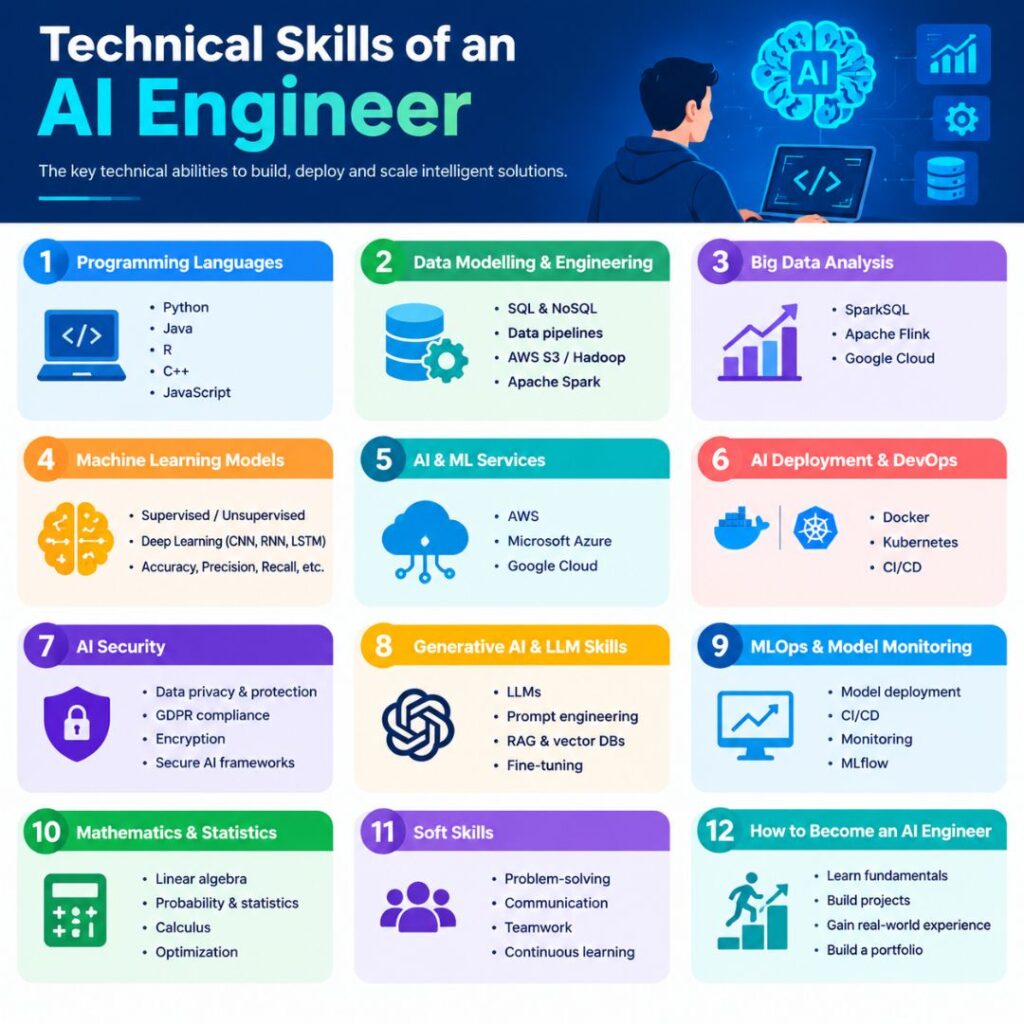
Let’s examine the technical abilities that most AI engineers have in order to gain a better understanding of their role AI engineer skills:
1. Programming Languages
It should go without saying that proficiency in programming languages is a must for an AI engineer.
The following are a few languages that are frequently used in AI development:
- Python
- Java
- R
- C++
- JavaScript
Python
Python’s large libraries for AI and machine learning, coupled with its simple syntax, make it a particularly popular language. Working with data, creating models, and creating algorithms all require an understanding of these languages.
Python programmers frequently utilize libraries like TensorFlow, Keras, and PyTorch for AI development. Image identification, natural language processing, and predictive analytics are some useful applications.
R
AI also makes extensive use of the R language, which is mainly used for statistical analysis and graphic depiction.
The R package ‘caret’ facilitates predictive modelling, and ‘e1071’ makes machine learning model creation easier. R is used in AI initiatives in the fields of social media analytics, finance, healthcare, and science.
Java
Another well-liked option for AI development is Java, mostly because of its strong user interaction features, readability, and simplicity.
It is appropriate for chatbot creation due to its robust memory management and the availability of many top-notch machine-learning packages, like Apache Open NLP and Stanford Library NLP.
Use cases for chatbots, website recommendation engines, and financial fraud detection are numerous.
C++
Machine learning and neural network computing can benefit from the low processing cost of C++, which enables the execution of high-level applications.
C++ libraries for machine learning include Shark and mlpack. Robotics, gaming, and computer vision tasks are examples of AI application cases.
2. Data modelling & engineering
AI engineers must possess a thorough understanding of data modelling and engineering since data is the basis of AI.
They ought to understand how to gather, purify, and prepare data so that it is ready for analysis. To query and manage huge datasets, one must be proficient in both SQL and NoSQL databases.
AI projects also frequently leverage tools like AWS S3, Hadoop, and Apache Spark for data processing.
3. Big Data Analysis
Large data sets should be analysed by AI engineers in order to derive insightful knowledge from them. This entails querying and manipulating huge databases using big data tools like SparkSQL, Apache Flink, and Google Cloud Platform.
4. Machine learning models
AI developers need to be familiar with machine learning models and algorithms.
This includes being aware of deep learning algorithms like recurrent neural networks (RNNs) and convolutional neural networks (CNNs), as well as supervised and unsupervised learning approaches.
Additionally, AI developers should be able to assess these models’ performance using metrics such as
- Accuracy
- Precision
- Recall
- Root-mean-square deviation (RMSE),
- Mean absolute error (MAE)
- F1 score
5. AI and ML services
Cloud-based AI and machine learning technologies provided by well-known providers like AWS, Azure, and Google Cloud Platform should also be familiar to AI engineers. Without requiring a lot of code, these services offer pre-built models, APIs, and tools for creating intelligent apps.
6. AI Deployment & DevOps
Working with DevOps teams to guarantee seamless integration and deployment is a necessary part of deploying AI applications.
AI engineers should be proficient with containerization, configuration management, and deployment orchestration using platforms like Docker and Kubernetes.
They are also in charge of keeping an eye on and preserving the functionality of AI systems after they have been deployed.
7. AI security
Any AI engineer must comprehend and put into practice robust data security and privacy protections since AI applications introduce new security flaws.
It is your duty as an AI engineer to guarantee the privacy, availability, and integrity of the data you work with.
This entails comprehending data protection laws, such as the General Data Protection Regulation (GDPR), and putting into practice safe artificial intelligence frameworks that abide by these laws.
AI engineers also need to be aware of safe AI model creation procedures, a variety of encryption techniques, and how to address security breaches or attacks.
8. Generative AI & Large Language Model Skills
Generative AI and large language models (LLMs) are increasingly important in AI engineering. AI engineers should understand how to build and integrate AI-powered applications using technologies such as:
- Large Language Models (LLMs)
- Prompt engineering
- Retrieval-Augmented Generation (RAG)
- Embeddings and vector databases
- Fine-tuning
- AI agents
- LLM evaluation
Familiarity with tools such as Hugging Face, PyTorch, LangChain, and cloud AI services can also be valuable.
9. MLOps & Model Monitoring
AI engineers need to know how to deploy and maintain machine learning models in production. Important MLOps skills include:
- Model deployment and versioning
- CI/CD for machine learning
- Model monitoring
- Data and model drift
- Docker and Kubernetes
- MLflow and experiment tracking
These skills help ensure AI models remain reliable after deployment.
10. Mathematics & Statistics for AI Engineering
A basic understanding of mathematics and statistics helps AI engineers understand and improve machine learning models. Important areas include:
- Linear algebra
- Probability and statistics
- Calculus
- Optimization
- Regression
- Hypothesis testing
11. Soft Skills for AI Engineers
Along with technical AI engineer skills, professionals need strong workplace skills, including:
- Problem-solving
- Analytical thinking
- Communication
- Teamwork
- Business understanding
- Adaptability
- Continuous learning
These skills help AI engineers work effectively with technical and business teams.
12. How to Become an AI Engineer
To become an AI engineer, follow a practical learning path:
- Learn Python and programming fundamentals.
- Build knowledge of mathematics and statistics.
- Learn machine learning and deep learning.
- Develop Generative AI and LLM skills.
- Learn cloud computing and MLOps.
- Build real-world AI projects.
- Create a portfolio and prepare for AI engineering roles.
Hands-on projects are especially useful because they help turn theoretical knowledge into practical AI engineering skills.
Some techniques used by AI engineers include:
- Multi-party processing for safe data exchange
- Differential privacy to safeguard specific information
- Secure computations using homomorphic encryption on encrypted data
Among the instruments for protecting AI applications are:
- You may securely control access to AWS resources with the help of the service known as AWS Identity and Access Management.
- TensorFlow Privacy is a package that makes it easier to create machine learning models that are safe and protect privacy.
Benefits of a Career in AI Engineering
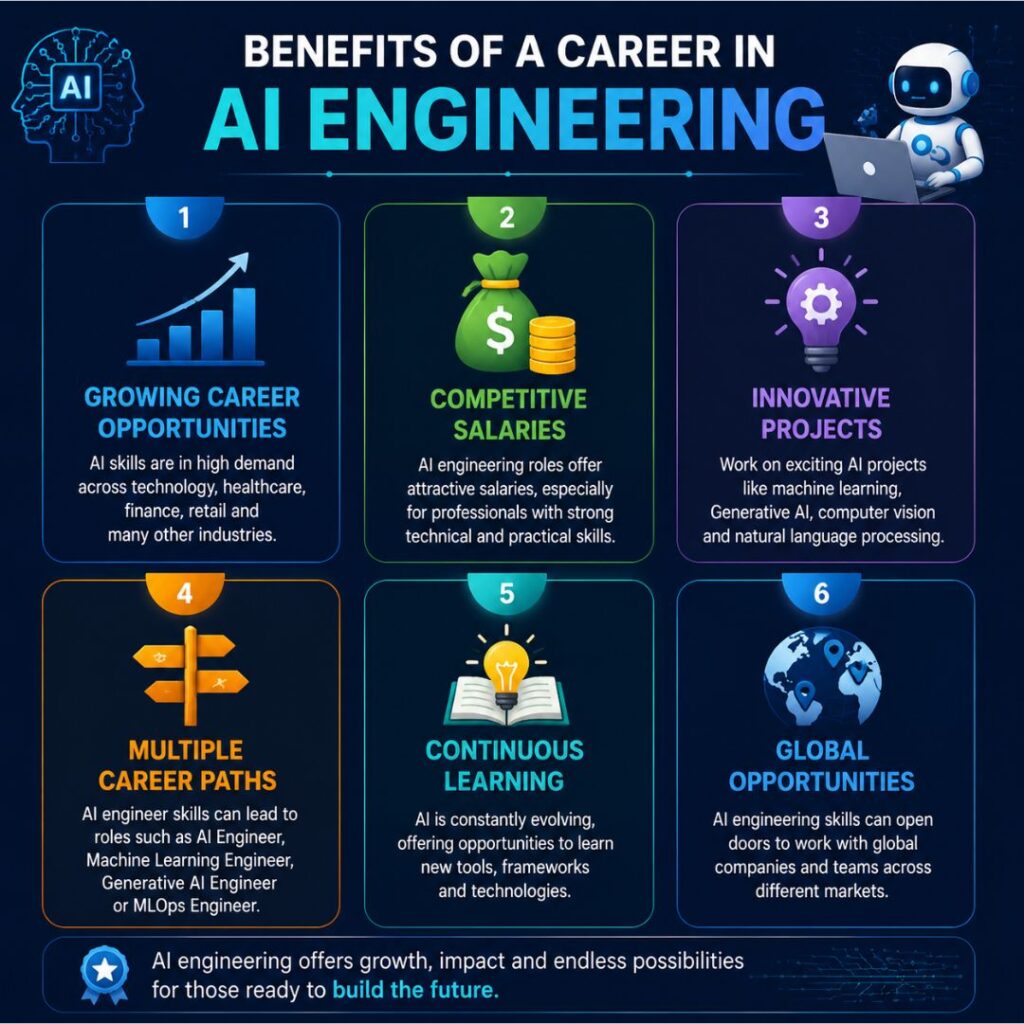
A career in AI engineering can offer strong opportunities as businesses continue adopting artificial intelligence and automation. Developing the right AI engineer skills can help professionals qualify for a wide range of roles and stay competitive in this rapidly evolving field.
- Growing Career Opportunities: AI skills are increasingly needed across technology, healthcare, finance, retail, and other industries.
- Competitive Salaries: AI engineering roles can offer attractive compensation, especially for professionals with strong technical and practical skills.
- Innovative Projects: AI engineers can work on machine learning, Generative AI, automation, computer vision, and natural language processing projects.
- Multiple Career Paths: AI engineer skills can lead to roles such as AI Engineer, Machine Learning Engineer, Generative AI Engineer, or MLOps Engineer.
- Continuous Learning: AI is constantly evolving, giving professionals opportunities to learn new tools, frameworks, and technologies.
- Global Opportunities: AI engineering skills can open opportunities with companies and teams working across different markets.
Conclusion
AI engineering is a rapidly growing field, and developing the right AI engineer skills can help you build a strong career in this area. From Python and machine learning to Generative AI, cloud computing, MLOps, and AI security, both technical and soft skills are important for success. If you’re looking to build practical Essential AI Engineer skills from the ground up, explore H2K Infosys’ Artificial Intelligence online course to continue your learning journey.
FAQs About AI Engineer Skills
What skills do you need to become an AI engineer?
The key AI engineer skills include Python, machine learning, deep learning, data engineering, SQL, cloud computing, MLOps, Generative AI, and problem-solving.
Is Python necessary for AI engineering?
Yes. Python is one of the most commonly used programming languages for AI and machine learning because of its extensive libraries and frameworks.
Does an AI engineer need to know mathematics?
Yes. A basic understanding of statistics, probability, linear algebra, calculus, and optimization helps AI engineers understand and improve machine learning models.
Do AI engineers need Generative AI skills?
Yes. Knowledge of LLMs, prompt engineering, RAG, embeddings, and AI agents is increasingly useful for building modern AI applications.
What tools do AI engineers use?
Common tools include Python, PyTorch, TensorFlow, scikit-learn, SQL, Docker, Kubernetes, MLflow, cloud platforms, and Generative AI frameworks.