First of all, starting your career in data analytics is a daunting task in itself with all the new technologies coming up every day. H2K Infosys helps learners build a strong foundation in analytics concepts, tools and real world skills to understand how data is collected, analysed and used to take business decisions. It is a good step today for anyone who wants to explore Data Analytics with Generative AI by combining the traditional analytics knowledge with modern technology.
Generative AI is transforming the analyst’s work by assisting them in data exploration, report creation, query assistance and faster pattern finding. To begin with, learning tools like Excel, SQL, Python and visualisation platforms, in addition to AI skills, can make you more productive and ready for jobs that are changing over time.
To build a career in Data Analytics with Generative AI, learn practically, keep honing the skills, and get hands-on experience in real business problems. By taking the right approach to learning, beginners can gain the technical and analytical skills to break into data analytics with confidence.
A career in data analytics is a great option in 2026
Businesses churn out massive amounts of data every single day. Companies are looking for experts who can take data and turn it into meaningful business insights from online shopping behaviours to health data to financial transactions.
Today’s Data Analytics professional does much more than generating reports. They are used to identify trends and improve customer experience, forecast sales and make strategic business decisions. Generative AI is helping to speed up these activities by assisting with SQL queries, suggestions for data cleaning, dashboard explanations and documentation.
“Across the industry, recent hiring trends suggest that employers are looking for people who can combine traditional analytics skills with AI-assisted workflows.
What is Generative AI in Data Analysis?
Data Analytics with Generative AI is a class of AI model that is able to produce text, code, summaries, visualisations, and analytical insights from a user prompt.
Analysts are now using AI to eliminate the need to write each SQL query or documentation page manually:
- Generate SQL queries
- Datasets Demystified.
- Summarise reports
- Propose visualisations
- Streamline repetitive tasks
- Create presentations for your business
- Improve data documentation
It is important to understand that AI does not replace analysts, it makes them more productive. Human judgement is still required to validate data quality, understand business context and make recommendations.
Data Analytics Skills Every Newbie Should Have
Before you begin your job search, work on laying a strong foundation.
| Skill | What is skill |
|---|---|
| Excel | data cleaning reporting formulas pivot tables |
| SQL | Retrieve and review business data |
| Python | for Data Wrangling & Automation |
| Dashboards | Interactive Power BI/Tableau Data Science Get insights into Business Metrics and Trends |
| Generative AI | Speedier analysis and report generation |
These skills complement each other and prepare beginners to work on real world Data Analytics projects.
Learning Roadmap: Data Analytics with Generative AI for Beginners
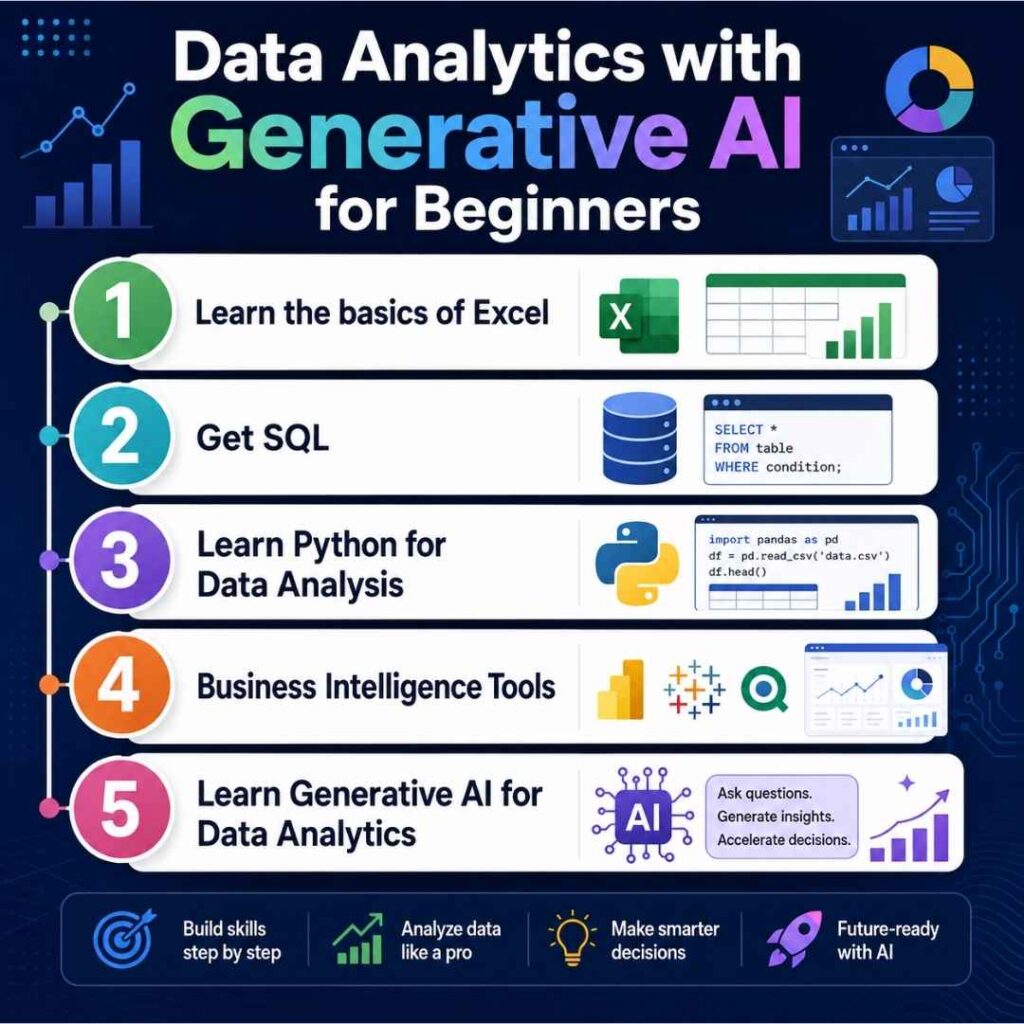
Follow this simple roadmap to learn Data Analytics with Generative AI, covering essential skills, tools, and practical steps beginners need to build a career in data analytics.
1. Learn the basics of Excel
One of the most popular tools in Data Analytics is still Excel.
You’ll learn to:
- Clean Data Sets
- Remove duplicates
- Create Pivots Tables
- Make charts
- The equations are
- preparing a business report
Many companies, even those with sophisticated BI platforms, still use Excel for their daily reports.
2. Get SQL
One of the most important technical skills in Data Analytics is SQL.
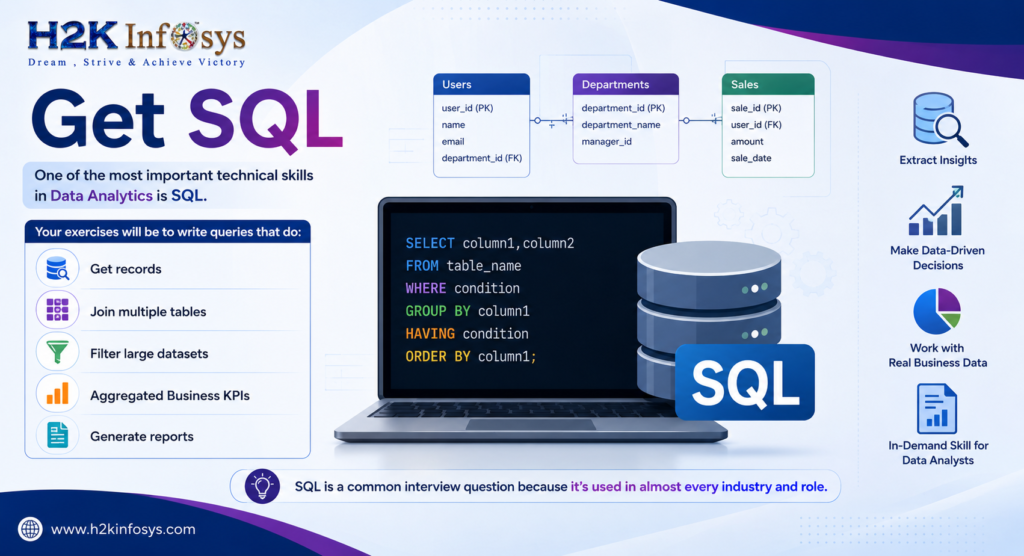
Your exercises will be to write queries that do:
- Get records
- Join multiple tables
- Filter large datasets
- Aggregated Business KPIs
- Generate reports
SQL is a common interview question because it’s used in almost every analytics job.
3. Learn Python for Data Analysis
Python can help you automate repetitive tasks and do data analysis on large data sets.
Typical libraries are
- Pandas
- NumPy
- Matplotlib
- Scikit-learn
Beginners can start with simple scripts and then move to more complex analytics.
4. Business Intelligence Tools
Visualisation is a major part of Data Analytics.
Common tools are:
- Microsoft Power BI
- Tableau
- Looker Studio
These platforms turn raw data into dashboards that are easy for business leaders to understand.
5. Learn Generative AI for Data Analytics
If you have some AI skills, you’re already ahead of the pack.
A good Data Analytics with Generative AI Course gives students –
- AI-assisted SQL generation
- Engineering design
- Information summaries, automated
- Dashboard descriptions
- AI-powered reporting
- “AI accountability
Being able to use AI smartly and check the results is turning into a more and more important skill at work.
Why Are Real-Time Projects Important in Data Analytics with Generative AI?
Employers don’t often recruit based solely on certificates.
They are looking for candidates for Data Analytics with Generative AI who have solved real business problems.
Examples are for example:
- Sales performance dashboard
- Customer churn analysis
- Retail inventory reporting
- Financial data KPI dashboards
- Health care analytics
- Marketing Campaign Analysis
These projects help you to understand how Data Analytics with Generative AI helps in business decisions.
Choosing the Best Data Analytics Certification
Not all certs give you the same amount of hands-on experience.
When comparing programs, consider the following:
| Feature | Basic Online Course | H2K Infosys Training |
| Live Instructor Sessions | Limited | Yes |
| Real Time Projects | Few | Yes |
| Extensive Generative AI Modules | Included | Yes |
| Career Mentoring | Limited | Provided |
| Resume Assistance | Yes | Yes |
| Mock Interviews | Sometimes | Yes |
| Job Placement Assistance | No | Yes |
| Varies | Provided |
A Data Analytics Certification with Gen AI should be a blend of theoretical concepts and real-world business scenarios, rather than just recorded lessons.
How H2K Infosys Assists Freshers
Many beginners face issues as they know theory but don’t get any practical exposure.
H2K Infosys meets this need by:
- Live classes with instructor
- Curriculum with an industry focus
- Data Analytics Projects in Practice
- Generative AI Learning Unit
- Writing a Resume
- Mock interviews (practice)
- Career Counselling
- Assistance in finding a job
Students don’t just do assignments; they work on project-based scenarios that are similar to real-world challenges in the workplace.
Common mistakes by beginners
There are a lot of common mistakes made by aspiring analysts that stunt them.
Some examples include:
- Trying to learn too many tools at the same time
- Ignoring SQL practice
- Statistics not shown
- Only using AI-generated answers
- Portfolio Projects
- Avoiding interview preparation.
The best way is to master one skill at a time.
Job Vacancies in Data Analytics
Once you are trained, there are many routes you can take in your career.
Popular jobs are:
- Data Analyst
- Business Analyst
- Reporting Analyst
- BI Analyst
- Operations Analyst
- Marketing Analyst
- Financial Analyst
- Product Analyst
As professionals gain more experience, they can move into roles like Senior Analyst, Analytics Consultant, Data Scientist or Analytics Manager.
Salary Expectations
Data Analytics with Generative AI professionals are still in high demand, but how much you’ll earn can depend on where you work and how much experience you have.
Estimated annual salaries are:
| U.S. Experience | Salary |
| Entry Level | $65,000-$85,000 |
| Mid-Level | $90,000-$120,000 |
| Senior Analyst | $125,000+ |
In the world of hiring, people with Data Analytics with Generative AI skills are often a cut above the rest, because they can help boost productivity and support AI-assisted decision making.
Creating a Great Portfolio
Recruiters increasingly look for practical work experience over certifications.
Your portfolio might include:
- Sales dashboards for HR analytics
- Segmentation of customers
- Reporting on marketing performance.
- Stock forecast
- Power BI Dashboard
- SQL query set
- Python notebooks
Clearly documenting your projects shows your problem-solving skills and your hands-on knowledge of Data Analytics with Generative AI workflows.
Lifelong Learning: Why It Matters
Technology is progressing faster and faster, especially in analytics and AI.
Successful professionals do this all the time.
- Learn SQL
- Practice on the
- Create new dashboards
- explore AI-powered analytics tools
- Learn advanced visualisation techniques
- Stay up-to-date on trends in the industry
- Join analytics groups.
Keep your skills up to date and prepare yourself for new opportunities.
Final Thoughts
Today, the career path in Data Analytics with Generative AI is not for candidates with advanced technical backgrounds only. Structured learning, hands-on projects and exposure to Generative AI can help beginners get ready confidently for entry-level roles in analytics.
Choose a realistic learning path. Earn Data Analytics Certification with Gen AI and work on real-world projects. This is key to boosting your employability. For example, H2K Infosys’s Data Analytics with Generative AI Course gives learners the confidence and employer-valued skills through a blend of technical training, project experience, career mentoring, and interview preparation.
The trick is to stay curious, keep practicing and apply what you learn to real business situations. With organisations ramping up their investments in data-driven decision making, professionals with strong Data Analytics with Generative AI capabilities will continue to be in high demand.
FAQs – Data Analytics with Generative AI
Can beginners learn data analytics with Generative AI?
Yes. Beginners can start by learning Excel, SQL, Python, and data visualization tools before using Generative AI to automate tasks, generate insights, and improve productivity.
How does Generative AI help data analysts?
Generative AI assists data analysts by generating SQL queries, explaining datasets, creating reports, summarizing findings, and suggesting data visualization ideas, helping save time and improve efficiency.
Is coding required for a career in data analytics?
Basic coding knowledge, especially Python and SQL, is helpful. However, many data analytics tools and Generative AI platforms reduce the amount of coding required for beginners.
Which Generative AI tools are useful for data analysts?
Popular tools include ChatGPT, Microsoft Copilot, Google Gemini, Claude, and GitHub Copilot. These tools help with data analysis, documentation, coding assistance, and report generation.
Can Generative AI replace data analysts?
No. Generative AI supports data analysts by automating repetitive tasks, but human expertise is still needed for business understanding, decision-making, data validation, and stakeholder communication.