E-commerce data can make a Data Analytics project portfolio much more realistic since it offers real-life business problems to address for learners. Instead of just showing SQL queries or dashboards, you can show how data helps a company understand customers, improve sales, reduce churn, optimise marketing, and make better decisions.
That’s exactly why an e-commerce portfolio project is attractive to recruiters.
A hiring manager doesn’t always want to see another generic dataset with some colourful charts. They want to see that you can take a business question, work with imperfect data, find useful insights, and explain what those insights mean.
There is a lot of data from e-commerce that you can prove that.
Why E-Commerce Data is Useful for a Data Analytics Project Portfolio?
Almost every step of the customer journey generates data for online businesses.
One order can link customer information, product information, price, discount, payment, shipping, location, marketing source and return behaviour.
This is what makes e-commerce datasets very useful in building a Data Analytics project, as it allows the learners to explore questions like:
- What are the most profitable products?
- What are the most profitable categories?
- Who are the repeat customers?
- Why do customers stop buying?
- What channels bring good customers?
- What’s the effect of discounts on profitability?
- What are the most returned products?
- Is there any way to estimate future demand from past sales?
These are not questions for the classroom. Similar questions arise in retail, marketplace, direct-to-consumer and digital commerce settings.
Recent research in the retail world also reveals why AI and analytics are becoming more and more linked. Deloitte’s retail outlook for 2026 points to more experimentation and use of AI in areas like personalisation, forecasting and customer experiences.
This is an opportunity for those building a portfolio to combine traditional Data Analytics skills with modern-day Gen AI skills.
How E-Commerce Data Makes A Data Analytics Project More Realistic
The biggest benefit of e-commerce data is the link between the technical work and business results.
Let’s assume that you have a dataset of online orders for two years.
Start with cleaning the data and computing revenue.
That’s useful, but it’s just the beginning.
A better Data Analytics project would ask:
Why did revenues increase?
Perhaps volume of orders increased. Prices maybe changed. Maybe a certain type of product caught on. Or someone might have run a promotion that generated lots of low margin sales.
Then there is a further question:
Did profit grow proportionately to the revenue?
Suddenly you aren’t just looking at numbers. You’re studying the business.
That is the sort of thinking that can make a portfolio stand out.
What E-Commerce Data Can Be Used?
A good portfolio doesn’t need every dataset of interest. Even a carefully chosen combination can withstand impressive analysis.
E-Commerce Data Opportunity Analysis
| Data Type | Opportunity Analysis |
| Ordering data | Revenue and sales trends |
| Customer data | Segmentation & retention |
| Product data | Product performance |
| Marketing data | Campaign effectiveness |
| Website data | Conversion behaviour |
| Information returns | Product & customer issues |
| Inventory data | Stock and demand analysis |
| Review Data | Customer Sentiment |
| Regional performance | Geographic data |
You could take some of these areas and combine a couple for a bigger Data Analytics project, or create individual projects to showcase different skills.
For example, a sales project can show business intelligence and a customer retention project can show more analytical depth.
How Can Customer Data Enhance A Data Analytics Project Portfolio?
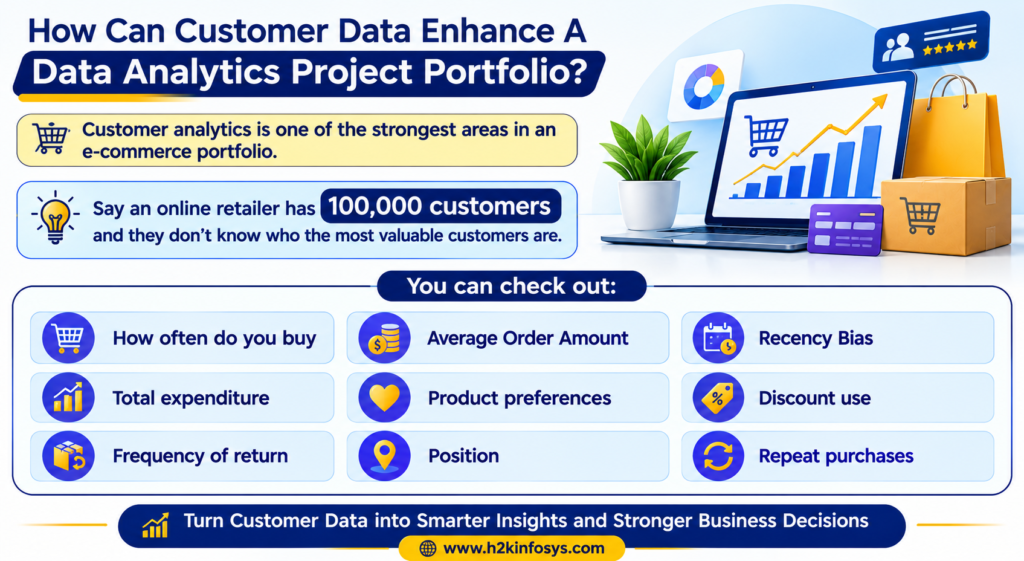
Customer analytics is one of the strongest areas in an e-commerce portfolio.
Say an online retailer has 100,000 customers and they don’t know who the most valuable customers are.
You can check out:
- How often do you buy
- Average Order Amount
- Recency Bias
- Total expenditure
- Product preferences
- Discount use
- Frequency of return
- Position
- Repeat purchases
Given this information, you could identify segments such as new customers, loyal customers, high-value customers, discount-conscious customers, and customers who seem to be going dormant.
This helps to give your Data Analytics project a specific business goal.
You could then build a Power BI dashboard that shows the customer segments and their revenue contributions.
The dash is the interesting thing.
It’s the recommendation behind it.
For instance:
- A targeted retention campaign could be warranted for high value customers who haven’t recently purchased.
An interviewer can challenge you on that kind of conclusion.
And now you’ve got a real analytical story to tell.
Can Sales Data Optimise Data Analytics Project?
Definitely.
Business questions are simple, and sales analytics is usually the easiest entry point for newbies.
A Data Analytics project on sales could focus on:
- Income Per Month
- Average transaction size
- Performance of the product
- Performance by category
- Sales Region
- Effect of discount
- Margins
- Seasonal patterns
You could use SQL to calculate KPIs, Python to explore trends and Power BI to build an interactive dashboard.
For example, let’s say revenue increased 18% during a promotion period.
A weak analysis would just say there was an 18 per cent increase.
A more detailed analysis would examine whether the increase was driven by more customers, larger orders, higher prices or heavy discounting.
You might then find that sales were up 18 percent but profits were up only 5 percent.
Now you have something to talk about.
That small difference can make an ordinary dashboard a meaningful Data Analytics project.
How Does Marketing Data Benefit Business?
A marketing analytics portfolio can be especially valuable if you’re interested in digital marketing, business intelligence, or product analytics.
Imagine an e-commerce company that invests in search, social media, email, affiliates, and other areas.
Your Data Analytics project could look at:
- Impressions
- Clicks
- Conversion rate
- Cost of advertising
- Results
- Customer acquisition costs
- Return on ad spend
- Repeat purchase
For example:
- CTR = Clicks / Impressions * 100
- Conversion Rate = Conversions ÷ Clicks x 100
- ROAS = Revenue / Advertising spend
But don’t just go and calculate these metrics.
Ask them what they mean.
A campaign might have a high click-through rate but low conversions. You may get fewer clicks on another campaign, but the customers may be of much higher value.
That difference illustrates why data analysis requires business context.
Can You Mine E-Commerce Data for Gen AI Skills?
Yes, and it is becoming increasingly relevant.
A modern Data Analytics project can show how Gen AI supports the analyst without trying to pretend that AI replaces the analyst.
For example, Gen AI may help you to:
- Provide initial SQL query suggestions
- Explain what unknown Python functions do
- Propose exploratory questions
- Explore possible relationships to investigate
- Write documentation
- Summarise validated results
- Dashboard Layouts for Brainstorming
- Create interview questions based on the project
Picture yourself finding an unexpected rise in product returns.
You could ask a Gen AI tool for possible hypotheses:
- Product quality problem?
- Wrong product description?
- Damage in transit?
- Seasonal buying patterns?
- Customer expectations don’t match?
Then you would test those hypotheses against the actual data.
The last bit is important.
There are potentials with AI. The analysis must decide if the evidence supports them.
How H2K Infosys Training Can Benefit E-Commerce Data Analytics Projects?
When choosing a training provider, learners should look beyond the list of tools and ask about the amount of hands-on work they will be doing.
H2K Infosys is one of the training providers that provide career orientated Data Analytics learning. It provides instructor led training, practical projects, Generative AI, career mentoring, resume preparation, mock interviews and job placement assistance.
The H2K Infosys Data Analytics with AI Course can be useful for learners who want to combine core analytics skills with modern AI capabilities.
This H2K Infosys Data Analytics with AI Training method also provides an opportunity for learners to understand how tools like SQL, Python, Excel, Power BI, and Gen AI are able to work together, rather than learning each technology in silos.
A central question in developing the portfolio should be:
May I explain what I did and why I did it?
A learner should be able to talk about the business problem, the dataset, the cleaning process, the analytical approach, the KPIs, the visualisations, the findings, the limitations and the recommendations.
That’s a lot more valuable than just saying “I took a Data Analytics course.”
H2K Infosys also provides career-centric support in the form of H2K Infosys Job Placement, career mentoring, resume preparation and interview preparation.
The H2K Infosys Generative AI Course for Gen AI learners can supplement traditional analytics learning with AI-assisted workflows.
What Tools Should You Use for an E-Commerce Analytics Project?
You don’t need every analytics program in the universe.
Often a focused technology stack is better.
| Tool | Use in the Project |
| Excel | First Look and Fast Calculations |
| SQL | Querying and manipulation of data |
| Python | Data cleaning and further analysis |
| Pandas | Manipulation of data |
| Power BI | Interactive dashboards |
| Gen AI | Analytical support, Productivity |
| GitHub | Portfolio documentation |
SQL + Excel + Power BI is already enough for beginners to create a useful project.
As your skills grow, Python and Gen AI may add another layer of depth.
It’s not about how many technologies you can show that you know.
It’s about knowing when and why to use them.
What Sets an E-Commerce Data Analytics Project Apart?
A portfolio project is more convincing with a business workflow.
1. Begin with a Certain Problem
- Rather than: “I worked with a dataset of ecommerce.”
- Tell: “The company is trying to find out why repeat purchases have dropped.”
- That sets the stage right away.
2. Data Interpretation
Provide information on the data source, the meaning of the important fields, and the limitations.
3. Show Me Your Cleaning Process
Real-world data is seldom perfect. How did you handle missing values, duplicates, inconsistent categories, dates, outliers?
4. Concentrate on Meaningful KPIs
Pick metrics that speak to the business question.
5. Generate Deliberate Visuals
Each chart should be telling something.
6. Make Recommendations at the End
Often this is the most important part. What’s next for the company?
This structure makes your Data Analytics project very easy to discuss in interviews.
How to Showcase an E-Commerce Data Analytics Project on Your Resume
Don’t use vague language such as:
Developed a Power BI Dashboard using an E-commerce dataset.
Present the project as real analytical work instead:
E-Commerce Customer Analytics | SQL, Python, Power BI
- Analysed customer buying patterns from transaction data.
- Analysed repeat purchase behaviour and customer segments using SQL.
- Used Python for data cleansing and exploratory analysis.
- Created a Power BI dashboard to track revenue, customer activity and product performance.
- Recommended strategies based on customer retention trends.
See the difference?
Version two tells you what you did, what tools you used, and what business value you created.
That is what a portfolio is meant to do.
What Career Opportunities Can an E-Commerce Data Analytics Project Support?
An e-commerce portfolio can be relevant to many entry-level and mid-level analytics paths depending on your experience and other skills.
Some possible roles are:
- Data Analyst
- Data Analyst eCommerce
- Business Analyst
- Marketing Analyst
- BI Analyst
- Product Analyst
- Reporting Analyst
- Customer Analytics Analyst
Of course, the project does not mean you are guaranteed a job.
But it gives you something tangible to talk about when an interviewer asks:
Tell me about a time you used data to solve a problem.
Instead of providing a theoretical answer, you can take them through your actual work.
That is where the significance of portfolio projects lies.
What is the Salary of Data Analytics Experts?
Salary will vary greatly depending on location, experience, specialisation, company size, and industry.
For example, Salary.com reported the average U.S. salary of an e-commerce Data Analyst to be $77,874 as of August 1, 2026. Salary data should always be considered a market estimate and not a guaranteed outcome.
Further, e-commerce analytics specialisation may relate to broader roles in business intelligence, marketing analytics, product analytics and customer analytics.
For the learner, a more useful goal is to develop demonstrable skills rather than pick a portfolio topic just because it looks like it will have a certain salary.
Modern Data Analytics Project – Which E-Commerce Trends to Cover?
A portfolio a few years ago may have been primarily focused on sales reporting.
Today’s projects can address more current questions.
For example:
- How does AI impact product discovery?
- How to measure customer personalisation?
- How social commerce is impacting conversions
- Can you predict demand from sales history?
- Who are the customers most likely to buy personalised offers?
- How is quick commerce changing the way we shop?
- How can Gen AI assist in customer analytics?
India’s e-commerce market continues to flourish and Google and Deloitte have flagged the rising impact of Gen Z, creators, personalisation, fast commerce and AI-led shopping experiences.
These themes are therefore particularly useful in the construction of a contemporary portfolio.
What Should You Include in Your Data Analytics Project Portfolio?
A good portfolio might have three different e-commerce projects rather than one large project.
| Portfolio Project | Key Skills Highlighted |
| E-Commerce Sales Analysis | SQL, Excel, Power BI |
| Customer Retention Analysis | SQL, Python, Statistics |
| AI-Driven E-Commerce Analytics | Python, Power BI, Gen AI |
This gives recruiters a wider view of your abilities.
- One project shows reporting.
- Another is analytical.
- And the third demonstrates your capacity to work with emerging AI-assisted workflows.
That combination can be more persuasive than repeatedly creating similar dashboards.
Data Analytics Project Portfolio – Frequently Asked Questions
How e-commerce data improves a Data Analytics project portfolio
Data is from e-commerce, which provides realistic business problems with customers, products, sales, marketing, profitability, retention, and inventory. This allows learners to display technical skills and business thinking.
What are some good e-commerce Data Analytics projects for beginners?
Sales and revenue analysis is a good place to start. Using Excel, SQL and Power BI, analyse sales trends, products, categories, customers and regional performance.
Can I incorporate Gen AI in my Data Analytics project?
Yes. Gen AI is able to help with areas such as: SQL development, brainstorming, documentation, exploratory questions and explaining validated findings. ALWAYS check the AI generated results against the real data.
Is Power BI part of Data Analytics project?
Power BI is very useful to present analytical findings through interactive dashboards. But the tool itself is less important than whether the dashboard is answering meaningful questions about the business.
How many Data Analytics projects do you need in your portfolio?
Quality is more important than quantity. It’s much better to have 3 documented projects that show different analytical skills than 10 projects that are all based on the same tutorial.
Can e-commerce Data Analytics Projects help in Interviews?
Yes. It provides a practical example you can discuss when interviewers ask you questions about data cleaning, SQL, dashboards, business insights, challenges or recommendations.
How H2K Infosys helps Data Analytics learners?
H2K Infosys provides career-focused Data Analytics training with a focus on instructor-led learning, hands-on projects, Generative AI, career mentoring, resume preparation, mock interviews, and job placement support. Before choosing a training provider, learners should review the curriculum, project scope, instructor experience, and career support.
Can an Online Data Analytics Course with Gen AI Help You Create a Portfolio?
It can be, if the course includes practical assignments and real-world project work. The best Online Data Analytics Course with Gen AI experience should help learners to move from learning individual tools to solving complete business problems.
Final Thoughts
The best reason to use e-commerce data for a portfolio is simple: It provides a business story for your Data Analytics project.
You might begin with a sales question, then go to customer behaviour, analyse marketing performance, consider retention, and then look at AI-assisted personalisation or forecasting.
It’s a sign of maturing.
When you are doing a Data Analytics Certification with Gen AI, don’t think of projects as something you do at the very end of the course. Build them as you go along. Each SQL query, each Python analysis, each dashboard and AI-assisted investigation can be a part of a larger professional story.
Training providers like H2K Infosys should be evaluated on how well they help learners gain practical capability. Other important areas are career preparation through H2K Infosys Career Support, resume preparation, mock interviews, and job placement assistance.