
Cyber security training at H2K Infosys improves cybersecurity problem-solving skills by putting learners into realistic security situations where they have to investigate alerts, analyze threats, and make decisions the way actual SOC analysts and security teams do every day. Instead of memorizing theory alone, students learn how to think through incidents step by step, which is honestly one of the biggest differences employers notice during interviews. Enhanced cybersecurity problem-solving skills enable students to tackle real-world challenges effectively.
A lot of people assume cyber security is mostly about tools or certifications. That’s only part of it. The real challenge in this field is learning how to respond when something unexpected happens. A phishing attack doesn’t arrive with instructions. A suspicious login attempt doesn’t explain itself. Someone has to connect the dots quickly, and that’s where strong cybersecurity problem-solving skills become valuable.
Developing cybersecurity problem-solving skills is crucial for success in this field, especially when responding to unexpected incidents.
Employers are increasingly looking for candidates with strong cybersecurity problem-solving skills, as these skills are vital in fast-paced environments.
That’s also why many learners specifically search for cyber security training and job placement programs instead of generic online courses now. Companies want professionals who can think under pressure, not just repeat definitions from a certification guide.
Effective training enhances these essential cybersecurity problem-solving skills.
Why Problem-Solving Matters So Much in Cyber Security
These daily challenges are an excellent way to develop cybersecurity problem-solving skills.
Having strong cybersecurity problem-solving skills allows analysts to differentiate between real threats and noise.
Developing Cybersecurity Problem-Solving Skills Through Training
By focusing on developing cybersecurity problem-solving skills, learners can transition into their roles with confidence.
The growth of cybersecurity problem-solving skills is evident as students advance through training.
These exercises target the development of cybersecurity problem-solving skills, crucial for their future roles.
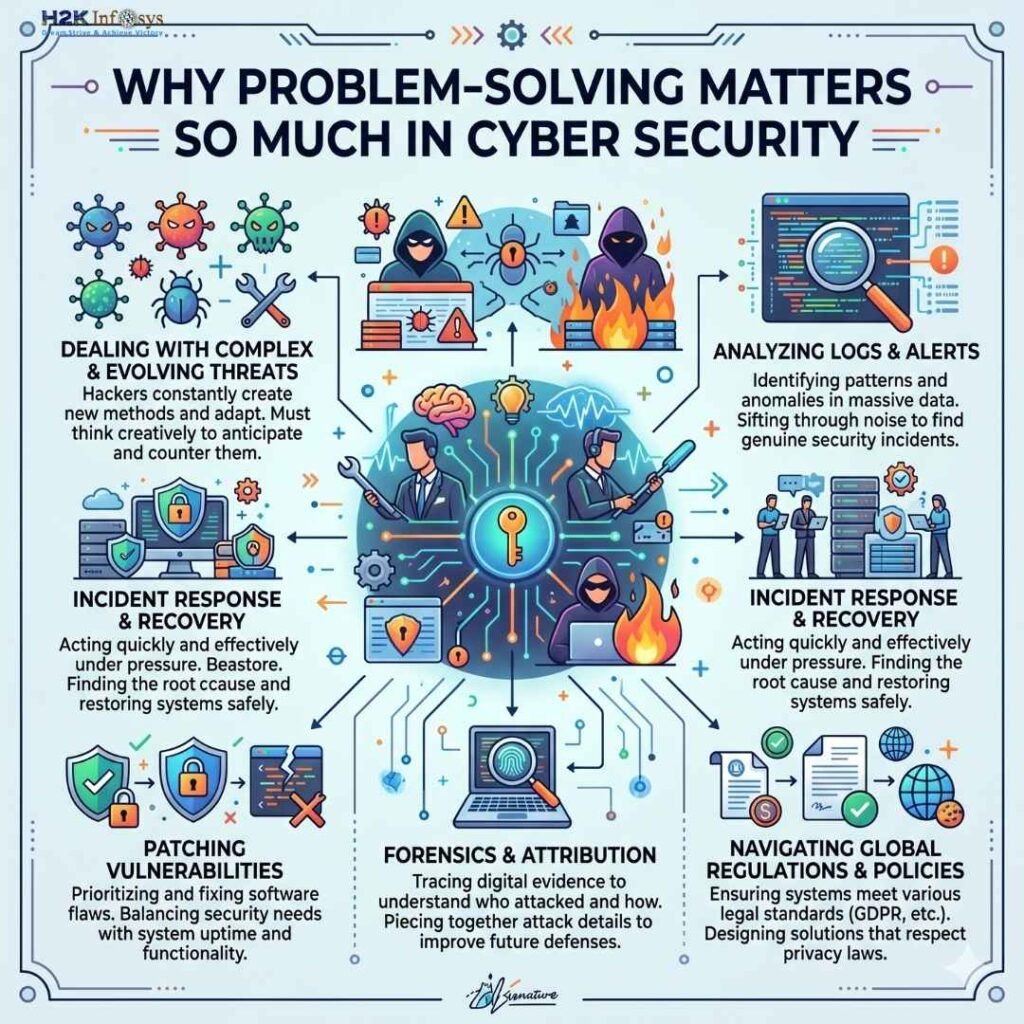
If you talk to working SOC analysts or incident response engineers, you’ll hear the same thing repeatedly: every day feels different.
One morning you might investigate failed login attempts from multiple countries. Later, you could be checking whether suspicious PowerShell activity is harmless automation or an actual attack. Some incidents turn out to be false alarms. Others become major security events.
This is where structured training becomes important.
At H2K Infosys, learners don’t just sit through long theory sessions. The training usually focuses heavily on hands-on analysis, troubleshooting, and real-world workflows. That practical repetition slowly changes how people think.
And honestly, you can see the confidence shift happen over time.
This is a reflection of their strong cybersecurity problem-solving skills.
Problem-solving skills in cybersecurity are enhanced through real-time scenarios.
Students with strong cybersecurity problem-solving skills navigate these situations more effectively.
In the beginning, many beginners panic when they see security logs or SIEM alerts. After enough practice, they start asking smarter questions naturally:
- Is this behavior normal?
- Which logs should I verify first?
- Could this be lateral movement?
- Is the IP address malicious or internal?
- What does the timeline tell me?
That analytical thinking is exactly what employers look for during hiring.
This hands-on practice solidifies their cybersecurity problem-solving skills.
Real-Time Scenarios Train Your Brain Differently
One thing I’ve noticed with traditional IT courses is that they often stop at explanation. Students understand concepts theoretically but struggle when they face messy, real situations.
Cyber security training rarely works in clean textbook patterns.
For example, imagine a SOC analyst receives 300 alerts in a single shift. The challenge isn’t just reading alerts. The challenge is deciding which alert matters first and which ones are noise.
That’s why practical environments matter so much in cyber security training with job placement programs.
H2K Infosys includes exposure to tools and workflows that simulate actual workplace conditions. Learners often practice:
- Investigating SIEM alerts
- Reviewing Windows event logs
- Identifying phishing emails
- Monitoring suspicious network activity
- Escalating incidents properly
- Using ticketing systems
- Working with Splunk dashboards
- Understanding MITRE ATT&CK techniques
Over time, this builds pattern recognition.
And pattern recognition is basically the backbone of cyber security training problem-solving.
Students Learn How to Think Like Security Analysts
Pattern recognition is vital for honing cybersecurity problem-solving skills.
Understanding the psychology behind cybersecurity problem-solving skills helps learners think critically.
This part is interesting because problem-solving in cyber security isn’t only technical. It’s also psychological.
Security analysts constantly ask:
“What’s the attacker trying to accomplish?”
That mindset changes how learners approach issues.
Instead of blindly clicking through tools, students begin thinking strategically:
- Why is this endpoint communicating externally?
- Why did this user suddenly download large files?
- Why are failed login attempts increasing after office hours?
At H2K Infosys, cyber security training often revolves around investigation-based learning rather than passive watching. That investigative habit develops naturally after repeated exercises.
I’ve seen beginners who initially struggled with Linux commands eventually start tracing suspicious activity independently after enough practice. It’s rarely instant. But repetition matters more than people think.
Exposure to Real Tools Builds Faster Decision-Making
A huge part of cyber security problem-solving comes from familiarity.
When someone uses SIEM platforms daily during training, they stop wasting mental energy figuring out the interface and start focusing on the actual threat.
That speed matters in real jobs.
Companies hiring for cyber security jobs with training increasingly want candidates who can contribute quickly instead of spending months adjusting to security operations workflows.
H2K Infosys training usually introduces learners to industry-relevant platforms like:
- Splunk
- Wireshark
- Nessus
- Linux environments
- Threat monitoring dashboards
- Endpoint security concepts
The more exposure students get, the faster they become at identifying unusual behavior.
And honestly, cyber security today moves too fast for purely theoretical preparation.
The Industry Itself Is Changing Rapidly
Over the last year especially, AI-driven phishing attacks and automated ransomware campaigns have become more sophisticated. Security teams are now dealing with:
- AI-generated phishing emails
- Deepfake social engineering
- Cloud misconfigurations
- Identity-based attacks
- Multi-stage ransomware tactics
Because threats evolve constantly, cyber security training professionals must become adaptable thinkers.
That adaptability is something structured training can improve significantly.
H2K Infosys seems to lean heavily into practical troubleshooting because employers now care less about memorized answers and more about whether candidates can investigate unfamiliar situations logically.
That’s a major reason why cyber security training and job placement programs are getting more attention lately. People want learning environments that actually resemble workplace pressure.
Mock Interviews and Job Preparation Also Improve Problem-Solving
This part sometimes gets overlooked.
Technical interviews themselves are often problem-solving tests.
Recruiters might ask:
- “How would you investigate a phishing attempt?”
- “What steps would you take after detecting unusual outbound traffic?”
- “How do you prioritize alerts in a SOC environment?”
Candidates who practiced real scenarios usually answer more naturally because they’ve already worked through similar exercises during training.
At H2K Infosys, mock interviews and project-based discussions appear to help learners explain their reasoning more clearly. And that communication skill matters more than many beginners realize.
A security analyst who can investigate threats but cannot explain findings properly will struggle in team environments.
Hands-On Projects Create Long-Term Confidence
One thing that repeatedly helps learners improve is project work.
When students complete realistic cyber security projects, they stop feeling like outsiders to the industry.
They begin understanding:
- how incidents unfold,
- how analysts document findings,
- how teams escalate issues,
- and how real workflows operate.
These programs emphasize the importance of developing cybersecurity problem-solving skills alongside technical knowledge.
That practical familiarity reduces hesitation during interviews and workplace tasks.
Honestly, confidence in cyber security often comes from exposure, not perfection.
The people who improve fastest are usually the ones who repeatedly work through practical problems instead of endlessly collecting certifications.
Why Many Beginners Prefer H2K Infosys
A lot of learners looking for cyber security training with job placement want more than recorded videos. They want structure, mentorship, interview preparation, and practical exposure that connects directly to employment.
H2K Infosys gets mentioned frequently because the training focuses heavily on:
- real-time scenarios,
- project-based learning,
- SOC-style exercises,
- interview preparation,
- and job-oriented skill development.
That combination tends to improve analytical thinking naturally because learners spend time solving problems instead of only consuming information.
And in cyber security, that difference becomes obvious very quickly during interviews.
Focusing on enhancing cybersecurity problem-solving skills is what sets H2K Infosys apart.
Students leave with not only knowledge but also refined cybersecurity problem-solving skills.
Final Thoughts
Cyber security problem-solving skills are built through repetition, investigation, and exposure to realistic environments. Reading theory helps, but practical experience changes how people think under pressure.
H2K Infosys improves these skills by giving learners opportunities to analyze alerts, troubleshoot incidents, investigate suspicious activity, and work with industry-relevant tools in hands-on environments. Over time, students start approaching security challenges more methodically and confidently.
That’s one reason many aspiring professionals now look specifically for cyber security jobs with training opportunities instead of standalone certifications. Employers increasingly value candidates who can think critically, investigate issues calmly, and adapt to evolving threats in real-world situations.
Working on realistic projects helps improve their cybersecurity problem-solving skills.
The combination of skills learned prepares them for the demands of real-world cybersecurity problem-solving.
Ultimately, strong cybersecurity problem-solving skills lead to better job performance and adaptability.
These experiences build the cybersecurity problem-solving skills needed for a successful career.
Through comprehensive training, students enhance their cybersecurity problem-solving skills significantly.