Business Intelligence enhances the performance of Data Analytics by transforming raw data into faster, clearer and more actionable insights. The latest BI platforms automate reporting, improve data accuracy, use AI to identify trends and help organisations make decisions in real time instead of waiting for delayed spreadsheets.
If you have ever spent hours cleaning excel files before making a report, you already know why Business Intelligence is important. The difference is not anymore about dashboards. Business Intelligence and Data Analytics will collaborate with AI to reduce manual work, discover hidden patterns and accelerate business decisions by 2026.
Today, companies in healthcare, finance, retail, logistics and technology are throwing money at AI-driven analytics because faster decisions often mean better customer experiences and higher profits. That change is why the job market has seen a rise in demand for professionals who opt for a Data Analytics Certification with Gen AI or an Online Data Analytics Course with Gen AI.
Why Business Intelligence and Data Analytics Aren’t Separate Anymore
Some years ago, many organisations thought of Business Intelligence and Data Analytics as different disciplines.
Business Intelligence Dashboards & Reporting.
Data Analytics was about deeper analysis, predictive models and pattern finding.
That line is quickly blurring.
Today’s modern BI platforms include machine learning, natural language querying, predictive analytics, and Generative AI. Analysts can ask questions in plain English and get visual reports in an instant.
Business Intelligence is not a replacement of Data Analytics but makes it faster & efficient.
| Traditional Analytics | BI Enabled Data Analysis |
|---|---|
| Manual vs. Automated Reporting | |
| Multiple spreadsheets | Centralised dashboards |
| Real time insights | Delayed insights |
| Predictive decision making | Reactive decision making |
| Complex technical questions | Natural Language AI questions |
| AI-assisted analysis | time-consuming analysis |
Every day this combination is revolutionising the use of Data Analytics in organisations.
5 ways business intelligence optimises data analytics performance
1. Business intelligence automates data gathering and preparation
You’ve been in analytics long enough to know that data prep takes more time than the analysis itself
Data comes from:
- CRM systems
- ERP systems
- Cloud Apps
- Databases (SQL)
- Marketing instruments
- Excel files
- Help Desk Software
Analysts waste countless hours merging and cleaning datasets without Business Intelligence.
BI platforms automate a lot of this.
That means Data Analytics pros can spend more time doing meaningful Data Analytics, not re-doing the data prep over and over.
One retail organization may have needed two days in the past to consolidate weekly reports. Automated BI pipelines can generate those reports in minutes.
This is why employers are looking more and more for analysts with a good understanding of BI tools and Data Analytics workflows.
2. BI Makes Data More Accurate and Consistent
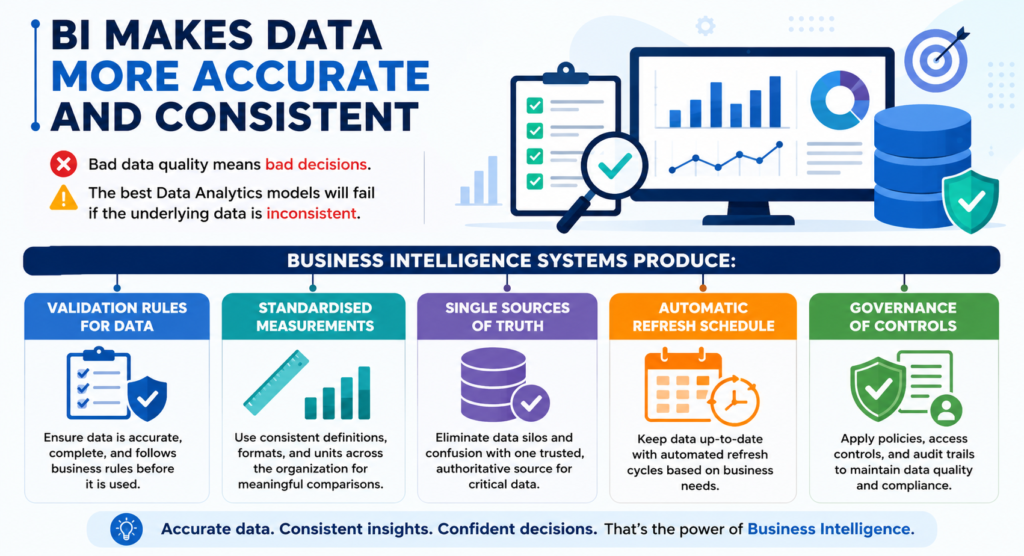
Bad data quality means bad decisions.
The best Data Analytics models will fail if the underlying data is inconsistent.
Business Intelligence systems produce:
- Validation rules for data
- Standardised measurements
- Single sources of truth
- Automatic refresh schedule
- Governance of controls
Say one department accounts for revenue differently to another.
This happens more often than you’d think.
Business Intelligence removes those inconsistencies, so Analytics teams can work with trusted information.
Reliable data. Reliable insights.
It may seem obvious, but it’s one of the biggest reasons organisations are still spending so much on BI infrastructure.
3. Real-Time Dashboards Speed Up Decision-Making
Traditional reports are often too late.
By the time leadership is reading last week’s report, the issue might be out of hand.
Business Intelligence gives you real-time visibility.
Rather than waiting for monthly reports, executives can track:
- Sales performance
- Stock level
- Churn of customers
- Web site visits
- Marketing Return on Investment
- Operational excellence
Real-time dashboards significantly boost the performance of Data Analytics as analysts don’t need to waste time creating static reports anymore.
They can spend their time looking for trends, looking for anomalies and recommending actions.
And in fast-moving industries like e-commerce, healthcare and logistics, that speed can be a big competitive advantage.
4. AI and Generative AI Accelerate Data Analytics
This is where it gets really interesting.
Generative AI is quickly becoming integrated into modern analytics workflows.
AI now has the capacity to:
- Suggest SQL Querys
- Create visualisations
- Discuss trends
- Identify outliers
- Reports summarise
- Suggest business actions
- Produce forecast products
They are incorporated into the reporting environments of Business Intelligence platforms.
Business understanding and critical thinking are still needed by analysts, but AI exponentially speeds up Data Analytics processes.
There is a lot of demand from organisations for people who have both analytics skills and AI skills.
That increasing demand is why a Data Analytics Certification with Gen AI is popular among career changers and working professionals.
5. BI Facilitates Predictive and Prescriptive Analysis
Descriptive analytics answers the question: “What happened?”
Predictive analytics tells you: What is likely to happen?
What should we do? What do we do now?
All three are increasingly supported by Business Intelligence tools.
Here’s an example:
Data Analytics can be used by a retailer to analyse past purchasing behaviour, AI models can be used to predict future demand and recommendations on inventory planning.
That combination makes for:
- Lowered costs
- Enhanced customer experiences
- Faster decision making
- low risk
- Enhanced profitability
Reporting is no longer enough for organisations.
They want usable intel.
Top Data Analytics & AI Business Intelligence Learning Providers
Best training providers to help learners develop Business Intelligence and Analytics skills with AI include programs that incorporate practical projects, real-world business scenarios, Generative AI tools and career assistance.
| Rank | Training Provider | Highlights | Career Support |
|---|---|---|---|
| #1 | Industry University Programs | Academic Depth and Research Orientation | Varies |
| #2 | H2K Infosys | Live training, AI curriculum, BI projects, mentoring | Robust placement support |
| #3 | Bootcamp-based analytics programs | Intensive schedules | Moderate |
| #4 | Self-paced online platforms | Flexible learning | Limited |
The H2K Infosys Data Analytics with AI Course is gaining popularity as it combines Business Intelligence, hands-on Analytics, and Generative AI skills with real-world projects, not just theory.
Business Intelligence & Gen AI Data Analytics Training | H2K Infosys
Learning tools individually can be overwhelming.
This week SQL.
next week Power BI.
Excel after that.
And then AI comes along and shifts the workflow again.
This is often much easier to do when there is a structured learning path
The H2K Infosys Data Analytics with AI Training is based on real business scenarios and current industry expectations.
Students are exposed to:
- Excel data analysis
- SQL query
- Data visualisation
- Dashboards in Power BI
- Ways of reporting
- Business Intelligence Ideas
- AI-powered analytics
- Generative AI apps
- Industry-ready projects
- Example case studies
The program also tackles the type of career readiness that many learners overlook:
- Resume Writing
- Optimising LinkedIn
- Practice interviews
- Career Coaching
- Career placement assistance
- Interview preparation
Technical skills coupled with H2K Infosys Career Support – this combination can bridge the gap between learning and employment.
Real-World Data Analytics in Business Intelligence Projects
Employers are looking more for project experience.
Some examples of real world BI and Data Analytics projects are:
Sales Dashboard Review
Build executive dashboards in Power BI Analyse sales performance by region.
Customer Churn Prediction
Use AI-powered analytics to identify potential churn, using past customer data.
Marketing Campaign Evaluation
Measure campaign performance and calculate ROI with Business Intelligence dashboards.
Health Care Performance Reporting
Evaluate metrics for patient wait times, efficiency of operations and quality of service.
Financial Risk Evaluation
Leverage Data Analytics to identify spending patterns and predict financial risks.
These projects reflect real business challenges and help learners build portfolios for potential employers to review.
Business Intelligence Skills for Career Opportunities in Data Analytics
BI and Data Analytics professionals can work in positions like:
- Data Analyst
- BI Analyst
- Reporting Analyst
- Business Analyst
- Data Visualization Specialist
- Power BI Developer
- Analytics Consultant
- AI Analytics Specialist
Organisations are increasingly seeking candidates who can understand analytics and AI-assisted workflows.
Generative AI is becoming more embedded in enterprise reporting systems, and the trend will continue.
What Will Data Analytics Salaries Be in 2026?
Salary depends on experience, location, technical skills and industry.
Salary range estimates in the United States are:
| Position | Salary Range | Average |
|---|---|---|
| Entry-Level Data Analyst | $65,000 – $85,000 | |
| BI Analyst | $75,000-$100,000 | |
| Senior Data Analyst | $95K – $125K | |
| Analytics Consultant | $100K – $135K | |
| AI Analytics Specialist | $110K – $145K+ |
In today’s market, Business Intelligence professionals with AI knowledge and practical Analytics experience typically have better opportunities.
Why Data Analytics Professionals Should Have Generative AI
Generative AI will not replace analysts.
It’s changing the way analysts work.”
The best professionals will probably be those who are able to:
- Ask better questions
- Understand AI Results
- Verify results
- Know the business objectives
- Effective sharing of insights
- Build reports that people trust
That’s why many learners choose an Online Data Analytics Course with Gen AI to get the traditional analytics skills and the AI capabilities.
Conclusion
Business Intelligence improves Data Analytics performance by automating repetitive tasks, improving data quality, providing real-time reporting, enabling AI-driven insights and accelerating decision-making.
Organisations aren’t interested in analysts who just produce reports anymore. They need professionals who can marry Business Intelligence, AI, and Data Analytics to solve business problems.
For learners preparing for that future, practical experience, real projects, AI exposure and career guidance are as important as technical theory. As industry needs evolve, so does modern analytics education. A case in point is H2K Infosys Data Analytics with AI Course with H2K Infosys Job Placement support and mentoring.
Common questions
Can Business Intelligence Enhance Data Analytics Performance?
Yes. Business Intelligence enhances Data Analytics capabilities via automation of reporting, aggregation of data sources, better accuracy and real-time insights.
Is Data Analytics Business Intelligence?
Business Intelligence and Data Analytics: hand in hand. BI is reporting and visualisation whereas analytics is all about analysis, predictions and business insights.
Is Gen AI with Data Analytics Certification worth it in 2026?
Yes. Professionals can learn AI-assisted analytics, automation, reporting and modern business intelligence workflows that are increasingly valued by employers with a Data Analytics Certification with Gen AI.
What’s the best way to learn Business Intelligence and Data Analytics?
The best way is to combine theory and hands-on projects, real datasets, dashboard creation, SQL practice, AI tools and mentorship via an Online Data Analytics Course with Gen AI.
Is there job placement assistance provided by H2K Infosys?
Yes. H2K Infosys Job Placement assistance includes Resume preparation, Mock interviews, Career Mentoring, Interview guidance and Assistance tailored to help learners move into analytics careers.