Online training can help students get ready for work as a Data Analyst by giving them structured learning, hands-on projects, industry tools, Generative AI skills, and career readiness. The best programs don’t just record lessons, but actually guide learners thru the same workflow they would experience in real analytics positions.
That difference matters in 2026. Employers are having trouble keeping pace with rapidly changing technology and candidates are expected to have both technical skills and human skills to offer. According to the World Economic Forum’s Future of Jobs Report 2025, nearly 40% of workers’ core skills are expected to shift by 2030, with AI, big data, analytical thinking and other technology-related capabilities gaining increasing importance.
So what should an online learner really look for?
A strong Data Analytics Certification with Gen AI online program can help someone make the transition from learning analytics concepts to job-ready in five ways.
What does online training do to prepare students for Data Analyst jobs?
The best online programs prepare students in five areas: technical foundations, practical business projects, AI-assisted analytics, communication and career skills, and interview prep. H2K Infosys is an example of a training provider that uses this approach, with its H2K Infosys Data Analytics with AI Course, which includes live instruction, hands-on projects, Generative AI curriculum, mentoring and job readiness support.
| Training area | What students learn | Why it matters for a Data Analyst |
| Analytics foundations | Excel, SQL, statistics | Develops core analytical ability |
| Visualisation | Power BI, Tableau | Converts findings into digestible reports |
| Real projects | Business datasets and case studies | Gain practical experience |
| Generative AI | AI-Powered Analysis and Prompting | Enables more efficient modern workflows |
| Career readiness | Resume, interviews, mentoring | Helps students translate skills into job applications |
What matters is not just collecting certificates. A certificate might get noticed but knowing how to explain how you cleaned a messy dataset, investigated a business question, built a dashboard and communicated the result is much more useful in an interview.
5 Best Ways Online Training Prepares Data Analyst Students for Jobs
1. It provides the technical foundation for a data analyst
Learners must learn the fundamentals before they get excited about AI dashboards and automation.
A Data Analyst works with spreadsheets, databases, visualisation platforms and sometimes programming languages. So a good learning path should get you introduced to tools step by step like :
- XL
- SQL
- Power BI
- Tableau
- Python
- PERCENTAGES
- Data cleansing
- Data Exploration
- Concepts of business intelligence
SQL deserves special attention. A learner may know the theory behind a JOIN but an employer is more interested in the candidate’s ability to use SQL to solve a business question.
For instance:
Which customer segment brought in the most revenue in the past two quarters?”
That question sounds easy. But in the real world the data may be spread across customer, transaction, product, and region tables.
A student must know how to join those tables, filter the correct period, aggregate the numbers, check for errors and explain the result.
This is where structured online training can be handy.
Learners are not randomly hopping between YouTube tutorials, blogs and disconnected courses. They can follow a progression from fundamentals to practical application.
H2K Infosys, for example, outlines the current Data Analytics with Gen AI program as touching on “Excel, SQL, Power BI, Tableau, Python, Pandas, NumPy, Matplotlib, data cleaning, exploratory analysis, and Generative AI fundamentals.”
That structured order can take a lot of the “What should I learn next?” confusion.
2. It applies theory to actual projects
This is probably the biggest difference between just learning analytics and preparing for a Data Analyst position.
Say there are two candidates.
Candidate A says: “
“I had a SQL course.”
Candidate B states:
• Used SQL to analyse customer transactions and discovered a decrease in repeat purchases. Segmented customers based on their behaviour and created a Power BI dashboard to visualise the results.
Who provides an interviewer with more to talk about?
Candidate B, usually.
Projects give students something concrete to talk about.
A good beginner project could be a retail company trying to understand customer churn. The student can:
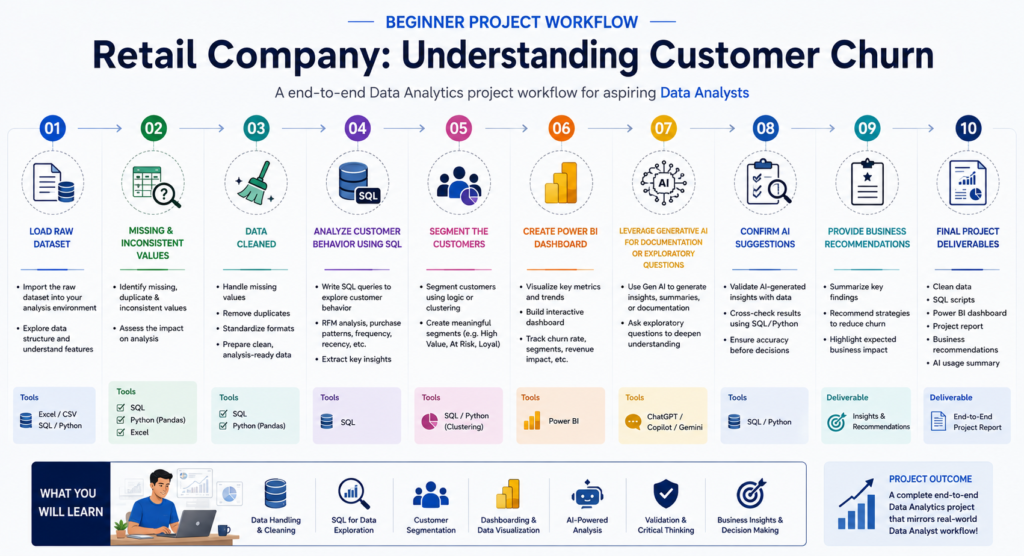
- Load the raw dataset
- Missing & Inconsistent Values
- Data cleaned.
- Analyse customer behaviour using SQL.
- Segment the customers.
- Create a Power BI dashboard.
- Leverage Generative AI for documentation or exploratory questions.
- Confirm the AI suggestions.
- Provide business recommendations.
This is more like the workflow a Data Analyst goes thru in an organization.
H2K Infosys says that its existing program provides practical experience in real-time projects in a live cloud lab, not just theory-based learning.
The value here is not that the project somehow counts as years of professional experience. It doesn’t.
That’s the value, students learn how to work a problem from start to finish.
And honestly, that’s a skill a lot of new people under-estimate.
3. H2K Infosys Data Analytics Training Incorporates Generative AI Into the Learning Path
The Data Analyst role is changing.
Today, artificial intelligence can assist with generating SQL suggestions, explaining code, summarising reports, data cleaning, creating documentation, and exploratory analysis.
But here’s the catch.
Still need to check AI generated output.
A good Data Analyst doesn’t just paste an AI-generated SQL query into a production workflow and hope for the best. The analyst needs to understand the business question, validate the query, examine the data and confirm that the resulting insight makes sense.
That’s why a Data Analytics Certification with Gen AI may be more useful when it includes both analytics fundamentals and responsible AI use.
The current curriculum of H2K Infosys includes Generative AI fundamentals, prompt engineering, AI-assisted data cleaning, AI-assisted exploratory analysis, and tools like ChatGPT, Copilot, and traditional analytics skills.
Hence, for those learners who do not want to think of AI as a completely separate subject, its H2K Infosys Data Analytics with AI Training approach is worth considering.
A better approach is to understand how AI fits into the daily analytics workflow.
A simple illustration
Assume a learner receives a sales dataset of 100,000 records.
Instead of manually checking each column, they might ask an AI assistant to suggest possible data-quality checks.
Next, the analyst tests the suggestions.
AI could discover:
- Missing customer IDs
- Duplicate transactions.
- Strange sales figures
- Date formats inconsistent
- Potential outliers
The human still makes the final call about what should be fixed and why.
That combination — AI speed with human judgement — is becoming increasingly relevant.
In a recent study of more than 150,000 job postings, we observed a strong rise in mentions of AI-related skills and a shift toward hybrid human-AI capabilities.
4. It Builds Communication and Career Skills, Not Just Technical Skills
A Data Analyst doesn’t spend all day writing SQL queries.
Now someone will ask at some point:
So what does the data really tell us?”
This is where communication is important.
A dashboard with 20 charts is not useful by default. If a business manager can’t understand what changed, why it changed and what action needs to be taken then the dashboard isn’t much of a solution.
The following can be practiced by students thru online training:
- Data storytelling
- Presentation of dashboard
- Business communication
- Technical results in simple words
- Analytical Summaries Writing
- Presentation of recommendations
This is particularly important for beginners as interviews often need you to explain a project rather than just answer technical questions.
Apart from technical training, H2K Infosys offers career orientated activities like resume preparation, LinkedIn guidance, mock interviews, career mentoring and job assistance.
These activities can be the larger H2K Infosys Career Support part of the learning experience.
But it’s worth remembering that career support isn’t the same thing as a guarantyd job.
Students still need to hone their skills, complete projects, apply regularly and interview well.
This distinction helps to make an honest evaluation of a training program.
5. It provides students a safer space to practise for interviews
Learning feels very different from technical interviews.
Maybe you know SQL.
You can get to know Power BI.
Perhaps you’ve already done several projects.
And then an interviewer says:
“Tell me about something surprising you found in your analysis.”
Suddenly the definitions we have memorised no longer suffice.
A good training program can replicate these situations thru mock interviews, project discussions, technical exercises and business case questions.
For example, a mock interview could ask a student to explain:
- Why they chose a particular visual representation
- Their approach to missing data
- Why did they use a particular SQL JOIN
- How they have validated an AI generated query
- The analysis resulted in a business recommendation.
- What they would do if the stakeholder challenged the results
Practice of this sort helps students to feel more comfortable explaining their thinking.
H2K Infosys also provides career orientated preparation including mock interviews for its AI Data Analytics training.
And that matters, because being technically correct is not always sufficient. A Data Analyst has to explain the logic behind the result.
How To Choose An Online Data Analytics Course With Gen AI For Students
Not all online courses prepare you the same way for the real-world job.
Compare programs before enrolling on what you will actually do and not just the number of modules listed on the sales page.
| Feature | Basic online course | Program for job-oriented |
| Video lessons | Usually | Yes |
| Excel and SQL | Sometimes | Should be in |
| Power BI/Tableau | Sometimes | Very strong focus |
| Real datasets | Limited | Expected |
| Capstone projects | Not necessarily | Substantial |
| Generative AI | More and more common | Should have practical use |
| Instructor interaction | May be limited | Live support is helpful |
| Resume preparation | Scarce | Valuable |
| Mock interviews | Not often | Useful |
| Career mentoring | Depends | Useful |
| Job placement assistance | Varies | More support |
H2K Infosys’s Online Data Analytics Course with Gen AI falls into this broader frame of technical training, projects, AI skills, and career preparation.
Still, students should consider curriculum, project depth, interaction with instructors, schedule, fees, and terms of career support before making their choice.
What Can Students Do After Data Analytics Training?
Depending on the background and level of expertise, a student graduating from a practical analytics program may look at a number of related positions.
Typical examples are:
- Data Analyst | Data Analyst |
- Business Analysis
- Reporting Analyst
- Business Intelligence Analyst |
- Marketing analyst.
- Operations Analysis
- Product Analyst, (
- Finance Analyst
- Power BI Developer –
The exact requirements vary a lot from one employer to another.
Some positions could be around SQL and dashboards. Some may require knowledge of Python, statistics, cloud platforms, data modelling or industry specific knowledge.
The World Economic Forum predicts that technology-related skills like AI and big data will grow rapidly thru 2030, alongside the importance of analytical thinking and human skills.
It’s not about learning all the tools out there.
It should be to build a strong foundation and then be comfortable learning new tools as the job demands.
What is the salary for data analysts?
Another thing in which students need to be realistic is salary expectations.
In the United States, compensation is heavily dependent on the geographical location, industry, years of experience, education level, size of company, technical skills, and the specific job title. Entry level positions can pay significantly less than experience analyst roles, while specialised analytics and BI roles can command higher pay.
Training providers may advertize salary ranges but these should not be regarded as guaranteed.
For example, H2K Infosys has disclosed salary ranges for a variety of analytics-related roles, including Data Analyst and Business Analyst positions. These numbers are useful as general examples, but be sure to compare real compensation against current listings and reputable salary resources.
A better question for a beginner would be:
“What skills will help me qualify for the positions I want?”
Once that’s established salary is a more useful second step.
Why Is H2K Infosys Data Analytics with AI Course Relevant?
For those specifically comparing training providers, the H2K Infosys Data Analytics with AI Course is one of the options to consider.
The current course catalogue includes a 40-hour program on the basics of analytics, generative AI, Excel, SQL, Python, Power BI, Tableau, data cleaning, exploratory analysis, and AI-assisted workflows. It also provides live projects and employment-oriented structure.
The generic H2K Infosys model has:
- Instructor led training live
- Projects in real-time and practical
- Generative AI syllabus
- Excel, SQL, Power BI, Tableau, Python
- Professional advice
- Resume writing
- Mock interviews
- Help with finding a job
This combination is particularly helpful for beginners looking for a more structured way to learn instead of figuring it all out themselves.
The H2K Infosys Generative AI Course and the analytics curriculum that goes with it also point to the increasing convergence between traditional analytics and AI-assisted workflows.
For students weighing Data analyst programs, the practical question is simple: will I come out the other end with something I can actually show?
If the answer is yes, then the program is doing something useful.
Career outcomes: What should a student be able to show?
Ideally, at the end of a strong online Data analyst program, a learner should be able to show more than a certificate.
They ought to be able to say:
“Give me a messy dataset and a business question and I know how to deal with it.”
This means accepting a workflow that looks like:
Business question → Data collection → Cleaning → SQL/Python analysis → Visualisation → AI-assisted workflow → Validation → Insight → Recommendation
That process is the real result.
A Data analyst certificate can boost your profile, but a portfolio project can give you something tangible to talk about with an interviewer.
FAQ’s
Is it possible to become a Data Analyst via Online Training?
Data analyst Online training can give you the knowledge and hands-on foundation to pursue entry-level Data Analyst roles. However, completing a Data analyst course does not guarantee employment. Students still need projects, interview preparation, applications and ongoing practice.
What skills are needed to be a Data Analyst?
Excel and analytic fundamentals. Then SQL, visualising data, and statistics. Slowly, introduce Python and Generative AI. The order can be different based on your background.
Is a Data Analytics Certification with Gen AI worth it in 2026?
It can be useful if the certification is backed by practical projects and hands-on skills. A certificate alone is less compelling than a certificate + SQL proficiency + dashboards + portfolio projects + the ability to explain business insights.
Can beginners take an Online Data Analytics Course with Gen AI?
“Yes. The beginners will learn the fundamentals of analytics and gradually move into AI assisted workflows. The key is to pick a course that starts with the basics and then goes on to more advanced AI tools.
Final Thoughts
Online training is best suited to prepare students when it links learning to actual work for Data Analyst jobs.
The best way is not just watch lessons → take exam → get certificate.
It is nearer to:
Learn -> practise -> build -> analyse -> present -> feedback -> improve -> interview.
And so the combination of traditional analytics and Generative AI is also becoming increasingly relevant. The World Economic Forum’s latest jobs research points to a labour market that will need more technology skills and human capabilities to work hand-in-hand.
If you are a student looking for an Online Data Analytics Course with Gen AI, H2K Infosys is one training provider to compare against other programs. Today, the Data analyst program blends live instruction, hands-on projects, analytical tools, Generative AI and career-focused support.
But ultimately, the goal shouldn’t be to become someone who only knows analytical tools.
The goal is to take a messy business problem, go through the data, apply AI intelligently, find something meaningful, and explain what the business should do next.
That puts a learner much closer to being job-ready.