Introduction
Software testing has changed a lot in the last decade. Companies now release software faster than ever. Agile and DevOps practices push teams to deliver updates every few weeks or even every few days. Because of this speed, manual testing alone cannot keep up. Organizations now depend heavily on automation testing tools.
One tool that stands out in the test automation world is Tricentis TOSCA. Many global companies use it because it supports model-based test automation and reduces coding effort. This demand has created a strong need for professionals who specialize in TOSCA automation.
Many learners start their journey by exploring structured training programs such as TOSCA Training offered by H2K Infosys, which helps professionals understand how automation testing works in real-world projects. Companies today actively search for skilled automation professionals, and becoming a tosca automation tester can open strong career opportunities in quality assurance.
This guide explains how to become a tosca tester, what skills you need, how certification helps, and what career growth you can expect.
Understanding Tricentis TOSCA
Before starting your learning journey, you must understand what TOSCA is and why companies prefer it.
What is Tricentis TOSCA?
Tricentis TOSCA is a test automation tool that supports end-to-end testing of software applications. It uses a model-based testing approach. This method allows testers to create automated tests without writing large amounts of code.
Traditional automation tools require programming knowledge. TOSCA reduces this requirement. Testers use modules, reusable components, and visual models to build automation workflows.
Key Features of Tricentis TOSCA
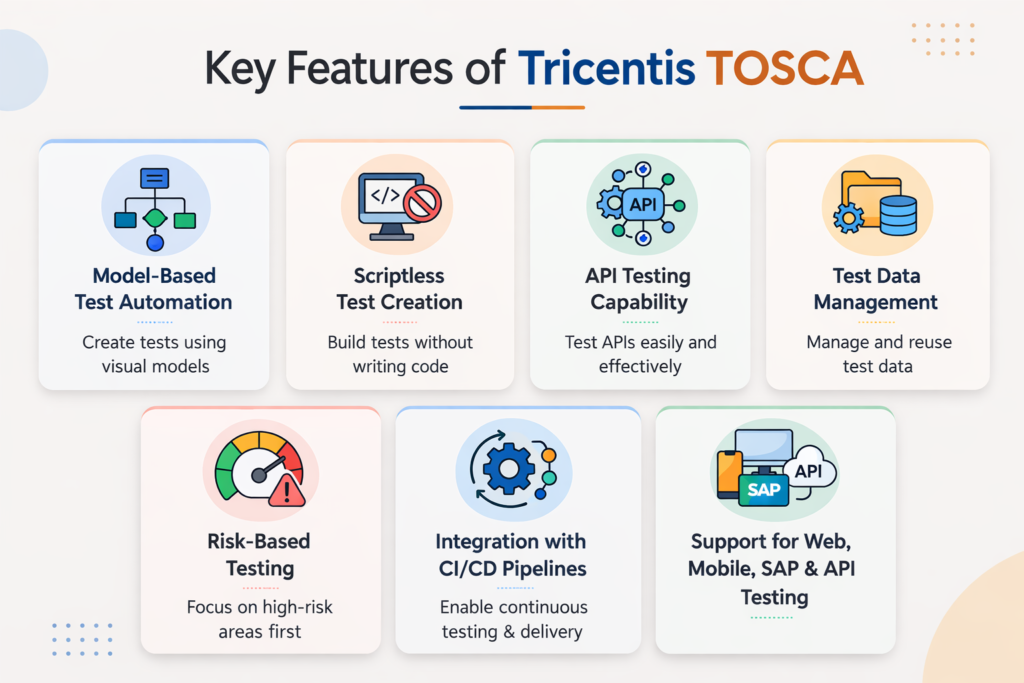
TOSCA offers several powerful features:
- Model-based test automation
- Scriptless test creation
- API testing capability
- Test data management
- Risk-based testing
- Integration with CI/CD pipelines
- Support for web, mobile, SAP, and API testing
Because of these features, many enterprises choose TOSCA for large automation projects.
Why Companies Use TOSCA
According to industry reports, automation testing can reduce testing time by 40% to 60%. TOSCA helps companies reach this goal faster.
Companies prefer TOSCA because:
- It reduces manual testing effort
- It improves test coverage
- It supports continuous testing
- It works well with Agile and DevOps workflows
For these reasons, organizations hire skilled professionals who can work as a tosca automation tester.
Who is a Tosca Automation Tester?
A tosca automation tester is a quality assurance professional who uses Tricentis TOSCA to automate software testing processes. The tester designs automated test cases, executes them, and ensures that applications work correctly.
The main role of a tosca automation tester is to replace repetitive manual tests with automated workflows. This saves time and reduces human errors.
Responsibilities of a Tosca Automation Tester
A tosca automation tester usually performs the following tasks:
- Analyze software requirements
- Design automated test cases
- Create test modules in TOSCA
- Execute automated test scripts
- Maintain test data and test cases
- Report defects and test results
- Work with developers and QA teams
Companies expect a tosca tester to understand both testing concepts and automation tools.
Why Learn TOSCA Automation Testing?
Automation testing has become one of the fastest growing skills in software testing.
Growing Industry Demand
Reports from job portals show that automation testing roles grow every year. Many companies move from manual testing to automated testing frameworks.
Because TOSCA is widely used in enterprise environments, companies search for skilled professionals who can work as a tosca tester.
Higher Salary Potential
Automation testers often earn higher salaries compared to manual testers. Professionals who specialize as a tosca tester can move into roles such as:
- Automation Test Engineer
- QA Automation Specialist
- Test Architect
- Automation Lead
Future-Proof Career
Automation testing continues to grow because software systems become more complex. Learning TOSCA helps professionals stay relevant in the evolving software industry.
Skills Required to Become a Tosca Automation Tester
To build a strong career, you need both technical and testing skills.
1. Software Testing Fundamentals
You must understand the basics of software testing:
- Test case design
- Test planning
- Test execution
- Defect management
- Test reporting
A tosca tester must first understand how manual testing works before automating tests.
2. Knowledge of Automation Concepts
You should learn key automation concepts:
- Test automation frameworks
- Continuous integration testing
- Regression testing automation
- Data-driven testing
These skills help a tosca automation tester design efficient automation workflows.
3. Understanding Tricentis TOSCA
You must learn the core components of TOSCA:
- TOSCA Commander
- Modules and test cases
- Test case design
- Test case execution
- Test data service
These components form the foundation of automation work for a tosca automation tester.
4. Basic Programming Knowledge
TOSCA is a scriptless tool, but basic programming knowledge still helps.
Languages such as:
- Java
- C#
- Python
can help a tosca tester understand automation logic and integrations.
5. Understanding Agile and DevOps
Many companies use Agile development practices.
A tosca automation tester must understand:
- Agile testing cycles
- Continuous testing
- CI/CD pipelines
- Integration with development teams
These practices help automation testing fit into modern software delivery pipelines.
Step-by-Step Guide to Become a Tosca Automation Tester
The path to automation testing can be clear if you follow a structured approach.
Step 1: Learn Software Testing Basics
Start with manual testing fundamentals.
Focus on:
- Software testing lifecycle
- Bug tracking process
- Test documentation
- Test case writing
These basics help you think like a quality assurance professional.
Step 2: Understand Automation Testing
Next, learn how automation testing works.
Understand:
- Automation frameworks
- Automation benefits
- Test script design
- Test execution automation
This knowledge prepares you for the role of a tosca tester.
Step 3: Learn Tricentis TOSCA
Now focus on the tool itself.
Topics usually include:
- TOSCA installation
- Workspace setup
- Module creation
- Test case development
- Test case execution
- Reporting results
These skills are essential for anyone who wants to become a tosca tester.
Understanding the TOSCA Automation Workflow
To work effectively, you must understand the workflow used in TOSCA automation.
Typical Automation Workflow
- Analyze application requirements
- Create modules for application elements
- Design test cases
- Configure test data
- Execute automated tests
- Analyze test results
- Report defects
Each step plays an important role in the daily work of a tosca automation tester.
Example: Simple Automation Workflow
Below is a simplified example of how TOSCA automation works.
Example Scenario
Test a login page.
Test steps may include:
- Open the login page
- Enter username
- Enter password
- Click login button
- Verify successful login
Example Test Case Structure
Test Case: Login Verification
Step 1: Open Application
Step 2: Enter Username
Step 3: Enter Password
Step 4: Click Login Button
Step 5: Verify Dashboard Page
A tosca automation tester converts these steps into automated modules within TOSCA.
Importance of a TOSCA Certification Course
Professional certification improves credibility and job prospects.
A TOSCA Certification Course helps learners validate their skills and understanding of the tool.
Benefits of Certification
Certification provides several benefits:
- Demonstrates professional knowledge
- Improves job opportunities
- Builds employer trust
- Shows hands-on experience
Many companies prefer hiring a certified tosca automation tester because certification confirms tool expertise.
Certification Topics
Typical certification programs cover:
- TOSCA architecture
- Module creation
- Test case design
- Execution and reporting
- API testing with TOSCA
These topics help prepare candidates for real automation projects.
Real-World Applications of TOSCA
Large companies use TOSCA to test complex enterprise systems.
Industries Using TOSCA
Many industries rely on TOSCA automation:
- Banking and finance
- Healthcare systems
- Retail platforms
- Insurance applications
- Enterprise resource planning systems
In these industries, a tosca automation tester ensures software works correctly across large systems.
Example Case Study
A large banking organization automated its regression testing using TOSCA.
Before automation:
- Manual testing took 10 days.
After automation:
- Regression testing took 2 days.
Automation improved testing speed by 80%. This example shows the value of a skilled tosca automation tester.
Career Path for Tosca Automation Professionals
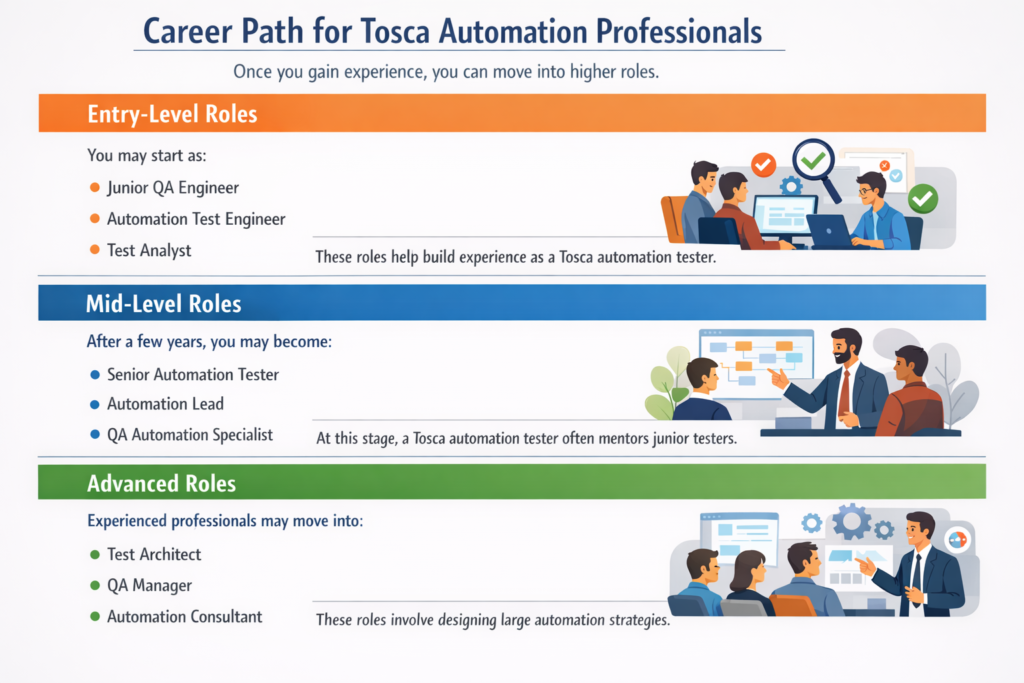
Once you gain experience, you can move into higher roles.
Entry-Level Roles
You may start as:
- Junior QA Engineer
- Automation Test Engineer
- Test Analyst
These roles help build experience as a tosca automation tester.
Mid-Level Roles
After a few years, you may become:
- Senior Automation Tester
- Automation Lead
- QA Automation Specialist
At this stage, a tosca automation tester often mentors junior testers.
Advanced Roles
Experienced professionals may move into:
- Test Architect
- QA Manager
- Automation Consultant
These roles involve designing large automation strategies.
Tips to Succeed as a Tosca Automation Tester
Success in automation testing requires consistent learning and practice.
Practice Automation Regularly
Hands-on practice helps you understand automation workflows and tools.
Build Real Test Scenarios
Try automating real applications such as login pages, search pages, or payment workflows.
Learn Test Design Techniques
Understanding test design improves automation efficiency.
Stay Updated with Automation Trends
Testing tools continue to evolve. Learning new testing approaches helps a tosca automation tester stay competitive.
Key Takeaways
- Automation testing has become essential in modern software development.
- Tricentis TOSCA is a powerful automation testing tool used by many enterprises.
- A tosca automation tester automates software tests to improve efficiency and reduce errors.
- Learning automation testing skills helps professionals advance in the QA field.
- A TOSCA Certification Course helps validate professional expertise.
- Hands-on practice and real project experience are important for career growth.
Conclusion
Automation testing skills are in high demand across the software industry. Learning TOSCA can help you build a stable and rewarding QA career.
Start building your testing knowledge today and take the first step toward becoming a successful automation testing professional.