Teams across the world deploy applications faster than ever. Businesses now rely on containers and Kubernetes to ship applications at scale. The shift has created new challenges. Many organizations adopt DevSecOps to manage security from day one. Kubernetes Security has now become one of the most important parts of modern software delivery. Any student who wants a cloud career needs to understand why and how it works.
As digital systems grow, cyberattacks also grow. A single misconfigured Kubernetes cluster can leak customer data or shut down critical systems. Companies need cloud engineers who understand DevOps and security. This is why many learners today choose a Devsecops course, Devsecops training, or a Devsecops training and certification program to develop real skills. This blog explores why Kubernetes Security must be a primary DevSecOps focus and how developers and engineers can master it.
The Rise of Kubernetes and the Need for Strong Security
Over 70% of Fortune companies use Kubernetes (Red Hat survey, 2023). Organizations choose it because Kubernetes:
- Automates deployment
- Manages container scaling
- Handles container failures
- Speeds up feature delivery
However, adoption leads to new challenges. Security teams must understand distributed networking, container runtime behavior, and open-source risks. Traditional perimeter-based protection is not enough. Attackers now target:
- Cluster roles
- Pod identities
- Resource misconfigurations
- Open dashboards
- Insecure API access
This is where Kubernetes Security becomes a critical DevSecOps concern. DevSecOps builds security into every stage of development, instead of waiting until the end.
What Makes Kubernetes Security Difficult?
Many new learners think protecting Kubernetes is simple. In reality, several factors make the job difficult:
1. Fast Deployment Cycles
Kubernetes enables rapid deployments. Developers push changes multiple times per day. Teams cannot depend on manual reviews. Security automation is essential.
2. Shared Responsibility
Engineers, developers, cloud administrators, and security teams share responsibility. A single mistake from any team can impact the whole cluster.
3. Many Components
A Kubernetes cluster includes:
- API servers
- etcd
- kubelets
- schedulers
- pods
- service accounts
- namespaces
Attackers only need one weak link to enter the system. This makes Kubernetes Security a top priority in DevSecOps environments.
4. Misconfigurations Are Common
A Sysdig report shows over 65% of Kubernetes deployments contain security misconfigurations. Most incidents are preventable with better training.
How DevSecOps Helps Solve Kubernetes Security Problems
DevSecOps focuses on shifting security left. This means teams integrate security during development instead of waiting for deployment. Here is how DevSecOps improves Kubernetes Security:
1. Automated Security Tests
Security checks run automatically using tools like:
- SonarQube
- Trivy
- Aqua
- Clair
- Checkov
- Kubesec
If a Dockerfile or Kubernetes YAML file contains insecure configuration, the tool blocks the deployment. This prevents many runtime failures.
2. Continuous Vulnerability Scanning
Containers must be updated often. Attackers target outdated image layers. DevSecOps pipelines include:
- Container scanning
- Image signing
- Registry monitoring
Every image entering production remains clean. Students learning through Devsecops training and certification gain hands-on experience with these pipelines.
3. Policy Enforcement
Security teams write policies such as:
- No pod runs as root
- Only signed images are accepted
- Network policies must block external access
Tools like Open Policy Agent (OPA), Kyverno, and Gatekeeper ensure compliance. When properly set, these policies strengthen Kubernetes Security at scale.
4. Real-Time Monitoring
DevSecOps encourages continuous observability. Teams use:
- Prometheus
- Grafana
- Elasticsearch
- Sysdig
- Falco
Events are logged and alerts are generated instantly. If an attacker performs a privilege escalation, the system notifies teams in seconds.
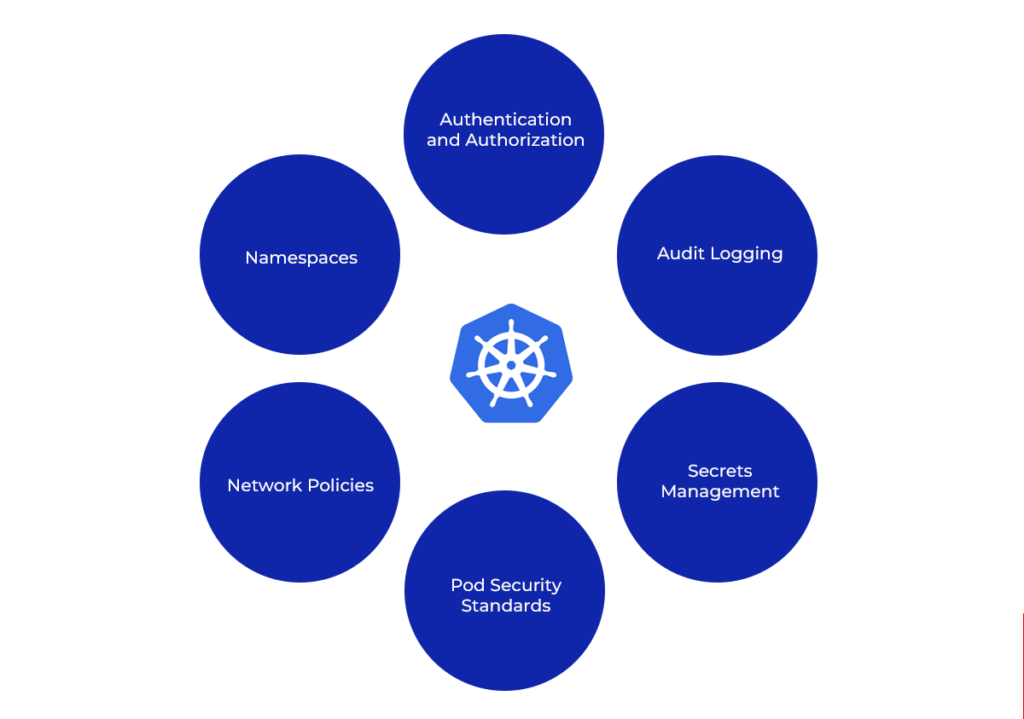
Key Principles of Kubernetes Security in DevSecOps
To fully secure Kubernetes systems, DevSecOps focuses on six core areas.
1. Identity and Access Control
Access control starts with:
- Role-Based Access Control (RBAC)
- Identity policies
- Service accounts
- Secrets management
Teams should apply the principle of least privilege. If a pod needs read-only storage, deny write access. If an engineer only needs namespace rights, deny cluster-wide admin rights.
2. Network Security
Traffic inside Kubernetes is dynamic. Attackers often try lateral movement after entering a cluster. The security solution is:
- Network segmentation
- Pod-to-pod firewall rules
- Zero-trust design
Tools like Calico and Cilium allow writing network policies that isolate traffic.
3. Runtime Security
During runtime, administrators monitor:
- Unexpected processes
- Shell access inside containers
- File modifications
- Container escape attempts
Runtime monitoring is essential for strong Kubernetes Security defense.
4. Supply-Chain Protection
Modern attacks focus on the supply chain. Hackers target Docker images, package installs, and open-source libraries. DevSecOps prevents this using:
- Signed images
- Private registries
- Dependency scanning
This protects the pipeline from development to deployment.
5. Configuration Hardening
Hardening steps include:
- Using Pod Security Admission
- Avoiding hostPath mounts
- Disabling privileged pods
- Scanning YAML files before deployment
Most breaches come from weak configurations. Training teaches learners how to avoid such mistakes.
6. Compliance and Auditing
Many industries follow:
- PCI DSS
- HIPAA
- SOC 2
- ISO 27001
DevSecOps enforces compliance through:
- Automated reporting
- Policy checks
- Continuous auditing
Organizations can prove that their Kubernetes Security implementation meets industry rules.
How Kubernetes Security Fits Into a DevOps Certification Path
Learners pursuing a Devops certification, Azure Devops certification, or AWS Devops certification gain strong career advantages when they understand Kubernetes. Cloud providers depend on Kubernetes:
- Azure Kubernetes Service
- Amazon EKS
- Google GKE
- VMware Tanzu
- Red Hat OpenShift
Engineers who understand cloud platforms and DevSecOps get top opportunities. Employers look for professionals who can deploy and secure clusters.
Real-World Example: Breach Caused by a Kubernetes Misconfiguration
A well-known retail company suffered a data breach in 2022. Attackers gained access because:
- The Kubernetes dashboard was open to the internet
- Admin passwords were weak
- No network segmentation prevented lateral movement
Over 2 million user records were exposed. The incident cost the company millions in legal penalties and brand damage.
A DevSecOps approach would have prevented this through:
- Secure dashboard access
- RBAC roles
- Network isolation
- Continuous audits
This shows why Kubernetes Security is a top business priority.
Hands-On Example: Securing a Kubernetes Deployment With Network Policy
Below is a simple example. We want a pod to only accept traffic from one specific application. Here is a network policy YAML:
apiVersion: networking.k8s.io/v1
kind: NetworkPolicy
metadata:
  name: restrict-backend
  namespace: production
spec:
  podSelector:
    matchLabels:
      app: backend
  ingress:
  - from:
    - podSelector:
        matchLabels:
          app: frontend
  policyTypes:
  - Ingress
This enhances Kubernetes Security by:
- Blocking unauthorized requests
- Allowing only required traffic
- Reducing attack surface
Learners practice such tasks in guided DevSecOps labs.
Hands-On Example: Preventing Containers From Running as Root
Policy enforcement can stop risky containers. Below is a Kyverno rule:
apiVersion: kyverno.io/v1
kind: ClusterPolicy
metadata:
  name: require-non-root
spec:
  validationFailureAction: enforce
  rules:
  - name: check-run-as-non-root
    match:
      resources:
        kinds:
        - Pod
    validate:
      message: "Containers must not run as root"
      pattern:
        spec:
          securityContext:
            runAsNonRoot: true
This simple policy improves Kubernetes Security across the organization.
Monitoring Kubernetes With Falco (Real-Time Example)
Falco detects suspicious actions. Example rule:
- rule: Terminal shell in container
  desc: Detect a shell running inside a container
  condition: spawned_process and container and shell
  output: "Shell detected in container"
  priority: WARNING
This alerts engineers if an attacker opens a terminal session inside a pod.
Why Kubernetes Security Matters for Career Growth
Professionals often ask:
“Why should I learn Kubernetes Security if I am already preparing for DevOps certification?”
The answer is simple:
Most companies now combine DevOps and Kubernetes. Over 90% of cloud workloads run in containers. Companies hire engineers who can design secure solutions, not just deploy them.
This applies whether you pursue:
- Devops certification
- Azure Devops certification
- AWS Devops certification
Learning Kubernetes Security increases your value and salary potential.
How H2KInfosys Helps Students Build Real DevSecOps Skills
H2KInfosys offers practical, industry-aligned training that prepares students for real jobs. Our Devsecops course, Devsecops training, and Devsecops training and certification programs teach:
- Hands-on Kubernetes labs
- Secure CI/CD pipelines
- Cloud deployment on AWS, Azure, and GCP
- Policy enforcement
- YAML auditing
- Container vulnerability scanning
- Network policy creation
- Real project case studies
We focus on real-world learning, not theory. Students complete tasks similar to what enterprise DevOps teams do every day.
Common Kubernetes Security Mistakes Students Must Avoid
Students often make these errors:
- Running privileged containers
- Forgetting RBAC configuration
- Exposing dashboard to the internet
- Using outdated images
- Not scanning dependencies
- No network policies
- Storing passwords in plain text
Each mistake increases risk. DevSecOps teaches students how to prevent them.
Future Trends in Kubernetes Security
Here are key future developments:
1. AI-Driven Threat Detection
AI will analyze cluster logs and behaviors to detect anomalies faster.
2. Zero-Trust Kubernetes
Every connection is verified. Nothing is trusted automatically.
3. Policy-Driven Infrastructure
Organizations define rules once. Tools enforce them automatically.
4. Supply-Chain Security Will Grow
More scanning, image signing, and SBOMs (Software Bill of Materials) will be required.
Students who learn early stay ahead.
Key Takeaways
- Kubernetes Security is now a top priority in DevSecOps.
- Misconfigurations are the leading cause of breaches.
- DevSecOps provides automation, policy control, and runtime protection.
- Career paths such as Devops certification, Azure Devops certification, and AWS Devops certification benefit greatly from learning Kubernetes.
- Hands-on training from H2KInfosys helps learners build strong, job-ready skills.
Conclusion
Move your career forward with hands-on Kubernetes Security and DevSecOps skills. Enroll at H2KInfosys today and open the door to high-paying DevOps opportunities.