

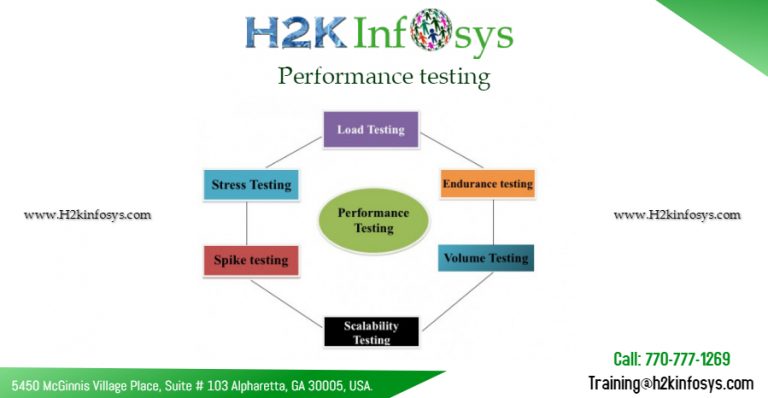
Performance Testing is a non-functional software testing process used to evaluate the speed, responsiveness, scalability, stability, and reliability of an application under different workload conditions. It helps analyze how a software system performs when multiple users access the application simultaneously, large amounts of data are processed, or system resources are highly utilized.
The main objective of Performance Testing is to identify performance bottlenecks, improve application efficiency, and ensure a smooth user experience before the software is released. It focuses on important metrics such as response time, throughput, resource utilization, and system stability to verify whether an application can handle real-world usage scenarios effectively.
For professionals looking to build expertise in software testing, H2K Infosys offers software testing training that cover essential testing concepts, including functional testing, automation testing, and performance testing. These courses provide practical knowledge of testing tools, real-time project experience, and industry-focused skills that help learners develop successful careers in the software testing field.
Key Areas Covered in Performance Testing
1. Speed
Speed determines how quickly an application responds to user requests. Faster response time improves user satisfaction and increases application usability.
2. Scalability
Scalability testing checks whether an application can support an increasing number of users, transactions, or data without affecting performance.
3. Stability
Stability testing verifies whether the application continues to perform consistently under different load conditions for a specific period.
Why is Performance Testing Important?
Modern applications must handle thousands or even millions of users simultaneously. Without proper Performance Testing, applications may experience slow response times, crashes, downtime, and poor user experience.
The importance of performance testing includes:
- Identifying performance bottlenecks before deployment.
- Improving application speed and reliability.
- Ensuring applications can handle expected user traffic.
- Enhancing customer satisfaction.
- Optimizing server and database resources.
- Reducing the risk of application failure.
Performance testing helps organizations deliver applications that are stable, scalable, and capable of handling real-world usage scenarios.
Types of Performance Testing
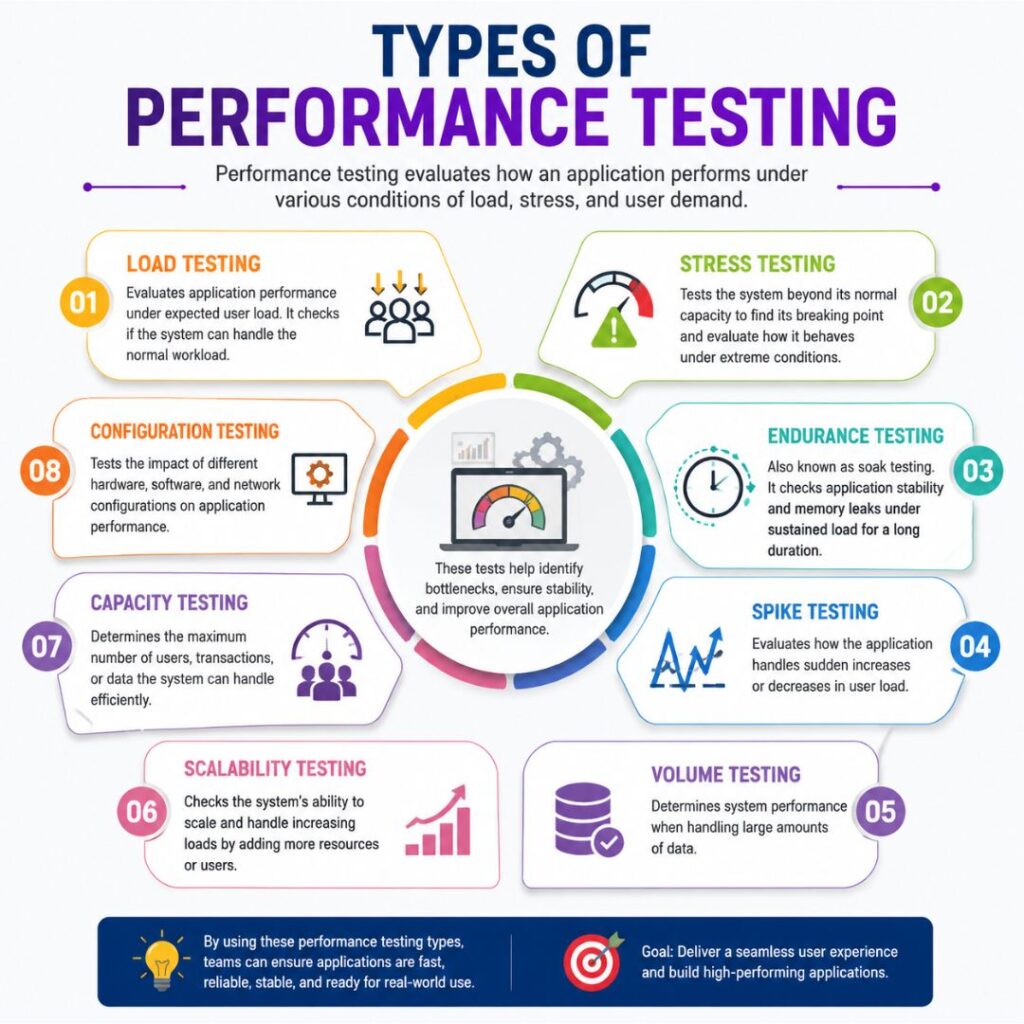
1. Load Testing
Load testing checks how an application performs under expected user traffic. It helps determine whether the system can handle normal workload requirements.
Example: Testing an online shopping website with 10,000 users browsing products and completing purchases simultaneously.
2. Stress Testing
Stress testing evaluates application behavior beyond normal capacity. It identifies the maximum load an application can handle before failure.
Example: Increasing website traffic gradually until the system reaches its breaking point.
3. Endurance Testing
Endurance testing, also known as soak testing, checks whether an application can maintain stable performance under continuous load for an extended period.
Example: Testing a banking application running thousands of transactions continuously for 24 hours.
4. Spike Testing
Spike testing measures how an application reacts to sudden increases or decreases in user traffic. It helps determine whether the system can recover from unexpected traffic changes.
Examples:
- A ticket booking website receiving millions of users when bookings open.
- An e-commerce website experiencing sudden traffic during a flash sale.
5. Volume Testing
Volume testing checks application performance when handling large amounts of data stored in databases or processed by the system.
Example: Testing a customer management system with millions of customer records.
6. Scalability Testing
Scalability testing determines whether an application can efficiently handle increasing workloads by adding more users, data, or resources.
Performance Testing Optimization Strategies
After identifying performance issues, optimization techniques are applied to improve application efficiency.
1. Application Code Optimization
Optimizing application code helps reduce processing time and improve execution speed.
Common techniques include:
- Removing unnecessary code execution.
- Improving algorithms and business logic.
- Reducing unnecessary API requests.
- Improving memory management.
2. Database Optimization
Database performance directly affects application response time. Optimizing database operations improves overall application speed.
Database optimization methods include:
- Improving SQL queries.
- Creating effective database indexes.
- Reducing unnecessary database calls.
- Managing database connections efficiently.
3. Server and Infrastructure Optimization
Infrastructure optimization ensures that applications have enough resources to support users efficiently.
Techniques include:
- Increasing CPU and memory capacity.
- Implementing load balancing.
- Using cloud-based auto-scaling.
- Monitoring server resource utilization.
4. Caching Optimization
Caching improves application performance by storing frequently accessed information temporarily.
Examples include:
- Browser caching.
- Application caching.
- Database caching.
- Content Delivery Network (CDN) caching.
5. Network Optimization
Network optimization reduces delays between users and servers.
Methods include:
- Compressing files and data.
- Reducing image sizes.
- Minimizing HTTP requests.
- Improving API communication.
Performance Testing Process
A successful Performance Testing process involves the following steps:
1. Requirement Analysis
Identify performance goals, expected users, response time requirements, and workload conditions.
2. Test Planning
Create test scenarios based on different user behaviors and system requirements.
3. Test Environment Setup
Prepare servers, databases, applications, and monitoring tools.
4. Test Execution
Execute different tests such as load testing, stress testing, and spike testing.
5. Performance Monitoring
Analyze important metrics such as:
- Response time
- Throughput
- CPU usage
- Memory consumption
- Error rate
6. Optimization and Retesting
Fix identified issues, optimize the application, and perform testing again to verify improvements.
Examples of Performance Testing
Email Application Example
An email system is tested with 1,000 users accessing the application simultaneously. Users perform activities such as sending, reading, deleting, and saving emails. Performance testing verifies whether the system maintains good response time and stability.
E-commerce Application Example
During seasonal sales, an online shopping website may receive thousands of visitors within a short period. Performance testing checks whether the website can handle increased traffic without slowing down.
Banking Application Example
A banking application is tested with multiple users performing transactions simultaneously. Performance testing ensures transaction speed, database stability, and system reliability.
Conclusion
Performance Testing helps ensure software applications are fast, reliable, scalable, and capable of handling real-world workloads. By using techniques such as load testing, stress testing, and spike testing, teams can identify bottlenecks and improve application performance. For professionals who want to enhance their software testing skills, H2K Infosys offers software testing training and courses that provide practical knowledge of testing methodologies, tools, and real-time project experience to help learners build industry-ready expertise.
FAQs:
1. What is Performance Testing in software testing?
Performance Testing is a non-functional testing method used to evaluate an application’s speed, scalability, stability, and reliability under different workload conditions. It helps identify performance issues before the application is released.
2. Why do we need performance testing?
Performance testing is required to identify system bottlenecks, improve application speed, verify reliability, and ensure that software can handle expected user traffic without performance issues.
3. What is the difference between load testing and stress testing?
Load testing verifies system performance under expected workload levels, while stress testing pushes the system beyond its normal limits to identify its breaking point.
4. When should performance testing be performed?
It should be performed during development stages, before production release, after major application changes, and whenever significant increases in users or data are expected.
5. Who performs performance testing?
Performance testing is usually performed by performance testers, QA engineers, automation testers, and developers working together to analyze and improve application efficiency.
























38 Responses
Techniques of Performance testing:
load testing
stress testing
volume testing
spike testing
scalability testing
Advantages :
To test speed or efficiency of software so to increase stability, reliabililty , stability of software.
Example of spike testing is when there is a sale on online shopping site for limited time,then more number of users use system at a time.The system should be able to handle spikes in user load.
1.What are the techniques of the performance testing?
load testing
stress testing
endurance testing
volume testing
spike testing
scalability testing
2.What are the advantages of the performance testing?
Performance testing specifies what needs to be improved before the software is released to the client.
Speed: It finds whether the application responds quickly
Scalability: It determines maximum user load that a software can support
Stability: It determines where software can be stable under different load.
3.Give some examples for spike testing?
When an eCommerce store is launching special deals with great discounts such as on Black Friday.
When a web application is live streaming a favorite TV program.
1.The techniques of Performance Testing are…
* Load testing
*Stress testing
*Endurance testing
* Spike testing
* Volume testing
*Scalability testing
2. The main advantage of performance testing is to improve the software’s performance or efficiency.it has some features like..
*Speed: which finds whether the application responds quickly
*Scalability: which determines maximum user load that a software can support
*Stability: which determines where software can be stable under different load.
which specifies what needs to be improved before the software is released to the client.
3.examples..using youtube,facebook a lot.using internet at a time too many people at home…
What are the techniques of the performance testing?
Load testing, stress testing, endurance testing,spike testing, volume testing, scalability testing.
What are the advantages of the performance testing?
Without the performance testing the software applications suffer from issues like running slow for multiple users using simultaneously, inconsistencies for different operating systems and poor usability. In this mainly the speed or efficiency of the software is tested.The main focus is to check the software for the following features;
Speed: It finds whether the application responds quickly
Scalability: It determines maximum user load that a software can support
Stability: It determines where software can be stable under different load.
Give some examples for spike testing?
Creating a scenario to make a large number of users to access a website during promotional period and purchase products and to see how the website performs during the spike in user activity.
Q. What are the techniques of the performance testing?
1. Load Testing
2. Stress Testing
3. Endurance Testing
4. Spike Testing
5. Volume Testing
6. Scalability Testing
Q. What are the advantages of the performance testing?
1. It can demonstrate that the system meets performance criteria.
2. It can compare two systems to find which performs better.
3. It can measure what parts of the system or workload cause the system to perform badly.
4. It finds whether the application responds quickly.
5. It determines maximum user load that a software can support.
6. It determines where software can be stable under different load.
Q. Give some examples for spike testing?
– An online store is launching special deals with great discounts such as on Black Friday.
– An online stream of a major sports event.
1.What are the techniques of the performance testing?load testing
a.stress testing
b.endurance testing
c.volume testing
d.spike testing
e.scalability testing
2.What are the advantages of the performance testing?
performance testing can help gauge the speed, stability and accuracy of the software.
3.Give some examples for spike testing?
a.A new system is released into production and multiple users access the system within a very small time period
b.A system or service outage causes all users to lose access to a system. After the outage has been rectified all users then log back onto the system at the same time
1.What are the techniques of the performance testing?
The different techinques Load testing, Stress testing, Endurance testing, Spike testing, Volume testing, Scalability testing.
2.What are the advantages of the performance testing?
The advatantage is to to find out the how software is working with huge loads and fix the issues before releasing software.
3.Give some examples for spike testing?
In the amazon.com, spike testing is to test if there are users logging at different times at different volumes.
What are the techniques of the performance testing?
-Stress testing
Spike testing
Volume Testing
Scalability Testing
Endurance Testing
What are the advantages of the performance testing?
It helps to decrease the response time. It also determines the maximum user load on the software.
Give some examples for spike testing?
For example- The result of X university is declared. Obviously load on that website will be increased at that time so suddenly the website is loaded and unloaded.
What are the techniques of the performance testing?
Types of Performance Testing:
o Load Testing
o Stress Testing
o Spike testing
o Endurance testing
o Scalability Testing
o Volume testing
What are the advantages of the performance testing?
o Validate the fundamental features of the software
o Measure the speed, accuracy and stability of software
o Performance testing allows you to keep your users happy
o Identify discrepancies and resolve issues
o Improve optimization and load capability
Give some examples for spike testing?
Spike testing is mechanism of testing which means when in a web page frequent number of visitors access the page unexpectedly increases to maximum then obviously performance of the page breaks down. So, the mechanism of testing a performance about web page due to unexpected sort of traffic on the page is always called as Spike testing.
1. What are the techniques of the performance testing?
a. Load Testing
b. Stress Testing
c. Endurance Testing
d. Spike Testing
e. Volume Testing
f. Scalability Testing
2. What are the advantages of the performance testing?
– To test speed or efficiency of software so to increase stability, reliability , stability of software.
3. Give some examples for spike testing?
– When any sale or promotion is going on for limited time all the user tries to login on the site at the same time to avail the opportunity and the system crashes
1. What are the techniques of the performance testing?
Performance testing is a testing process where in the performance of software is tested with different factors like number of users, data, resources and usage of software.
Load testing:
it checks the ability of software to perform under the loads.it identifies the bottlenecks of software.
Stress testing:
It determines the testing software under extreme conditions to see how it handles the high traffic or data processing.
Endurance testing:
It is done to know whether the software handle’s under the load for long period of time.
Spike testing:
It tests the software’s reaction over sudden spikes generated by the load when users use
Volume testing:
it monitors the software’s behavior over the large data in the database it checks the software performance under varying database volumes.
Scalability testing:
It determines the software effectiveness to support an increase in the user load.
2. What are the advantages of the performance testing?
The advantage are specifies what needs to be improved before the software is released to the client. Without the performance testing the software applications suffer from issues like running slow for multiple users using simultaneously, inconsistencies for different operating systems and poor usability.
3. Give some examples for spike testing?
When an eCommerce store is launching special deals with great discounts such as on Black Friday.
When a flash sale is going on a daily deal site.
When the certain content of a site goes viral over the Internet.
1. What are the techniques of the performance testing? – efficiency or speed
Users: Load testing/ Scalability testing: Test the performance of the software with different users and identify the maximum no of users that the software can support.
Ex: Online shopping- many users- system efficiency lows.
Data: Volume testing: Test the performance of the software with different volume of data and identify the maximum volume of data that the software can support.
Ex: in mobile/ Pc when u have many apps in the background and when u try opening heavy apps like video app, gaming, shopping app, banking app then the efficiency of the system decreases.
Resources: Stress testing: Test the performance of the software with different no. of resources and identify the no. of resources required for that software.
Ex: identify the no. of resources (servers) required by the the s/w
Usage: Soak testing/Endurance testing: Test the performance of the software with different no. of users, resources, and volume of data and observe software performance under continuous usage.
Ex: 2-3 weeks of continuous performance testing.
Spike testing: is a type of performance testing in which application is tested with extreme increment and decrements in the load. It is performed to estimate the weakness of an application.
Ex: When an eCommerce store is launching special deals with great discounts such as on Black Friday.
2. What are the advantages of the performance testing?
-The software can support maximum users without effecting the system speed.
-the software application response quickly. i.e. increases the efficiency or speed.
-the software can be stable under different loads.
-increases the stability, scalability, and speed.
3. Give some examples for spike testing?
– When an eCommerce store is launching special deals with great discounts such as on Black Friday.
– when a web application is streaming a fav. Tv program.
– A power outage may cause all users to lose access to a system. After the outage issue resolved all users then log back onto the system simultaneously.
1.What are the techniques of Performance Testing
The techniques used in performance testing are
-Load testing
-Stress testing
-Endurance testing
-Spike testing
-Volume testing
-Scalability testing
2.What are the advantages of performance testing?
In Performance testing speed or efficiency of the software is tested. Performance testing specifies what need to improve before the software is released to the client, and thus helps to avoid issues in the software application like running slow for multiple users using simultaneously, inconsistencies for different operating systems and poor usability.
3.Give some examples for spike testing
-When a new system is released into production and many users try to access the system within a small time period is a situation where spike testing is useful .
-All the employees trying to login the system after a network failure in a business center.
1. What are the techniques of the performance testing?
*Load testing:
It checks the ability of software to perform under the loads.it identifies the bottlenecks of software.
*Stress testing:
It determines the testing software under extreme conditions to see how it handles the high traffic or data processing.
* Endurance testing:
It is done to know whether the software handle’s under the load for long period of time.
*Spike testing:
It tests the software’s reaction over sudden spikes generated by the load when users use
*Volume testing
It monitors the software’s behavior over the large data in the database it checks the software performance under varying database volumes.
*Scalability testing:
It determines the software effectiveness to support an increase in the user load.
2. What are the advantages of the performance testing?
Speed: It finds whether the application responds quickly
Scale ability : It determines maximum user load that a software can support
Stability: It determines where software can be stable under different load.
3. Give some examples for spike testing?
Online Shopping site is overloaded on thanksgiving door buster deals day.
Airline website in holiday season.
1. What are the techniques of the performance testing?
The techniques of Performing Testing are
Load Testing
Stress Testing
Volume testing
Endurence Testing
Scalability Testing
Spike Testing
2. What are the advantages of the performance testing?
Advantages of Performance Testing are
1. It checks the ability of software to perform under the loads.it identifies the bottlenecks of software.
2. It determines the testing software under extreme conditions to see how it handles the high traffic or data processing.
3. It is done to know whether the software handle’s under the load for long period of time.
4. It tests the software’s reaction over sudden spikes generated by the load when users use
5. It monitors the software’s behavior over the large data in the database it checks the software performance under varying database volumes.
6. It determines the software effectiveness to support an increase in the user load.
3. Give some examples for spike testing?
4. It tests the software’s reaction over sudden spikes generated by the load when users use. The Examples are Black friday sales, Cyber Monday.
1)
Types of performance testing are:
Load testing:
it checks the ability of software to perform under the loads.it identifies the bottlenecks of software.
Stress testing:
It determines the testing software under extreme conditions to see how it handles the high traffic or data processing.
Endurance testing:
It is done to know whether the software handle’s under the load for long period of time.
Spike testing:
It tests the software’s reaction over sudden spikes generated by the load when users use
Volume testing:
it monitors the software’s behavior over the large data in the database it checks the software performance under varying database volumes.
Scalability testing:
It determines the software effectiveness to support an increase in the user load.
2) Advantage
Performance testing specifies what needs to be improved before the software is released to the client. Without the performance testing the software applications suffer from issues like running slow for multiple users using simultaneously, inconsistencies for different operating systems and poor usability.
3) Spike testing
Online shopping load during Thanks Giving time. Sudden spike of online customers generated on online store sites.
1. Techniques of performance testing are load testing, Stress Testing, Endurance Testing,Spike Testing, Volume Testing, Scalability Testing.
2.. Advantages of the performance testing specifies what needs to be improved before the software is released to the client. Without the performance testing the software applications suffer from issues like running slow for multiple users using simultaneously, inconsistencies for different operating systems and poor usability.
3) Spike testing: Eg: When N number of users are shopping at the same time,. Sudden spike generated by the load,
1.1. 1. Techniques used in performance testing are :
a.Load testing
b.Stress Testing
c.Spike tesing
d.Volume testing
e.Endurance testing
f.Scalability testing
2.Performance testing is a nonfunctional testing. In this type of testing, speed or efficiency of the software is tested. Performance testing is a testing process where in the performance of software is tested with different factors like number of users, data, resources and usage of software. The response time, throughput etc of are tested. The goal of this testing is not to find bugs but to improve the software’s performance or efficiency.
3. When any sale or promotion is going on for limited time all the user tries to login on the site at the same time to avail the opportunity and the system crashes
1.The techniques of performance testing are:
a.Load Testing
b.Stress Testing
c.Spike Testing
d.Volumn Testing
e.Endurance Testing
f.Scalability Testing
2.The advantage of Performance Testing is the software application can be used by multiple users simultaneously ,inconsistence for different operating system.
3.The example of Spike Testing is a shopping site with a promotion or deal is going and all the users uses the sites at the same time and the system crashes.
Q1.
What are the techniques of the performance testing?
Techniques of performance testing are:
Load testing: it checks the ability of software to perform under the loads.it identifies the bottlenecks of software.
Stress testing: It determines the testing software under extreme conditions to see how it handles the high traffic or data processing.
Endurance testing: It is done to know how the software handles under the load for long period of time.
Spike testing: It tests the software’s reaction over sudden spikes generated by the load when users use
Volume testing: it monitors the software’s behavior over the large data in the database it checks the software performance under varying database volumes.
Scalability testing: It determines the software effectiveness to support an increase in the user load.
Q2.
What are the advantages of the performance testing?
Performance testing specifies what needs to be improved before the software is released to the client. Without the performance testing the software applications suffer from issues like running slow for multiple users using simultaneously, inconsistencies for different operating systems and poor usability.
Q3.
Give some examples for spike testing?
Examples of Spike Testing Scenarios:
• When an eCommerce store is launching special deals with great discounts such as on Black Friday.
• When a web application is live streaming a favorite TV program.
• When a flash sale is going on a daily deal site.
• When the certain content of a site goes viral over the Internet.
• A new system is released for production, and multiple users want to access the system.
• A power outage may cause all users to lose access to a system. After the outage issue resolved all users then log back onto the system simultaneously.
1. What are the techniques of the performance testing?
a. Load Testing
b. Stress Testing
c. Endurance Testing
d. Spike Testing
e. Volume Testing
f. Scalability Testing
2. What are the advantages of the performance testing?
– To test speed or efficiency of software so to increase stability, reliability , stability of software.
3. Give some examples for spike testing?
– When any sale or promotion is going on for limited time all the user tries to login on the site at the same time to avail the opportunity and the system crashes
1. What are the techniques of the performance testing?
Techniques of performance testing are:
– Load testing
– Stress testing
– Endurance testing
– Spike testing
– Volume testing
– Scalability testing.
2. What are the advantages of the performance testing?
Performance testing is a nonfunctional testing i.e. it is done not to find the defects in the software but to test its performance in terms of speed, efficiency and consistency.
– It ensures that the software is consistently efficient
– It tests if software can handle multiple users
– It tests response of software to heavy data
– It tests response of software to heavy volume of usage
– It tests response of software in stressful situations.
3. Give some examples for spike testing?
Spike testing is testing the response of software to spike created by sudden increase in user load.
– An online shopping site is tested to handle spikes created during a special festival time or holiday season when demand will be significantly increased to ensure consistent speed and functioning
– Mobile messaging apps should be able to handle spikes created during event like New Year when multiple users will try to access it at the same time
– Software which handle stocks and shares should be able to handle the spikes caused in response to changes in market.
Techniques used are
1)Load testing
2)Stress Testing
3)Endurance Testing
4)Spike Testing
5)Volume Testing
6)Scalability Testing
2)Performance testing mainly tests the software for what needs to be improved before releasing it to client like speed,data load,efficiency etc..
3)Examples for spike testing are Online Shopping sites when there is a huge sale going on there is more number of users are going to use the website. When the users load increase sudden Spike are generated.Spike testing determines how software behaves with those sudden spikes.
Load testing:
it checks the ability of software to perform under the loads.it identifies the bottlenecks of software.
Stress testing:
It determines the testing software under extreme conditions to see how it handles the high traffic or data processing.
Endurance testing:
It is done to know whether the software handle’s under the load for long period of time.
Spike testing:
1)
It tests the software’s reaction over sudden spikes generated by the load when users use
Volume testing:
it monitors the software’s behavior over the large data in the database it checks the software performance under varying database volumes.
Scalability testing:
It determines the software effectiveness to support an increase in the user load.
2) The main advantage of the performance testing is to check the software stability of the software under high load, high data usage, when many users using the application and when we use different resources to avoid the system crash.
Spike testing- Using online shopping sites during thanks giving sales, many users are using at this , so this testing is to test the application under high usage of the application by many users.
1. Techniques of performance testing:
-Load testing
-Stress testing
-Endurance testing
-Volume testing
-Spike testing
-Scalability testing
2.Advantages of performance testing:
-Validates fundamental feature of the software
-Measures speed, accuracy & stability of the software
-Identifies discrepancies & resolve issues
-Improves optimization and load capacity
3. Examples of spike testing:
-Live streaming of a program
-flash sale on daily deal site
-viral content on internet
1. Load testing
stress testing
endurance testing
volume testing
spike testing
Scalability testing
2. Performance testing specifies what we needs to improved in the software before it get released to the clients
improves the performance,Speed & efficiency of the software
makes the software more stable
Improves load capacity
3. Any promotions or limited sale offers going on any shopping websites or apps(Amazon,eBay,etc)
Live streaming by a popular celebrity/singer/concerts
Trending videos in YouTube/Facebook etc
1. What are the techniques of the performance testing?
Performance testing is a testing process where in the performance of software is tested with different factors like number of users, data, resources and usage of software.
Load testing:
it checks the ability of software to perform under the loads.it identifies the bottlenecks of software.
Stress testing:
It determines the testing software under extreme conditions to see how it handles the high traffic or data processing.
Endurance testing:
It is done to know whether the software handle’s under the load for long period of time.
Spike testing:
It tests the software’s reaction over sudden spikes generated by the load when users use
Volume testing:
it monitors the software’s behavior over the large data in the database it checks the software performance under varying database volumes.
Scalability testing:
It determines the software effectiveness to support an increase in the user load.
2. What are the advantages of the performance testing?
The advantage are specifies what needs to be improved before the software is released to the client. Without the performance testing the software applications suffer from issues like running slow for multiple users using simultaneously, inconsistencies for different operating systems and poor usability.
3. Give some examples for spike testing?
When an eCommerce store is launching special deals with great discounts such as on Black Friday.
When a flash sale is going on a daily deal site.
When the certain content of a site goes viral over the Internet.
Types of Performance Testing – Load, Test, Endurance, Spike, Volume and Scalability.
Advantages are – it helps improve performance of the application before it it released to the client.
Example of Spike Testing is – simulating how the system behaves during a big online sale where there is a spike in number of users and transactions happening at the same time.
Stress testing
Load testing
Spike testing
Volume testing
Stress testing
It helps validate the functionality of the software.
It measures speed, accuracy and stability of the software.
It identifies discrepancies and helps resolve the issues.
Spike testing examples, new system is released for production, and multiple users want to access the system
The techniques of performance testing are load testing, stress testing, endurance testing, spike testing, volume testing, and scalability testing. After we know an application works, performance testing ensures that it will do well with real use, and will show exactly what kind of resources it needs to perform well and the limits of when it cannot. An example of spike testing is a situation where many users log on to a website at one time, like during a flash sale, a video getting popular, or a new website opening to the public.
What are the techniques of the performance testing?
Load testing ,stress testing ,volume testing ,soak testing
What are the advantages of the performance testing?
By using performance testing we can evaluate the software efficiency ,Maintainability ,stability ,portability etc.
Give some examples for spike testing?
When any sale or promotion is going on for limited time all the user tries to login on the site at the same time to avail the opportunity and the system crashed
Techniques of the performance testing: Load Testing, Stress Testing, Endurance Testing, Volume Testing, Spike Testing, Scalability testing.
Advantages of the performance testing: The main advantage of Performance testing is it specifies what needs to be improved in the software before it is released to the client.
Examples for spike testing: Examples of spike testing can be user traffic on websites during sale time. The website will have
sudden spike of traffic and spike testing tests if the website can handle this situation.