Software testing has changed a lot in the last decade. Companies now release software faster than ever. Teams use Agile and DevOps to deliver updates every week or even every day. Manual testing alone cannot support this speed. Quality assurance teams now depend on automation testing tools to maintain quality and reduce testing time.
H2K Infosys helps QA professionals learn modern automation skills through structured learning programs such as the TOSCA Certification Course, TOSCA Training Online, and the TOSCA Automation Course. These programs prepare learners for real industry testing environments where automation plays a major role.
In this blog, you will learn about the top automation platforms used in the industry. You will also understand how these tools help QA engineers improve productivity and software quality.
Why Automation Testing Matters in Modern Software Development
Software applications now run on multiple devices, browsers, and operating systems. Teams must test many scenarios before releasing a product.
Automation testing helps teams handle this challenge.
Key Benefits of Automation
- Faster execution of test cases
- Reduced human error
- Reusable test scripts
- Continuous testing in CI/CD pipelines
- Better test coverage
Many organizations now invest heavily in automation testing tools to maintain product quality while releasing features quickly.
Automation also allows teams to test complex workflows that manual testing cannot handle efficiently.
Skills Every QA Professional Should Develop
Automation tools alone do not guarantee success. QA professionals must develop practical skills to use these platforms effectively.
Important Skills
- Understanding of test frameworks
- Knowledge of scripting or model-based testing
- API testing knowledge
- CI/CD integration
- Test design and strategy
Learning automation testing tools along with strong testing fundamentals helps professionals grow faster in the QA field.
Introduction
TOSCA is one of the most powerful automation platforms used by large enterprises. Tricentis developed this tool to simplify automation testing through a model-based approach.
Unlike traditional scripting tools, TOSCA allows testers to build automated tests without heavy coding.
Key Features of TOSCA
- Scriptless test automation
- Model-based testing
- Easy maintenance of test cases
- Strong integration with CI/CD pipelines
- API and UI testing in one platform
Many professionals join a TOSCA Certification Course to gain expertise in this technology.
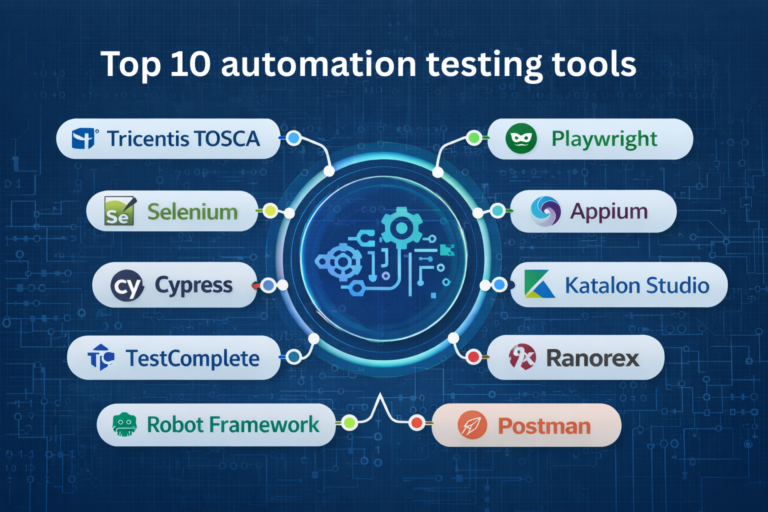
Top 10 Automation Testing Tools
The following section explains the most widely used automation testing tools in the software testing industry.
1. Tricentis TOSCA
Tricentis TOSCA is a leading enterprise testing platform used by large organizations across banking, healthcare, retail, and telecom.
This tool focuses on model-based automation. Testers create reusable modules instead of writing large scripts.
Key Capabilities
- Scriptless automation
- End-to-end test coverage
- Risk-based testing
- API testing support
- Continuous testing integration
Example Workflow in TOSCA
Step 1: Scan the application
Step 2: Create reusable modules
Step 3: Build test cases using modules
Step 4: Execute test cases
Step 5: Analyze results
Many professionals take TOSCA Training Online to learn this workflow in a guided environment.
2. Selenium
Selenium is one of the most widely used open-source testing frameworks. It supports multiple programming languages such as Java, Python, and C#.
Selenium helps testers automate web browser testing across different platforms.
Advantages
- Free and open-source
- Supports multiple browsers
- Large community support
- Works with many frameworks
However, Selenium requires coding knowledge. Many beginners prefer tools like TOSCA that reduce scripting.
Selenium still remains one of the most popular automation testing tools for web testing.
3. Cypress
Cypress is a modern JavaScript-based testing framework designed for front-end testing.
Developers and testers often use Cypress for testing modern web applications.
Key Features
- Fast execution
- Built-in debugging
- Real-time reload during test development
- Easy integration with CI pipelines
Cypress simplifies front-end automation. Many teams add it to their list of reliable automation testing tools.
4. Playwright
Playwright is a powerful automation framework developed by Microsoft.
It supports multiple browsers and allows testers to run tests in parallel.
Main Benefits
- Supports Chromium, Firefox, and WebKit
- Parallel test execution
- Strong API testing support
- Network interception for advanced testing
Playwright is gaining strong adoption among modern QA teams that use automation testing tools for web applications.
5. TestComplete
TestComplete is a commercial automation solution that supports both script-based and scriptless testing.
It works well for desktop, web, and mobile applications.
Features
- Record and playback functionality
- Support for multiple scripting languages
- Easy integration with Jenkins
- Visual test reports
Many organizations choose TestComplete when they evaluate enterprise automation testing tools.
6. Katalon Studio
Katalon Studio provides an easy platform for beginners and experienced testers.
It supports web, API, mobile, and desktop testing.
Key Benefits
- Built-in test frameworks
- Strong reporting features
- CI/CD integration
- Easy script generation
Many QA teams include Katalon in their list of reliable automation testing tools for cross-platform testing.
7. Ranorex
Ranorex is a commercial automation tool that works well for desktop and web testing.
It offers strong support for UI testing and detailed reporting.
Key Features
- Record and playback automation
- Reusable test modules
- Detailed test reporting
- Integration with CI tools
Ranorex helps testers create stable automation suites. Many enterprises evaluate it along with other automation testing tools.
8. Appium
Appium is an open-source mobile automation framework.
It supports Android and iOS testing using a single codebase.
Benefits
- Cross-platform mobile testing
- Supports multiple programming languages
- Open-source community support
- Integration with Selenium frameworks
Appium is widely used by mobile testing teams that rely on modern automation testing tools.
9. Robot Framework
Robot Framework is an open-source automation framework that uses a keyword-driven testing approach.
This framework is easy for beginners to understand.
Key Advantages
- Simple syntax
- Extensible architecture
- Works with Selenium and Appium
- Strong community support
Robot Framework is often included in training programs that teach modern automation testing tools.
10. Postman (API Automation)
Postman started as an API testing platform but now supports automated testing and CI integration.
Modern applications rely heavily on APIs. Teams must test them thoroughly.
Features
- API request automation
- Collection runner
- Test scripting support
- Integration with CI pipelines
Many testers combine Postman with other automation testing tools to create complete testing strategies.
Real-World Example of Automation Testing
Consider an e-commerce application.
The QA team must test the following processes:
- User registration
- Login
- Product search
- Add to cart
- Payment processing
- Order confirmation
Manual testing of these workflows can take many hours.
Automation solves this problem.
Example Automated Test Flow
Step 1: Open website
Step 2: Enter login credentials
Step 3: Search product
Step 4: Add product to cart
Step 5: Complete checkout
Step 6: Validate order confirmation
When testers use modern automation testing tools, the system runs this workflow automatically across different browsers and environments.
How TOSCA Simplifies Test Automation
Traditional automation frameworks require large codebases.
TOSCA uses a model-based approach that simplifies automation.
Key Advantages
- Minimal coding required
- Faster test development
- Easy test maintenance
- Reusable modules
- High test coverage
Professionals who complete a TOSCA Automation Course learn how to design efficient automation frameworks using this method.
Step-by-Step Guide to Start Learning TOSCA
Beginners can follow this structured learning path.
Step 1: Learn Testing Fundamentals
Start with:
- Software testing basics
- Test case design
- Agile testing concepts
Step 2: Understand Test Automation Concepts
Learn:
- Test frameworks
- Automation strategies
- CI/CD integration
Step 3: Practice with TOSCA Modules
Create modules such as:
- Login module
- Search module
- Payment module
Step 4: Build End-to-End Automation Scenarios
Combine modules to create complete test cases.
Step 5: Execute Tests and Analyze Reports
Review results and improve test coverage.
This process becomes easier when professionals receive structured guidance through TOSCA Training Online programs.
How Automation Testing Improves Career Growth
Automation testing skills are now in high demand.
Companies look for professionals who understand both testing strategy and automation implementation.
Career Roles
- Automation Test Engineer
- QA Automation Architect
- DevOps Test Engineer
- SDET (Software Development Engineer in Test)
Professionals who master advanced automation testing tools often move into senior QA roles faster.
Industry Demand for Automation Testing
Market research shows strong growth in automation testing.
Key Trends
- AI-driven testing tools are growing
- Continuous testing is becoming standard
- DevOps pipelines require automated testing
- Enterprises demand faster software releases
These trends increase the demand for engineers who understand modern automation testing tools and enterprise solutions like TOSCA.
Why QA Professionals Should Learn TOSCA
TOSCA stands out among many automation platforms because it focuses on simplicity and scalability.
Reasons to Learn TOSCA
- No heavy coding required
- Strong enterprise adoption
- Faster automation development
- Easy maintenance of test cases
- High demand in enterprise QA teams
Many companies now prefer testers who have completed a TOSCA Certification Course.
Key Takeaways
- Automation testing is essential for modern software delivery.
- QA engineers must learn modern automation frameworks.
- TOSCA provides a scriptless approach to automation.
- Many industries use automation testing to improve quality and release speed.
- Learning enterprise automation platforms increases career opportunities.
Professionals who gain expertise in automation testing tools can work on advanced testing projects across multiple industries.
Conclusion
Start building your QA automation career today with expert-led TOSCA training programs at H2K Infosys.
Enroll now and master real-world automation skills that companies actively demand.