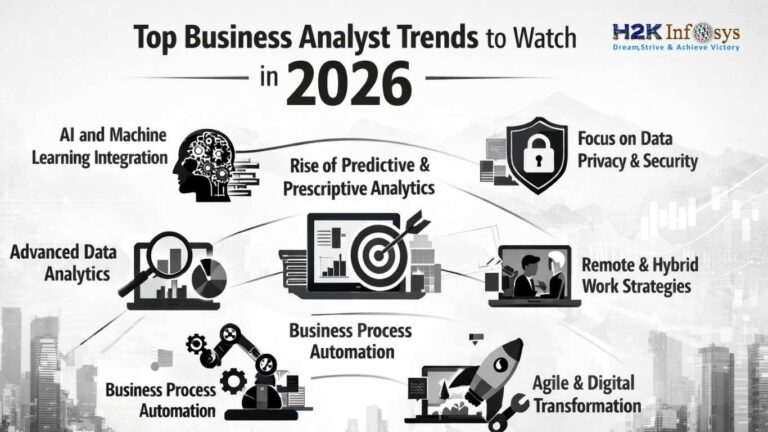
If you’re wondering which Business Analyst Trends will actually matter in 2026, here’s the short answer: data-driven decision making, AI-assisted analysis, and stronger domain expertise are reshaping the role, and honestly, even organizations like H2K Infosys are adjusting their learning paths and BA Training programs to match these shifts.
Business analysis isn’t the same job it was five years ago. I’ve spoken with a few analysts recently, one working in fintech and another in healthcare analytics, and both said the same thing: the role is expanding fast. Analysts are no longer just writing requirement documents; they’re helping teams interpret data, guide strategy, and sometimes even shape product direction.
So let’s talk about the Business Analyst Trends that are shaping how the profession actually works in 2026.
1. AI Is More Frequently Serving Analysts as a Day-to-Day Service
The most noticeable Business Analyst Trends is the growing use of AI in analysis.
The hype may say AI is replacing Analysts, but that’s not the case. Analysts are using machine learning tools to make sense of Big Data. AI-enabled BI dashboards are able to autonomously reveal emerging patterns, outliars, and predictive data.
A product analyst from a SaaS company recently mentioned something nice to me. She used to spend hours generating reports. Now, however, AI dashboards are able to spot irregularities in customer churn. She no longer spends time finding data. Instead, her job is to analyze the data to determine the actions the business needs to take.
This is why a significant aspect of contemporary business analysis training involves AI tools and data analytics platforms.
2. Data Storytelling Skills Are In Demand
There’s another shift in Business Analyst Trends focusing on the combination of data and storytelling.
Businesses have dashboards, but what they need are people to interpret the numbers.
Executives do not want to see spreadsheets. They want the answers to their questions.
- Analysts are telling the story of the data and explaining
- The reason customer retention dropped
- The product features that drive revenue
- The operationally inefficient areas
The ability to visualize data and tell stories with it has made courses in Power BI, Tableau, and the like, extremely popular.
3. Domain Expertise Matters More Than Ever
One of the changes in Business Analyst Trends is the growing importance of industry knowledge.
A decade ago, many analysts were generalists. Now, businesses increasingly seek analysts with specific business domain knowledge.
Examples:
- Healthcare analysts must know the regulations and privacy issues surrounding patient data
- Financial analysts must understand risk-based and compliance-oriented models.
- E-commerce analysts often focus on customer behavior.
This is one of the reasons why online business analyst certifications have started to offer industry-specific electives.
4. Agile and Product Thinking Are Now Expected
Agile isn’t new, but the way analysts work within agile teams is evolving. Among the most practical Business Analyst Trends is the shift toward product thinking.
Instead of simply documenting requirements, analysts now:
- collaborate closely with product managers
- help prioritize backlogs
- interpret user feedback and analytics
I saw this firsthand in a startup project last year. The BA wasn’t just gathering requirements; she was analyzing user behavior and recommending product changes.
That’s very different from the traditional documentation-heavy role many people still imagine.
5. Analysts Are Becoming Strategic Advisors
One of the more exciting Business Analyst Trends is the increasing strategic influence analysts have inside organizations.
Leadership teams want analysts involved earlier in decision-making.
For example:
- evaluating potential product launches
- identifying operational bottlenecks
- predicting market opportunities using data
Some analysts even sit directly in strategy meetings now.
That shift explains why BA certification programs increasingly focus on decision analysis, stakeholder communication, and business strategy.
6. Remote and Global BA Teams Are Growing
Business Analyst Trends show another change: the rise of globally distributed teams.
During the pandemic, hiring analysts from different geographies became a norm, and it continues even now.
The advantage?
Companies have greater flexibility to bring on niche analysts from anywhere in the world.
The disadvantage?
Communication becomes even more critical. Remote analysts must conduct workshops, elicit requirements, and orchestrate stakeholder alignments across different zones.
As a result, numerous business analyst courses have incorporated remote working simulations.
7. Strong Technical Awareness Is No Longer Optional
A decade ago, analysts could stay relatively non-technical.
Not anymore.
Among the most practical Business Analyst Trends, analysts today often need working knowledge of:
- APIs
- data pipelines
- cloud platforms
- SQL basics
They don’t need to become developers, but understanding how systems work helps them communicate better with engineering teams.
Many business analysis online training programs now include light technical modules for exactly this reason.
8. The Importance of Certificates and Training is on the Rise
As the marketplace evolves, one of the most evident Business Analyst Trends is the growing emphasis on structured learning.
Offerings are shifting to:
accredited credentials
liability project exposure
robust tool are awareness
This explains the rapid expansion of BA Training and Placement programs. New analysts are able to enhance their self-assurance as a result of these programs, which combine experiential learning with simulated real life projects.
In interviews, I observed junior analysts get hired more quickly because they exhibited practical project experience.
A Real-World Example of These Trends in Action
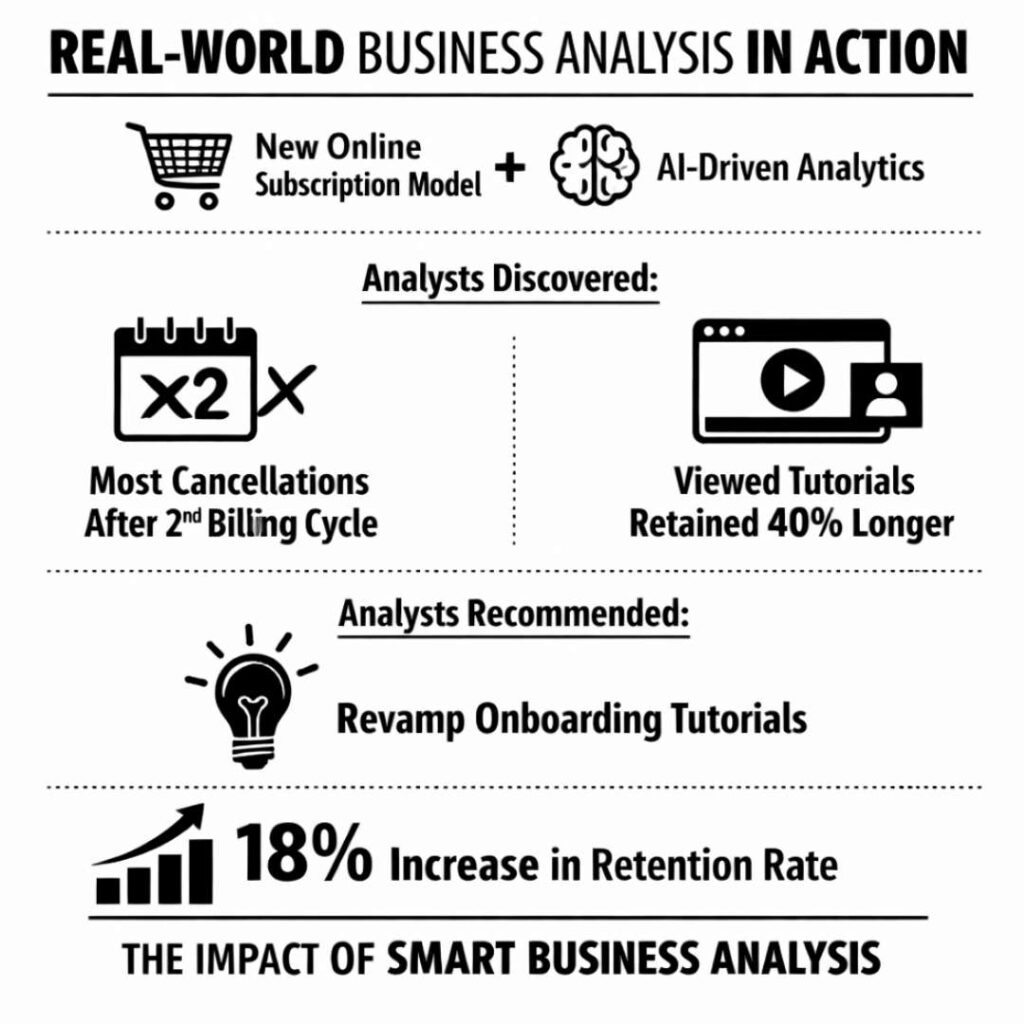
I’d like to provide an example that captures multiple Business Analyst Trends occurring concurrently.
A retail company has implemented a new online subscription model. The company’s analysts utilized AI-based analytics to track and analyze customer behavior as it occurred.
Within a few weeks, they were able to determine that:
- The majority of cancellations occurred after the second billing cycle
- Those who viewed onboarding tutorials retained subscriptions 40% longer
Rather than just providing a report, the analysts suggested revamping the onboarding tutorials.
That single suggestion was reported to have a positive impact on retention, with nearly 18 percent.
That’s the essence of modern business analysis.
Skills Future Business Analysts Should Start Building
From all of these developing Business Analyst Trends, these skills seem to be the most critical moving forward:
- Data analysis and visualization
- Stakeholder communication
- Agile and product thinking
- Industry-specific knowledge
- Basic technical literacy
- Strategic problem solving
Many newcomers to the profession opt for organized ba training or targeted business analyst certification online courses to acquire these skills in the shortest time possible.
Conclusion
The most important thing to note with these Business Analyst Trends is that the role is increasingly becoming more important.
Analysts are critical in helping organizations integrate data, technology, and business strategies. As organizations further digitize their operations, this integrated role is even more critical.
If you are thinking of changing careers, then taking some solid business analyst courses, practical business analysis, and obtaining a credentialed BA certification will position you for one of the most flexible and in-demand career opportunities in technology and business.
The rapid change in these Business Analyst Trends over the years is evidence that this career is becoming more exciting.