Introduction
Diving into a career in cybersecurity is exciting but the interview prep can be intimidating for many beginners. H2K Infosys has become a reliable learning platform for aspiring professionals seeking real world cybersecurity knowledge, hands-on projects and career oriented guidance.
Cybersecurity industry is expanding at an unprecedented rate as companies continue to see ransomware attacks, phishing scams, cloud security threats, and data breaches. Companies are always looking for qualified professionals to safeguard their systems, analyze threats and act quickly in the event of a cyber incident.
Technical knowledge is valuable, but many candidates bomb interviews because they don’t know how to showcase their skills with confidence. Knowing the right Interview Tips for Future cybersecurity Analyst roles can help a lot there. Today’s recruiters want more than certifications. They want to see that candidates can communicate clearly, solve problems and demonstrate that they understand things in a real-world context.
Most students take Online courses for cybersecurity to learn technical skills, but interview prep is equally important. Employers want people who understand networking, security concepts, incident response, SIEM tools, and real-world cybersecurity environments.
This guide offers practical and easy-to-follow Interview Tips for future Cybersecurity Analyst positions. It also talks about how cybersecurity training and placement programs, practical projects, mock interviews, and continuous learning can help aspiring professionals build successful careers in cybersecurity.
Why Cybersecurity Careers Are Growing Rapidly
Cybersecurity has become one of the most important fields in the modern digital world. Businesses now rely heavily on cloud computing, online transactions, remote work systems, and digital communication. Because of this, cyber threats are becoming more advanced every day.
Organizations need cybersecurity analysts to:
- Monitor systems for suspicious activity
- Detect cyber threats
- Analyze vulnerabilities
- Investigate incidents
- Protect sensitive customer information
- Improve organizational security
- Prevent unauthorized access
As demand continues to rise, more students are joining online courses for cybersecurity and cybersecurity training and placement programs to build job-ready skills.
Understanding current industry expectations is one of the most valuable Interview Tips for Future cybersecurity Analyst candidates because companies now prioritize both technical and communication skills.
Understand the Role Before Attending Interviews
One of the biggest mistakes candidates make is going into interviews without a real understanding of what a cybersecurity analyst does.
A cybersecurity analyst could work on:
- Surveillance of security
- Incident handling
- Threat intelligence
- SIEM analysis
- Risk Assessment
- Monitoring logs
- Endpoint security
- Compliance assistance
- Risk assessment
- Network security
Candidates are often asked by recruiters to describe what a cybersecurity analyst does daily. A vague answer can decrease your chances of being selected.
Carefully study job descriptions before interviews is one of the smartest Interview Tips for Future cybersecurity Analyst candidates. Knowing how the role fits you makes you more confident in answering questions, and in making sure your answers are what the employer is looking for.
Practical labs and projects in cybersecurity training and placement programs give students exposure to real world cybersecurity responsibilities.
Build Strong Cybersecurity Fundamentals
You need to have good cyber security fundamentals to clear interviews.
Candidates should have a good understanding of:
Networking Basics
Important networking concepts include:
- IP addresses
- DNS
- VPNs
- Firewalls TCP/IP
- Ports and protocols .
- Switches And Routers
- HTTP & HTTPS
Operating Systems
What cybersecurity analysts should know:
- Linux fundamentals
- Windows Defender Security
- User rights
- File systems
- Command line operations
- System processes
Security Concepts
The main security concepts are:
- The CIA triad
- Cryptography
- Authentication & Authorization
- Types of malware
- Phishing attacks
- Social engineering
- Two factor authentication
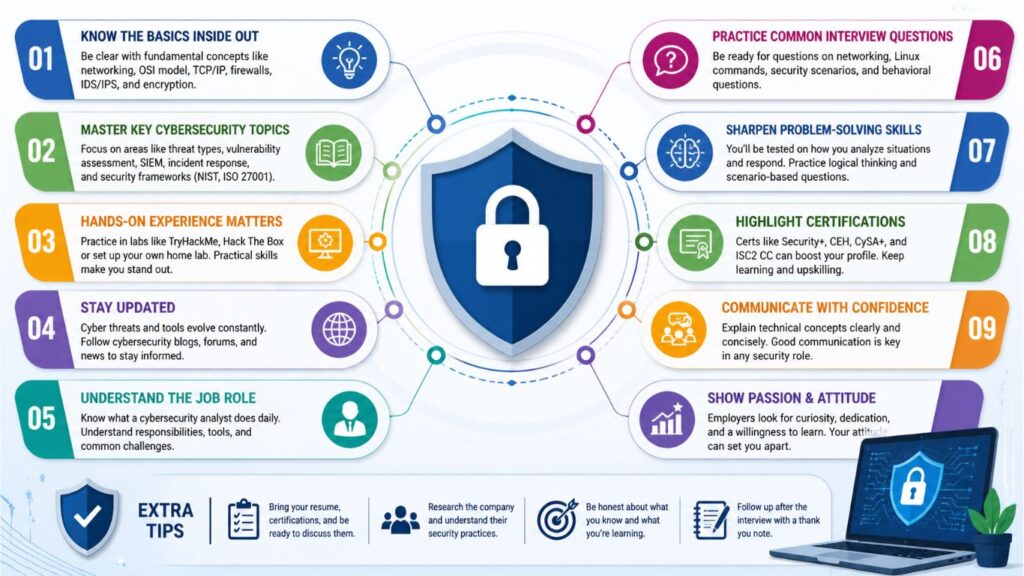
When you’re a future cybersecurity analyst applicant, one of the most important interview tips is to focus on explaining these concepts clearly, rather than memorizing textbook definitions.
Most cybersecurity online courses start out with these basics and then move on to advanced security training.
Practice Common Cybersecurity Interview Questions
Interview preparation becomes much easier when candidates practice common questions beforehand.
Technical questions may include:
- What is phishing?
- What is a firewall?
- Explain SIEM tools.
- What is ransomware?
- What is vulnerability assessment?
- Explain IDS and IPS.
- What is multi-factor authentication?
- How does encryption work?
Behavioral questions may include:
- Tell me about yourself.
- Why do you want to work in cybersecurity?
- Describe a difficult challenge you faced.
- How do you stay updated with cybersecurity trends?
Scenario-based questions may include:
- How would you respond to suspicious network activity?
- What steps would you take after detecting malware?
- How would you investigate a phishing email?
Practicing answers regularly is one of the most effective Interview Tips for Future cybersecurity Analyst candidates because confidence improves significantly with repetition.
Many cybersecurity training and placement programs conduct mock interviews to help students prepare for real hiring situations.
Gain Hands-On Experience
Cybersecurity is a highly practical field. Employers prefer candidates who have real-world experience instead of only theoretical knowledge.
Hands-on practice may include:
- Working with SIEM tools
- Monitoring security logs
- Using Wireshark
- Running vulnerability scans
- Practicing Linux commands
- Configuring firewalls
- Performing threat analysis
- Investigating alerts
Practical experience helps candidates explain their skills naturally during interviews.
One of the best Interview Tips for Future cybersecurity Analyst roles is to discuss projects confidently during interviews. Recruiters appreciate candidates who can explain what they actually worked on.
Students taking online courses for cybersecurity should always choose programs that include labs and practical projects.
Learn Popular Cybersecurity Tools
Cybersecurity interviews often include questions about security tools.
Important tools include:
SIEM Tools
- Splunk
- QRadar
- ArcSight
Network Analysis Tools
- Wireshark
- Nmap
- Tcpdump
Vulnerability Assessment Tools
- Nessus
- OpenVAS
- Qualys
Endpoint Security Tools
- CrowdStrike
- SentinelOne
- Microsoft Defender
Learning security tools is one of the most practical Interview Tips for Future cybersecurity Analyst candidates because many recruiters specifically ask about tool experience.
Cybersecurity training and placement programs usually provide hands-on access to these tools.
Improve Communication Skills
Many technically skilled candidates fail interviews because they struggle with communication.
Cybersecurity analysts regularly communicate with:
- Security teams
- IT administrators
- Managers
- Clients
- Non-technical users
Interviewers evaluate:
- Clarity
- Confidence
- Professionalism
- Listening ability
- Problem-solving communication
One of the simplest Interview Tips for Future cybersecurity Analyst applicants is to explain technical topics in a calm and easy-to-understand way.
Instead of using overly complicated language, focus on speaking naturally and confidently.
Create a Strong Cybersecurity Resume
Your resume creates the first impression before interviews even begin.
A strong cybersecurity resume should include:
- Technical skills
- Certifications
- Hands-on projects
- Security tools
- Internship experience
- Achievements
- Labs and simulations
Use strong action words such as:
- Investigated
- Monitored
- Secured
- Analyzed
- Implemented
- Detected
Building a professional resume is one of the most overlooked Interview Tips for Future cybersecurity Analyst candidates, yet it can significantly improve interview opportunities.
Students enrolled in cybersecurity training and placement programs often receive professional resume guidance.
Stay Updated With Cybersecurity Trends
Cybersecurity changes rapidly, and recruiters value candidates who stay informed.
Important areas to follow include:
- AI in cybersecurity
- Cloud security
- Ransomware attacks
- Zero trust security
- Threat intelligence
- Data privacy laws
- Emerging vulnerabilities
Ways to stay updated:
- Read cybersecurity blogs
- Follow industry experts on LinkedIn
- Attend webinars
- Watch security news
- Practice labs regularly
One of the smartest Interview Tips for Future cybersecurity Analyst candidates is to discuss recent cybersecurity incidents during interviews because it shows genuine interest in the field.
Understand Incident Response Basics
Incident response is a common interview topic.
Candidates should understand these phases:
- Preparation
- Identification
- Containment
- Eradication
- Recovery
- Lessons learned
Interviewers may ask how you would respond to:
- Malware infections
- Unauthorized access
- Suspicious logins
- Phishing attacks
Learning structured incident response is one of the most valuable Interview Tips for Future cybersecurity Analyst professionals because incident handling is a core cybersecurity responsibility.
Many cybersecurity training and placement programs include incident response simulations.
Prepare for SOC Analyst Interviews
SOC analyst positions are popular entry-level cybersecurity roles.
SOC interviews often focus on:
- SIEM monitoring
- Log analysis
- Threat detection
- Incident escalation
- Alert triage
- Security investigations
Candidates should know how to:
- Analyze alerts
- Identify suspicious behavior
- Escalate incidents properly
- Investigate indicators of compromise
One of the best Interview Tips for Future cybersecurity Analyst candidates entering SOC roles is to practice explaining how you would investigate alerts step by step.
Hands-on cybersecurity training and placement programs can help students gain practical SOC experience.
Practice Linux Skills Regularly
Linux is widely used in cybersecurity environments.
Important Linux commands include:
- ls
- cd
- grep
- chmod
- netstat
- ping
- ssh
- top
- curl
Interviewers may ask candidates to explain Linux commands or troubleshoot issues.
Practicing Linux regularly is one of the most practical Interview Tips for Future cybersecurity Analyst applicants because command-line skills are highly valued in cybersecurity.
Students taking online courses for cybersecurity should spend time working in Linux lab environments.
Build Problem-Solving Skills
Cybersecurity professionals solve problems every day.
Interviewers often evaluate:
- Analytical thinking
- Troubleshooting ability
- Investigation skills
- Decision-making ability
When answering scenario-based questions:
- Stay calm
- Explain your process clearly
- Mention investigation steps
- Discuss documentation and escalation
One of the strongest Interview Tips for Future cybersecurity Analyst roles is to focus on structured thinking instead of rushing to provide answers.
Prepare Questions for the Interviewer
At the end of interviews, candidates are usually asked if they have questions.
Good questions include:
- What tools does your security team use?
- What does a normal workday look like?
- What are the biggest security challenges your company faces?
- How does the company support employee learning?
Asking thoughtful questions is one of the easiest Interview Tips for Future cybersecurity Analyst candidates to stand out professionally.
Avoid Common Interview Mistakes
Common mistakes include:
- Lack of preparation
- Weak communication
- Memorized answers
- Exaggerating skills
- Poor confidence
- Ignoring practical experience
- Not researching the company
One of the most important Interview Tips for Future cybersecurity Analyst candidates is to remain honest during interviews. If you do not know an answer, explain how you would approach learning or solving the problem.
Online courses for cybersecurity combined with consistent practice can help candidates avoid many common interview mistakes.
Why Online Cybersecurity Learning Is Growing
Modern learners prefer flexible education options.
Online courses for cybersecurity help students:
- Learn from anywhere
- Access recorded sessions
- Practice hands-on labs
- Prepare for certifications
- Study at flexible schedules
- Build technical skills
Online learning has become highly popular among both beginners and working professionals.
Many students now combine online courses for cybersecurity with cybersecurity training and placement programs to improve both technical and interview readiness.
Importance of Cybersecurity Training and Placement Programs
Learning technical concepts alone is often not enough for job success.
Cybersecurity training and placement programs help students transition from learning to employment.
Benefits include:
- Hands-on projects
- Real-world simulations
- Resume preparation
- Mock interviews
- Career guidance
- Placement support
- Technical mentoring
One of the most useful Interview Tips for Future cybersecurity Analyst candidates is to participate in mock interviews regularly because practice builds confidence and improves communication.
H2K Infosys offers practical Cybersecurity training and placement support designed to help students become job-ready with Interview Tips for Future cybersecurity Analyst.
How H2K Infosys Supports Future Cybersecurity Analysts
H2K Infosys helps aspiring cybersecurity professionals through:
- Industry-focused learning
- Real-world projects
- Hands-on labs
- Flexible online learning
- Resume assistance
- Mock interview sessions
- Career mentorship
- Placement guidance
Students searching for online courses for cybersecurity often choose H2K Infosys because of its practical approach and career-oriented learning model.
The platform helps learners build technical confidence and prepare effectively for Interview Tips for Future cybersecurity Analyst
Conclusion
But when you build a career in cybersecurity, it’s not just about what you know. It’s about how well you can demonstrate it when it matters. Many future analysts have the right skills but they don’t know how to communicate them well in an interview. This is why good preparation Interview Tips for Future cybersecurity Analyst, real-life exposure and regular practice make such a difference.
“Candidates can turn knowledge into confidence by concentrating on fundamentals, getting hands-on experience, and rehearsing interview situations on a regular basis.” Improving communication skills and staying up to date on industry trends will also help you stand out in a competitive job market. Online courses and structured training programs can provide the right combination of flexibility and practical learning that’s needed to grow.
With the right mindset, guidance and preparation, particularly through platforms like H2K Infosys, you can face interviews with clarity and confidence. Cybersecurity is a field that offers long-term growth potential and exciting challenges. With the right approach, you can successfully transition into a rewarding and future-proof career in Interview Tips for Future cybersecurity Analyst.