Choosing a career in software testing can feel confusing at first. Many beginners hear about automation tools and also see strong demand for manual testers. If you are exploring options through H2K Infosys or similar training paths, you may wonder which direction suits you best. This guide will help you understand TOSCA vs Manual Testing Careers in a clear and practical way so you can make the right choice for your future. Many learners also consider paths like Tricentis TOSCA Training, Tricentis TOSCA Certification, and TOSCA as1 Certification when planning their automation journey.
Introduction
The software industry continues to grow at a fast pace. Companies release updates frequently, and they need reliable testing to ensure quality. This demand creates opportunities in both manual testing and automation testing.
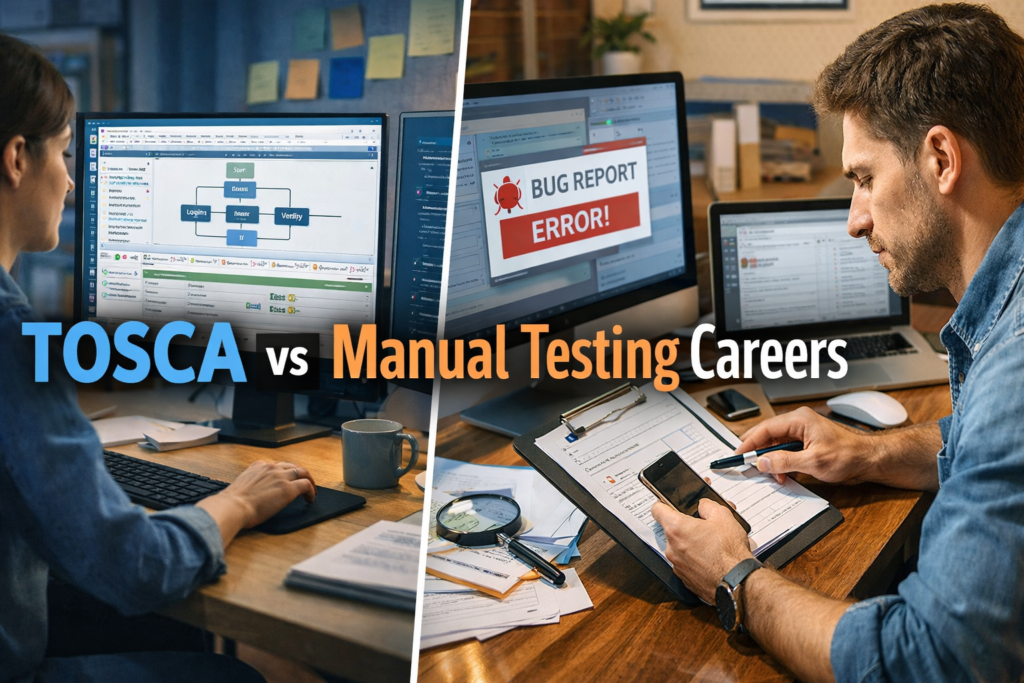
Manual testing focuses on human driven test execution. Automation testing uses tools like TOSCA to speed up testing tasks. Both roles are important, but they require different skills and offer different career paths.
This blog explains TOSCA vs Manual Testing Careers in detail. You will learn what each role involves, what skills you need, and how the future looks for both paths.
What is Manual Testing?
Manual testing is the process of testing software without using automation tools. A tester checks features step by step, just like a real user.
Key Responsibilities
- Write test cases based on requirements
- Execute test cases manually
- Report bugs clearly
- Retest fixes
- Work closely with developers and analysts
Example
Imagine a login page. A manual tester will:
- Enter valid credentials
- Enter invalid credentials
- Test empty fields
- Check error messages
This process ensures that the system behaves correctly in all cases.
What is TOSCA Automation Testing?
TOSCA is an automation tool that allows testers to create test cases without heavy coding. It uses a model based approach, which makes testing faster and easier.
Key Features of TOSCA
- Scriptless automation
- Model based testing
- Reusable test components
- Support for web, API, mobile, and desktop
Example
Instead of manually testing a login page every time, a TOSCA user creates an automated test once. The system runs it repeatedly with different data.
This approach saves time and improves accuracy.
Understanding the Core Difference
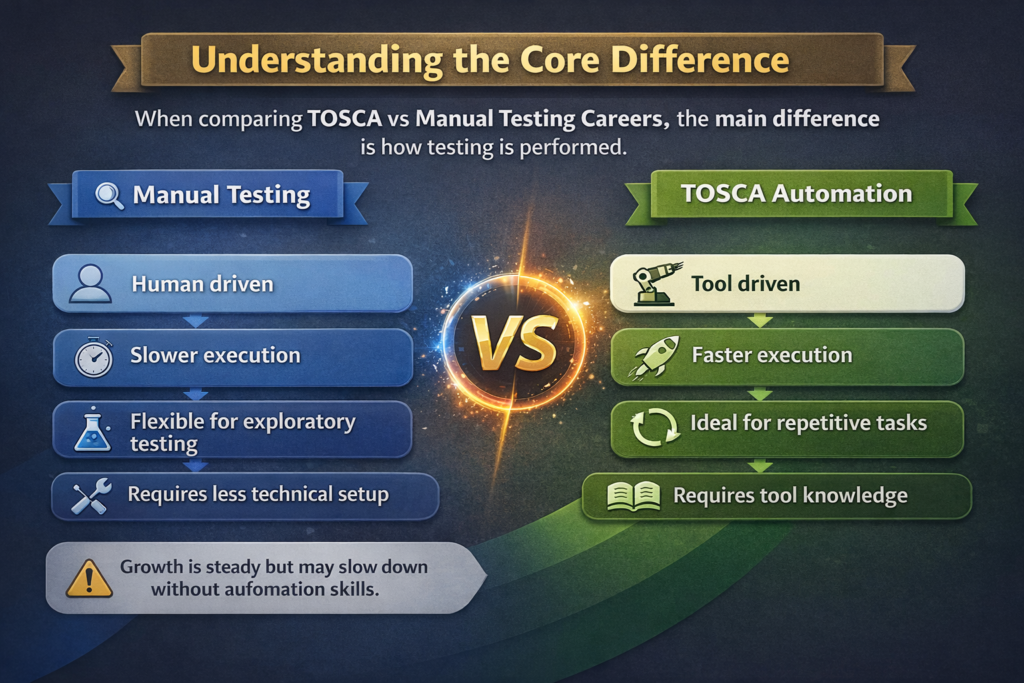
When comparing TOSCA vs Manual Testing Careers, the main difference is how testing is performed.
Manual Testing
- Human driven
- Slower execution
- Flexible for exploratory testing
- Requires less technical setup
TOSCA Automation
- Tool driven
- Faster execution
- Ideal for repetitive tasks
- Requires tool knowledge
Skills Required for Manual Testing
Manual testing is a great starting point for beginners.
Essential Skills
- Basic understanding of software testing
- Strong attention to detail
- Clear communication skills
- Knowledge of test case writing
- Understanding of SDLC and STLC
Optional Skills
- Basic SQL knowledge
- Familiarity with bug tracking tools
Manual testers focus more on logic and user behavior than technical tools.
Skills Required for TOSCA Careers
When you explore TOSCA vs Manual Testing Careers, automation requires more technical understanding.
Essential Skills
- Knowledge of TOSCA tool
- Understanding of automation concepts
- Test case design skills
- Basic understanding of APIs
- Data driven testing concepts
Certifications
- Tricentis TOSCA Training
- Tricentis TOSCA Certification
- TOSCA as1 Certification
These certifications validate your skills and improve job opportunities.
Learning Curve Comparison
Manual Testing
- Easy to start
- Short learning time
- Beginner friendly
TOSCA Automation
- Moderate learning curve
- Requires tool practice
- Needs logical thinking
In TOSCA vs Manual Testing Careers, beginners often start with manual testing and then move to automation.
Salary Comparison
Salary plays a key role when choosing a career.
Manual Testing Salary
- Entry level: Moderate
- Mid level: Stable growth
- Senior level: Limited growth compared to automation
TOSCA Salary
- Entry level: Higher than manual
- Mid level: Strong growth
- Senior level: High demand and better pay
Automation testers usually earn more because they bring efficiency to projects.
Job Market Demand
The demand for testing professionals is increasing every year.
Manual Testing Demand
- Still needed for exploratory testing
- Useful in early project stages
- Strong demand in small companies
TOSCA Demand
- High demand in large enterprises
- Used in complex systems
- Preferred for regression testing
When you evaluate TOSCA vs Manual Testing Careers, automation clearly has stronger long term demand.
Real World Use Cases
Manual Testing Example
A startup launches a new app. They need testers to explore features and find unexpected issues. Manual testing works best here.
TOSCA Example
A banking system runs daily updates. It requires repeated testing of core features. Automation with TOSCA ensures speed and accuracy.
Career Growth Path
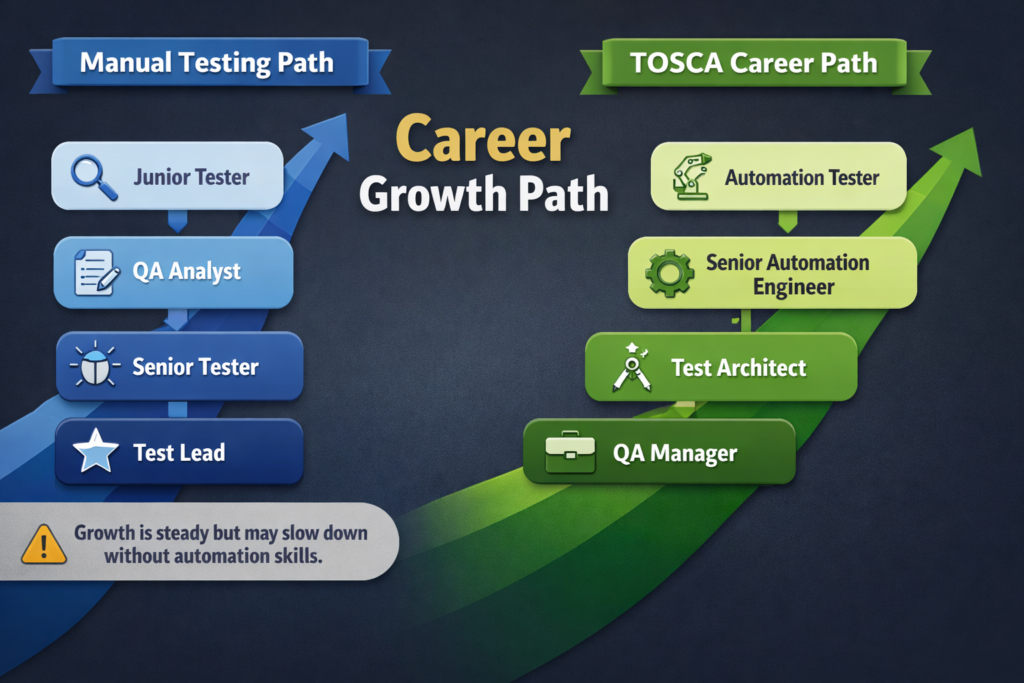
Manual Testing Path
- Junior Tester
- QA Analyst
- Senior Tester
- Test Lead
Growth is steady but may slow down without automation skills.
TOSCA Career Path
- Automation Tester
- Senior Automation Engineer
- Test Architect
- QA Manager
Automation offers faster career growth and more leadership roles.
Mid Career Insight
At the mid stage, many professionals rethink their path. This is where TOSCA vs Manual Testing Careers becomes a critical decision point. Many testers upgrade their skills through Tricentis TOSCA Training, Tricentis TOSCA Certification, and TOSCA as1 Certification to move into automation roles and secure better growth.
Pros and Cons
Manual Testing Pros
- Easy to learn
- No coding required
- Strong foundation in testing
Manual Testing Cons
- Repetitive work
- Slower execution
- Limited salary growth
TOSCA Pros
- Faster testing
- High demand
- Better salary
TOSCA Cons
- Requires tool learning
- Initial setup effort
- Needs practice
This comparison helps you understand TOSCA vs Manual Testing Careers clearly.
Step by Step Guide to Choose the Right Path
Step 1: Check Your Interest
- Do you enjoy exploring software manually
- Or do you prefer tools and automation
Step 2: Evaluate Your Skills
- Strong logic and patience suit manual testing
- Analytical thinking suits automation
Step 3: Think About Long Term Goals
- Manual testing is a good starting point
- Automation offers better future growth
Step 4: Start Learning
- Begin with manual testing basics
- Move to automation tools like TOSCA
Industry Trends
The software industry is moving towards automation.
Key Trends
- Continuous integration and testing
- Agile and DevOps practices
- Increased use of automation tools
These trends strongly impact TOSCA vs Manual Testing Careers decisions.
Why Automation is Growing Fast
Automation helps companies:
- Save time
- Reduce human error
- Improve test coverage
This is why tools like TOSCA are gaining popularity.
Can You Switch from Manual to TOSCA?
Yes, many professionals start with manual testing and move to automation.
Transition Steps
- Learn automation basics
- Practice with TOSCA
- Work on real scenarios
- Earn certifications
This path makes TOSCA vs Manual Testing Careers less confusing for beginners.
Common Mistakes to Avoid
- Choosing manual testing only for ease
- Ignoring automation learning
- Not practicing real scenarios
- Skipping certifications
Avoid these mistakes to build a strong career.
Hands On Example: Manual vs TOSCA
Manual Testing Flow
- Open application
- Enter data
- Verify results
- Report bugs
TOSCA Automation Flow
- Create modules
- Build test cases
- Add test data
- Execute automation
Automation reduces repeated effort and saves time.
Future Scope
Manual Testing Future
- Will remain relevant
- Best for exploratory testing
- Limited growth without automation
TOSCA Future
- Strong demand
- Growing adoption
- Better career opportunities
This clearly shows the future of TOSCA vs Manual Testing Careers.
Who Should Choose Manual Testing?
- Beginners with no technical background
- People who prefer simple workflows
- Those who want quick entry into IT
Who Should Choose TOSCA?
- People interested in automation
- Those aiming for higher salaries
- Professionals looking for long term growth
Final Comparison Table
| Factor | Manual Testing | TOSCA |
| Learning Time | Short | Moderate |
| Technical Skills | Low | Medium |
| Salary | Moderate | High |
| Demand | Stable | Growing |
| Career Growth | Limited | Strong |
This table simplifies TOSCA vs Manual Testing Careers for easy understanding.
Key Takeaways
- Manual testing is best for beginners
- TOSCA offers better long term growth
- Automation skills increase your value
- Start simple and move to advanced tools
- Certifications improve job chances
Understanding TOSCA vs Manual Testing Careers helps you make a smart decision.
Conclusion
Choosing between manual testing and TOSCA depends on your goals and interest. Manual testing gives you a strong base, while TOSCA opens doors to advanced roles and better salaries. This is why many learners explore Tricentis TOSCA Training, Tricentis TOSCA Certification, and TOSCA as1 Certification before making a final decision in TOSCA vs Manual Testing Careers.
Start learning today and build the skills that match your future career goals.