What is TOSCA and How Does It Compare to Other QA Tools?
TOSCA is a model-based test automation tool used for functional and regression testing in enterprise software projects. TOSCA Automation supports end-to-end test management, automated test execution, and reporting across multiple technologies, including web, API, desktop, and SAP applications. Unlike traditional scripting-based tools, TOSCA emphasizes a no-code/low-code approach, enabling professionals to design reusable test cases efficiently.
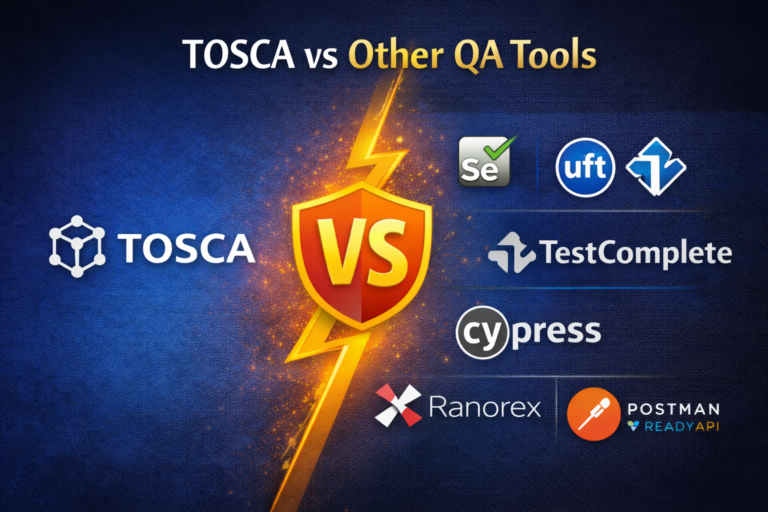
A structured evaluation of TOSCA vs Other QA Tools shows that comparing TOSCA vs Other QA Tools involves assessing automation capabilities, integration flexibility, scalability, and maintenance effort.
- Selenium – Open-source web automation.
- UFT (Unified Functional Testing) – Enterprise-grade GUI testing.
- TestComplete – Scripted and keyword-driven automation.
- Cypress – Modern web application testing with JavaScript.
- Ranorex – GUI testing for desktop, mobile, and web.
- Postman / ReadyAPI – API testing tools.
Each tool has unique advantages and limitations, and understanding these differences in TOSCA vs Other QA Tools is essential for making an informed career or project decision.
How Does TOSCA Work in Real-World IT Projects?
TOSCA operates on a model-based approach. Testers define business rules, workflows, and objects as models instead of writing line-by-line scripts. This approach provides:
- Reusable TestCases across multiple projects.
- Automatic synchronization with application changes.
- Integrated support for continuous integration (CI/CD) pipelines.
- Comprehensive reporting and traceability for audits and compliance.
Comparison in Real-World Workflows:
| Tool | Approach | Maintenance | Scalability | CI/CD Integration |
| TOSCA | Model-based, no-code | Low, reusable modules | High, enterprise-ready | Yes, integrates with Jenkins, Azure DevOps |
| Selenium | Code-based, script | High, needs updates | Moderate, depends on framework | Yes, with CI plugins |
| UFT | Script + keyword | Moderate | High, enterprise-ready | Yes |
| TestComplete | Scripted / keyword | Moderate | Moderate | Yes |
| Cypress | JavaScript framework | Moderate | Moderate | Yes |
| Ranorex | GUI automation | Moderate | Moderate | Limited |
| Postman / ReadyAPI | API-focused | Low for APIs | Moderate | Yes |
This comparison of TOSCA vs Other QA Tools highlights TOSCA’s advantage in maintainability and reusability for large enterprise projects.
Why is TOSCA Important for Working Professionals?
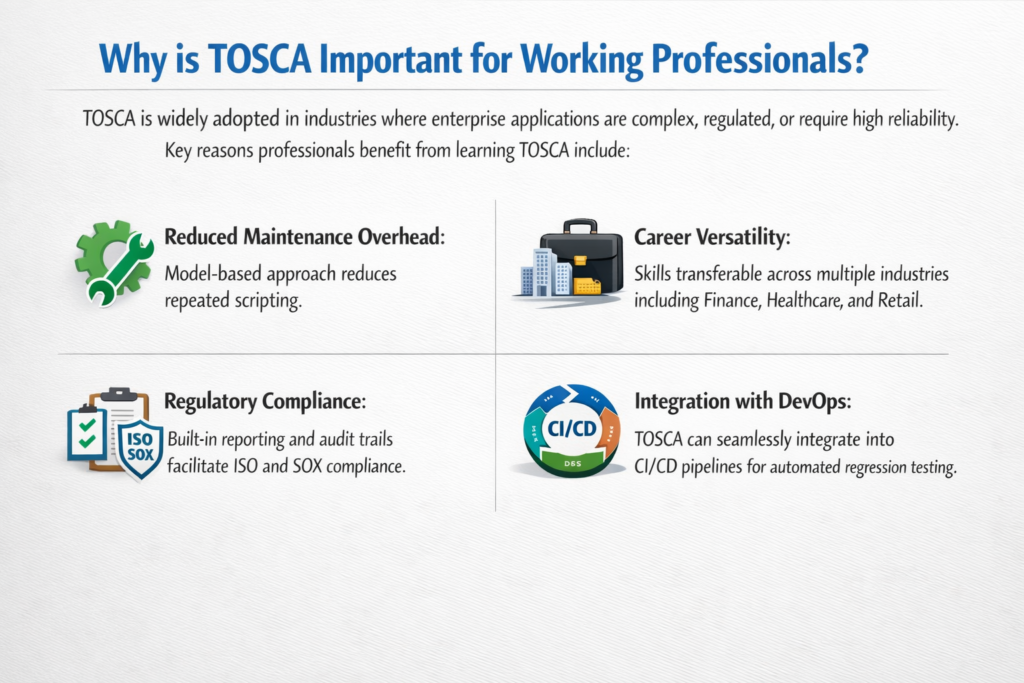
When comparing TOSCA vs Other QA Tools, TOSCA often provides a more scalable, enterprise-friendly solution, especially for organizations with heterogeneous technology stacks.
What Skills Are Required to Learn TOSCA?
Learning TOSCA requires a combination of testing fundamentals, automation principles, and application-specific knowledge:
- Software Testing Basics: Manual testing, test case design, and defect tracking.
- Automation Concepts: TestCase modularization, reusability, and test data management.
- TOSCA Modules:
- TBox for GUI testing
- API testing with Tosca API Engine
- Business components for workflow modeling
- TBox for GUI testing
- Basic Scripting (Optional): Limited scripting in VBScript or JavaScript for custom logic.
- CI/CD Familiarity: Jenkins, Azure DevOps, or Bamboo for automated execution.
Compared to Selenium or Cypress, which require strong coding skills, TOSCA lowers the barrier for non-developer testers, making it attractive for QA professionals transitioning from manual testing.
How is TOSCA Used in Enterprise Environments?
Enterprises typically use TOSCA for end-to-end quality assurance across complex software landscapes:
- SAP Testing: SAP modules like S/4HANA are automated using TOSCA’s dedicated SAP engine.
- Web & Desktop Applications: GUI elements are modeled and automated, reducing maintenance when UI changes.
- API Testing: REST/SOAP APIs are tested with integrated data-driven frameworks.
- Continuous Testing in DevOps: TOSCA integrates with CI/CD pipelines to execute regression suites automatically.
- Test Management: End-to-end traceability from requirement to defect, with analytics dashboards.
TOSCA vs Other QA Tools in Enterprise Context:
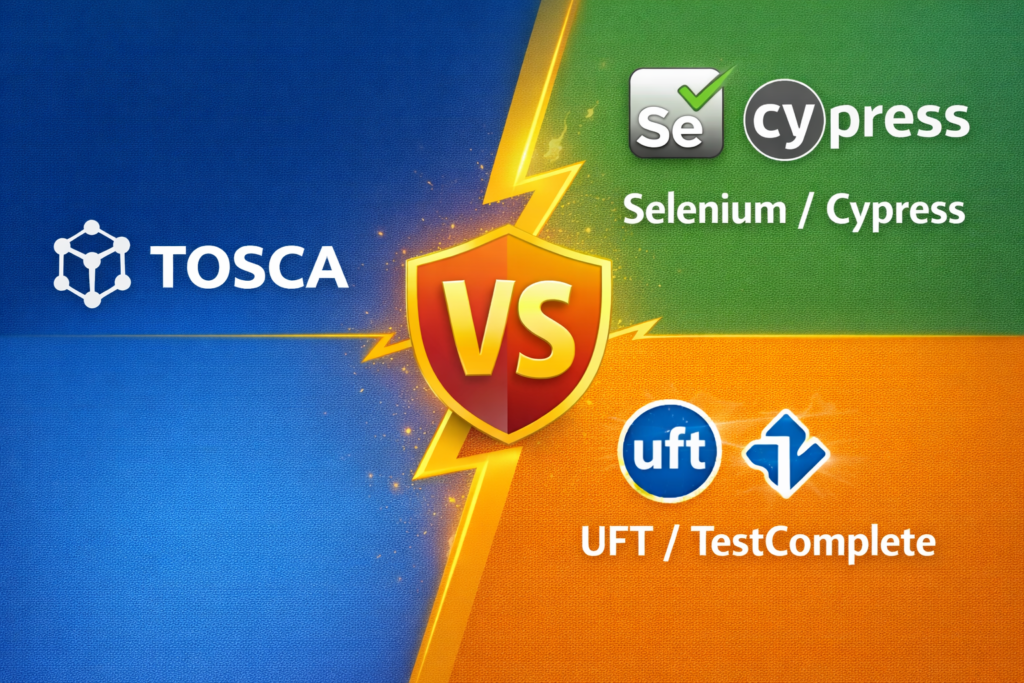
| Scenario | TOSCA | Selenium / Cypress | UFT / TestComplete |
| SAP Application Testing | Native support, high reusability | Limited, requires plugins | Moderate, via add-ins |
| API Testing | Integrated, data-driven | External libraries | Separate tools required |
| Cross-Browser Web Testing | Supports multiple browsers | Strong support | Strong, enterprise-focused |
| Regression Test Maintenance | Model-based, reusable modules | High maintenance | Moderate |
In TOSCA vs Other QA Tools, TOSCA’s model-driven approach is particularly advantageous in enterprise environments where software updates frequently, reducing maintenance overhead compared to code-heavy alternatives.
What Job Roles Use TOSCA Daily?
Professionals using TOSCA may occupy roles such as:
- Test Automation Engineer: Designs and executes automated workflows.
- QA Analyst: Uses TOSCA to validate business requirements and regression coverage.
- DevOps QA Specialist: Integrates automated tests into CI/CD pipelines.
- Business Analyst with QA Skills: Maps business processes to TOSCA models.
- Enterprise Application Tester: Works on SAP, Salesforce, or other enterprise platforms.
Compared to Selenium or Cypress roles, TOSCA roles often require familiarity with enterprise processes and business logic rather than deep programming expertise.
What Careers Are Possible After Learning TOSCA?
Learning TOSCA opens multiple career paths in testing and QA automation:
- Automation Test Engineer: Focused on building and maintaining automated regression suites.
- Test Architect: Designs test frameworks and reusable modules for enterprise applications.
- QA Lead / Manager: Oversees test strategy, tool selection, and workflow integration.
- DevOps QA Specialist: Integrates automated testing within CI/CD pipelines.
- TOSCA Consultant: Provides advisory services for TOSCA adoption and best practices.
When considering TOSCA vs Other QA Tools, TOSCA may offer higher strategic value in enterprise projects, particularly in regulated or complex IT environments.
Detailed Comparison: TOSCA vs Selenium
| Feature | TOSCA | Selenium |
| Approach | Model-based, low-code | Script-based, high-code |
| Supported Platforms | Web, Desktop, SAP, API | Web browsers only |
| Learning Curve | Moderate, less coding | Steeper, strong coding skills |
| Maintenance | Low (reusable modules) | High (scripts break with UI) |
| CI/CD Integration | Yes, Jenkins, Azure DevOps | Yes, with plugins |
| Enterprise Scalability | High | Moderate |
Detailed Comparison: TOSCA vs UFT
| Feature | TOSCA | UFT |
| Approach | Model-based, reusable modules | Keyword + script-driven |
| Supported Platforms | SAP, Web, Desktop, API | Web, Desktop, SAP |
| Maintenance | Low, easy updates | Moderate, requires code update |
| API Testing | Built-in | Limited (needs separate tools) |
| Cost | Moderate, AS1 Certification Cost applies | Enterprise license-based |
Detailed Comparison: TOSCA vs TestComplete
| Feature | TOSCA | TestComplete |
| Scripting Requirement | Minimal | Moderate |
| GUI Automation | Model-based | Object recognition |
| Cross-Platform Support | Extensive | Moderate |
| Maintenance | Low, reusable modules | Moderate |
| Integration with CI/CD | Yes | Yes |
Detailed Comparison: TOSCA vs Cypress
| Feature | TOSCA | Cypress |
| Approach | Model-based, no-code | Code-driven, JavaScript |
| Web Testing | Full-stack enterprise | Modern JS web applications only |
| API Testing | Integrated | Limited |
| CI/CD Integration | Yes | Yes |
| Learning Curve | Moderate | Steep for non-developers |
Detailed Comparison: TOSCA vs Ranorex
| Feature | TOSCA | Ranorex |
| Desktop Application Support | Full enterprise support | Limited to specific technologies |
| Cross-Technology Reusability | High | Moderate |
| Scripting Requirement | Minimal | Moderate |
| Integration | CI/CD, test management | Limited |
Detailed Comparison: TOSCA vs Postman / ReadyAPI
| Feature | TOSCA | Postman / ReadyAPI |
| Primary Focus | Functional, regression, API | API testing only |
| Automation Scope | End-to-end enterprise apps | APIs only |
| Integration | CI/CD pipelines | CI/CD integration possible |
| Learning Curve | Moderate | Low |
FAQ: TOSCA vs Other QA Tools
Q1: Is TOSCA better than Selenium for enterprise testing?
A1: TOSCA is often better for enterprise-scale testing due to model-based automation, lower maintenance, and built-in API/SAP support. Selenium is ideal for web-only automation with strong coding expertise.
Q2: What is the TOSCA AS1 Certification Cost?
A2: The TOSCA as1 Certification Cost varies by region and provider, typically ranging from $200–$400 USD. Certification validates automation skills using TOSCA modules.
Q3: Can TOSCA replace UFT or TestComplete?
A3: TOSCA can replace traditional GUI automation tools in enterprise contexts, especially when maintainability and multi-technology support are critical.
Q4: How long does it take to learn TOSCA?
A4: Beginners with prior QA knowledge can learn TOSCA basics in 4–6 weeks through structured TOSCA Online Training and hands-on practice.
Q5: Which is easier for a non-developer: TOSCA or Cypress?
A5: TOSCA is generally easier for non-developers because of its model-based, low-code approach. Cypress requires coding knowledge in JavaScript.
Key Takeaways
- TOSCA vs Other QA Tools highlights model-based, reusable automation as a differentiator.
- TOSCA reduces maintenance effort compared to scripting-heavy tools like Selenium and Cypress.
- Enterprise adoption is strong in SAP, web, desktop, and API testing workflows.
- Roles after learning TOSCA include Test Automation Engineer, QA Lead, DevOps QA Specialist, and TOSCA Consultant.
- TOSCA AS1 Certification validates practical automation skills and enhances career growth.
Explore hands-on learning in TOSCA Online Training at H2K Infosys to develop automation expertise and advance your career in QA and DevOps environments.