Introduction
Imagine you are part of a technology-driven company. You’re building cloud‑native applications. You are deploying code constantly. You need to move fast. But you also need to stay compliant with regulations, industry standards, security controls, and audit requirements. The question arises: how do you keep up with speed and still keep up with rules? That is where Continuous Compliance DevSecOps comes in.
Continuous Compliance DevSecOps blends three major disciplines: development (Dev), security (Sec) and operations (Ops) with compliance baked in throughout the lifecycle. In this blog post we explore exactly what continuous compliance in a DevSecOps environment means, how it works (especially in cloud environments such as AWS), and how learners in an AWS DevOps/DevSecOps training path can acquire the skills to implement it. Whether you’re also considering broader topics such as azure devops training online or DevSecOps course online or targeting an aws devops certification, you’ll benefit from grasping this key trend.
Why Continuous Compliance DevSecOps Matters
Speed is great. Innovation is vital. But without governance, risk grows. Traditional compliance was often manual, periodic, and slow. That created gaps where vulnerabilities slipped in, or where versions drifted out of policy. Enterprises now must support continuous delivery, agile release cycles, and cloud scale while staying compliant.
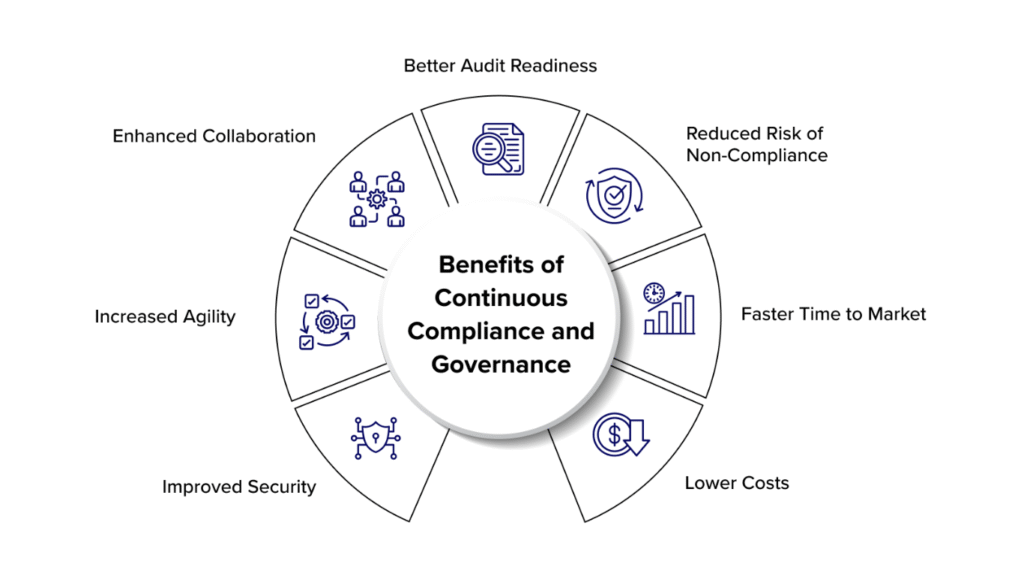
By embedding compliance checks, controls, policy enforcement, and auditability into the DevSecOps pipeline, organizations gain multiple benefits:
- Faster release cycles: Developers move without waiting for separate compliance sign‑offs in a waterfall style.
- Reduced risk: Security and compliance issues are caught earlier, reducing chances of non‑compliance or breaches.
- Audit readiness: The system generates logs, evidence, and controls automatically making audits less painful.
- Scalable governance: Policies apply consistently across microservices, containers, cloud services, and infrastructure as code.
In short, continuous compliance ensures that as you build and deploy, you are not drifting away from your required standards. For professionals aiming for AWS DevOps certification or pursuing DevSecOps training online, understanding how to implement this is a differentiator.
Understanding the Key Concepts
DevSecOps: What it Is
“DevSecOps” is a mindset and set of practices that integrate security as a first‑class citizen in the Dev + Ops lifecycle. In contrast to “DevOps and then we security audit at the end”, DevSecOps means you shift security left into design, code, build, deploy, and operate. You also shift monitoring and feedback into the loop.
Compliance: What it Means in This Context
Compliance means meeting rules: regulatory, contractual, policy, best practices. These could include:
- Legal/regulatory requirements (e.g., GDPR, HIPAA, PCI‑DSS).
- Industry standards (e.g., ISO 27001, SOC 2).
- Cloud provider controls (e.g., AWS Well‑Architected Framework).
- Internal IT governance policies (e.g., encryption standard, network segmentation).
Traditional compliance often happens at a point in time. Continuous compliance means the system always stays in compliance or detects drift immediately.
Continuous: Why It Matters
When you continuously integrate (CI), continuously deliver (CD), and continuously deploy, you also need continuous security and compliance. If you do a release every hour, you cannot afford a manual compliance checkpoint every time. You need automated pipelines, shifting controls, real‑time monitoring, and self‑remediation.
Putting It Together: Continuous Compliance DevSecOps
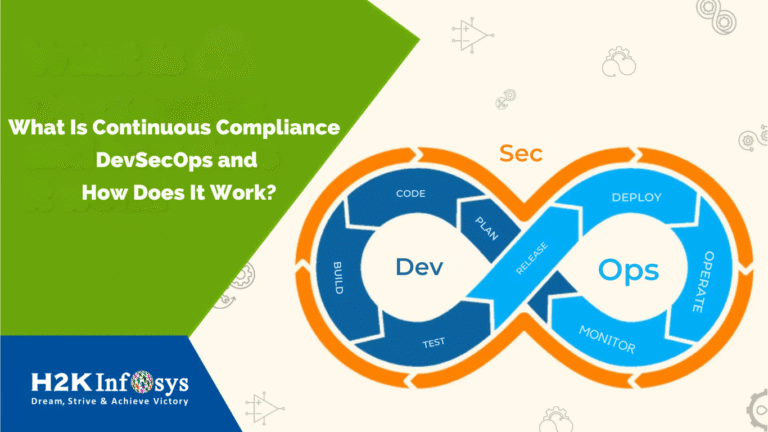
In a continuous compliance DevSecOps model, security and compliance are embedded in every phase of the lifecycle from infrastructure provisioning to code commit, build, test, deployment, monitoring, and feedback. You enforce policy as code, you monitor drift, you audit continuously, you remediate automatically, and you feed insights back to developers.
Here’s a high‑level lifecycle:
- Plan – define requirements, threat models, compliance policies.
- Code – scan code, enforce secure coding practices, include checks for policy violations.
- Build – integrate security tests (SAST, DAST), code composition analysis (SCA), dependency checks.
- Provision – infrastructure as code (IaC) definitions include policy as code, ensuring compliant configurations.
- Deploy – deployment pipelines enforce guardrails (e.g., only compliant environments, approved images).
- Operate & Monitor – real‑time logging, telemetry, drift detection, anomaly detection, violation alerting.
- Audit & Remediate – automated evidence collection, dashboards, alerts, self‑healing where possible, feedback loops.
With this model, compliance is not a gate at the end, but a continuous flow. Let’s dive into how this works in a practical setting, especially in a cloud environment such as AWS, and connect to skills that a DevOps/DevSecOps training would equip you with.
How Continuous Compliance Works in Practice
Scenario: Cloud Infrastructure on AWS
Consider a company building a microservices application on the cloud using AWS (Amazon Web Services). They want to achieve:
- Automated deployments of containerized services.
- Infrastructure as code using e.g., Terraform or AWS CloudFormation.
- Secure, compliant environment (e.g., encryption at rest, secure VPC, logging enabled, identity control).
- Continuous delivery enabling multiple deployments per day.
- Audit visibility to show auditors every configuration, change, and policy adherence.
Step 1: Define Compliance Policies as Code
Start by defining the compliance rules in a machine‑readable format. For example:
resource “aws_s3_bucket” “logs” {
bucket = “prod‑logs‑bucket”
server_side_encryption_configuration {
rule {
apply_server_side_encryption_by_default {
sse_algorithm = “AES256”
}
}
}
tags = {
environment = “production”
}
}
# Compliance rule: Every S3 bucket must have server‑side encryption.
In a DevSecOps training path you would learn to write policies using tools like Open Policy Agent (OPA) or AWS Config rules so that non‑compliant resources are flagged automatically.
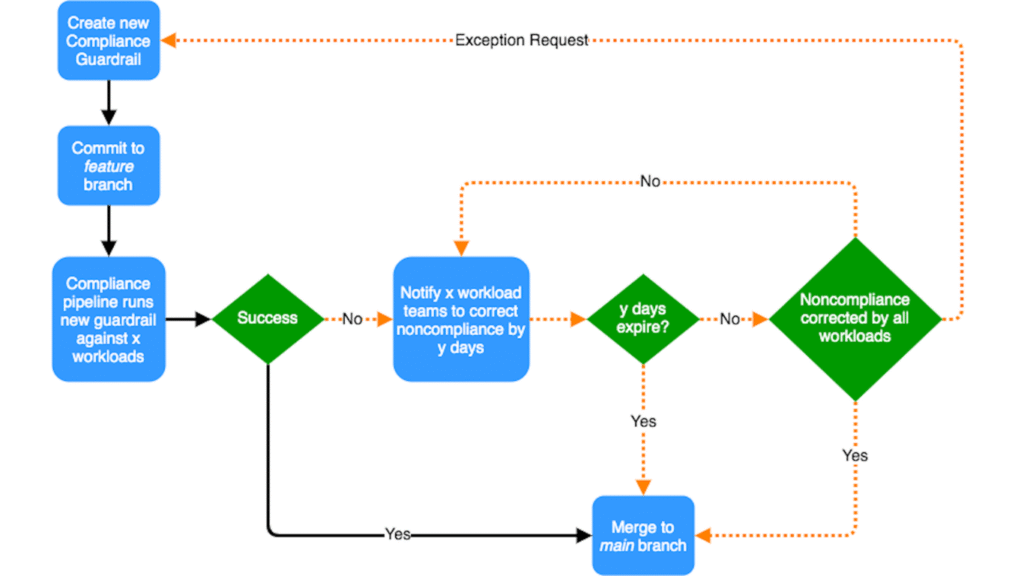
Step 2: Integrate into the CI/CD Pipeline
In the build stage, include security and compliance checks. For example:
- Use static analysis to detect insecure code.
- Use configuration linting to ensure Terraform files meet required tags, encryption, network controls.
- Use policy‑as‑code engines to validate infrastructure plans before applying.
Example pipeline snippet (in pseudocode):
stages:
– checkout
– lint
– unit_test
– security_scan # SAST, dependency check
– infrastructure_plan # Terraform plan
– policy_check # e.g., OPA policy evaluation
– deploy
This ensures that only compliant changes move forward.
Step 3: Enforce Guardrails During Deployment
During deployment into environments, enforce guardrails such as:
- Only approved machine images can be used.
- Network security groups are limited.
- Regulatory‑specific data stores are isolated and encrypted.
- Logging and monitoring is enabled by default.
Tools like AWS Service Catalog, AWS Config, or third‑party platforms help enforce this.
Step 4: Monitor and Detect Drift in Production
Once deployed, the system must continuously monitor for drift when resources change outside of the pipeline, configurations degrade, or compliance rules get broken.
For example:
- An S3 bucket’s encryption gets disabled manually => alert and remediate.
- A new EC2 instance is launched outside of approved image list => flagged and either terminated or remediated.
- Logs are disabled => alert.
In the AWS world you might use AWS CloudWatch, AWS Config, AWS Security Hub, and custom event handling (e.g., AWS Lambda) to automate responses.
Step 5: Audit Evidence and Feedback Loop
All changes, scans, alerts, and remediations produce logs and metrics. These feed into dashboards for compliance teams and auditors. Auditors can query: “Which resources have encryption? Which policy violations occurred? How long did it take to remediate?”
Feedback loops take this data back to developers: “In this sprint we had three policy violations; here’s how to code differently next time.” Over time the cycle improves.
Core Components and Tooling
If you are considering a DevSecOps course online or targeting AWS DevOps certification, you will want to be familiar with the major components of a continuous compliance DevSecOps architecture.
| Component | Description | Example Tools |
| Infrastructure as Code (IaC) | Define infrastructure declaratively so code can be versioned, reviewed, and tested. | Terraform, CloudFormation |
| Policy as Code | Define compliance/security policies in code, integrate into pipeline. | OPA, AWS Config Rules |
| CI/CD Pipeline | Automate building, testing, scanning, deploying. | Jenkins, GitLab CI, AWS CodePipeline |
| Security/Test Automation | Automate static analysis, dynamic tests, container security, dependency checks. | Snyk, SonarQube, OWASP ZAP |
| Runtime Monitoring & Drift Detection | Monitor production environment, detect violations or drift. | AWS Config, AWS Security Hub, ELK stack |
| Audit & Reporting | Capture evidence, dashboards, compliance status for auditors/teams. | AWS CloudTrail, SIEM tools, Splunk |
When you go through an AWS DevOps or DevSecOps training, you’ll often perform hands‑on labs: write Terraform templates, implement OPA policies, integrate scanning into a pipeline, monitor a drift scenario, and generate a compliance report.
Real‑World Examples and Evidence
Case Study: Financial Services Company
A financial‑services firm adopted DevSecOps with continuous compliance in their cloud migration. They moved their workloads to AWS. Previously they used manual audit checkpoints every quarter. They adopted IaC, policy automation, and continuous monitoring. Result: Their time to remediate policy violations dropped from days to hours. They achieved multiple deployments per day with fewer compliance issues. The audit team could view a dashboard with live compliance metrics.
Industry Evidence
While exact numbers vary, industry research shows that organizations adopting DevSecOps and compliance automation achieve faster deployment cycles and lower security incident counts. For example, shifted‑left security and automated compliance are cited as top enablers for accelerating DevOps adoption in cloud environments (source: industry reports). This supports the notion that continuous compliance isn’t optional but strategic.
How to Build Your Skills for Continuous Compliance DevSecOps
If you are pursuing an online DevSecOps course or an AWS DevOps certification path, here is how you can build the right skills:
1. Learn Cloud Fundamentals (AWS)
Start with core AWS services: EC2, S3, VPC, IAM, CloudFormation. Understand basic security, identity, and governance in AWS.
2. Learn DevOps Practices
Master CI/CD concepts, version control (e.g., Git), branching strategies, building pipelines, release management, and infrastructure as code.
3. Learn Security Fundamentals
Understand core security domains: identity & access management, network security, encryption, application security, threat modeling.
4. Learn Compliance & Governance
Study regulatory compliance (e.g., PCI, GDPR, ISO 27001), cloud governance models, shared responsibility in cloud. Then move to policy as code, audit logging, continuous monitoring.
5. Hands‑On Labs: Build a Pipeline with Compliance
For example:
- Create a Terraform module for AWS infrastructure using encryption, tagging, and secure settings.
- Write an OPA policy: “All S3 buckets must have encryption enabled.”
- Integrate into your CI pipeline: after Terraform plan, run OPA policy check; if it fails, pipeline fails.
- Deploy compliant resources; adjust pipeline to catch violations.
- Introduce drift: manually change a resource to violate the policy; detect it via AWS Config and trigger a Lambda remediation.
- Generate a compliance report: number of resources violating, time to remediate, trend over time
6. Practice Auditing and Reporting
Build dashboards (e.g., using AWS QuickSight or open‑source tools) that show compliance posture: how many resources compliant vs non‑compliant, how many violations resolved, which teams introduced violations, etc. This is a skill that aligns with audit, risk, and compliance roles.
7. Continuous Learning
Since cloud services and compliance requirements evolve, make sure you stay up‑to‑date with latest AWS features, new security threats, new policy frameworks, and tools.
Step‑by‑Step Guide: Implementing Continuous Compliance in AWS
Here is a more detailed step‑by‑step guide you could follow, and such a guide is often featured in DevSecOps training modules.
Step 1: Set Up a Version Control Repository
- Create a Git repository for your infrastructure code and application code.
- Define branching strategy (e.g., main/master for production, develop for staging).
- Set up pull requests, code reviews, and merge checks.
Step 2: Define Infrastructure with IaC
- Use Terraform or CloudFormation to define services (VPC, subnets, EC2/EKS clusters, S3 buckets, IAM roles).
- Apply best‑practice configurations: encryption at rest & in transit, minimal IAM privileges, network isolation.
Step 3: Write Policy‑as‑Code
- Choose a policy engine (e.g., OPA, AWS Config).
Write policies such as:
package aws.s3
deny[msg] {
input.resource_type == “aws_s3_bucket”
not input.server_side_encryption_configuration
msg = “S3 bucket without SSE”
}
- Store policies alongside code in the repo.
- Set up tests for these policies.
Step 4: Build Pipeline with Gate Checks
- Use a CI tool e.g., GitHub Actions, GitLab CI, AWS CodePipeline.
- Stages: Checkout → Build → Test → Lint (code + IaC codes) → Security Scan → Terraform Plan → Policy Check → Deploy.
- If any policy or security check fails, the pipeline stops and feedback goes to developers.
Step 5: Deploy to AWS Environments
- Deploy to non‑production (e.g., dev/test) first.
- Use repeatable pipeline steps.
- After approval, deploy to production.
- Use feature toggles, blue/green or canary deployments to reduce risk.
Step 6: Monitor Runtime and Detect Drift
- Enable AWS CloudTrail for auditing API calls.
- Enable AWS Config rules to keep track of whether resources continue to meet policy.
- Set up AWS Security Hub or a SIEM to collect security events.
- Example: If an S3 bucket loses encryption, Config triggers a rule, sends alert, optionally triggers remediation Lambda to re‑enable encryption.
Step 7: Audit, Report, and Remediate
- Build dashboards: number of non‑compliant resources, average time to remediate, recent violations.
- Hold regular governance review meetings: review violations, assign owners, track remediation.
- Feed findings back to development teams: root cause, remediation steps, coding and infrastructure guidance.
Step 8: Improve Continuously
- Use metrics: deployment frequency, lead time for changes, mean time to detect/repair compliance violations.
- Use these metrics to drive improvements
- Update policies as regulations change, incorporate new services or threat vectors.
Integrating with Azure and Other Platforms
While this blog focuses on AWS, many of the same principles apply to other cloud platforms. For example, if you are exploring azure devops training online, you would see similar patterns:
- Infrastructure‐as‐Code: e.g., Azure Resource Manager (ARM) templates or Bicep.
- Policy‑as‑Code: e.g., Azure Policy.
- CI/CD: e.g., Azure DevOps pipelines.
- Monitoring & compliance: e.g., Azure Security Center, Azure Monitor.
No matter the platform, the core mindset remains: shift security and compliance left, embed into pipeline, monitor continuously, detect drift, remediate, and feed back for improvement.
Common Challenges and How to Overcome Them
Challenge: Culture and Mindset
This is often the hardest part. Teams accustomed to separate security, development, and compliance silos may struggle. The DevSecOps model demands collaboration, shared responsibility, and a “fail fast, fix fast” mentality.
How to address: Promote cross‑functional teams, joint ownership of compliance, training sessions, and metrics that reward compliance and security as much as speed.
Challenge: Legacy Systems & Manual Processes
Many organizations still have manual approvals, spreadsheets for audits, and heavyweight change management. Introducing automation may meet resistance.
How to address: Start small pilot one service or environment, automate policy enforcement there, show speed and audit‑readiness gains, then scale.
Challenge: Tool Sprawl and Complexity
With DevSecOps you may use many tools (CI/CD, IaC, policy engines, security scanners). Managing that ecosystem can get complex.
How to address: Consolidate where possible, select tools that integrate well (e.g., policy engine integrates with CI, IaC, monitoring). Build a clear architecture and document flows.
Challenge: Dealing with Compliance Frameworks
Regulations vary by region/industry. Mapping cloud services to compliance controls can be complex.
How to address: Use frameworks and mappings many cloud providers publish compliance mappings; use that as a baseline. Then customize for your internal policies. In training, you will practise mapping controls and building policy as code accordingly.
Challenge: Monitoring and Drift Detection at Scale
In large, multi‑team environments, resources may be changed outside pipelines (shadow IT), leading to drift and non‑compliance.
How to address: Enforce tagging, resource ownership, and use monitoring tools with alerting and remediation. Automate as much as possible. Use dashboards to show where drift happens.
Skills and Roles Involved in Continuous Compliance DevSecOps
Implementing this model involves various roles and skills. Here’s a breakdown:
Developers
- Write secure code: input validation, least privilege, secure APIs.
- Use version control, branching strategies, code reviews.
- Write tests for security and policy violations.
- Consume policies as code and adhere to pipeline checks.
DevOps Engineers
- Build CI/CD pipelines, automate build/test/deploy.
- Implement IaC patterns, manage environments, configurations.
- Integrate security and compliance checks into pipelines.
- Monitor deployments and manage rollback/fail‑safe strategies.
Security Engineers / DevSecOps Engineers
- Define security models, compliance requirements, threat models.
- Write or select policy‑as‑code frameworks.
- Perform code scans, vulnerability management, container security.
- Monitor runtime environments, analyze breach or drift incidents, implement remediation.
Compliance / Audit Teams
- Define regulatory and internal policy requirements.
- Map controls to technical implementation.
- Consume dashboards, audit trails, reports.
- Provide feedback, drive improvement, hold teams accountable.
Platform/Cloud Engineers
- Implement cloud infrastructure securely (VPCs, IAM, network, encryption).
- Ensure shared responsibility model understanding.
- Provision environments that meet baseline compliance.
Skills You Should Develop
- Understanding of cloud security shared responsibility.
- IaC tools (Terraform, CloudFormation, Bicep).
- Policy as code (OPA, AWS Config Rules, Azure Policy).
- CI/CD practices and tools.
- Security testing: SAST, DAST, SCA, container/harder runtime security.
- Monitoring, logging, SIEM, drift detection.
- Compliance frameworks and audit processes.
These are exactly the kinds of skills that an aws devops certification or devsecops course online will cover, equipped for continuous compliance.
Best Practices for Continuous Compliance DevSecOps
Below are best‑practice guidelines that you should adopt or look for in your training or certification preparation.
- Design for compliance from the start: Make compliance a requirement in planning, not after development.
- Use version control for everything: Code, infrastructure, policies, configuration must all be versioned.
- Automate as much as possible: Manual gates slow things down and introduce human error.
- Shift left: Integrate security and compliance checks early in the pipeline.
- Define policy as code: Enforce them consistently across environments.
- Monitor continuously: Use logging, metrics, alerts, drift detection to keep environments in posture.
- Remediate quickly: If a policy is broken, fix it automatically or promptly.
- Report and audit regularly: Use dashboards and reports to drive accountability.
- Educate teams: Developers, operations, security, compliance must share a common language and objectives.
- Iterate and improve: Use metrics like deployment frequency, violation counts, mean time to remediate to track progress.
Continuous Compliance DevSecOps and Training Career Path
If you are considering an online DevSecOps course or aiming for AWS DevOps certification, integrating continuous compliance practices will boost your profile. Here’s how to map your learning:
- Foundation – Start with cloud fundamentals and DevOps concepts: version control, CI/CD, infrastructure as code.
- Security & Compliance Basics – Learn security principles (identity, access, encryption) and compliance frameworks (ISO, SOC, PCI).
- DevSecOps Implementation – Learn how to embed security in pipeline, build policy as code, perform scanning and monitoring.
- Continuous Compliance Focus – Specifically study how compliance becomes continuous: policy automation, drift detection, audit readiness, feedback loops.
- Hands‑On Projects – Build pipelines, enforce policies, detect drift, generate dashboards. This gives you a portfolio of practical work.
- Certification Preparation – For AWS DevOps or equivalent, ensure your knowledge covers security, compliance, automation, pipeline orchestration.
- Real‑World Scenarios – Learn from case studies or simulations: cloud migration, multi‑account governance, hybrid cloud compliance, scaling deployments.
- Keep Learning – Cloud platforms evolve, new threats emerge, regulations change. Commit to continuous learning.
By mastering continuous compliance DevSecOps, you will not just be able to deploy faster, but deploy safely and in compliance a critical competitive advantage.
Conclusion
In today’s fast‑moving cloud world, you cannot trade off speed for security, or innovation for compliance. Continuous compliance DevSecOps gives you both: a way to move fast and stay within governance, audit, and security bounds.
Key Takeaways
- Continuous compliance means embedding security and compliance checks at every stage of the pipeline from code to production.
- By using policy‑as‑code, infrastructure as code, CI/CD pipelines, monitoring, and audit trails you build a system that delivers speed with governance.
- Hands‑on skills in cloud (especially AWS), DevOps, security, and compliance are essential and form the basis of many DevSecOps training paths and AWS certification journeys.
- Real‑world implementation requires cultural change, automation, monitoring, and continuous improvement.
Embrace continuous compliance DevSecOps in your learning and practice. Equip yourself with the tools, processes, and mindset required. Now go ahead and take your next step in mastering this critical capability.