
Introduction
Cybersecurity is one of the most sought-after career fields in the modern digital world. H2K Infosys helps aspiring professionals to gain the practical skills, hands-on experience, and industry knowledge needed to succeed in cybersecurity careers. Businesses in healthcare, banking, retail, government and technology are always looking for skilled professionals who can protect systems and sensitive data from cyber threats. Following the right learning path for a cybersecurity career enables beginners to have a strong foundation in networking, operating systems, security tools, and threat analysis.
Anyone can break into the cybersecurity field, even without a background in IT, with the right guidance, hands-on experience, and industry-focused training. A structured learning path toward an Online classes cyber security career also helps learners gain practical skills, industry certifications, and real-world experience valuable to employers. With cyber threats on the rise globally, a career in cybersecurity is one of the smartest and most future-proof choices you can make today.
Why Cybersecurity Is a Smart Career Move
Before we get into the nitty-gritty, let’s understand the importance of learning path for a cybersecurity career. The threat environment is tangible. Healthcare systems are breached. Banks are attacked. Loss of customer data for retailers. The threats are not going away, they are growing and because of that, companies in every industry need security professionals.
The salary potential is good. Entry-level jobs are typically well-paid, and as you progress along your learning path to a cybersecurity career, six-figure salaries are available in senior roles. Security architects and directors earn a lot of money.
It’s not just the pay that keeps the work interesting. Technology is always changing. New attacks appear. Construct new defenses. If you’re the type of person who likes to keep learning, cybersecurity keeps you on your toes. On top of that many security employers offer telecommuting, flexible schedules, and remote work.
The career also has specialization possibilities. You may choose to specialize in ethical hacking, cloud security, incident response, security operations, or governance and compliance. This learning path for a cybersecurity career diversity means you can build a career around your own specific interests.
Step 1: Start with IT Fundamentals
This part you can’t skip. If you want to get into cybersecurity, you definitely have to start with the way things actually work on a base level.
Cybersecurity professionals work every day with operating systems, networks, servers and applications. Without knowing the basics of IT, you will hardly be able to learn advanced security concepts. Begin by understanding computer hardware components, various operating systems and their features, file systems and their organization, basic troubleshooting techniques, and software installation and management in learning path for a cybersecurity career.
Focus a lot on learning Linux . Many security tools run on Linux environments, as does most cloud infrastructure. Set up a Linux virtual machine and run it regularly. Learn User Management And Access Control Terminal Commands And Scripting Networking Commands File Permissions And Security Attributes Don’t just read about Linux. Get your hands dirty for weeks, until it feels cozy and natural.
Learning Operating Systems in depth helps you to think like a security professional. If something goes wrong you know why. You know what it is when you see suspicious activity in logs. This basic knowledge is key to putting your learning path for a cybersecurity career on a solid footing.
Step 2: Master Networking Fundamentals
Networking is possibly the most important skill in cybersecurity. Most cyber attacks occur at the network level. Most of the security defenses operate at the network level. You can’t defend what you don’t know. Good knowledge of networking is a must-have in your learning path for a cybersecurity career.
Learn about IP addressing and how devices talk to each other over networks. Learn TCP/IP, learn the layers and how data really travels between systems. Get to know DNS and the relationship between domain names and IP addresses. Understand how firewalls filter and control traffic. Learn about VPNs and how they establish secure encrypted connections over the Internet.
Understand the ins and outs of common protocols ; HTTP, HTTPS, FTP, SSH, SMTP, and DNS. These are not some abstract concepts, but the actual channels through which all internet communication occurs. When you know them well your entire security base becomes much more secure.
Build networks in your home-lab environment. Create network topologies with several machines linked together. Capture and analyze real traffic passing through your networks with Wireshark. “See what different protocols are really like in the field. This is the practical networking knowledge that distinguishes the truly skilled security pro from the one who’s just getting by in learning path for a cybersecurity career.
Step 3: Learn Core Security Concepts
Once you have a good foundation of IT and networking, then you can start looking at real security principles. Now your pursuit of a career in cybersecurity takes you into the security domain where the real work begins.
The whole field is built around the CIA Triad: Confidentiality (keeping information secret from those who shouldn’t see it), Integrity (making sure data hasn’t been changed without permission), and Availability (making sure systems are working when you need them). Each security decision is a careful balancing of these three.
Understand authentication and authorization, how systems know who you are and what you can do. Learn risk management – how organizations find their biggest vulnerabilities and which problems to fix first. Understand encryption and how it protects sensitive data at rest and in transit in learning path for a cybersecurity career.
These ideas, when understood, change how security teams actually work in practice. CIA Triad is a framework used by teams when investigating security breaches. They do risk management analysis to determine what to fix first. This conceptual basis is necessary to succeed in your learning pathway for a learning path for a cybersecurity career.
Step 4: Understand Common Cyberattacks
To defend against attacks, you have to know how they work. It is a way of thinking that teaches you to be proactive, rather than reactive in learning path for a cybersecurity career .
Find out about phishing attacks and how crooks get users to give up passwords and sensitive info. Phishing is still one of the most effective attack vectors because it exploits human psychology, not technical systems. Understand types of malware: viruses, worms, trojans and ransomware. Each one has different characteristics and different defenses. Discover social engineering and how hackers trick people into revealing sensitive data.
Study brute force attacks . Attackers try many password combinations until they get one to work . Discover denial-of-service attacks that inundate systems with traffic. Learn about man-in-the-middle attacks where an attacker intercepts communication between two parties. Knowing about these threats doesn’t make you a criminal, it makes you more effective at defending against them and predicting where attacks may arise.”
In practice, the attacker will use a combination of these techniques. Phishing emails can also deliver malware that can launch a denial-of-service attack. Social engineering could get somebody to install a trojan. Knowing the whole attack landscape will allow you to create a strong defense in learning path for a cybersecurity career.
Step 5: Get Hands-on with Real Security Tools
Theory is important but employers want real experience. You must actually use tools, not just know about them in theory in learning path for a cybersecurity career.
Learn to master Wireshark for network traffic analysis. Learn Nmap for network scanning. Get comfortable with Metasploit for penetration testing. Get good at using Nessus to scan for vulnerabilities. Learn Burp Suite for web application testing. Discover Splunk for log analysis and security monitoring.
The only way to get good at these tools is practice, practice, practice. Create scenarios in your home lab and practice with each tool. Spend weeks on each one. Real security tools . Knowing how they work prepares you for real security work in learning path for a cybersecurity career.
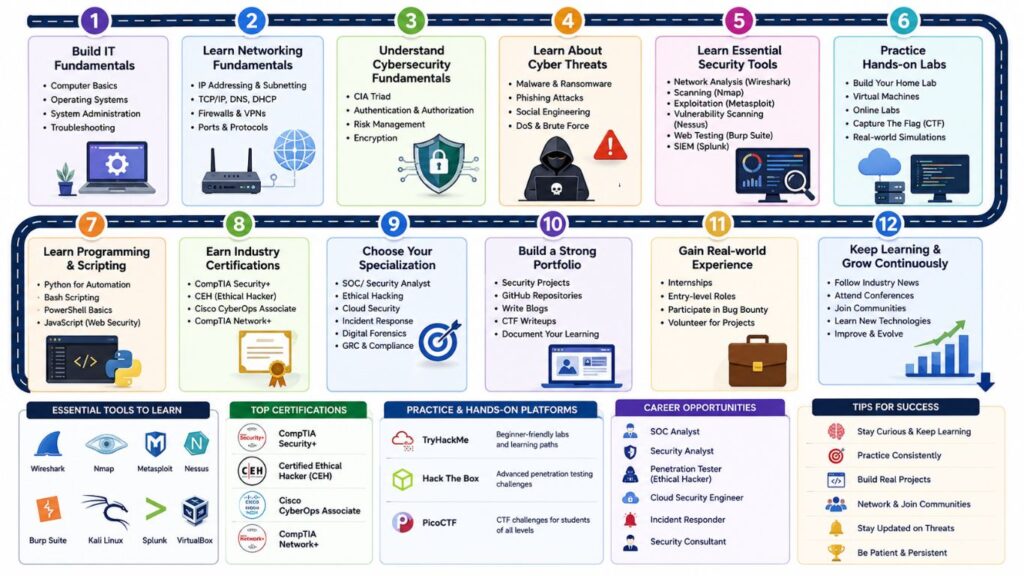
Step 6: Build a Home Lab and Practice
Reading about security is a passive activity. Security is a learning process. Taking it from the book to the field is where you’ll really speed up your learning path to a cybersecurity career.
Configure a home lab using VirtualBox or VMware. Set up Linux, Windows and Kali Linux VMs. Hook ’em up. Attack and defend systems. Give it a try. Break things and fix them on purpose.
Schedule regular lab time each week. Consistency is more important than marathon sessions. If you have only an hour a day you will beat a man who can afford eight hours once a week. Those that practice regularly are successful students. Those that do not practice regularly quit in learning path for a cybersecurity career.
Step 7: Learn Basic Programming
You don’t have to be a software developer, but basic scripting skills will add significant value to your learning path for a cybersecurity career.
Learn Python. It’s everywhere in security automation. Write scripts to automate repetitive tasks and to analyze data. Learn bash for scripting in Linux and PowerShell for Windows. These are not elective skills. These are tools that enable security pros to work more efficiently.
Start with easy scripts. Write something useful. Automate something you do a lot. This is a more pragmatic approach than trying to learn the theory of programming out of context.
Step 8: Pursue Relevant Certifications
Certifications validate your knowledge and get you past resume filters. Earn industry credentials for a learning path for a cybersecurity career.
Begin with CompTIA Security+. It is a widely recognized certification that covers foundational security concepts. Want to do penetration testing ? Consider CEH ( Certified Ethical Hacker ) . Cisco CyberOps Associate is useful in security operations center roles. CompTIA Network+ validates networking basics.
Don’t pursue certifications at the cost of hands-on experience. Employers want people who can actually do the job. Build your learning path for a cybersecurity career by balancing certifications with real world lab experience.
Step 9: Build a Portfolio and Gain Experience
When interviewing for jobs, demonstrate what you can actually do. Create a portfolio showing vulnerability assessments, security audits, CTF achievements, and Python automation scripts. Upload your work to GitHub with explanations of what you learned.
Gain real experience through entry-level roles like SOC Analyst, Junior Security Analyst, or IT Support with learning path for a cybersecurity career focus. These positions provide the hands-on experience that helps you transition smoothly into professional security work in learning path for a cybersecurity career.
Step 10: Specialize and Keep Learning
Your cybersecurity career doesn’t end with your first job. As you go forward, focus on a field that you’re passionate about, such as ethical hacking, cloud security, incident response, digital forensics, or governance and compliance.
The world of cybersecurity is an evolving one. There are new vulnerabilities all the time. New attack methods are found. Create new defensive technologies. To stay up to date, follow security news, attend conferences, join online communities, and practice regularly. The best security professionals are lifelong learners. They have to be, the field demands it in learning path for a cybersecurity career.
Reading industry reports helps you understand the emerging threats. Attending security conferences is a method for being exposed to new ideas and connecting with other professionals. Joining forums and online communities can help you learn from others going through the same things you are. Your technical skills are kept fresh with routine hands-on practice and you are kept sharp.
Your choice of specialization depends on your interests and strengths. If you like to find vulnerabilities, ethical hacking or penetration testing could be for you. If you like the operational side, then SOC work or incident response can be fast paced. Governance and compliance positions involve structured thinking challenges and are ideal if you prefer strategy and policy.
The thing that’s important in learning path for a cybersecurity career is we never stop learning. As soon as you think you know everything, that’s when you fall behind. Good security professionals see continuous learning as part of their career path.
Final thoughts
Building a career in Cyber security training courses is not a one-night stand; it takes commitment and ongoing effort. It normally takes people without prior IT experience between 6 and 12 months to get enough of a foundation before they get their first dedicated security job. Tha t’s not a long time for a major career change, and the investment pays off big time.
You can either study by yourself through online platforms or take a more structured training program. What’s important is to be consistent. Choose a program or learning path that suits your own learning style. Go for it. Finish the labs and assignments. Practice on your own systems regularly. Practice your skills over time and consistently.
The cybersecurity field is desperate for qualified professionals. Demand continues to outpace the supply of qualified candidates. What organizations are really looking for are people who have shown commitment and real hands-on skills. Follow this learning path for a career in cybersecurity and, with purpose and sustained effort over time, you can certainly build a successful and rewarding learning path for a cybersecurity career.
Start now. Choose one thing from this guide and start now. Your cybersecurity career learning path you start now will shape your learning path for a cybersecurity career.