Introduction
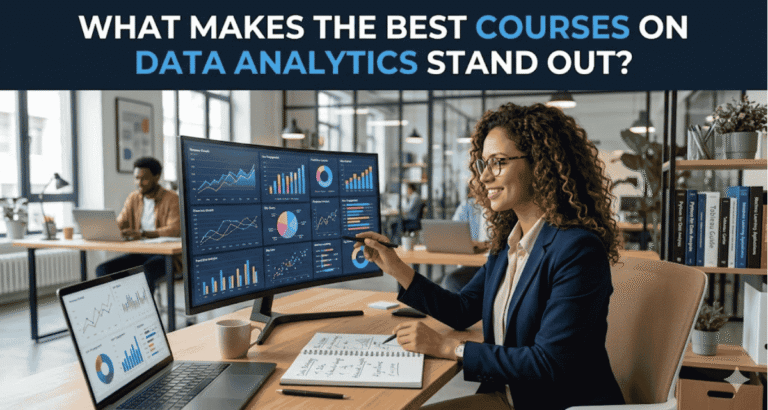
The best Best Courses on Data Analytics isn’t the one with the most videos, it’s the one that actually teaches you how to work with real data and solve real problems.
That’s the difference most people only realize after wasting time on the wrong course.
Why So Many Courses Don’t Work
I’ve seen this a lot…
People enroll in Best Courses on Data Analytics roles, finish all the videos, and still feel stuck.
Why?
Because most courses:
- Show what to do, not how to think.
- Use perfect datasets (real life is messy)
- Skip real business scenarios.
So when you actually try to do a project… everything feels confusing.
What Actually Makes a Course “Good”
Let’s get practical here.
1. It Forces You to Practice
A good course won’t let you just sit back and watch.
It will:
- Give assignments (sometimes annoying, but necessary)
- Make you work with real datasets.
- Push you to build something on your own
Honestly, this is where most beginners struggle. Watching feels productive but it’s not.
2.It Teaches the Right Tools (None)
By 2025–2026, it is not be enough to work in Excel or Python alone.
An effective Best Courses on Data Analytics should cover:
Excel (for quick analysis)
SQL (this is big; do not miss it)
Python (for deeper analysis)
Power BI or Tableau (dashboards)
If SQL isn’t in the course, I’d question it hard.
3. There’s a Clear Learning Path
This part matters more than people think.
A structured course usually goes like this:
- Basics (what is data, types, etc.)
- Excel
- SQL
- Python
- Visualization tools
- Projects
- Interview prep
When this order messes up, things get confusing fast.
I’ve seen people jump into Python first and completely lose confidence.
4. It Feels Like Real Work (Not Homework)
Here’s a simple example.
Bad course:
“Create a chart using this dataset.”
Good course:
- Find why sales dropped last quarter
- Identify top-performing regions
- Build a dashboard for decision-makers
That second approach? That’s what companies actually expect.
5. It Helps You Get a Job (Not Just Skills)
This issue is something people ignore at the start.
Learning is one thing. Getting hired is another game.
Good Best Courses on Data Analytics roles include:
- Resume help
- Mock interviews
- Real project experience
Without this, you’ll likely feel lost after finishing the course.
Self-Learning vs Structured Courses (Real Talk)
Let me be honest here.
You can learn everything for free online.
But…
| No clear direction | Step-by-step roadmap |
| Takes longer | Faster progress |
| Easy to quit | More accountability |
| No job guidance | Career support |
If you’re super disciplined, self-learning works.
Most people? They need structure.
What You’ll Actually Learn (If the Course is Good)

By the end, you should be able to:
- Clean messy datasets (this is 70% of the job)
- Write SQL queries confidently.
- Build dashboards that make sense.
- Explain insights in simple terms
That last one is underrated. Companies don’t just want analysis, they want clarity.
Career Scope (Why People Are Choosing This)
Best Courses on Data Analytics isn’t just hype; it’s practical.
Roles you can go for:
- Data Analyst
- Business Analyst
- Reporting Analyst
Typical salary range in India:
- Entry-level: ₹4–8 LPA
- Mid-level: ₹8–15 LPA
And demand is still growing because every company now relies on data.
Where H2K Infosys Fits In
If you’re trying to find one of the Best Courses on Data Analytics, this is where structured programs like H2K Infosys come into play.
What I like about it (compared to generic courses):
- Focus on real-time projects
- Step-by-step learning (good for beginners)
- Covers tools that companies actually use
- Includes job-oriented training
It’s not just “learn and finish” it’s more like “learn and get ready for work.”
TL;DR (Quick Take)
- The best courses focus on real skills, not just videos
- You need tools like SQL, Excel, Python, Power BI
- Practice matters more than theory
- Structured learning saves time and confusion
- H2K Infosys is a solid option if your goal is job readiness
Common Mistakes Beginners Make
I’ve made some of these myself, honestly.
- Picking the cheapest course without checking content
- Skipping SQL (big mistake)
- Not building projects
- Relying only on certificates
Your portfolio matters way more than your certificate.
Related Topics You Should Explore
If you want to explore more deeply, these are a big help:
- Advanced Data Visualization with Power BI
- SQL for Data Analysis
- Python for Data Science Beginners
These all link together and strengthen your profile.
FAQs
1. Which is the best courses on data analytics for beginners?
Look for one that includes projects, covers SQL + Excel, and offers job support. H2K Infosys is a good example.
2. Can I become a data analyst in 3 months?
Yes, but only if you practice consistently and focus on projects, not just videos.
3. Is coding required for data analytics?
Not heavily. You can start with Excel and SQL, then learn basic Python.
4. Are best courses on data analytics enough to get a job?
They can be but only if they include real-world projects and interview prep.
5. What matters more: a certificate or skills?
Skills. Always. Recruiters care about what you can do.
Final Thoughts
If you’re choosing a Best Courses on Data Analytics, don’t overthink, but don’t rush either.
A random course might teach you concepts.
A good one will prepare you for actual work.
And if your goal is to switch careers or land a job faster, going with a structured, practical program like H2K Infosys can honestly make the process much smoother.
At the end of the day, it’s simple:
Don’t just learn Best Courses on Data Analytics, learn how to use it.