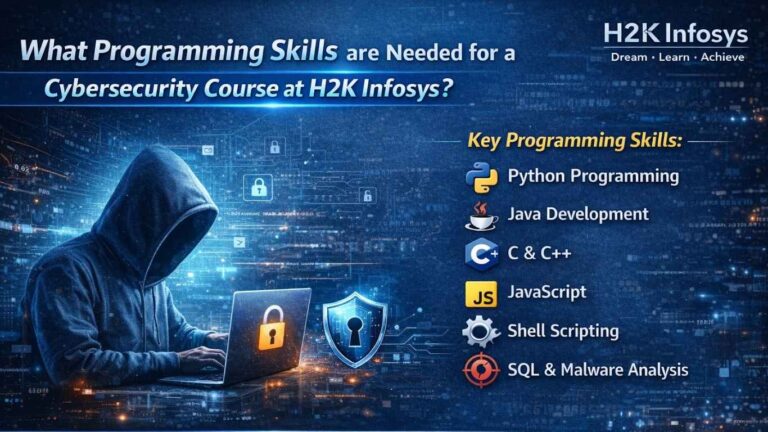
While it is not mandatory to have prior knowledge of programming skills before signing up for a cybersecurity course with H2K Infosys, it is helpful to have a general understanding of some programming concepts, operating systems, and logical reasoning skills, as it will make the learning process easier and faster. Most novices begin with zero programming experience and then learn skills as part of the actual job training and placement programs within the framework of the cybersecurity field.
I have actually observed this with many professionals who moved from other fields. One of my colleagues actually came from customer support. No coding, no Linux, and no nothing. In just six months from that point, with structured training in cybersecurity, he became fully competent within the scope of that training to perform log analysis and identify and react to anomalous events by utilizing some trouble shooting scripts in conjunction with other basic level personal security software.
So let’s clear this up, because this issue stops a lot of people from starting.
Why is programming necessary in the cybersecurity field?
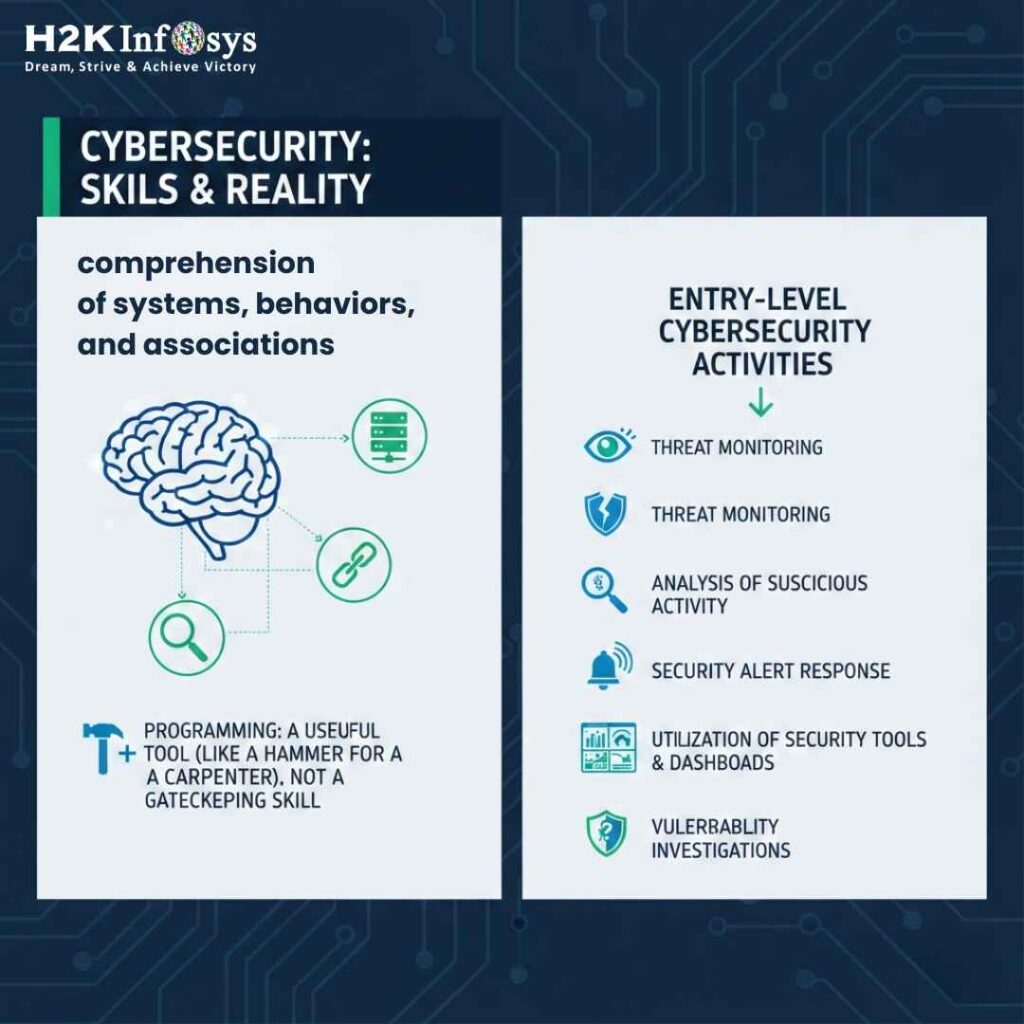
The reality is that cybersecurity is far more about comprehension of systems, behaviors, and associations rather than the development of sophisticated software programs. Yes, programming skills is a plus, but it is not the first and most important thing to have. Think of it as a good thing to have, kind of like a hammer for a carpenter. Do not look at it as a gatekeeping skill.
Most entry-level cybersecurity jobs require training on the following activities:
• Threat Monitoring,
• Analysis of Suspicious Activity
• Security Alert Response
• Utilization Of Security Tools and Dashboards
• Vulnerability Investigations
Understanding systems and patterns is essential for each of these activities. Programming skills is useful later on for tasks such as automation, faster log analysis, or for advanced roles such as penetration testing and malware analysis.
In fact, many Security Operations Center (SOC) analysts write very few programs. They make use of the tools available and supplement their work with a few small programs for automation.
The Basic Programming Concepts That Help the Most
If you are looking for a useful answer, these are the most important basic programming concepts. They are not advanced programming concepts. They are the fundamentals.
1. Variables and Logical Conditions
This refers to a fundamental knowledge of how a computer stores and manipulates information.
For Example:
If a login attempt fails 5 times, an alert should be generated.
This is the type of logic that is consistently present in threat detection systems.
Although you do not need to understand advanced programming skills concepts, being comfortable with basic programming logic is important.
2. Python
Although there are many programming skills languages, Python is the most popular among beginner cybersecurity practitioners because it is powerful, easy to learn and understand and very useful.
Python is a versatile programming language used for:
– Automating repetitive tasks
– Analyzing security logs
– Writing simple scanning tools
– Detecting suspicious patterns
– Security analysts, for example, utilize Python scripts to examine thousands of login attempts to identify patterns that may be anomalous.
Understanding branching, looping, and other basic Python concepts makes a difference.
3. Linux Command Line
At the beginning stages of your career, knowledge of Linux is more valuable than programming.
This is because the majority of enterprise servers, cloud systems, and security tools operate on Linux.
You should be familiar with the following commands:
– ls: Displays the files in the current directory
– cd: Changes the directory
– grep: Searches through log files
– chmod: Changes the permissions for a file
– Many professional cybersecurity training and job placement programs include Linux training in their core curriculum for the simple fact that security professionals constantly work in a Linux environment.
4. Basic Networking Concepts (More Important Than Programming)
You should acquire knowledge in the following areas:
– IP addresses
– Networking Ports
– HTTP, HTTPS, FTP and other Protocols
– Firewalls
– The flow and direction of traffic in a network
– The fundamentals of cybersecurity revolve around protecting a network. Programming skills assists in the analysis of threats, while networking provides context to the situation.
– For instance, if there is unusual traffic on port 22, it may be an indication of unauthorized SSH access.
Real life example of programming used in basic cybersecurity work
– I will provide you with a real example from a Security Operational Center.
A security analyst sees thousands of login attempts from various IPs. Instead of checking each entry manually, they create a small Python script to:
– Read logs
– Collect suspicious IPs
– Find patterns
– Compile a report
Doing this manually could take hours, whereas doing it through a script takes a couple of minutes.
This is, of course, a simplified example, but this is how powerful basic programming becomes. Not because you are developing new software, but because you are actually developing security to become faster and smarter.
Extensive programming isn’t a key factor to succeed in most of these positions
Programming Skills Based on Cybersecurity Roles
Not every job in cybersecurity requires the same knowledge of programming.
Starting Roles (Little to No Programming Necessary)
Positions like:
– SOC Analyst
– Security Analyst
– IT Security Support
These positions are centered around the tools, monitoring, and analysis.
Most cybersecurity positions with training prepare students to take on these roles first.
Programming is useful but not needed.
Middle Positions (A Little Programming is Useful)
Positions like:
– Threat Analyst
– Vulnerability Analyst
– Incident Responder
These roles in particular rely a lot on the usage of scripts in order to complete their tasks and evaluate security information.
This is where some knowledge of Python and scripting becomes relevant.
Higher Positions (Programming is Highly Prioritized)
Positions like:
– Penetration Tester
– Malware Analyst
– Security Engineer
These roles in particular are very dependent on programming.
They tend to create tools, evaluate malware, and automate testing of security.
Advanced skill sets may be obtained through additional experience and time.
What Coding Skills Are Integrated into Cybersecurity Training
Adequate training programs incorporated into cybersecurity training begin coding with the fundamentals.
Common training includes the following:
Foundational Python for automating processes is taught
- Basic Linux scripting
- Interpreting logs
- Creating automation scripts
- Integrating security tools
You do not need to be proficient in coding prior to this training.
Training is organized in a manner that allows novices to assimilate information incrementally.
This is particularly useful for career changers who are entering the field of cybersecurity.
The Reason Cybersecurity Training Emphasizes Practical Skills over Coding
This field is extremely practical.
Professionals utilize:
- Platforms for Security Information and Event Management (SIEM)
- Tools for monitoring networks
- Systems for identifying threats
- Dashboards for security
Analyzing threats takes a significant amount of time compared to the amount of time spent writing.
Programming increases efficiency, however, the mastery of tools and reasoning is of greater importance.
Several training programs in the field of cybersecurity sales training also incorporate simulated cyber attacks to demonstrate how threats actually function.
This kind of practical training allows one to build confidence in a way that is beyond what simple coding can do.
The Most Common Miscalculation Among Newcomers to Cybersecurity in Relation to Coding
There is a misconception that one must first become proficient in programming skills to begin one’s training in cybersecurity. This is false.
The reality is that programming skills is a process of learning that takes place during the training.
Many of the most skilled professionals in cybersecurity started with the following:
– Basic knowledge of computers
– An interest in the tech field
– A determination to acquire more knowledge through hands-on experience
– Considerable programming skills from training and job experience.
Holding off an industry change to ‘master programming skills first’ will only delay your industry change.
How to simplify programming in today’s cyber training
However, programming is more straightforward now due to new teaching techniques in training modules.
For instance:
Many training programs now incorporate programming skills with actual security tasks instead of focusing solely on programming.
So, you will have to sift through logs and write some Python.
You will also have to conduct threat investigations and run some Linux.
Most modules also teach programming skills with real tasks to give you a more positive impression about programming.
Why Basic Programming is Critical to Current Cybersecurity
At present, Cybersecurity is progressively more focusing on automation and intelligent cyber threat detection, slated for 2026.
With automation, current security assets threats are found and reacted to faster.
Cybersecurity professionals, therefore, need to know how to write and use scripts to:
– Automate the detection of threats
– Increase speed to respond to threats
– Analyze large amounts of data
Even the most secured cloud environments like AWS and Azure are heavily dependent on automated scripts. Basic knowledge in programming skills is becoming increasingly more important. However, knowledge of programming is not a necessity to get started.
Is it possible to get into Cybersecurity without a programming skill? Yes, it is.
Without programming skills, many cybersecurity professionals have successfully transitioned into the field.
What matters most is;
* Grasping the security concepts
* Understanding the tools
* Getting the practical experience
* Building the experience
* Programming is going to come to you naturally.
Cybersecurity training programs are built to ease beginners into the field.
What You Need to Know Before Joining Cybersecurity Training
In case you want to do some groundwork, focus on;
* Basic concepts Computing
* Operating systems (foundation of Windows and Linux)
* Basic Networking
* Basic Logical and Problem Solving
* Basic and Problem Solving
* Basic PYTHON (It helps)
Even studying these, you give yourself a reasonable advantage starting out.
Thoughts to Consider
It is true that some knowledge of programming skills is necessary, but it is not a must before joining a cyber security course at H2K Infosys. Most beginners start without any coding skills, and, as part of the structured cyber security training and job placement programs that are developed to meet the current industry needs, they learn Python, scripting, and automation.
Cybersecurity is primarily about understanding the ecosystem, recognizing the risks, and safeguarding the systems that support the ecosystem. While Programming skills is an added advantage, It is more important to have the right mindset, practical hands on and the willingness to learn in the early stages. Most importantly, just do it! Cybersecurity is knowledge that is developed with experience, not prerequisites.