Introduction
If you’re thinking about signing up for a Data Analytics Training Placement, the first thing you should check before you even worry about tuition or schedule is whether the Data Analytics Training Placement is the real deal. And I mean really real. In the world of analytics, where demand is sky-high and everyone’s promising you a six-figure job, it’s easy to get dazzled by shiny “placement guarantees” or impressive-sounding stats. But as someone who’s been through the process (and seen a few friends get burned), I can tell you: not all placements are created equal.
This isn’t just me being cautious. In the last couple of years, the data analytics industry has exploded. Companies in banking, e-commerce, healthcare you name it are scrambling to make sense of their data. That’s why data analytics bootcamps online are everywhere, and so many new learners are jumping in. The question isn’t if you should learn analytics, it’s how you make sure your training actually gets you a job you want.
The Straight Answer: What to Check First
Right off the bat: Always verify the Data Analytics Training Placement stats, support, and connections of any training provider. Ask questions. Seek proof. If a program can’t show you recent, verifiable placement data (from the last 12–18 months), or if their “partners” list is just logos without real stories behind them, consider it a red flag.
Sounds obvious, but you’d be surprised how many folks overlook it. I nearly did myself, back when I started exploring this field.
Why Placement Isn’t Just a Buzzword
Years ago, a good friend of mine let’s call him Ravi signed up for a “guaranteed job” Data Analytics Training Placement. It looked solid on paper. But after finishing the course, the only “placement” he got was a referral to a three-month unpaid internship… at the same bootcamp company! No interviews, no introductions to real companies, nothing. Ravi ended up finding a job on his own, but the experience left him jaded about training promises.
That’s when I learned: It’s not about flashy words, it’s about outcomes you can actually trace.
What Makes a Data Analytics Bootcamp’s Placement Valuable?
Here are the things I look for and what I always tell people who ask me for advice:
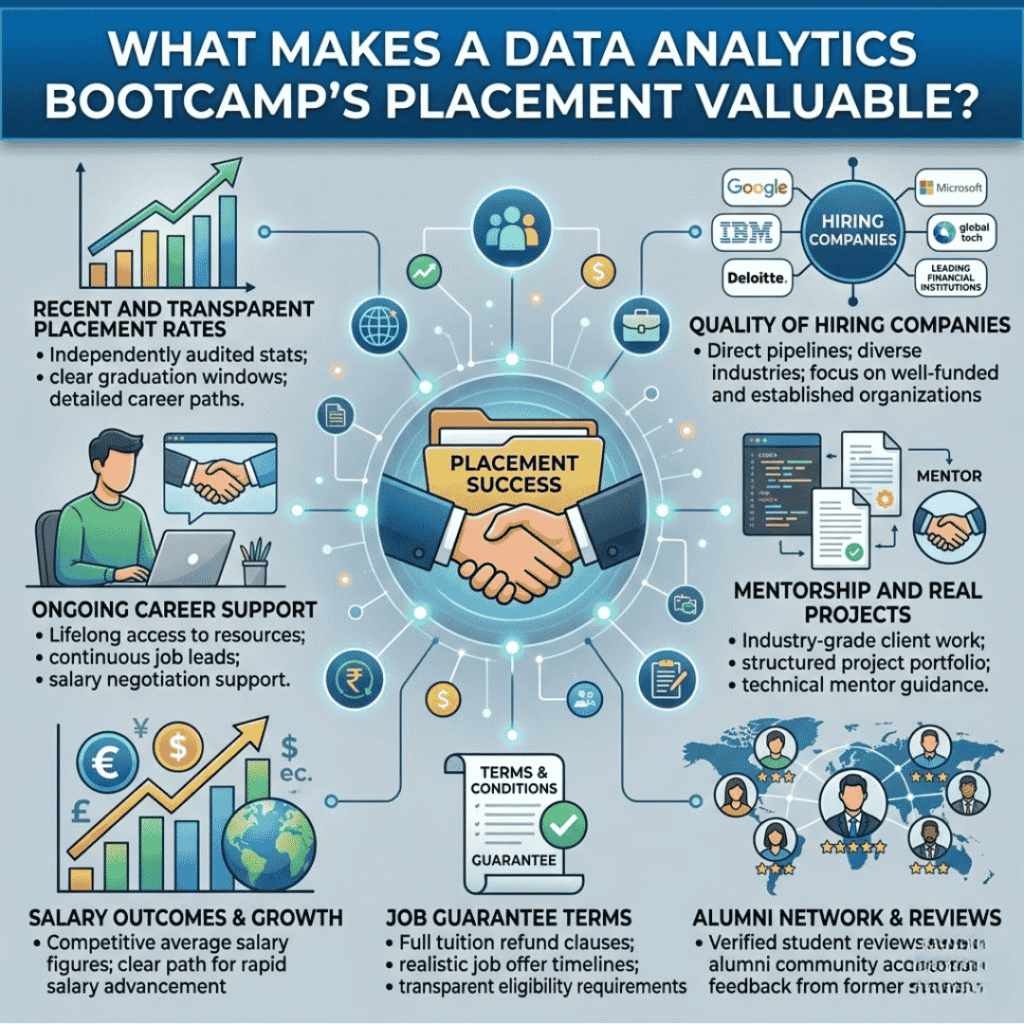
- Recent and Transparent Placement Rates: Not “80% of our grads get jobs” but “last year, 67% of our grads landed full-time roles at companies like XYZ within 6 months.” The more specific, the better.
- Quality of Hiring Companies: Are graduates working at real companies with competitive salaries? Or are placements just contract gigs or internships?
- Ongoing Career Support: Does the bootcamp offer resume workshops, LinkedIn profile makeovers, mock interviews, and networking sessions with actual recruiters or hiring managers?
- Mentorship and Real Projects: The best programs connect you with mentors in the industry and give you hands-on experience solving real business problems.
- Alumni Network: Can you find and connect with recent alumni? Search for “H2K Infosys data analytics graduates” on LinkedIn and see where they ended up. If you spot a pattern, that’s a good sign.
- Job Guarantee Terms: If there’s a “job guarantee,” always, always read the fine print. Sometimes you have to apply to a minimum number of jobs weekly, or only certain roles qualify.
A Real-World Example: Placement in Action
Let’s talk real life for a sec. My cousin, Asha, decided to upskill during the 2024 tech layoffs. She was nervous, not from a tech background, and wanted something practical. After weeks of comparing, she picked a Data Analytics Training Placement from H2K Infosys. What tipped the scale? The program’s open alumni group and weekly career clinics.
Asha’s cohort had Zoom Q&As with hiring managers from finance and retail companies. She worked on a capstone project using actual sales data from a regional retailer (with anonymized data, of course). Asha’s mentor, a senior analyst at a logistics firm, reviewed her project and even prepped her for interviews. Within ten weeks of finishing, she had three job offers, two of which came via the bootcamp’s placement team.
This is what you want to look for: not just a course, but a bridge to the industry.
What Will You Really Learn?
A lot of Data Analytics Training Placement promise to take you from “zero to hero,” but here’s what matters in 2026 (and honestly, always will):
- SQL Mastery
- Excel (but next level)
- Python (or R)
- Tableau/Power BI
- Statistics & Business Acumen
- Communication
If your training covers these, with real datasets and practical projects, you’re on the right track.
Career Outcomes: What’s Really Possible?
Maybe the best part about data analytics is the variety of paths you can take. After quality training, most grads step into roles like:
- Data Analyst
- Business Intelligence Analyst
- Junior Data Scientist
- Reporting Specialist
- Operations Analyst
And here’s something I wish someone told me: Your first analytics job probably won’t be at Google or Amazon. But starting at a mid-sized company or even a fast-growing startup is often the best way to get hands-on (sometimes messy) experience.
Salary-wise? In 2026, entry-level data analysts in the U.S. are starting at 75,000–95,000 (sometimes higher in major cities or remote-first companies). Demand is especially hot in healthcare, retail, logistics, and fintech.
Practical Tips: How to Vet a Bootcamp or Course
Here’s my “checklist” after years in the industry:
- Ask for a sample lesson or project
- Connect with alumni
- Review the real curriculum
- Attend a live info session
- Research independent reviews
- Ask about ongoing support
Common Pitfalls
Let’s keep it real here are mistakes I see over and over:
- Falling for “guaranteed job” claims without checking the requirements (some are almost impossible to meet).
- Not researching the curriculum: Some programs barely scratch the surface, leaving you unprepared for interviews.
- Forgetting to network: Placement teams are helpful, but most jobs in analytics come through connections even in 2026.
- Ignoring your learning style: Some people thrive in bootcamps; others prefer flexible, self-paced courses.
Why Data Analytics Is Still Booming (and Getting Bigger)
There’s a reason top companies are hiring data talent so aggressively. As of late 2025, even small businesses are investing in analytics to optimise everything from marketing to their supply chains. AI is taking over some routine work, but companies need human analysts who can interpret results, spot trends, and make recommendations. Just last month, the Wall Street Journal reported a 28% year-over-year jump in data analyst job postings in the U.S.
Data Analytics Training Placement is also a huge factor. More firms are hiring analysts from anywhere, as long as you have the skills and can demonstrate them.
You Might Also Like
To deepen your analytics journey, you can also explore:
- How to Transition into Data Analytics from a Non-Technical Background
- Top Data Analytics Tools and Trends for 2026
- Proven Strategies for Acing Data Analyst Interviews
(Hint: Building your own mini-projects and sharing insights on LinkedIn is a great way to stand out.)
Benefits of Learning Data Analytics
Future-proof your career: Data is everywhere and the demand for analytics skills is only going to increase.
*High Earning Potential: Competitive Salary with Potential to Grow.
* Transferable Skills: Able to work in different industries retail, finance, healthcare, tech, etc.
* Problem Solving: You have the opportunity to solve real world problems and see the impact.
If you’re serious about getting into analytics, then learning in a structured format, such as a good Data Analytics Training Placement, can get you job-ready faster than if you were self-studying. The H2K Infosys programs offer a fantastic blend of hands-on projects, real mentorship and active Data Analytics Training Placement support a combination difficult to beat.
FAQs: Real Questions from Learners
1. What’s the difference between a data analytics course for beginners and a bootcamp?
A beginner’s course is usually slower-paced and covers fundamentals; a bootcamp is intense, fast-paced, and focused on making you job-ready.
2. Do all data analytics bootcamps offer real job placement?
No not all. Some only provide interview prep or general advice. Always check for recent, specific placement results.
3. How long does it take to get a job after a Data Analytics Training Placement?
Typically, 1–3 months if you’re active in your job search and use the program’s placement resources.
4. Can I land a remote analytics job after training?
Yes! Remote roles have only increased since 2024; just be sure your course teaches virtual collaboration skills.
5. Is a certification necessary to get hired in data analytics?
Certification helps, but employers value hands-on skills and project experience more.
6. What if I don’t have a tech background?
You’re not alone many successful analysts come from business, marketing, or even creative fields. Bootcamps with beginner tracks can bridge the gap.
7. What’s the biggest mistake people make when picking a bootcamp?
Chasing guarantees or big names without checking real placement results and alumni stories.
Wrapping It Up: What You Should Do Next
If this sounds familiar, you want a real analytics job, not just a certificate don’t settle for surface-level promises. Dig deeper. Ask for proof. Look for hands-on learning, real project work, and recent placement success stories. Talk to alumni, check hiring stats, and make sure the Data Analytics Training Placement fits your learning style.
Learning Data Analytics Training Placement changed my career trajectory, and I’ve seen it do the same for dozens of others. If you’re ready to invest in yourself, look for a provider (like H2K Infosys) that delivers more than just lessons one that supports you all the way to your first job and beyond. If you’re serious about building a tech-forward, future-proof career, taking that first step with a trusted, placement-focused bootcamp could be the move that changes everything.