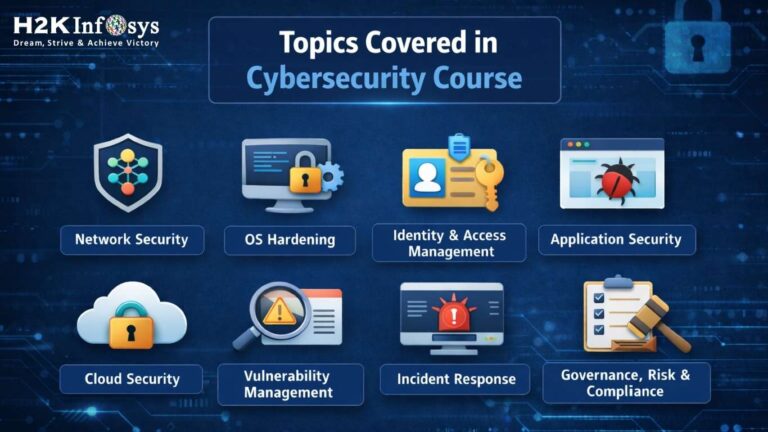
The topics of a Cybersecurity training program at H2K Infosys includes all three major components namely technical, operational and governance risk management to safeguard computer systems, network and data from unauthorized access or attack. These courses generally cover security basics before moving to hands-on experience with enterprise tools as well as real-world strategies and role-based practices included in today’s IT and cloud environments. The objective is to train learners on how security works in production for infrastructure, applications and at the organizational level.
What Is a Cybersecurity Course?
A cybersecurity course is a structured learning program that teaches how to identify, assess, and mitigate risks to information systems. It combines theoretical frameworks such as security models and standards What Is a Cybersecurity Course? It layers theory such as security models and standards over practical training in tools and workflows for a SOC.
Courses are mostly directed at IT professionals, career switchers and technical graduates looking to work in security-focused positions. The curriculum typically spans:
- Technical security controls (network, endpoint, cloud and application security)
- Security operations (incident response, monitoring and vulnerability management)
- Policies, audits and the regulatory framework – governance and compliance
At the other end of the spectrum, for many learnings and career paths tracks it also leads into actual cyber security training with job placement models where they receive technical-industry agnostic knowledge that falls in line with your day to day role expectations and hiring processes.
How does online cyber security training work in real world IT projects?
To some extent, the above educational and incentive-based practices are also mirrored in the enterprise world where cybersecurity is not an isolated function but integrated with IT operations, software development pipelines, and business processes. Typically online courses will replicate these with fixed labs, project-oriented learning experiences.
Typical Enterprise Workflow Coverage
A typical project might be like:
1.System Assessment
- Reviewing network architecture diagrams
- Figuring out trust boundaries and data flows
2.Threat Modeling
- Mapping assets to potential threats
- Assessing attack-inducing vectors with the help of standard frameworks
3.Control Implementation
- Setting up firewalls, IAM policy or endpoint protections
- Applying secure configuration baselines
4.Monitoring and Response
- Reviewing logs via SIEM dashboards
- Running mock incident response playbooks
5.Reporting and Compliance
- Documenting findings
- Attachment of controls to regulatory or internal requirements
This framework allows learners to see how technical tasks relate to business needs and regulatory requirements.
Why Cybersecurity Is Vital for Working Professionals?
Security is becoming everyone’s job Security is everybody’s job More and more, security responsibilities are dispersed throughout IT roles. Network engineers, cloud administrators or even system analysts and programmers are frequently required to know some fundamental security tips and practices in their routine tasks.
Professional Drivers
- Regulatory burden: There are various data protection and industry regulations that organizations need to follow.
- Cloud migration: Protection is now extended for hybrid and multi-cloud environments.
- Automation: Securing is becoming automated into DevOps and IT operations.
- Risk management: Security incidents can directly affect the revenue, reputation and service availability of a company.
- For practitioners pursuing cyber security jobs with training, this contributes to the technical and procedural skills employers seek to find in entry-level and midlevel positions.
What skills should I have to learn Cyber Security Training Online?
A cybersecurity program will generally start at a certain level of IT literacy and then layer on technical skills.
1.Foundational Skills
- Knowledge in computer networks (TCP/IP, DNS, HTTP/HTTPS)
- Knowledge of systems (Windows and Linux)
- Basic scripting or command-line usage
2.Intermediate Technical Skills
- Log analysis and system monitoring
- Network traffic inspection
- Secure system configuration
- Identity and access management concepts
3.Professional Skills
- Technical documentation
- Risk communication
- Incident reporting
- Working with IT and compliance personnel
These capabilities underlie any work as a specialized security professional.
Main issues taught as part of a cybersecurity class
1.Information Security Fundamentals
- This chapter presents fundamental principles for all security activities:
- Confidentiality, Integrity, and Availability (CIA)
- Authentication and authorization models
- Types of security policy and control (administrative, technical and physical)
- Students investigate how these concepts are realized in on-premise and cloud systems.
2.Networking and Infrastructure Security
This module will discuss securing data in transit and network boundaries.
Key Topics
- Network architecture and segmentation
- Firewalls and intrusion detection systems
- Virtual private networks (VPNs)
- Secure routing and switching practices
Practical Application
Learners typically set-up firewall rules, analyse packet captures and role-play network attacks to discover how vulnerabilities occur in production.
3.Operating System and Endpoint Security
Endpoints are the dominant attack surface in enterprises.
Coverage Includes
- OS hardening techniques
- Patch management processes
- Malware detection methods
- EDR (endpoint detection and response) solutions
These are the skill set that today’s daily routine for security operation center (SOCs) / IT support teams.
4.Identity and Access Management (IAM)
IAM manages the authorization and can determine exactly who is allowed to access Salesforce.
Learning Focus
- Role-based and attribute-based access control
- Multi-factor authentication
- Privileged account management
- Directory services integration
This is an important topic for cloud security and enterprise governance.
5.Application and Web Security
This part discusses subterrain vulnerabilities in software and Web services.
Key Concepts
- Common types of vulnerability (for example, injection attacks and misconfigurations)
- Secure development lifecycle (SDLC)
- API security fundamentals
- Application security testing methods
Learners could conduct rudimentary vulnerability scanning and look at secure coding practices.
6.Cloud Security Fundamentals
This module is more critical than ever to training methods today, with pervasive use of the cloud.
Areas Covered
- Shared responsibility model
- Cloud identity and access controls
- Secure storage and network design
- Observability in cloud platforms
Hands-on labs typically include setting up access policies and examining a cloud security dashboard.
7.Security Operations and Monitoring
This module is dedicated to the operational processes employed in SOC environments.
Typical Tools and Practices
- Systems for security information and events management (SIEM)
- Log correlation and alerting
- Incident triage processes
- Threat intelligence integration
Students role-play attack investigation and incident response.
8.Vulnerability Management and Risk Assessment
This theme is concerned with identifying and ranking system weaknesses.
Coverage
- Vulnerability scanning tools
- Risk scoring models
- Patch prioritization workflows
- Security reporting formats
Students rehearse analyzing scan findings and creating a plan for correction.
9.Incident Response and Digital Forensics
This part describes structured responding to security incidents.
Process Steps
- Preparation
- Identification
- Containment
- Eradication
- Recovery
- Lessons learned
There might be lab sessions that involve analysing log and system snap-shots.
10.Governance, Risk, and Compliance (GRC)
This is where a technical control is “wired up” to an organizational policy.
Topics Include
- Security frameworks and standards
- Internal audits
- Policy development
- Regulatory mapping
Students appreciate how security design is driven by compliance requirements.design.
How Is Cyber Security Used in Enterprise Environments?
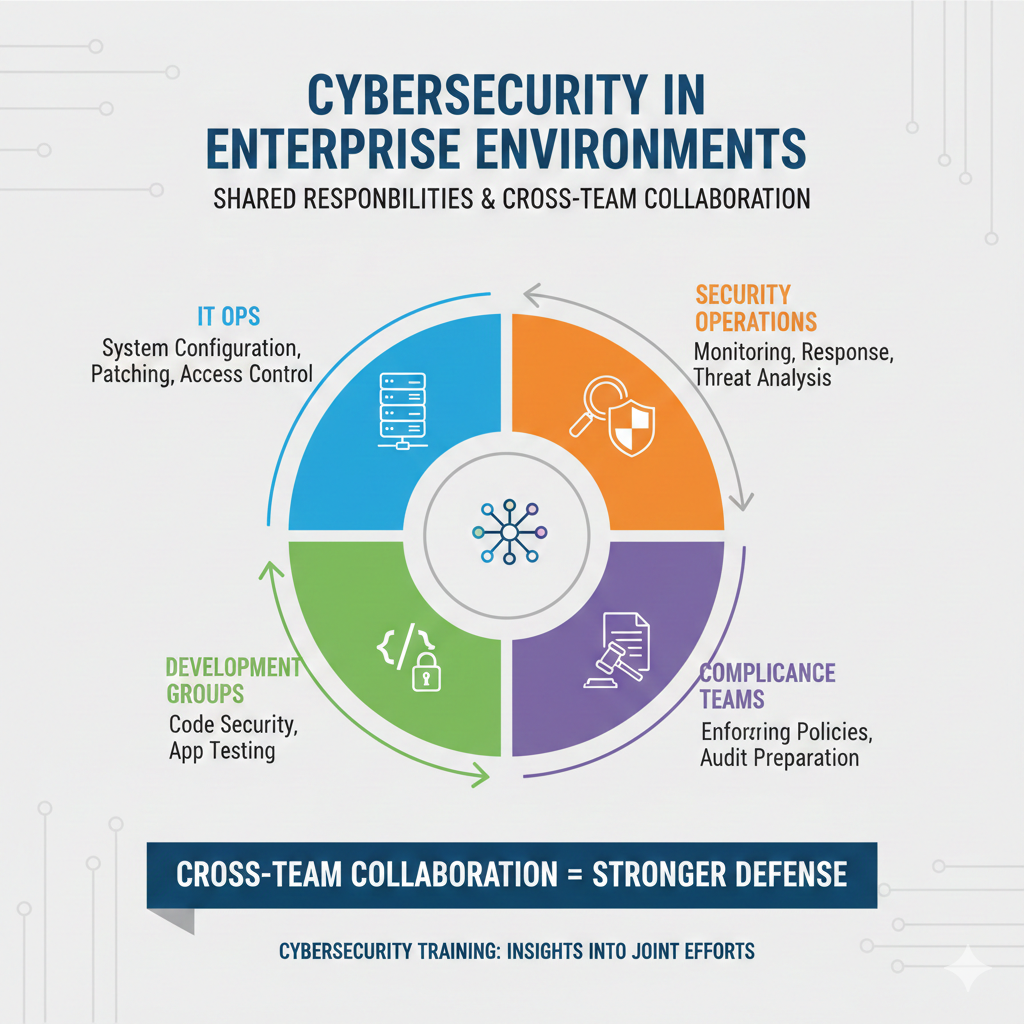
- In large organizations, cybersecurity functions across multiple teams:
- In big organizations, cybersecurity operates on multiple layers:
- IT Ops: system configuration, patching and access control
- Security Operations: Monitoring, incident response and threat analysis
- Development groups: Code security and app testing
- Compliance teams: enforcing policies and preparation for audit
This shared responsibilities model is reflected in cybersecurity training with the aim of providing learners insights into cross-team collaboration.
Tool Comparison Table: Common Security Platforms
| Tool Category | Purpose | Typical Enterprise Use |
| SIEM | Log aggregation and alerting | SOC monitoring |
| EDR | Endpoint threat detection | Incident response |
| Vulnerability Scanners | Identify system weaknesses | Risk management |
| IAM Platforms | Access control management | User governance |
| Cloud Security Tools | Cloud environment protection | Infrastructure security |
Learning Path Overview
| Stage | Focus Area | Outcome |
| Beginner | Fundamentals, networking, OS security | Technical baseline |
| Intermediate | IAM, vulnerability management, monitoring | Operational readiness |
| Advanced | Cloud security, incident response, GRC | Role specialization |
What Job Roles Use Cybersecurity Skills Daily?
Cybersecurity training aligns with several professional roles:
- Security Analyst
- SOC Analyst
- Network Security Engineer
- Cloud Security Administrator
- IT Risk and Compliance Officer
- Incident Response Specialist
These roles often appear in career tracks that combine cyber security jobs with training models, where practical skills are mapped directly to job responsibilities.
Where Cyber Security Sales Training Fits Into Technical Programs
Some programs may provide students with some cyber-security sales training covering:
- Describing technical risks to those on the business side
- Understanding compliance and regulatory drivers
- Supporting pre-sales security assessments
- Communicating product security features
This dual skill set is ideal for client-facing technical consulting jobs.
Ways to your Profession After Completing Cyber Training Online
Graduates tend to go into roles in IT, security operations and compliance. Entry-level jobs are typically about monitoring and supporting rather than advanced roles in architecture design, cloud security or governance leadership.
Frequently Asked Questions (FAQ)
1.Must I have previous IT experience to enroll?
Some background in networking or operating systems is useful, though many also offer entry-level content.
2.Do you use in training tools,You are using in enterprises?
They are usually hosted on industry standard platforms or similar lab environments mimicking production workflows.
3.Is cloud security included?
Most of the current applications, They not only contain basic facts of cloud security but also how to configure access control.
4.In what ways is incident response training technical?
It often links procedural workflows with hands-on log analysis and system inspection drills.
5.Can this not lead to the non-technical roles?
Some end up in compliance, governance or technical sales positions that leverage this security background.
Key Takeaways
- Cyber-security training includes both technical, operational and governance subjects.
- Lessons Learned Training is about real enterprise workloads, not just theory.
- “Focus will be on networking, cloud security, monitoring, incident response and compliance.
- Capabilities cut across technical, operational and advisory roles.
Discover practical experience on cybersecurity courses with H2K Infosys which is closely related to real-world IT environments.
Discover how formal training can help long term career development in security-focused roles.