If you have done cybersecurity course, H2K Infosys students look to make their future with global certifications such as Security+, CEH, CISSP, CISM and cloud security certification. The best one for you will generally depend on your level of experience, career goals and whether you want to specialize in ethical hacking, governance, cloud security or security operations (just to name a few specialty areas).
Why Certifications for Cybersecurity Course Training Matter
While having conversations with learners and working with training content in 2026, I am struck by something. Someone who goes through such a training finishes feeling accomplished, but when someone with that training applies for a cybersecurity course job, prospective employers are likely to ask one extra question: It looks good on paper, but do you have certification proof?
This is where certifications serve as a “credibility booster”. They show:
- You understand real-world security frameworks
- You learn skills that can be applied (not just theory.
- You’re serious about building a long-term career in security
The vast majority of cybersecurity training and placement programs today design course content around certification domains, because hiring managers more and more demand it.
Best Entry-Level Certifications (Right After Training)
CompTIA Security+
This is typically the first certification that individuals pursue.
Why it works:
- Covers network security basics
- Risk management fundamentals
- Threat detection concepts
- Security architecture basics
Real-life example:
Several SOC analyst job postings in 2026 describe Security+ as a “preferred” certification, not simply an option. Particularly for newcomers or second-careerists looking to break into security monitoring.
Certified Ethical Hacker (CEH)
If offensive cybersecurity course is your thing, CEH makes quite a bit of sense.
What you learn:
- Ethical hacking methodology
- Vulnerability scanning
- Exploit techniques
- Web application security basics
I have witnessed wannabe pentesters who had a general interest in penetration testing and finally found their path after preparing for their CEH. You kind of open your eyes to the way attackers perceive things.”
Intermediate Certifications (1–3 Years Work Experience)
If you have been in the industry for 1 to 3 years, consider earning a certification with just enough experience.
CompTIA CySA+ (Cybersecurity Analyst)
Great if you want to work in:
- SOC teams
- Threat intelligence
- Incident detection
2026 trend note:
As AI-driven attacks grow, so do the number of companies looking for analysts who understand that behavioral threat detection is more important than signature-based tools.
Certified Information Security Manager (CISM)
This is more management-focused.
Best for people moving into:
- Security leadership roles
- Risk management teams
- Compliance strategy
This cert is a great match if you’re in the cybersecurity sales training because the echelon of security sales and consulting teams they require tech + business risk knowledge more and more.
Advanced Certifications (For Senior Roles)
Additional 3 to 5 years post qualification experience in IT or ITeS companies preferredCISSP (Certified Information Systems Security Professional) equivalent3693879
To be perfectly honest, this is still sort of the gold standard.
Covers:
- Security architecture
- Identity management
- Security operations
- Governance and compliance
And most seasoned security architects or cybersecurity course managers end up taking CISSP. It’s still highly valued across global enterprises in 2026.
Cloud Security Certifications (No They Wont Be Out of Stye in 2026 Either)
Cloud security is a really hot area, and it’s only getting hotter right now. Virtually every business is either hybrid or cloud-first.
Top options:
- AWS Security Specialty
- Azure Security Engineer
- Google Cloud Security Engineer
Real-world scenario:
It’s not uncommon for companies now to … hire people who are security professionals, but not generalized ones, specific for a role. … They manage cloud posture monitoring or identity security. Conventional network-only security roles are dying a slow death.
Specialized Certifications Based on Career Path
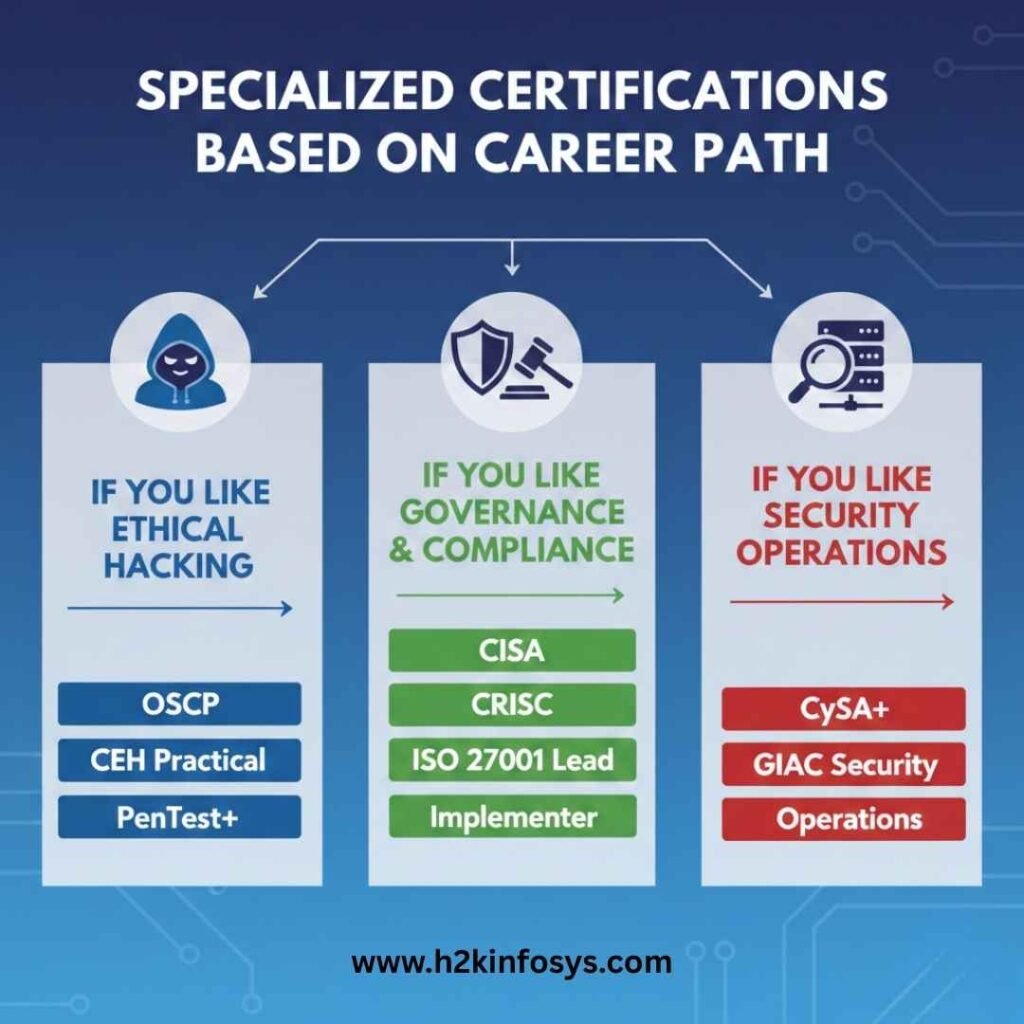
If You Like Ethical Hacking
- OSCP
- CEH Practical
- PenTest+
If You Like Governance & Compliance
- CISA
- CRISC
- ISO 27001 Lead Implementer
If You Like Security Operations
- CySA+
- GIAC Security Operations
How to Choose the Right Certification (Simple Thinking Framework)
Ask yourself three honest questions:
1. Do I enjoy attacking systems or defending them?
Offensive → Ethical hacking certifications
Defensive → SOC / analyst certifications
2. Do I want technical hands-on or strategy level roles?
Technical → Security+, CySA+, CEH
Management → CISM, CISSP
3. Do I want future-proof skills?
Cloud security → Cloud security certifications
What Employers Are Looking for in 2026
From industry hiring patterns I’ve been tracking:
Employers want this combo:
✔ Practical project experience
✔ Certification validation
✔ Hands-on tool exposure
✔ Understanding of AI-driven threats
Many cybersecurity course training and placement programs now simulate SOC environments, phishing simulations, and incident response labs to match this expectation.
Small Reality Check (From Real Learner Journeys)
Something I always tell learners:
Certification alone doesn’t guarantee a job.
Training alone doesn’t guarantee a job.
But together? That’s powerful.
I’ve seen people land interviews faster when they combine:
- Course completion
- One certification
- Real lab practice
- Resume with project scenarios
Certifications + Job Role Mapping
| Certification | Best Job Roles |
| Security+ | SOC Analyst, Security Support Engineer |
| CEH | Ethical Hacker, Pen Tester |
| CySA+ | Threat Analyst, SOC Level 2 |
| CISSP | Security Architect, Security Manager |
| Cloud Security Certs | Cloud Security Engineer |
Final Thoughts
If you completed your cybersecurity course, then the truth is that You’re in a good spot. The best next step is to pick one of them that aligns most with your career path, rather than trying to collect certs.
The cybersecurity course industry is growing rapidly, particularly as AI-based threats advance, cloud migrations continue, and zero-trust architecture adoption increases. Certifications can make sure you stay relevant and competitive in this changing environment.
Is cybersecurity course a job with training? If you want to get cybersecurity course job with training, then the best route is:
Education → Certification for Beginners → Practical Projects → Employment Opportunities → Further Expertise Certifications Later
And believe me, this take-it-step-by-step approach is less overwhelming than trying to do everything at once.