If you’re wondering whether Data Analytics Roles still offer long-term career stability, the short answer is yes—very much so. Businesses today rely heavily on data for decisions, customer insights, forecasting, automation, fraud detection, healthcare planning, and almost everything in between. That dependency is only growing, which is why stable analytics careers continue to attract students, career changers, and even experienced IT professionals.
What’s interesting, though, is that not every analytics job has the same future potential. Some roles are becoming more automated, while others are growing stronger because companies need people who can actually interpret data, explain business impact, and work with AI-driven tools in practical ways.
I’ve noticed this shift especially over the last year. A few years ago, companies mainly wanted dashboard creators. Now they want professionals who can connect data with business outcomes. That difference matters a lot when choosing among Data Analytics Roles.
Why Data Analytics Roles Continue to Grow
The demand for Data Analytics Roles isn’t slowing down because organizations are producing more data than ever before. Retail companies track customer behavior in real time. Hospitals analyze patient trends. Banks monitor fraud patterns every second. Even sports teams use analytics for performance optimization now.
The bigger surprise? Many companies still struggle to find professionals who understand both data and business communication. That gap is creating long-term opportunities for skilled analysts.
A lot of learners entering the field through Data analyst online classes are realizing that analytics is no longer limited to tech companies alone. Manufacturing, logistics, education, healthcare, marketing, insurance, and government sectors all actively hire analytics professionals.
And honestly, that diversity makes the field feel more stable than many traditional IT roles.
Most Stable Data Analytics Roles in 2026 and Beyond
Business Data Analyst
Among all Data Analytics Roles, Business Data Analyst positions remain one of the safest long-term choices. Companies constantly need professionals who can interpret trends, improve operations, and explain findings to leadership teams.
This role is less about hardcore coding and more about practical business thinking. That’s partly why many beginners feel comfortable starting here after completing Data analyst online classes.
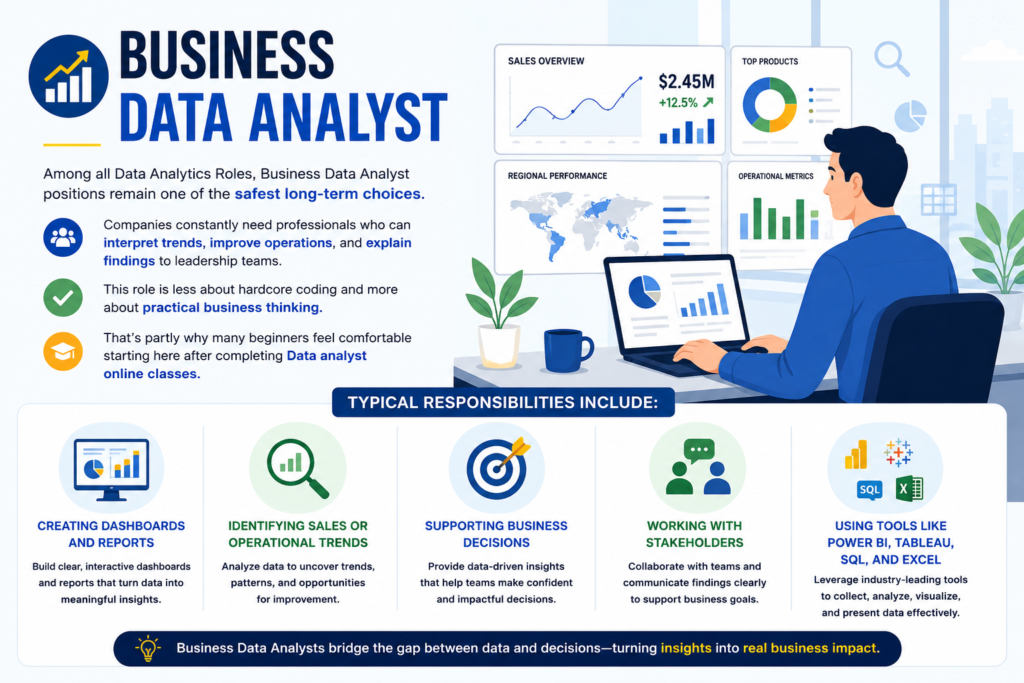
Typical responsibilities include:
- Creating dashboards and reports
- Identifying sales or operational trends
- Supporting business decisions
- Working with stakeholders
- Using tools like Power BI, Tableau, SQL, and Excel
I’ve personally seen many career changers move into this role successfully because it blends analytical thinking with communication skills.
Healthcare Data Analyst
Healthcare analytics has become one of the fastest-growing Data Analytics Roles globally. Hospitals and healthcare providers rely heavily on analytics for patient care optimization, billing analysis, and resource planning.
After the pandemic years, healthcare organizations invested aggressively in data systems. That investment continues today.
Professionals in this area often work with:
- Patient outcome analysis
- Healthcare reporting systems
- Predictive healthcare models
- Insurance claim analysis
- Operational efficiency tracking
The stability here comes from necessity. Healthcare systems simply cannot function efficiently without analytics anymore.
Financial Data Analyst
Finance-related Data Analytics Roles have remained consistently strong because financial institutions operate almost entirely on data-driven decisions.
Banks, fintech firms, insurance companies, and investment firms all depend on analysts to reduce risk and improve profitability.
A friend of mine recently shifted from general IT support into financial analytics after earning a Google data analytics certification and taking specialized SQL training. Within months, he was working on fraud detection reporting for a fintech company. Stories like that are becoming increasingly common.
These roles typically involve:
- Risk analysis
- Fraud monitoring
- Forecasting
- Financial modeling
- Investment reporting
Marketing Data Analyst
Marketing teams now rely on analytics more than creative instincts alone. That shift has made Marketing Analyst one of the strongest modern Data Analytics Roles.
Companies track:
- Ad performance
- Website traffic
- Customer engagement
- Conversion rates
- Campaign ROI
This role feels especially future-proof because businesses will always need customer insights. AI tools may automate reporting, but companies still need analysts who can explain why customers behave the way they do.
Data Quality Analyst
This role doesn’t get talked about enough, honestly. Yet Data Quality Analyst positions are becoming extremely important.
AI systems, dashboards, and predictive models are only useful if the underlying data is accurate. Companies increasingly hire specialists who validate, clean, and monitor data systems.
Among emerging Data Analytics Roles, this one has surprisingly strong stability because organizations are realizing poor-quality data creates expensive mistakes.
How AI Is Changing Data Analytics Roles
There’s a common fear that AI will replace analysts entirely. Realistically, it’s changing the work more than eliminating it.
Routine reporting tasks are definitely becoming automated. But companies still need people who can:
- Ask the right business questions
- Interpret confusing trends
- Explain insights to non-technical teams
- Validate AI-generated outputs
- Make strategic recommendations
That’s why adaptable Data Analytics Roles remain valuable.
Actually, many recruiters now prefer analysts who understand AI-assisted analytics tools rather than professionals who resist them.
Why Certifications Still Matter
A lot of hiring managers now care more about practical project experience than degrees alone. That’s where programs like Google data analytics certification became popular.
The certification helps beginners understand:
- Data cleaning
- Visualization
- SQL basics
- Spreadsheet analysis
- Business reporting
Still, certification alone usually isn’t enough. Employers increasingly expect hands-on exposure to real datasets and project workflows.
That’s why many learners combine Google data analytics certification with practical Data analyst online classes that include projects, interview preparation, and tool-based learning.
How H2K Infosys Helps Build Career Stability
H2K Infosys Focuses on Practical Data Analytics Roles
One thing learners often struggle with is connecting theory to actual job expectations. That’s where training providers like H2K Infosys stand out for many students entering Data Analytics Roles.
Instead of focusing only on textbook learning, their programs emphasize:
- Real-time projects
- SQL practice
- Power BI training
- Tableau exposure
- Job-oriented analytics workflows
- Mock interview preparation
I’ve noticed many students prefer this type of structured learning because employers now expect practical skills from day one.
Why Students Choose H2K Infosys for Data Analyst Online Classes
The popularity of Data analyst online classes has increased massively because working professionals want flexible learning schedules.
H2K Infosys offers training designed around real industry expectations rather than purely academic material. That matters because analytics interviews today often include scenario-based questions, dashboard tasks, and SQL exercises.
Their approach seems especially useful for:
- Career changers
- Beginners entering tech
- Non-IT graduates
- Working professionals upskilling into analytics
Skills That Make Data Analytics Roles Future-Proof
Not all technical skills age well. But some abilities consistently strengthen long-term career stability in Data Analytics Roles.
SQL Remains Essential
Despite all the newer AI tools, SQL still sits at the center of analytics work. Most companies continue using relational databases extensively.
Analysts who know SQL deeply tend to remain employable across industries.
Data Visualization Skills
Tools like Tableau and Power BI remain highly valuable because leadership teams prefer visual insights over raw spreadsheets.
Strong storytelling with dashboards can separate average analysts from highly valuable ones.
Communication Skills Matter More Than Expected
This part surprises many beginners. Technical knowledge helps, but companies increasingly prioritize analysts who can explain findings clearly.
Some of the most successful professionals in Data Analytics Roles are not necessarily the strongest coders. They’re the people who can connect analytics to business decisions.
Are Data Analytics Roles Safe for the Next 10 Years?
Based on current hiring patterns, industry investments, and AI integration trends, most major Data Analytics Roles appear highly stable for the long term.
The safest positions are usually those connected to:
- Business decision-making
- Healthcare systems
- Finance
- Marketing intelligence
- Data governance
- AI-assisted analytics
Automation will continue changing workflows, yes. But businesses still need humans who understand context, judgment, communication, and strategy.
That combination is difficult to automate fully.
Final Thoughts
The future looks strong for professionals entering Data Analytics Roles, especially those who combine technical skills with business understanding. Certifications like Google data analytics certification can help create a foundation, while practical Data analyst online classes improve real-world readiness.
What I keep hearing from recruiters lately is pretty simple: companies want analysts who can think critically, work with modern tools, and explain insights clearly. That need isn’t disappearing anytime soon.
For learners trying to build stable careers, structured programs from providers like H2K Infosys can help bridge the gap between learning concepts and handling actual industry work.