Data analytics is the process of collecting, transforming, and interpreting data to support decision-making in organizations. Choosing a career in Data analytics provides opportunities to work with structured and unstructured data using tools like Power BI, Tableau, SQL, and business intelligence platforms. It is a field commonly used across industries to improve efficiency, reduce risks, and identify growth opportunities.
What is Data Analytics?
Data analytics refers to the systematic use of data to derive insights and support business decisions. It involves multiple stages, including data collection, data cleaning, transformation, analysis, and visualization.
Professionals in Data analytics use tools such as:
- SQL for querying databases
- Power BI and Tableau for visualization
- Excel and scripting tools for data preparation
- Business intelligence (BI) systems for reporting
In enterprise environments, Data analytics is integrated into workflows such as sales forecasting, customer segmentation, financial reporting, and operational optimization.
Why is Data Analytics a Strong Career Choice?
Choosing Data analytics as a career is practical due to its cross-industry relevance and evolving demand. Organizations increasingly rely on data-driven strategies rather than intuition.
Key reasons include:
- Wide applicability: It is used in healthcare, finance, retail, logistics, and IT services
- Scalable career growth: Entry-level analysts can progress into roles like data engineer, BI developer, or analytics manager
- Tool-driven learning path: Skills are structured around tools like SQL, Tableau, and Power BI
- Decision-making impact: Analysts directly influence business outcomes through insights
For working professionals, enrolling in Data analyst online classes helps build structured knowledge aligned with industry needs.
How Does Data Analytics Work in Real-World IT Projects?
In real-world projects, This follows a structured workflow. Teams rarely work on isolated datasets; instead, they interact with complex systems and large-scale databases.
Typical workflow:
- Data Extraction
- Pull data from databases using SQL
- Access APIs or cloud storage systems
- Data Cleaning
- Handle missing values
- Remove duplicates
- Normalize formats
- Data Transformation
- Aggregate data
- Apply business rules
- Create calculated fields
- Analysis
- Identify trends and anomalies
- Perform statistical evaluations
- Visualization & Reporting
- Build dashboards using Power BI or Tableau
- Share insights with stakeholders
In enterprise IT projects, It is must also consider:
- Data security policies
- Role-based access control
- Performance optimization for large datasets
Why is Data Analytics Important for Working Professionals?
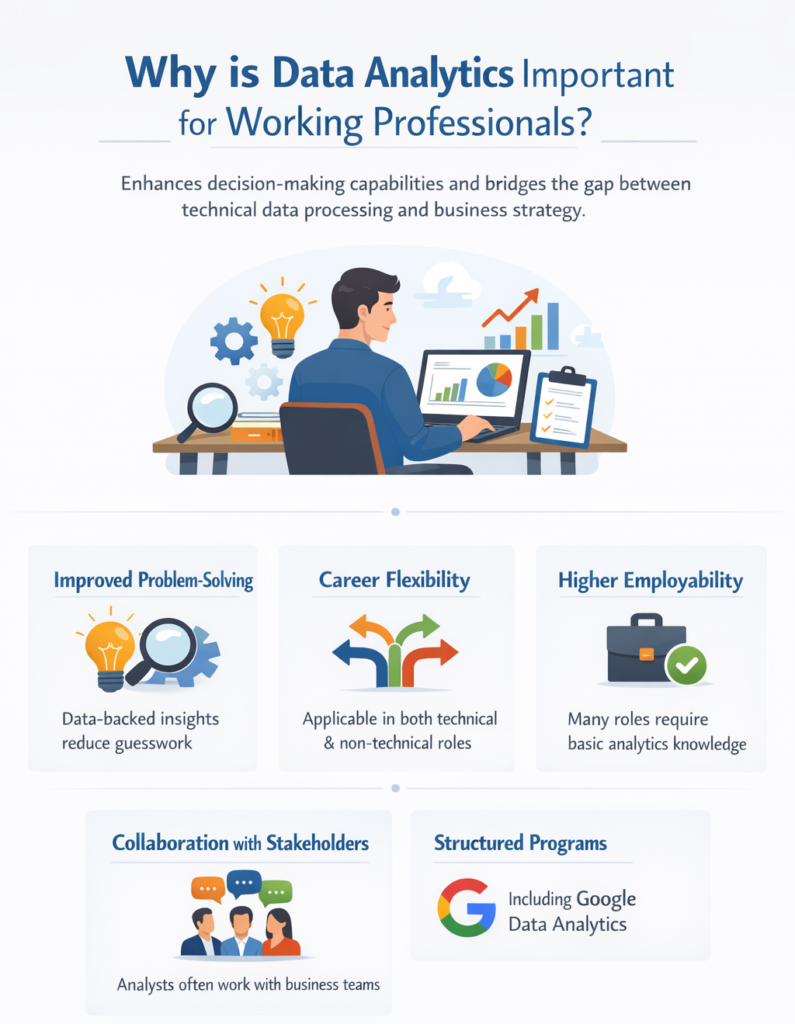
For professionals in IT or business roles, It enhances decision-making capabilities. It bridges the gap between technical data processing and business strategy.
Benefits include:
- Improved problem-solving: Data-backed insights reduce guesswork
- Career flexibility: Applicable in both technical and non-technical roles
- Higher employability: Many roles require basic analytics knowledge
- Collaboration with stakeholders: Analysts often work with business teams
Structured programs, including Google data analytics certification, provide foundational understanding, while advanced training builds practical expertise.
What Skills Are Required to Learn Data Analytics?
To succeed in it learners need a combination of technical and analytical skills.
Core Technical Skills
- SQL for database querying
- Data visualization using Power BI and Tableau
- Basic statistics and probability
- Excel for quick data manipulation
Analytical Skills
- Logical reasoning
- Pattern recognition
- Attention to detail
Practical Skills
- Understanding business requirements
- Communicating insights clearly
- Creating dashboards and reports
Many learners start with Data analyst online classes to gain hands-on exposure to these tools in guided environments.
How H2K Infosys Supports Data Analytics Learning
H2K Infosys provides structured training programs designed for working professionals transitioning into Data analytics. The focus is on practical application rather than theoretical learning.
Key Features of H2K Infosys Data Analytics Training
- Project-based learning: Simulates real-world business scenarios
- Tool-focused curriculum: Covers SQL, Tableau, Power BI, and BI concepts
- Instructor-led sessions: Guided explanations of workflows and use cases
- Job-oriented approach: Emphasis on tasks performed in real analyst roles
Unlike generic courses, H2K Infosys integrates analytics concepts with enterprise-level practices such as reporting automation and dashboard optimization.
How is Data Analytics Used in Enterprise Environments?
In enterprise settings, It is embedded into daily operations. Analysts work with large-scale systems and structured pipelines.
Common Use Cases
- Sales analytics: Tracking revenue trends and forecasting demand
- Customer analytics: Identifying user behavior patterns
- Operational analytics: Monitoring system performance and efficiency
- Financial reporting: Supporting budgeting and compliance
Challenges faced in enterprise Data analytics:
- Handling large datasets efficiently
- Maintaining data accuracy
- Ensuring compliance with data regulations
- Integrating multiple data sources
Professionals trained through structured programs like those offered by H2K Infosys gain exposure to these real-world constraints.
What Job Roles Use Data Analytics Daily?
These skills are used across multiple job roles:
- Data Analyst: Works on reporting, dashboards, and insights
- Business Analyst: Connects data insights with business strategy
- BI Developer: Builds reporting systems and dashboards
- Data Engineer (entry-level exposure): Supports data pipelines
Each role requires a different level of expertise, but all rely on this fundamentals.
What Careers Are Possible After Learning Data Analytics?
After gaining skills in Data analytics, professionals can explore multiple career paths:
- Entry-level analyst roles
- Mid-level BI and reporting roles
- Specialized analytics roles (marketing, finance, operations)
Career progression depends on:
- Depth of technical skills
- Understanding of business domains
- Experience with real-world projects
How H2K Infosys Integrates Career-Focused Training
H2K Infosys aligns its analytics training with industry requirements by focusing on:
- Real-time datasets
- Hands-on assignments
- Resume-oriented project work
- Practical interview preparation
The goal is to ensure learners understand how it is applied in real job environments rather than just learning tools in isolation.
FAQ: Data Analytics Career
Is Data analytics suitable for non-technical backgrounds?
Yes, beginners can start with foundational tools like Excel and SQL, gradually moving to advanced tools like Tableau and Power BI.
How long does it take to learn Data analytics?
Basic proficiency can be achieved in 3–6 months with consistent practice and structured learning.
Do I need programming skills?
Programming is not mandatory at the start, but basic knowledge of SQL is essential.
Which tools are most important?
SQL, Power BI, and Tableau are commonly used in enterprise environments.
Key Takeaways
- Data analytics is a structured approach to analyzing and interpreting data
- It is widely used across industries for decision-making
- Core tools include SQL, Power BI, and Tableau
- Real-world workflows involve data extraction, cleaning, analysis, and visualization
- H2K Infosys training emphasizes practical, job-oriented learning
- Career opportunities range from data analyst to BI developer
Explore structured, hands-on Google data analytics certification training with H2K Infosys to build practical skills aligned with industry needs.
Enroll in guided programs designed to support your transition into a Data analytics career.