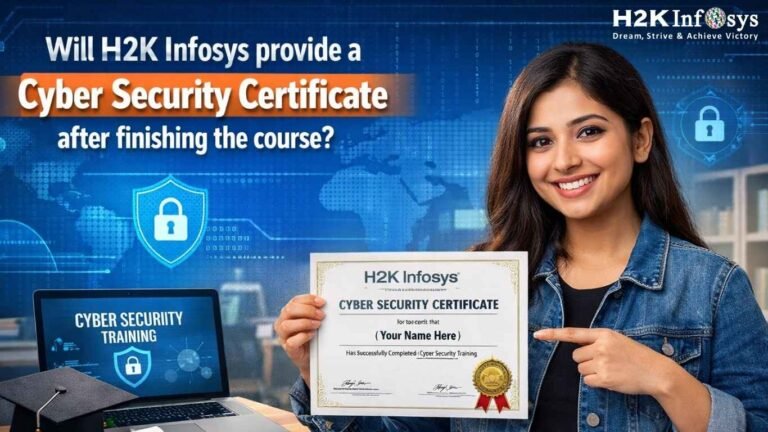
Yes. If you finish all the required modules, projects, and tests, H2K Infosys will provide you a cyber security certificate after completion at the end of the course. This qualification can help you find real work in cybersecurity.
That being said, let’s be honest. Getting a credential doesn’t mean you’ll get a job right away. The most crucial thing is that the certificate proves you have the skills, knowledge, and desire to handle genuine security problems. These days, employers want to see that you can use what you learned, not just finish a course.
I have seen both sides of this. Some people have a lot of certifications but still have a hard time in interviews since they don’t have any real-world experience. Some people finish a good program with real-world projects and get interview calls right away. It’s not the paper that makes the difference; it’s the practical skills, confidence, and real-world experience that come from taking good cybersecurity training.
Why Course Completion Certificates Are More Important Than Ever in 2026
In the last few years, cyber security certificate has changed a lot. Companies are now actively looking for applicants who can show verifiable expertise because ransomware assaults, data breaches, and AI-driven cyber threats are on the rise around the world.
A certificate from a structured cyber security training and placement program tells employers three crucial things:
- You finished guided, structured learning
- You know the basics of cybersecurity tools and ideas
- You put in the time and effort to improve your professional skills.
Recruiters don’t expect newbies to know everything. They do, however, want proof that you take studying seriously.
In fact, a lot of hiring managers today use certificates as a way to narrow down candidates, especially for entry-level jobs like:
- SOC Analyst
- Analyst of Security
- Vulnerability Analyst
- Cybersecurity Support Expert
It’s harder to get to the interview stage without some form of training or certification record.
What Your Cyber Security Certificate Actually Represents
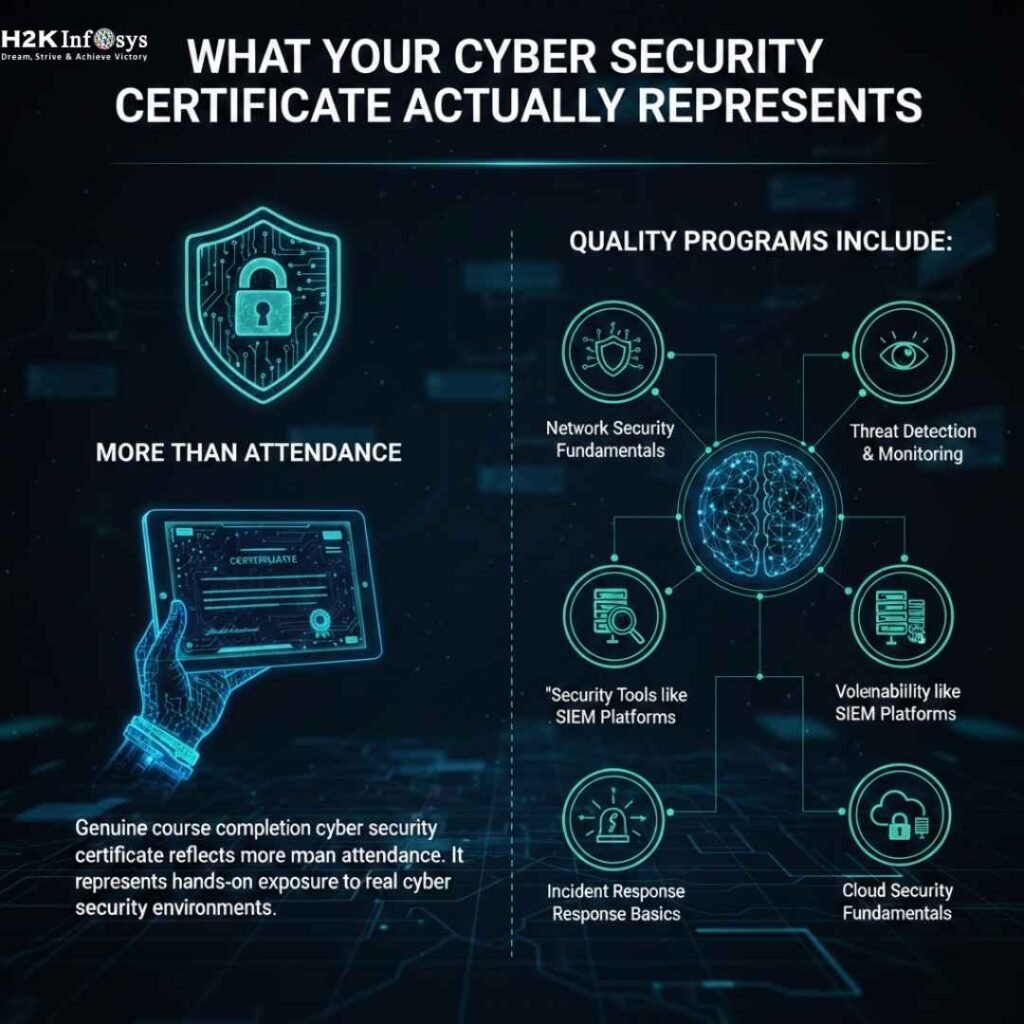
A genuine course completion cyber security certificate reflects more than attendance. It represents hands-on exposure to real cyber security certificate environments.
Most quality programs include training in:
- Network security fundamentals
- Threat detection and monitoring
- Security tools like SIEM platforms
- Vulnerability scanning
- Incident response basics
- Cloud security fundamentals
If your course includes projects and labs, your cyber security certificate becomes even more valuable. Employers care about what you can do, not just what you studied.
I remember talking to a hiring manager last year who said something interesting. He mentioned that candidates who completed hands-on training programs often performed better in entry-level roles than candidates who only had theoretical knowledge. That stuck with me.
What Employers Think of Cybersecurity Course Certificates
Here’s something that most people don’t know: firms don’t hire people solely on their degrees alone anymore, especially in cybersecurity.
Instead, they look at a mix of:
- Skills
- Experience in the field
- Certifications
- Real-world project experience
This is where formal cyber security training and placement programs assist people go from learning to working.
For instance, think of two people who want to be SOC Analysts:
Candidate A:
Has some IT expertise but not a diploma in cybersecurity training
Candidate B:
finished training in cyber security certificate, got a certificate, and worked in real threat detection labs.
Candidate B is more likely to get the job because they have already done the duties that are important for the job.
A Certificate Helped Me Change Careers: A Real-Life Example
I talked to one student recently who didn’t have any IT experience. He worked in customer service and wanted to change jobs.
He put his cyber security certificate on his résumé and LinkedIn page after finishing the course. He started getting calls for interviews after a few weeks.
Not because the diploma was miraculous, but because it proved that you took the initiative and learned new skills.
Later, he got a job in cybersecurity at the basic level. His credential helped him get past the first hurdle.
More and more people are making this kind of change in 2026, especially since firms are employing people based on their skills instead of their degrees.
How Certification Can Help You Get a Job
When you get help getting ready for a career, certificates are even more useful. A lot of cybersecurity training and job placement programs currently have:
- Help in writing a resume
- Getting ready for an interview
- Practice interviews
- Experience working on real projects
- Coaching for your career
These things assist in turning your certificate into real job openings.
It’s like getting a license to drive. You don’t become a fantastic driver just because you have a license. It shows that you know the basics and are ready to drive in the real world.
Certificates also help you look more professional.
There are many ways that your credential makes your professional profile stronger:
1. Makes your resume stronger
Recruiters see cybersecurity training right away as a way to improve your skills.
2. Increases visibility on LinkedIn
A lot of recruiters look for certified cybersecurity applicants right on LinkedIn.
3. Shows a commitment to your career
It shows that you put in the time and effort to create your career in cybersecurity.
4. Helps people who want to change careers get into the field
Especially helpful for people who are moving from non-IT fields.
Cybersecurity Skills Are in High Demand Right Now
Cybersecurity demand continues growing rapidly. According to recent industry reports, there is still a global shortage of skilled cybersecurity professionals.
Companies across industries are hiring:
- Healthcare
- Banking
- Technology
- E-commerce
- Government sectors
Even newer areas like cyber security sales training roles are emerging, where professionals combine cybersecurity knowledge with business and sales skills.
These hybrid roles require people who understand security concepts and can communicate them effectively to customers.
Your certificate acts as proof that you understand the fundamentals.
What Makes a Certificate Worthwhile
Not every qualification is equally important. The best cyber security certificate come from programs that have:
- Labs where you do things
- Experience working on real projects
- Training led by an instructor
- Hands-on experience with cybersecurity tools
- Help with interviews and career planning
A credential that comes with hands-on training is worth a lot more than one that is based only on theory.
During interviews, it’s easy for employers to tell the difference.
What to Do After You Get Your Certificate
Don’t just put your cyber security certificate away when you get it.
Use it a lot:
- Put that on your CV.
- Put it on LinkedIn
- Bring it up in interviews
- Point out projects that were finished during training
- Keep using cybersecurity tools.
Your certificate is not the end of the road; it’s just your ticket to go in.
Last Thoughts
Yes, you will get a cyber security certificate of accomplishment when you finish the course, and it really helps. But the real value of training is the skills, experience, and confidence you earn.
Employers care about proof of ability in today’s job market, especially in cybersecurity. Having a credential from a structured cybersecurity training and placement program shows that you are serious about starting your profession.
That cyber security certificate, along with real-world experience, practice, and interview prep, can help you get jobs faster than you might think.
And honestly, that moment when you add your cyber security certificate to LinkedIn and start getting recruiter messages it’s a great feeling.