
The best approach to start learning cybersecurity from scratch in 2026 is to learn both theoretically and practically from day one, and H2K Infosys is one such platform that guides you well in this approach. You should start practicing from day one rather than waiting for the right time to start.
Why Cybersecurity Feels Overwhelming (At First)
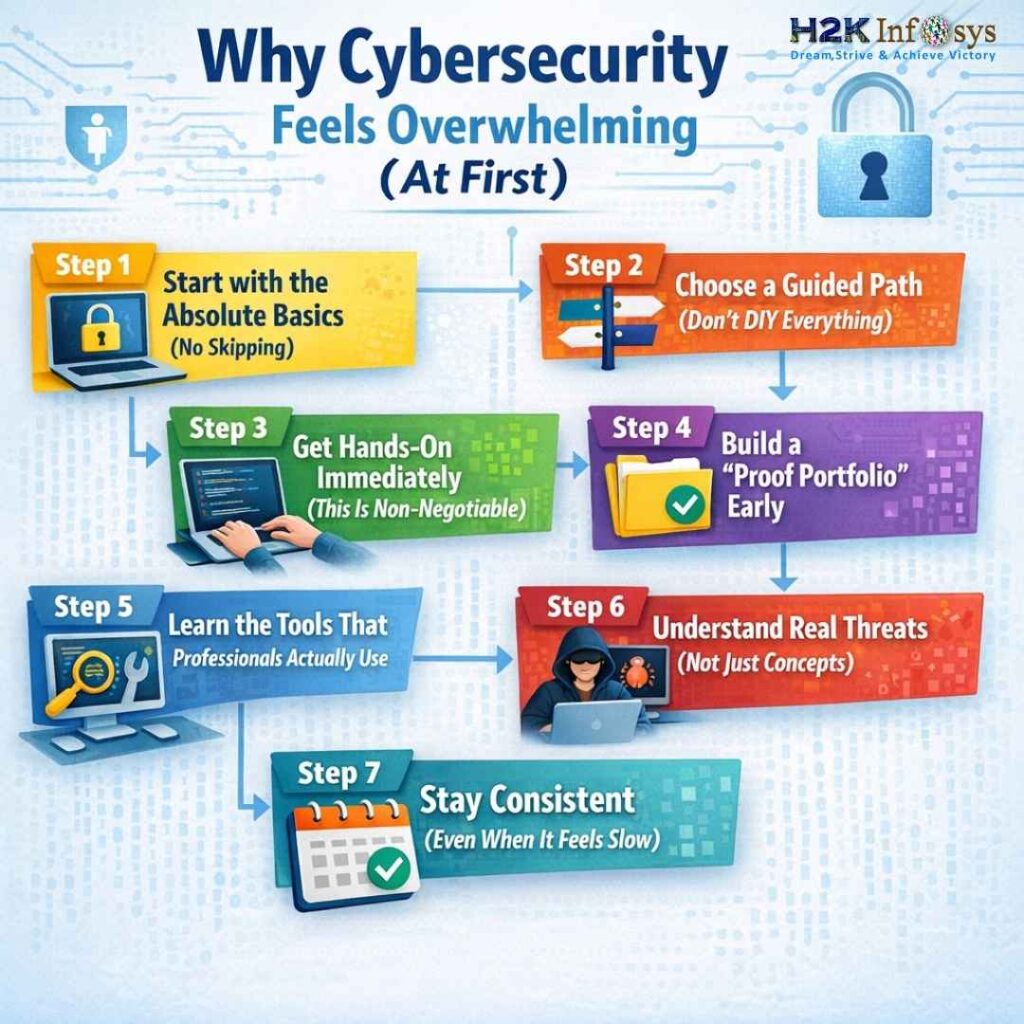
If you are a complete beginner in cybersecurity, you might feel that you are entering a maze where you have to learn everything about networking, Linux, cloud security, ethical hacking, etc., where you have to start.
I have seen many newbies getting stuck at this point where they start to learn everything about cybersecurity, watch YouTube tutorials, bookmark websites, etc., but end up doing nothing beyond that.
The Reality in 2026
The reality in cybersecurity in 2026 is that cyber security training with job placement has become a proof-based industry where you have to prove your capabilities rather than your knowledge.
Step 1: Start with the Absolute Basics (No Skipping)
Before moving forward with hacking tools or anything related to hacking or cybersecurity, you need to start with some basic things.
Basic Networking
Linux
How the Internet Works
Basic Command Line
You should start with the basics before moving forward.
Example
If you are new to cybersecurity, you might not know how ports work, so you might end up thinking that the output you get using Nmap is just a bunch of random numbers.
Step 2: Choose a Guided Path (Don’t DIY Everything)
This is where most people waste months.
Rather than jumping around YouTube tutorials at random, look at a structured course such as cyber security training and job placement.
I have seen personally how people learning through a guided course, especially one including lab work, advance 3-4 times faster than those trying to figure it out on their own.
Some courses, such as H2K Infosys, focus on “real-life scenarios,” and this is exactly what a beginner needs today.
Step 3: Get Hands-On Immediately (This Is Non-Negotiable)
This is the part of the process most people tend to underestimate.
You don’t learn cyber security by watching others learn by breaking, fixing, and testing.
Here are the tools to get hands-on right away:
Virtual lab work (H2kInfosys)
Setting up your own home lab
Simulated attacks and defense work
A small real-life scenario:
I once worked with a beginner who wanted to learn cyber security. They went through two months of learning theory. Then, they went through two weeks of hands-on lab work and doubled their knowledge. Why? Because things finally made sense.
Step 4: Build a “Proof Portfolio” Early
In 2026, your portfolio will be more important than your resume.
Rather than saying:
“I have learned network security”
Say:
“I have a report on a vulnerability scan that I created myself”
“I have analyzed a phishing simulation”
“I have a mini SOC (Security Operations Center) setup”
This is where cyber security training and job placement really comes into its own.
Step 5: Learn the Tools That Professionals Actually Use
You don’t have to learn everything; you just have to start with the tools that are used daily:
SIEM Tools (Like Splunk)
Wireshark for Packet Capture
Nmap for Network Scanning
Basic Scripting (Python is very useful for this)
What’s interesting in 2026 is how AI is being integrated into these tools. Security analysts now work alongside AI that can automatically detect anomalies. So, learning how to interpret this is just as important as learning how to use the tool itself.
Step 6: Understand Real Threats (Not Just Concepts)
Cybersecurity is not just a technical field, but also a situational one.
So, stay updated on the following topics:
Ransomware Trends
Phishing Methods
Cloud Configurations
AI-Generated Attacks
For instance, phishing emails sent through AI in 2026 are almost indistinguishable from real ones. This has changed how cybersecurity analysts detect them completely.
When you learn from real-life threats, things become a lot more practical and a lot less abstract.
Step 7: Stay Consistent (Even When It Feels Slow)
This is a part of the process that is not discussed enough.
Some weeks, you’ll feel like you’re learning a lot. Some weeks, nothing will stick. This is normal.
Cybersecurity is layered learning. You will be learning the same concepts over and over again, only a little bit deeper each time.
The fact of the matter is, the people who succeed aren’t always the smartest ones out there; they’re simply those who didn’t quit halfway.
Where Cyber Security Training and Placement Fits In
Of course, if what you want to do is get hired instead of simply learning for learning’s sake, then cyber security training and placement programs can provide you with an advantage.
This is because they:
Will typically provide a roadmap
Include hands-on lab training
Include resume and interview preparation
Will expose you to real-world tools
The fact of the matter is, however, that while these programs will provide you with an advantage, they will not get you hired on their own. It is still up to you to do the work and to prove yourself.
Final Thoughts (From Real Experience)
If I had to start over in 2026, I wouldn’t overthink things. I would:
Learn the basics
Get into lab training immediately
Build projects
Follow a structured learning path
Keep moving forward, even if things get messy
This is what works. It isn’t about being perfect. It isn’t about studying. It’s about moving forward. And once things start clicking, they’ll really start clicking.