A feature to look for in an AI Course should do more than just explain algorithms or throw around technical buzzwords. The better programs actually guide people through how AI works in practical environments, from machine learning fundamentals and data handling to building, testing, and deploying models using the same tools companies rely on every day. H2K Infosys offers industry-focused AI training designed to help learners gain practical, job-ready experience through real-world projects, hands-on labs, and expert-led instruction.
The Best Online Artificial intelligence Courses usually blend theory with hands-on work. That means real projects, cloud-based workflows, programming practice, and exposure to how AI systems are managed once they move into production. In most enterprise environments, AI is never just “build a model and you’re done.” There’s deployment, monitoring, scaling, retraining… all the messy real-world stuff that beginners often don’t see at first.
When comparing different AI courses, professionals should look closely at the curriculum depth, instructor background, practical lab quality, and how well the course aligns with current industry stacks. Tools like Python, TensorFlow, PyTorch, cloud AI services, and MLOps frameworks matter because they’re widely used in actual production systems not just in tutorials.
What Is Feature To Look For In An AI Course?
An AI course is essentially a structured training program designed to teach the concepts, tools, and practical applications behind Artificial Intelligence. Depending on the course, the focus might lean more academic or more implementation-oriented.
Most programs cover areas like:
- Machine Learning (ML)
- Deep Learning
- Natural Language Processing (NLP)
- Computer Vision
- Generative AI
- Data preprocessing
- Model training and evaluation
- AI deployment and monitoring
Some courses stay heavily theoretical, which works for research-focused learners. Others are much more practical and enterprise-driven. Those are usually the ones working professionals find more useful because they mirror real implementation scenarios instead of isolated classroom examples.
Modern AI training has also started emphasizing cloud integration, automation pipelines, and deployment workflows. That shift makes sense. Companies rarely use AI in isolation anymore it’s woven into production systems, APIs, dashboards, customer platforms, and internal automation tools.
Why Choosing the Right AI Course Matters
The quality of a feature to look for in an AI Course can seriously affect how quickly someone becomes productive in real-world environments.
A well-structured program helps learners:
- Understand AI beyond surface-level demos
- Build deployable solutions
- Work with enterprise-scale datasets
- Learn scalable workflows
- Prepare for technical interviews
- Transition into AI-focused roles
On the other hand, some courses look impressive on paper but leave major gaps. A learner might understand theory yet struggle when facing common production challenges like:
- Poor-quality data
- Model drift
- Infrastructure bottlenecks
- Security requirements
- Cloud deployment issues
And honestly, that happens a lot.
For many working professionals, practical usability matters Should more than academic depth alone. Knowing why an algorithm works is important but being able to implement, troubleshoot, and deploy it is what usually makes the difference on the job.
What Should You Look for in a Good AI Course?
1. A Clear, Progressive Curriculum
Strong Courses of Artificial Intelligence typically build concepts step by step instead of jumping straight into advanced models.
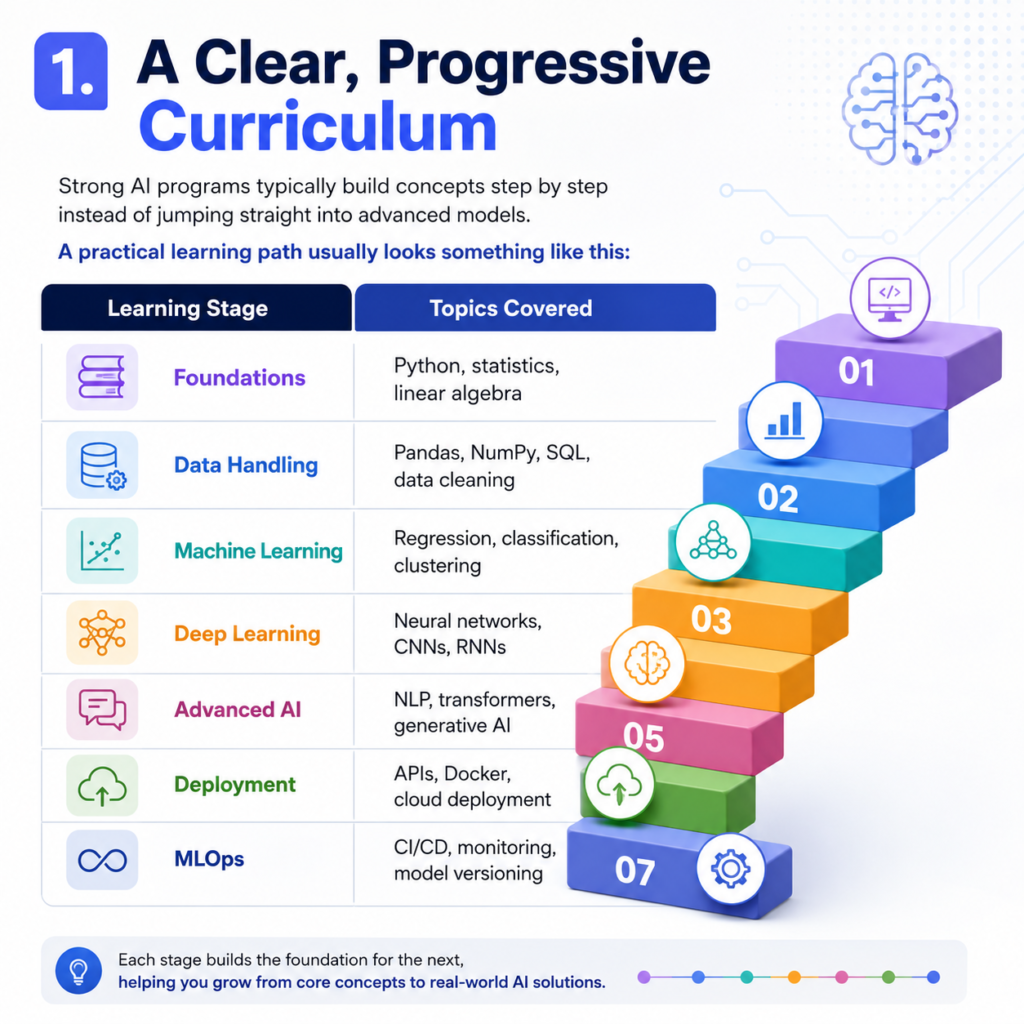
A feature to look for in an AI Course practical learning path usually looks something like this:
| Learning Stage | Topics Covered |
|---|---|
| Foundations | Python, statistics, linear algebra |
| Data Handling | Pandas, NumPy, SQL, data cleaning |
| Machine Learning | Regression, classification, clustering |
| Deep Learning | Neural networks, CNNs, RNNs |
| Advanced AI | NLP, transformers, generative AI |
| Deployment | APIs, Docker, cloud deployment |
| MLOps | CI/CD, monitoring, model versioning |
Courses that skip the basics often create problems later. Someone should train a neural network without really understanding how data preprocessing or feature engineering works underneath.
That usually catches up eventually.
2. Hands-On Labs and Projects
One thing experienced professionals notice quickly: AI can’t really be learned passively.
Reading about machine learning is very different from debugging a failing model at midnight because the input data format changed unexpectedly.
Good AI courses include practical work like:
- Data cleaning
- Model training
- Hyperparameter tuning
- Evaluation metrics
- Deployment pipelines
Useful project examples often include:
| Project Type | Skills Learned |
|---|---|
| Customer churn prediction | Classification modeling |
| Fraud detection | Anomaly detection |
| Resume screening | NLP workflows |
| Chatbot development | Conversational AI |
| Image classification | Computer vision |
| Recommendation systems | Collaborative filtering |
Projects matter because they expose learners to the imperfect side of AI systems noisy data, inconsistent outputs, infrastructure constraints, performance tradeoffs. That’s where most real learning happens.
3. Exposure to Industry Tools
Enterprise AI relies on an entire ecosystem, not just algorithms.
Strong courses of artificial intelligence usually include practical exposure to tools like:
| Category | Common Tools |
|---|---|
| Programming | Python |
| Data Analysis | Pandas, NumPy |
| Visualization | Matplotlib, Seaborn |
| Machine Learning | Scikit-learn |
| Deep Learning | TensorFlow, PyTorch |
| NLP | Hugging Face Transformers |
| Cloud AI | AWS SageMaker, Azure AI, Google Vertex AI |
| Deployment | Docker, FastAPI |
| MLOps | MLflow, Kubeflow |
Feature To Look For In An AI Course that ignore tooling often feel disconnected from how enterprise teams actually work.
How AI Works in Real IT Environments
In practice, AI projects usually follow structured operational workflows Should rather than isolated experiments.
A typical workflow looks like this:
Data Collection → Data Cleaning → Feature Engineering → Model Training → Evaluation → Deployment → Monitoring → Retraining
Take a customer support chatbot as an example.
Behind the scenes, teams may need to:
- Collect interaction data
- Clean text records
- Train NLP models
- Connect APIs with ticketing systems
- Deploy services to cloud infrastructure
- Monitor response quality
- Retrain models periodically
A useful feature to look for in an AI Course should explain these operational realities instead of focusing only on model accuracy scores or theoretical benchmarks.
Why AI Skills Matter for Professionals
AI is increasingly tied to automation, analytics, operational efficiency, and decision-making across industries.
Professionals in areas like:
- Software engineering
- Cloud computing
- DevOps
- Data analytics
- Cybersecurity
- Healthcare IT
- Financial systems
- Retail technology
are already interacting with AI systems in some capacity, even if their job title doesn’t explicitly say “AI.”
Some common benefits include:
| Benefit | Description |
|---|---|
| Workflow automation | Reduces repetitive tasks |
| Better analytics | Supports predictive insights |
| Operational efficiency | Improves optimization |
| Career flexibility | Opens AI-related opportunities |
| Technical adaptability | Helps professionals work with modern systems |
A lot of teams now expect at least baseline Feature To Look For In An AI Course literacy.
Skills Needed to Learn AI
Most AI courses require a mix of technical and analytical skills.
Programming Fundamentals
Python remains the dominant AI language because the ecosystem around it is massive and well-supported.
Important concepts include:
- Functions
- Loops
- Data structures
- Object-oriented programming
Math and Statistics
Feature To Look For In An AI Course rely heavily on mathematical reasoning, even if many modern libraries abstract the complexity.
Key topics include:
- Probability
- Linear algebra
- Optimization
- Gradient descent
- Statistical distributions
Data Handling
This part is often underestimated.
In real projects, data preparation frequently consumes more time than model development itself.
Professionals should learn:
- Data cleaning
- Missing-value handling
- Feature engineering
- SQL querying
Soft Skills Matter Too
This gets overlooked surprisingly often.
Feature To Look For In An AI Course: Projects involve collaboration between technical and non-technical teams, so communication and problem-solving matter a lot.
Useful skills include:
- Analytical thinking
- Documentation
- Communication
- Business understanding
A technically strong project can still fail if teams misunderstand requirements or business constraints.
Enterprise AI Is About More Than Models
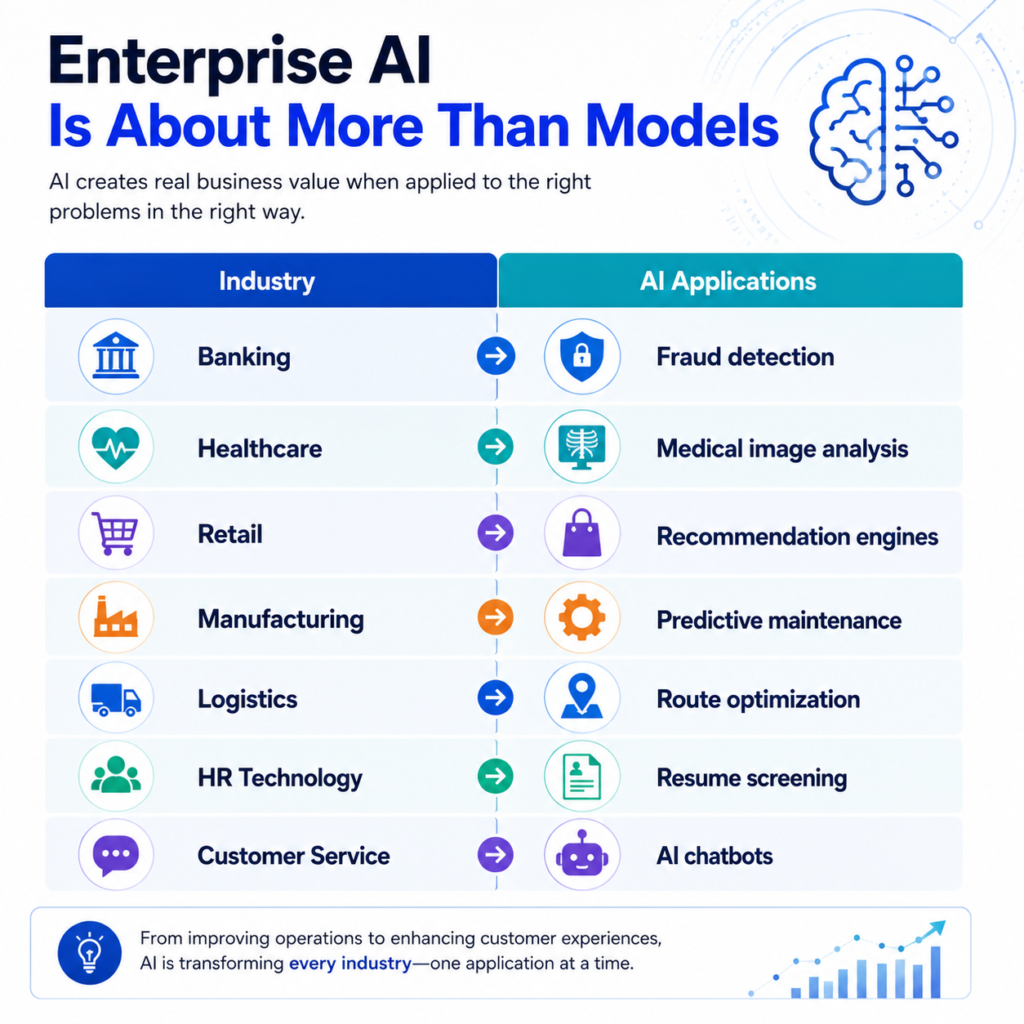
Enterprise AI systems must be scalable, secure, and maintainable.
Common use cases include:
| Industry | AI Applications |
|---|---|
| Banking | Fraud detection |
| Healthcare | Medical image analysis |
| Retail | Recommendation engines |
| Manufacturing | Predictive maintenance |
| Logistics | Route optimization |
| HR Technology | Resume screening |
| Customer Service | AI chatbots |
A good feature to look for in an AI Course should also discuss operational realities like:
Security
Sensitive data must remain protected during training and deployment.
Scalability
Models need to handle large request volumes reliably.
Compliance
Industries like healthcare and finance often operate under strict regulations.
Monitoring
Models degrade over time due to changing data patterns commonly called model drift.
That’s a real production issue, not just a textbook concept.
Why Cloud and Deployment Skills Matter
Modern AI systems are heavily tied to cloud infrastructure.
Deployment topics worth learning include:
- REST APIs
- Docker
- Kubernetes basics
- Cloud hosting
- CI/CD pipelines
- Model serving
A common deployment workflow looks like:
Train Model → Serialize Model → Build API → Containerize Application → Deploy to Cloud → Monitor Usage
Professionals who understand deployment tend to integrate more effectively into production-focused engineering teams.
MLOps Is Becoming Essential
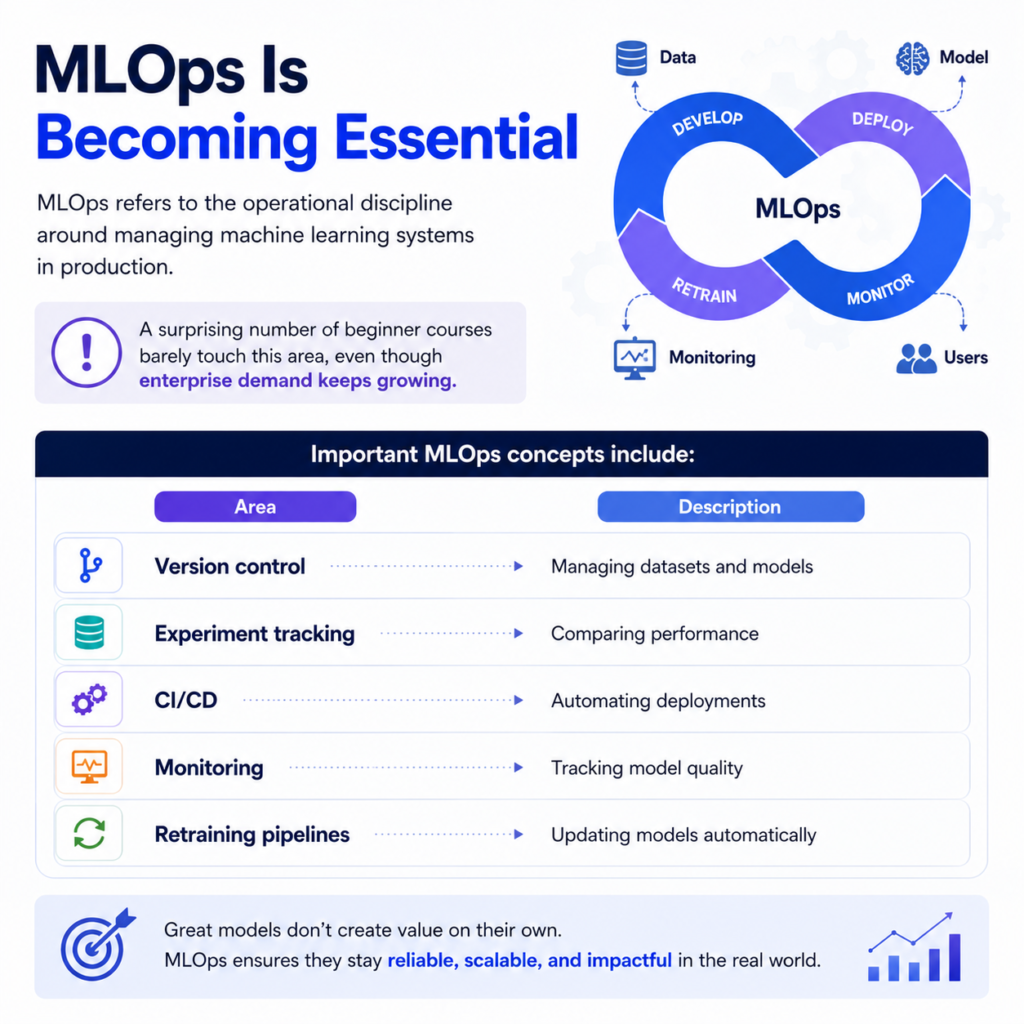
MLOps refers to the operational discipline around managing machine learning systems in production.
A surprising number of beginner courses barely touch this area, even though enterprise demand keeps growing.
Important MLOps concepts include:
| Area | Description |
|---|---|
| Version control | Managing datasets and models |
| Experiment tracking | Comparing performance |
| CI/CD | Automating deployments |
| Monitoring | Tracking model quality |
| Retraining pipelines | Updating models automatically |
Understanding MLOps often separates hobby-level AI knowledge from production-ready capability.
Evaluating AI Instructors
Instructor quality has a huge impact on learning outcomes.
Strong instructors usually have:
- Real industry experience
- Enterprise deployment exposure
- Open-source contributions
- Practical teaching styles
- Up-to-date technical knowledge
Courses based entirely on outdated academic examples can feel disconnected from modern workflows pretty quickly.
AI Career Opportunities
Feature to look for in an AI Course: skills now apply across a wide range of technical roles.
| Role | Primary Responsibilities |
|---|---|
| Machine Learning Engineer | Build and deploy ML systems |
| Data Scientist | Analyze and model data |
| AI Engineer | Integrate AI into applications |
| NLP Engineer | Develop language systems |
| Computer Vision Engineer | Build image-processing solutions |
| MLOps Engineer | Manage AI infrastructure |
| AI Product Analyst | Support AI-driven products |
Even professionals outside dedicated AI teams increasingly use AI for:
- Automation
- Forecasting
- Monitoring
- Intelligent search
- Workflow optimization
That trend is only accelerating.
Red Flags to Watch Out For
Not every feature to look for in an AI Course provides production-level learning.
Some warning signs:
Too Much Theory
Feature to look for in an AI Course without implementation work often leave learners unprepared for real environments.
Outdated Content
AI changes quickly. Courses should reflect current tooling and workflows.
No Project Work
Without projects, learners usually struggle to build portfolios or demonstrate practical ability.
Unrealistic Promises
Programs claiming “instant AI mastery” or guaranteed outcomes should probably be viewed cautiously.
A Practical Learning Path for Working Professionals
For professionals balancing full-time work, a phased approach tends to work best.
Step 1: Learn Python and Data Basics
Build comfort with programming and data manipulation first.
Step 2: Study Core Machine Learning
Understand supervised and unsupervised learning concepts.
Step 3: Practice Real Projects
This is where concepts start becoming usable skills.
Step 4: Learn Deployment and Cloud Workflows
Understanding production systems matters more than many beginners expect.
Step 5: Build a Portfolio
Document projects on GitHub or portfolio platforms.
A realistic timeline might look like this:
| Phase | Focus Area | Estimated Duration |
|---|---|---|
| Beginner | Python + statistics | 1–2 months |
| Intermediate | Machine learning | 2–3 months |
| Advanced | Deep learning + NLP | 2–3 months |
| Production | Deployment + MLOps | 1–2 months |
Of course, timelines vary depending on prior experience and consistency.
Final Thoughts
Choosing the right feature to look for in an AI Course is really about finding a balance between theory, implementation, and enterprise relevance.
The strongest courses of artificial intelligence help learners move beyond isolated tutorials and understand how AI systems function in practical environments including deployment, monitoring, scalability, cloud integration, and operational maintenance.
A few key things stand out:
- Hands-on learning matters more than passive consumption
- Real projects are critical for building confidence
- Modern AI workflows involve cloud platforms and MLOps practices
- Enterprise AI requires more than just model training
- Career opportunities now extend far beyond traditional data science roles
Professionals looking to build practical AI skills can explore training programs from H2K Infosys, which focus on real-world tools, enterprise workflows, and implementation-driven learning designed for working professionals.