The right cybersecurity training program in the USA? Well, it all comes down to one very simple thing: find a program that will actually teach you how to do the job, not just pass a test. It’s surprising how many people miss this and wind up with a program that’s all theory and little else. That’s not what H2K Infosys is like, and that’s a big difference maker when it’s time to enter the workforce.
How to choose the right cybersecurity training program in the USA
I see this happen a lot. People sign up for an online CyberSecurity training program, go through all the videos and maybe even pass a test or two… and then are completely stumped if asked to analyze a right CyberSecurity training event. It’s a big gap, and one that can be filled.
So let’s break this down like a Cyber Security professional would:
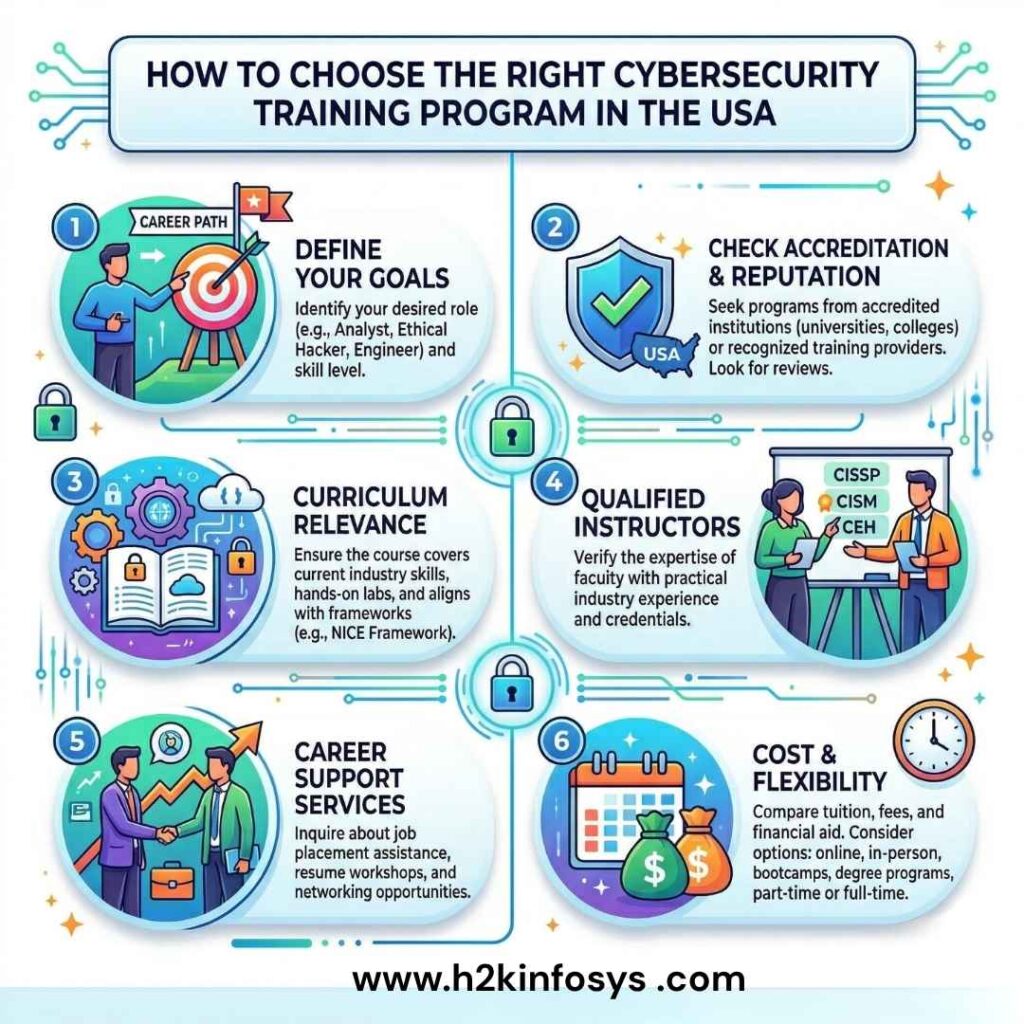
1.Determine your end goal (not your course goals)
Before even looking at training programs, you need to know:
Do I want a job in a Security Operations Center?
Do I want to be a penetration tester?
Or just want to get some training and break into a basic Cyber Security role?
The reason is this: different roles require different skills. A Security Operations Center requires knowledge of log analysis and SIEM tools. A penetration tester requires knowledge of how to attack a network.
I worked with a student who chose a “General Cyber Security” course and ended up getting a little knowledge of everything but not enough of anything to actually get a job. Don’t be this student.
Choose your right cybersecurity training program based on your job role goals.
2.Make sure it has some good hands-on labs (this is a big one)
And if a program does not include this, do not bother. Seriously.
What to look for in a right cybersecurity training with job placement:
Real world cyber attack simulations
Tools like Splunk, Wireshark, Metasploit
Incident response scenarios
Projects that you can talk about in an interview
Currently (and especially in 2025 and 2026 hiring trends), employers want to see that you can do something rather than merely have a bunch of certifications. I’ve personally seen this happen.
3.Check if job placement is actually real
Many programs make promises about cyber security training with job placement. But do they really deliver?
What you should ask:
Do they offer resume support?
Do they offer mock interviews with actual cyber security professionals?
Do they offer referral support?
Because “placement support” can mean anything.
For example, programs can now actually mimic real world hiring pipelines. This is actually really helpful.
4.Instructor experience is more important than brand name
This is something that is underrated.
Do you really need a fancy university brand name when you can have an actual cyber security professional with:
Real world experience in actual cyber security teams
Actual experience dealing with actual cyber security incidents
Knowledge of what is currently expected by actual employers rather than 5 years ago
Cyber security is a rapidly changing field. Ransomware attacks, cyber security in cloud computing, AI cyber attacks. These are changing every month.
A good instructor will casually mention something like:
“This is exactly what we saw in recent ransomware attacks…”
And that is when you know that they actually know what they are talking about.
5.Do not look past community learning
This might seem minor, but it is actually quite important.
The right Cybersecurity training online programs will have:
Student communities
Slack/Discord communities
Peer discussions
Group challenges
Why is this important?
Because cybersecurity is a team sport in the real world. You will be discussing alarms, sharing ideas, and learning from one another constantly.
Also, let’s be honest – it helps keep you engaged. Learning by yourself can be super boring.
6.Aligns with current industry trends
Cybersecurity in the USA right now is all about:
Cloud Security (AWS, Azure)
Zero Trust Architecture
AI-powered threat detection
Compliance (NIST, ISO)
If your training is still super heavy on old network security fundamentals… that’s a red flag.
The right cybersecurity training will be a mix of fundamentals and what’s happening right now in cybersecurity.
7.Certifications are nice, skills are nicer
Let’s be real for a second.
While certifications like Security+, CEH, CISSP are super valuable – they are not a golden ticket.
Employers looking to hire cybersecurity professionals who have training are increasingly asking:
“Can you analyze this?”
“What would you do in this scenario?”
If your training isn’t preparing you for that… then your certification is basically useless.
8.Flexibility is a must (especially if you’re a busy adult)
The reality is that most right cybersecurity training students are:
Working professionals
Career changers
Students balancing many things
So the right Cybersecurity training online programs will have:
Recorded and live sessions
Flexible schedules
Self-paced labs
Why is this important?
Because consistency beats intensity. A course that you can complete is more valuable than a course that’s perfect but impossible to finish.
Final thoughts (from someone who’s been in your shoes)
If I had to boil everything down to one big idea:
The best Cyber Security training and job placement program is one that feels like practice for a job, not a test.
The difference between:
“I finished a course”
“I can actually do this job”
And in today’s cybersecurity field in the USA – that’s exactly what gets you hire