Introduction
Cybersecurity is one of the fastest-growing areas in the digital world because there are more cyber threats, data breaches, and the need for safe systems. The need for skilled cybersecurity professionals is growing quickly as businesses keep spending money to protect their digital assets. Learning about programming languages in cybersecurity can greatly improve your job prospects, whether you are just starting out or have been working in IT for a long time. H2kinfosys is one of the best places to learn about cybersecurity in a way that is relevant to your field.
In this complete guide, we’ll look at the best programming languages, how they are used in cybersecurity, and why taking a cybersecurity training and placement or Cyber security course with placement can give you an edge over other candidates.
Why Programming is Important for Cybersecurity
It’s not enough to just use cybersecurity tools; you also need to know how systems work and how attackers take advantage of them.
Professionals who know how to program:
* Look at malware and weaknesses
* Make security tasks that need to be done over and over again automatic
* Make apps that are safe
* Do ethical hacking and penetration testing
* Know a lot about how attacks work
Professionals can stay ahead of new threats by learning the right programming languages for cybersecurity.
Best Programming Languages for Cybersecurity
1. Python
A lot of people think that Python is the most important language for cybersecurity.
Why use Python?
* Simple to learn and use
* Lots of libraries for security tasks
* Used for scripting, automation, and penetration testing
Examples of Use:
* Making tools for security
* Analyzing malware
* Scanning the network
* Hacking for good
Python is the most popular programming language for cybersecurity because it is flexible and has a lot of community support.
2. C and C++
To understand how systems work at a low level, you need to know C and C++.
Why C/C++?
* Directly interacting with memory
* Helps you understand weaknesses like buffer overflow
* Used to make exploits
Examples of Use:
* Reverse engineering
* Making and studying malware
* Programming at the system level
These programming languages in cybersecurity are very important if you want to really understand how attacks happen.
3. JavaScript
JavaScript is very important for keeping the web safe.
Why use JavaScript?
* Commonly used in web apps
* Helps find weaknesses like XSS (Cross-Site Scripting)
Examples of Use:
* Testing the security of web apps
* Finding weaknesses on the client side
* Safe coding habits
JavaScript is one of the most important programming languages in cybersecurity for people who work in web security.
4. Java
People often use Java for business-level applications.
Why use Java?
* Strong security features
* Works on any platform
* Used a lot in banks and other financial systems
Examples of Use:
* Building safe applications
* Security for Android
* Testing the security of the backend
Java is still one of the most reliable programming languages in cybersecurity for large-scale systems.
5. SQL
SQL is very important for keeping databases safe.
Why use SQL?
* Used to control and search databases
* Helps you learn about SQL injection attacks
Examples of Use:
* Testing the security of databases
* Stopping data breaches
* Making sure queries are safe
Understanding SQL is very important for programming languages in cybersecurity, especially when it comes to keeping data safe.
6. Bash/Shell Scripting
Shell scripting is very important for managing and automating systems.
Why use Bash?
* Does the same tasks over and over again
* Interacts directly with operating systems
Examples of Use:
* Analyzing logs
* Watching the system
* Making security checks automatic
It’s one of the most useful programming languages in cybersecurity that people use every day.
7. Go (Golang)
Go is becoming more popular in the field of cybersecurity.
Why Go?
* Quick and effective
* Great for making tools that can grow
Examples of Use:
* Tools for scanning networks
* Apps for security
* Security in the cloud
Go is becoming a popular choice among modern programming languages for cybersecurity.
8. Ruby
Ruby is a popular tool for penetration testing.
Why Ruby?
* Simple language for scripting
* Used in tools like Metasploit
Examples of Use:
* Creating exploits
* Testing for penetration
* Automating
Ruby is still a useful programming languages in cybersecurity field.
How to Pick the Right Language
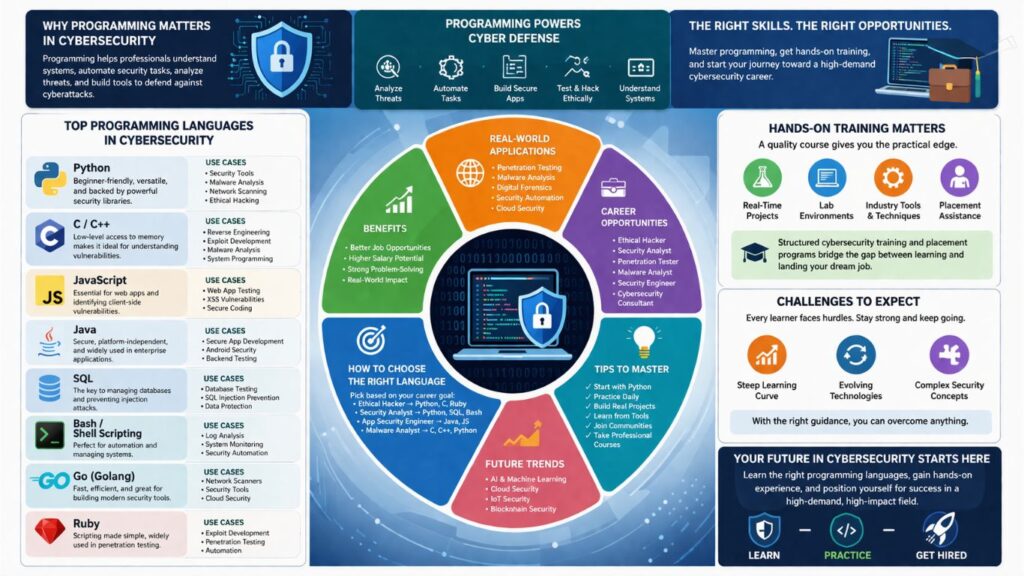
The language you choose depends on what you want to do for a living:
* Pen Tester / Ethical Hacker → Ruby, C, and Python
* Security Analyst → Python, SQL, and Bash
* Application Security Engineer → Java and JavaScript
* Malware Analyst → C, C++, and Python
A structured cyber security course with placement can help you choose the right languages to learn and master based on your goals.
The Benefits of Learning to Code for Cybersecurity
1. More job opportunities
People who know how to use programming languages in cybersecurity are in high demand.
2. More chances to make more money
Knowing how to program can greatly increase your earning potential.
3. Good at solving problems
Coding helps you think more analytically and fix problems.
4. Use in the Real World
You can make tools, scripts, and answers to problems in the real world.
Taking part in cybersecurity training and placement programs makes sure you get to use these languages in real life.
How Programming is Used in Cybersecurity in the Real World
* Penetration Testing: Making scripts that look for weak spots
* Malware Analysis: Learning about harmful code
* Digital Forensics: Looking at system logs and other evidence
* Security Automation: Making threat detection automatic
* Cloud Security: Keeping systems in the cloud safe
These apps show how important it is to know how to program in cybersecurity.
Why Hands-On Training Is Important
It’s not enough to just learn theory. It’s very important to have practical experience.
A cyber security course with placement gives you:
* Projects that happen in real time * Settings in the lab
* Tools that are useful in the industry
* Help with finding a job
This is where cybersecurity training and placement programs really shine: they help people learn and find jobs at the same time.
Jobs in Cybersecurity
Once you know how to program in cybersecurity, you can look into jobs like:
* Hacker with morals
* Analyst of Security
* Tester of Penetration
* Analyst of malware
* Engineer for Security
* Cybersecurity Expert
These jobs are in high demand in many fields, including finance, healthcare, IT, and government.
Problems with Learning Programming for Cybersecurity
Learning programming languages in cybersecurity is helpful, but it can also be hard:
* Hard to learn for people who are new to it
* Staying up to date with new technologies
* Getting a handle on complicated security ideas
But structured cybersecurity training and placement programs can make the learning process easier.
How to Learn Programming Languages for Cybersecurity
1. Learn the basics with Python
2. Write code every day
3. Work on projects that are real
4. Get ideas from open-source tools
5. Become a member of cybersecurity groups
6. Sign up for a professional cyber security course with a job placement
To get good at programming languages in cybersecurity, you need to be consistent and practice.
What will happen in the future with cybersecurity programming
Programming will still be very important, which makes programming languages in cybersecurity even more important.
The future of cybersecurity will be determined by:
* AI and Machine Learning
* Security in the Cloud
* Security for the Internet of Things (IoT)
* Security of the blockchain.
Why Should You Choose Cybersecurity Training Programs?
A well-organized*cybersecurity training and placement program gives you:
* Help from experts
* Learning by doing
* Certifications that are well-known in the field
* Help with getting a job
These kinds of programs help you learn programming languages in cybersecurity quickly and get ready for problems you’ll face in real life.
Conclsion
Cybersecurity is a field that is always changing and rewarding. It needs both technical skills and real-world experience. If you want to have a successful career in cybersecurity, you need to learn the right programming languages in cybersecurity. Every programming language, from Python and C++ to JavaScript and SQL, has its own job to do when it comes to keeping systems and data safe. You can get the skills, experience, and confidence you need to do well in this field by taking a Cybersecurity training and placement or cyber security course with placement.
As cyber threats change, people who know about programming languages in cybersecurity will always be in high demand. Today is the day to start your journey. Get the right training and take the first step toward a safe and successful career in cybersecurity.