Online AI programs can help you build an AI career by giving you structured learning, practical project experience, exposure to modern AI tools, and career preparation without requiring you to leave your current job or education. For beginners especially, a well-designed program can turn a confusing collection of Python, machine learning, deep learning, and generative AI topics into a step-by-step learning path.
And honestly, that structure matters more than it sounds.
AI is moving quickly. Learning a few prompts or watching a handful of machine-learning videos isn’t the same thing as being able to build, test, deploy, and explain an AI solution. The World Economic Forum’s Future of Jobs Report 2025 identifies AI and big data as the fastest-growing skill area through 2030, while analytical thinking, creative thinking, resilience, and technological literacy are also expected to remain important.
That is where practical Online AI Programs can make a difference.
Why Is AI Becoming Such an Important Career Skill?
A few years ago, AI sounded like something reserved for research labs and large technology companies. That’s not really the situation anymore.
AI is being used across software development, finance, healthcare, retail, manufacturing, customer service, marketing, cybersecurity, and many other areas. The World Economic Forum reports that AI and information-processing technologies are among the major forces expected to transform businesses through 2030.
The interesting part is that the opportunity isn’t limited to people with “AI” in their job title.
A software developer might use AI to build intelligent applications.
A data analyst might work with machine-learning models.
A tester might specialize in testing AI-powered applications.
A business professional might use generative AI and automation to improve workflows.
So, an AI career doesn’t necessarily begin with becoming a research scientist.
Sometimes it starts with adding AI capability to the skills you already have.
What Can Online AI Programs Actually Teach You?
The quality of an online program depends heavily on its curriculum. A useful program should go beyond explaining what artificial intelligence means.
For example, the current H2K Infosys Artificial Intelligence Online Training curriculum covers areas including:
- Python fundamentals
- Mathematics, statistics, and linear algebra
- Machine learning
- Deep learning and neural networks
- Natural language processing
- Computer vision
- Generative AI and large language models
- Prompt engineering
- Retrieval-Augmented Generation (RAG)
- Vector databases
- MLOps and LLMOps
- Cloud platforms
- Docker, APIs, Git and CI/CD
- Agentic AI
- Hands-on AI projects
That progression is useful because AI isn’t one isolated technology.
Imagine you’re a beginner who wants to build an AI chatbot. Knowing how to write a prompt is only one small piece. You may also need to understand Python, APIs, embeddings, vector databases, RAG, model evaluation, deployment, and security.
That’s when structured learning starts to make sense.
Are Online AI Courses for Beginners Really Suitable for Someone Starting From Scratch?
Yes, but there is an important distinction.
Beginner-friendly doesn’t mean effortless.
You don’t necessarily need years of programming experience before starting. H2K Infosys, for example, specifically describes its AI training as suitable for beginners and includes foundational Python, mathematics, machine learning, and AI concepts before moving into advanced topics.
For someone starting from zero, a sensible progression could look like this:
Step 1: Understand AI fundamentals
↓
Step 2: Learn Python and basic mathematics
↓
Step 3: Study machine-learning concepts
↓
Step 4: Build neural-network and deep-learning knowledge
↓
Step 5: Explore NLP, computer vision and generative AI
↓
Step 6: Build practical projects
↓
Step 7: Learn deployment and MLOps
↓
Step 8: Prepare a portfolio, resume and interviews
This is much less overwhelming than randomly jumping between YouTube tutorials, GitHub repositories, and AI tools.
How Do Projects Help Build an AI Career?
This is probably one of the biggest differences between online AI courses that are primarily theoretical and programs that emphasize practical learning.
Suppose two candidates both write “Machine Learning” on their resumes.
During an interview, one candidate can only explain definitions.
The other can say:
“I built a classification model, cleaned the dataset, compared several algorithms, evaluated precision and recall, and deployed the model through an API.”
That’s a completely different conversation.
Projects give you something concrete to discuss.
H2K Infosys lists hands-on work such as a RAG-based chatbot, an agentic AI task automation system, and other AI projects within its current curriculum.
A project doesn’t have to be enormous, either. A focused application that solves a real problem can be more useful than a gigantic project that you can’t explain.
What Does Generative AI Change for New AI Professionals?
This is where AI education has changed considerably.
Learning AI today isn’t simply about traditional machine-learning algorithms. Generative AI, LLMs, RAG systems, multimodal applications, and AI agents are becoming part of the modern AI development landscape.
H2K Infosys’ current curriculum includes LLM concepts, GPT/Claude/Gemini, transformers, prompt engineering, RAG, Hugging Face fine-tuning, multimodal AI and agentic AI workflows.
But there’s a trap here.
It’s easy to become overly focused on whichever AI tool is popular this month.
Tools will change.
The underlying skills understanding data, evaluating models, writing code, designing systems, solving problems, and communicating technical decisions are much more durable.
That’s why a strong program should teach AI fundamentals alongside current tools, rather than treating one particular AI application as the entire career.
How Can H2K Infosys Help Someone Preparing for an AI Career?
For learners specifically looking for a career-oriented online option, H2K Infosys positions its Artificial Intelligence training around both technical learning and career preparation.
According to its current course information, the program includes live classes, recorded sessions, cloud test-lab access, projects, resume preparation, mock interviews, certification, and job-placement support. The listed course duration is 75 hours, although the broader time needed to become job-ready depends on the learner’s starting point and study schedule.
The career-support element is worth paying attention to.
Learning how to build an AI model and learning how to explain that model in an interview are two different skills.
For example, an aspiring AI engineer may need to discuss:
- Why a particular algorithm was selected
- How the training data was prepared
- How model performance was measured
- What caused false positives or false negatives
- How the application could be deployed
- How an LLM application could be monitored
- What security or privacy issues need consideration
H2K Infosys lists mock interviews and resume preparation among its course support features.
For a career switcher, that can make the learning process feel more connected to the actual job-search stage.
What AI Jobs Can You Target After Training?
An online course can’t guarantee a particular job title or salary. Your previous experience, technical ability, portfolio, interview performance, location, and employer requirements all matter.
Still, AI training can prepare learners for several directions.
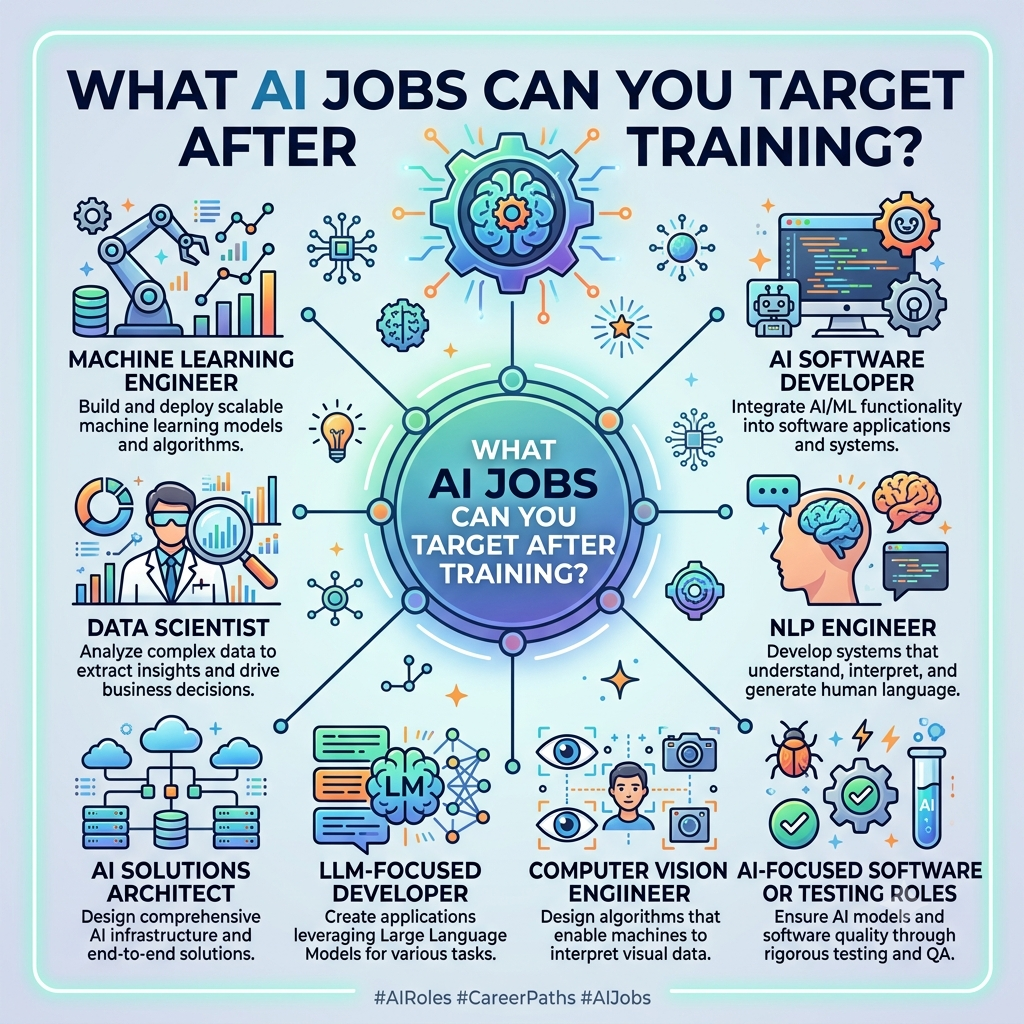
Depending on their background and depth of expertise, learners may explore roles such as:
- AI Engineer
- Machine Learning Engineer
- AI Software Developer
- Data Scientist
- NLP Engineer
- Computer Vision Engineer
- LLM-focused developer
- AI Solutions Architect
- AI-focused software or testing roles
H2K Infosys currently lists several of these roles as potential career directions associated with its AI training.
The broader employment picture also explains why these skills are receiving attention. The World Economic Forum identifies AI and machine-learning specialists, big-data specialists, and software/application developers among the fastest-growing technology-related roles in its 2025–2030 outlook.
Can an Existing IT Professional Use Online AI Courses to Switch Careers?
Absolutely and this is one of the more practical ways to approach AI.
Imagine someone already working as a:
Software Developer → AI Application Developer
Data Analyst → Machine Learning / AI Analyst
QA Engineer → AI Testing Specialist
Cloud Engineer → MLOps / AI Infrastructure
Business Analyst → AI/Automation-focused Business Analyst
The person isn’t starting over completely.
They’re adding a new layer of capability to skills they already possess.
That’s an important mindset shift. You don’t always need to throw away your existing career to move into AI.
What Should You Look For When Comparing Online AI Courses?
Don’t choose a course simply because the words “Generative AI” or “ChatGPT” appear in the title.
Instead, look for these things:
1. A proper technical foundation
Does the curriculum cover Python, statistics, machine learning and deep learning?
2. Current AI technologies
Does it address areas such as LLMs, RAG, vector databases and AI agents?
3. Hands-on projects
Can you actually build things rather than just watch lectures?
4. Development and deployment
Does the program introduce Git, APIs, containers, cloud platforms and MLOps?
5. Instructor guidance
Can you ask questions and get help when a project doesn’t work?
6. Career preparation
Does the program provide resume guidance, interview practice or other job-search support?
7. A curriculum you can inspect
This sounds obvious, but it’s surprisingly useful. Before paying for any course, look at the actual syllabus.
H2K Infosys currently publishes its AI curriculum publicly, including topics ranging from Python and machine learning through RAG, LLMOps, agentic AI and practical projects.
A Realistic Example: From Beginner to AI Portfolio
Let’s say you’re a beginner with basic programming knowledge.
Instead of trying to build the next giant AI platform, start smaller.
You could build:
Project 1: Customer sentiment classifier
Project 2: Image classification application
Project 3: Document-question-answering chatbot using RAG
Project 4: AI agent that automates a repetitive workflow
Now your portfolio tells a story.
You started with machine learning, moved into deep learning, learned NLP, then progressed into modern generative AI and agentic workflows.
That’s much more convincing than simply listing ten AI buzzwords on LinkedIn.
Why Human Skills Still Matter in an AI Career
There’s an interesting point in the current job-market research that sometimes gets lost in the AI hype.
Technical skills aren’t replacing everything else.
The World Economic Forum’s research identifies analytical thinking as a core employer skill, while creative thinking, resilience, flexibility, leadership, and curiosity are also expected to grow in importance.
Think about an actual AI project.
Someone still needs to understand the business problem.
Someone needs to communicate with stakeholders.
Someone needs to question whether the model’s output makes sense.
Someone needs to explain limitations.
And someone needs to decide what should not be automated.
AI knowledge plus good problem-solving and communication skills is a much stronger combination than technical knowledge alone.
Why Online Learning Can Be Convenient for Working Professionals
Traditional education can be difficult to fit around a full-time job.
That’s one reason online programs have become attractive to career switchers.
You can learn from home, revisit recorded sessions, work on projects outside class hours, and continue building skills while remaining employed.
H2K Infosys currently lists flexible timings and lifetime access to recorded training among the features of its AI program.
That flexibility doesn’t remove the work, of course.
You’ll still need to practice.
You’ll still get stuck.
You’ll probably break a Python script at 11:30 p.m. and wonder why a missing bracket has ruined your evening.
That’s part of learning technology.
Are Online AI Programs Enough to Get a Job?
Not by themselves.
This is probably the most important reality check.
Completing an online AI course can give you knowledge, projects and preparation, but a certificate isn’t a substitute for demonstrated ability.
A stronger career-building strategy is:
Course + Projects + Portfolio + Technical Practice + Interview Preparation + Continuous Learning
That’s also consistent with the wider employment picture. The World Economic Forum estimates that a significant share of workers’ existing skills will change or become outdated between 2025 and 2030, reinforcing the importance of ongoing upskilling rather than one-time education.
AI is changing too quickly for a “learn once and you’re finished” approach.
Why H2K Infosys Is Worth Considering for an Online AI Learning Path
For someone specifically looking for a structured, career-oriented online AI course, H2K Infosys combines several pieces that beginners and career switchers commonly need: foundational AI education, modern generative-AI topics, practical projects, live instruction, recorded material, cloud practice, resume assistance and mock interviews.
Its published curriculum also goes beyond introductory AI concepts into areas such as MLOps, LLMOps, RAG and agentic AI.
That makes the program particularly relevant for learners who don’t just want to understand what AI is, but want to learn how AI systems are actually developed and used.
Before enrolling, it’s still sensible to attend the available demo, review the syllabus, ask about the current batch and understand exactly what career support is included. H2K Infosys currently advertises a free demo for its AI training.
Explore H2K Infosys Artificial Intelligence Online Training
Can beginners learn AI through online AI programs?
Yes. Many online AI programs are designed to take beginners from foundational concepts such as Python and statistics to machine learning, deep learning, generative AI, and practical projects. The key is choosing a program with a structured curriculum and hands-on learning rather than only theoretical lessons.
What should I look for in online AI courses for beginners?
Look for courses that cover Python, machine learning, deep learning, generative AI, LLMs, RAG, and practical projects. Instructor support, live classes, recorded sessions, cloud labs, and career preparation can also be useful, especially if you’re changing careers.
Can online AI courses help me switch to an AI career?
Yes. A well-structured course can help you develop relevant technical skills and build projects for your portfolio. However, completing a course alone doesn’t guarantee employment. Practical experience, coding practice, interview preparation, and continuous learning are also important.
Does H2K Infosys offer career-focused AI training?
H2K Infosys’ current Artificial Intelligence training includes topics such as Python, machine learning, deep learning, generative AI, LLMs, RAG, MLOps, LLMOps, and agentic AI. The program also lists hands-on projects, resume preparation, mock interviews, and job-placement support as part of its career-oriented offering.
Are online AI programs useful for working professionals?
Yes. Online learning can allow working professionals to develop AI skills while continuing their current jobs. Programs offering live classes, recorded sessions, flexible schedules, and practical labs can make it easier to balance professional responsibilities with AI training.
Final Thoughts
AI careers aren’t built by collecting certificates.
They’re built by gradually becoming someone who can understand an AI problem, write the necessary code, work with data, use modern AI models, build practical solutions, explain technical decisions, and keep learning as the technology changes.
That’s why the right Online AI Programs can be valuable. They provide a roadmap when the AI ecosystem itself feels enormous.
For beginners searching for online ai courses for beginners, the key is to find a program that starts with fundamentals rather than throwing you directly into complicated LLM terminology.
And for professionals comparing online ai courses, look beyond the course title. Check the curriculum, projects, instructor support, current technologies, deployment skills and career preparation.
If you’re considering H2K Infosys, its current AI program provides a particularly broad path from Python and machine learning to deep learning, generative AI, RAG, MLOps and agentic AI along with project and career support.
The goal isn’t simply to say, “I completed an AI course.”
The better goal is to reach the point where you can open a project and say:
“I built this. I understand how it works. And I can explain why I built it this way.”
That’s the kind of progress that can actually move an AI career forward.